Archive | Skills RSS feed for this section

What’s In Your Toolbox?

4 Feb

Last fall, the Graduate School of Biomedical Sciences here at the University of Massachusetts Medical School hired, for the first time, an Assistant Dean for Career and Professional Development. Cynthia Fuhrmann, PhD, has been on the job since September, working hard towards her charge of establishing an overall program for career planning for the doctoral students at our university. Dr. Fuhrmann comes to us from the University of California, San Francisco, a school that has proved to be a leader in the area of academic career development.

Why, you might ask, do students in such a specialized field need help deciding on a career? Haven’t they already done that? Isn’t that why they’re here pursuing graduate studies? The answer seems to be both yes and no. Many students do enter graduate school with some idea of the direction that their career will take. Most probably believe that they’re on the well-trod path of those who’ve gone before them, because for a long time, careers in science followed a pretty specific pipeline:

Undergraduate degree in a science  ->  Graduate degree in a science  ->  Postdoctoral training  -> Tenure-track faculty in academia

Like many other professions today, however, the path that we used to follow is nowhere near as clear-cut or as straight. Today’s doctoral students are just as likely to end up working for biotech companies, for the government, or for universities, or even some combination of these. They may end up doing research, creating new products or drugs, teaching, writing, policy-making, or any number of other things. In fact, as more and more students earn PhDs, the number of tenure track positions available to them lags significantly behind. Even if they enter their graduate studies wanting to stay in academia, the odds of doing such are against them.

The National Institutes of Health and other funding agencies have noticed this trend and are beginning to call on graduate schools and programs to better prepare their students for a broader career path. Students need to have ways to explore their different career options, develop the skills they need in these different areas, and gain relevant experience that will serve them well as they move into the biomedical workforce. Thus, schools like UCSF and now my own institution, UMMS, are designing programs, services, and educational opportunities to meet this growing need.

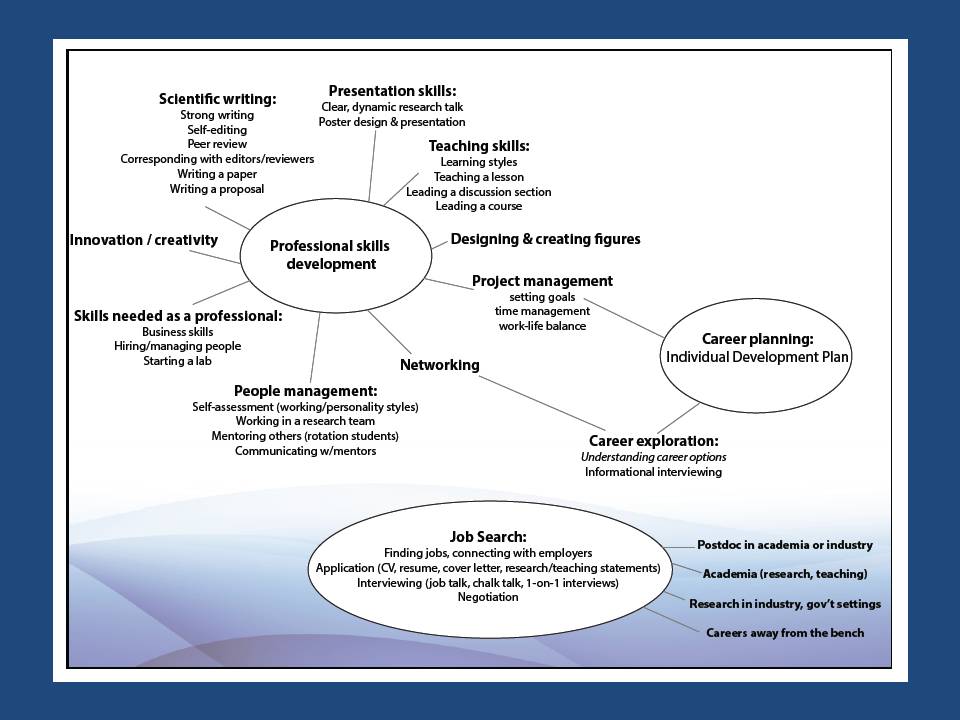
I had the chance to hear Dr. Fuhrmann speak last week. In her presentation, she outlined this need and her vision, goals and anticipated outcomes for her new position. I’d had some brief communication with her earlier and we have plans to work on a project together in the future, but this was my first opportunity to hear first-hand why the University created this new position and what will come out of it. A little more than half-way through her talk, she put up the following slide:
Fuhrmann_Skills Slide

Credit: Cynthia Fuhrmann, PhD
Used with permission.

As I read the different pieces, particularly the spokes off of the “Professional Development Skills” balloon, I couldn’t help but notice the striking resemblance between these skills and those that we’ve been talking about in our own profession. Strong writing and editing, including the ability to write proposals for projects or grants, are needed by young scientists. They’re needed by librarians and/or informationists, too. When graduates become researchers, they likely need to know how to present their work, their proposals, their findings. They likely need to know how to teach the subject(s) that they’ve learned. It’s expected of them. The same can be said for the librarian. It’s expected of us. We all need to know how to manage projects. We all need to know how to manage (or at least work successfully with) other people. We all need to become more creative and more innovative. In other words, we’re all in the same boat.

Will library and information science schools get on board with biomedical science programs and begin to develop the necessary programs to best prepare their graduates in these areas? And for those of us already working, can we or do we easily find the opportunities that we need to continue our professional development around these things? It’s true that you can learn a lot on the job, but it’s also true that simply standing in front of a classroom of students is not teaching. Juggling projects is not the same as managing them. Working with people via forced teams or committees doesn’t guarantee the best outcomes. Networking is more than talking to people at a party. We need to learn and hone the skills necessary in these areas that will bring us success. It needs to become a priority.

It’s my hope that as we continue to branch out in our own field, we will begin to see more clearly the skills we need for success and then, once we identify them, have the support of our institutions, our administrations, and our professional organizations towards meeting them. I hope we can expand our offerings of CE classes at professional meetings, bringing in courses that touch on some of these other skills. I hope we can be supported to go to different kinds of meetings and events outside of the usual suspects. And more than anything, I hope that we individually have the spark and initiative and excitement to do so. With these all coming together, we will surely strengthen both ourselves and our profession.

Special thanks to Cynthia Fuhrmann, PhD, for her insights related to this post and for sharing her presentation slides with me.
Where the Rubber Hits the Road (Part II)

30 Jan
A fantastic recording, btw!

A fantastic recording, btw!

When we first saw the request for proposals that ultimately secured the supplemental grant for an informationist and brought me into this work, we began to think about the roles I would take, the tasks I would assume, and the skills I would bring to a research team. In short, we put together an argument for the value of having an informationist on a research team. It’s no secret that this is an argument in the making. One of the main reasons that the National Library of Medicine and the National Institutes of Health funded the program was to study the role and to evaluate its worthiness. Making our case was somewhat easier in that we had a template, i.e. the requirements of the RFP. Still, it was a new concept to our researchers and thus we had to invest some time and effort towards explaining what we hoped to achieve in this new partnership.

Since I began working on the mammography study in September, I’ve also been talking to other researchers on campus about the possibility of working with them. For the most part, I’ve leveraged relationships already formed between myself and certain researchers and/or departments. When trying to make my way in this new arena, I’m looking for all of the help I can get. At least with established relationships I have a head-start on arguing for the importance and relevance of the library. I’ve also taken advantage of attending meetings, symposia, and other forums where researchers present their work. One of these was the Community Engagement Symposium last November, hosted by our CCTS Section of the same name. I attended this event intending to try and talk to a couple of people in particular. When that didn’t happen, I used the meeting’s evaluation form to both thank the organizers of the event (who, by the way, I knew thanks to past collaborations) and to state my desire to meet with the leadership of the Section to talk about possibilities of being an informationist for them. Some time passed, but then a couple of weeks ago I got the following email from one of the organizers:

Sally,

Thanks for coming to the Symposium!

You had requested a meeting to discuss forming partnerships for the library work of informationist. We are wondering if we could set up a time for you to talk with us as a group. We have a meeting on Feb 5 from 1-2. Would you like to join us? Or, is there a better time?

Thanks!

Amy

WOW!! GREAT!! I was delighted with the invite. I shared it with both my library director and my immediate supervisor, and they were really pleased, too. Then, a week later I got another email:

Sally,

So that we could make the best use of our time, could you please share with us:

  • 3-5 questions that you would like to discuss
  • Background information on this new work

Thanks!

Amy

My immediate response was, “Uh oh.” I’m not sure why, but it was. Despite the fact that I’ve been doing this work for a few months now AND that I’d asked for the meeting, the thought of having to articulate the who, what, and why of it all gave me pause. Instinct, perhaps. This is all still new, not only the work itself but the selling of it to others. I’ve been reading and writing about being entrepreneurial, but now is the time to put all of that learning to work. How will I do?

I thought about my response for over a week. I traveled to the Miner Library at the University of Rochester Medical School last week to lead a workshop on these very things. As I spent almost a dozen hours driving solo to and from Rochester, I had a lot of time to talk to myself and formulate some ideas on how to proceed. This morning, I sat down and wrote my response. What do you think? If you were (or are) a researcher, is it enough to set the stage for a meeting? If you’re a librarian, would you present other skills or ask other questions? I’d love to hear your thoughts in the comment section below. In the meantime, I’ll prepare myself for this opportunity – one that I really am excited about. And next week, I’ll report back on how it went.

Date: 01/30/2013

Proposal: To provide informationist/embedded librarian services to the Department of Preventive and Behavioral Medicine, specifically, though not limited to, projects related to the UMass CCTS Community Engagement and Research Section.

Background: Informationists are librarians with a disciplinary background in biomedical, behavioral or biological sciences, as well as library and information science. Medical librarians began serving as informationists in the clinical setting approximately 10 years ago, but more recently have begun to find a relevant place embedded in research teams and/or projects.

In the summer of 2012, the Library successfully collaborated with two principal investigators at UMMS, as well as their research team, to receive a supplemental grant from the National Library of Medicine. The award, an “NLM Administrative Supplements for Informationist Services in NIH-funded Research Projects”, was one of eight awarded nationally. It provides funding to support an informationist, or in-context information specialist, who serves the research team by offering expertise in the areas of data and information management.

For 18 months (Sept 2012 – Jan 2014), I’m serving as a member of the research team on the grant, “Promoting Breast Cancer Screening in Non-Adherent Women” (R01 CA-132935, National Cancer Institute, National Institutes of Health). I’m devoting a quarter of my scheduled work time to the project, undertaking projects such as developing data management tools (a data dictionary and data request form), providing an in-depth literature review and report on the issues facing researchers and internet technology professionals when building and implementing research tools, assisting with a systematic review on the effectiveness of telephone intervention protocols for preventive screenings, and instructing the members of the team in advanced searching techniques and bibliographic management.

As we prepared this proposal with Drs. Luckmann and Costanza, Elaine Martin, Library Director, became convinced that this was both a relevant and exciting new opportunity for the Library and decided to commit to the service. I’ve been given a new role in the Library, informationist or embedded librarian, and charged with seeking out other opportunities where I can be integrated into research teams to provide library, information, and data management expertise as needed.

With an educational background in both exercise physiology and library science, years of providing support to the UMMS research community, and additional work as an exercise physiologist for a couple of Sherry Pagoto’s studies, I feel there’s likely not a better fit for me on this campus than the Department of Preventive and Behavioral Medicine and/or the UMass CCTS Community Engagement and Research Section. When we meet on 2/5, I’d like to talk about this further and answer any questions you might have regarding the work I’m doing now for the Luckmann/Costanza study. Additionally, I’d like to hear your thoughts and experiences regarding how (or if) you think an informationist could be of benefit to your team(s). Specifically:

  • What is your current process for obtaining relevant literature and other supporting information for preparing grant proposals, thinking of new research projects, staying current in your research areas, etc.?
  • Could members of the Department benefit from regular training in areas such as searching the literature, managing and organizing information, and/or improving communication between team members?
  • Do you have an established protocol for training new members to the Department or projects in the above-referenced areas? If not, would you be interested in having such?
  • How do you currently communicate and share information between team members?
  • When beginning research projects, do you establish standards for data collection, management, and sharing? Are these methods sufficient for your work?
  • Has anyone considered writing a formal systematic review on the topics studied by your group? If so, have you considered the benefits of having a dedicated librarian involved in such an endeavor?

Life on the Playground (Everyone Wants to be Picked for a Team)

17 Jan

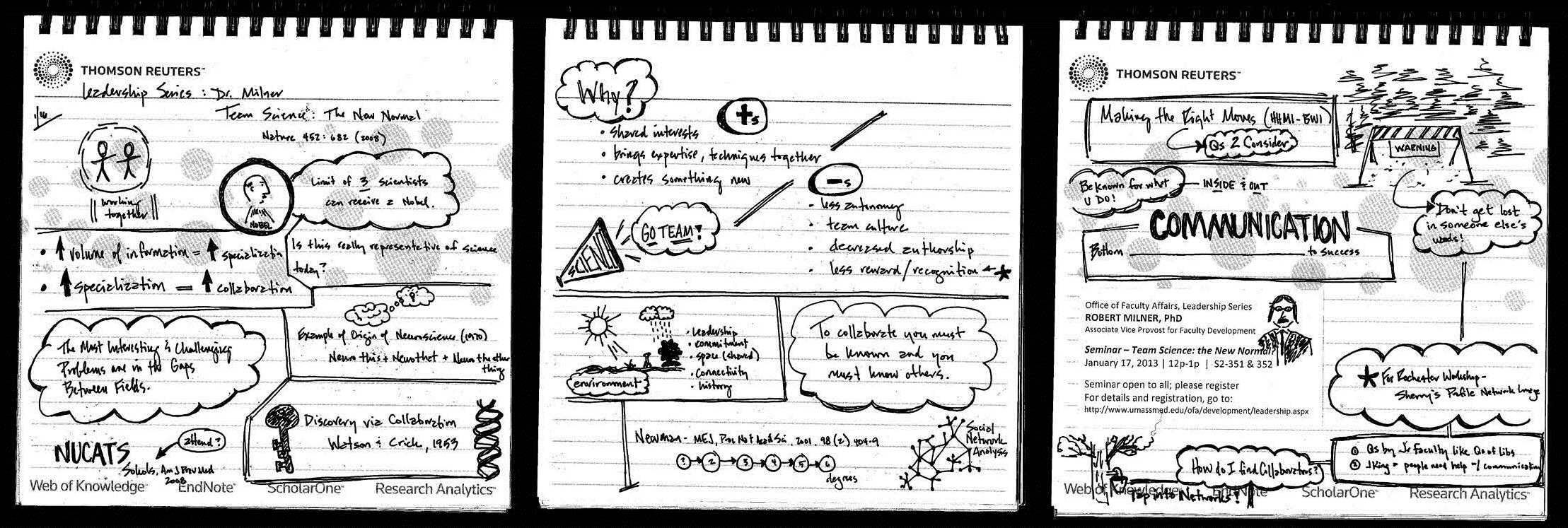
I just returned from a seminar hosted by the Office of Faculty Affairs at my workplace (University of Massachusetts Medical School) entitled, “Team Science: The New Normal”. It was led by Dr. Robert Milner, Associate Vice Provost for Faculty Development. Along with his role in administration, Dr. Milner’s research background and focus is in neuroscience.

The reason I’m writing this post is twofold. First, it was my first real formal attempt at utilizing the things I learned reading Mike Rohde’s book, The Sketchnote Handbook (and watching the accompanying DVD). I’ve also worked through Sunni Brown’s online course on visual note taking and read all three of Dan Roam’s books on using pictures in the practice of problem solving. If you find that you’re looking for a new, different, and I’d attest, better, way to think and process and take notes, you might want to give these leading folks in the field a look see. So really, my first reason for writing this post is to show off my new skill.

The second reason is because the seminar had a slant towards junior faculty, those early in their careers who are trying to find their way, make connections, and both raise awareness of and gain recognition for the work that they do. As I took my notes, I couldn’t help but think of how much of what Dr. Milner was sharing about team science, as it applies to junior faculty, sounded so much like what we talk about when we’re trying to figure out how to be successful as embedded librarians and/or informationists.

  • How do you find collaborators?
  • How do you get invited to be on a team?
  • How do you weigh out your contributions?
  • How do you not get lost in the work of others?

These are exactly the same questions we’re asking! And the answers shared were similar, too.

  • Tap into your networks,
  • Be known for what you do,
  • And bottom line, learn how to communicate well.

I went to this session, hoping I’d find a way to better articulate how informationists fit on research teams. Happily, I came away with one more bit of proof that we’re really not that different from scientists at all. I’m going to remember this as I continue to do my work and make my way in this “New Normal”.

Team Science Notes

Click on my notes for a bigger picture. If something doesn’t make sense in them, feel free to ask in the comments section below.