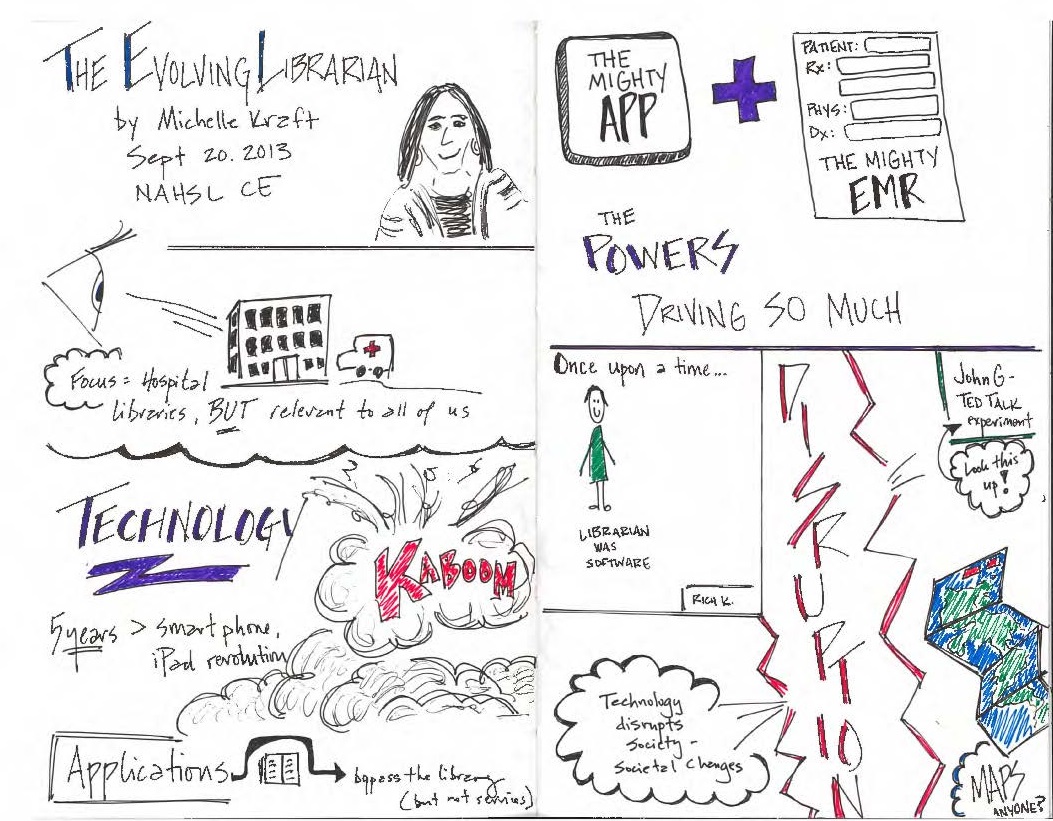
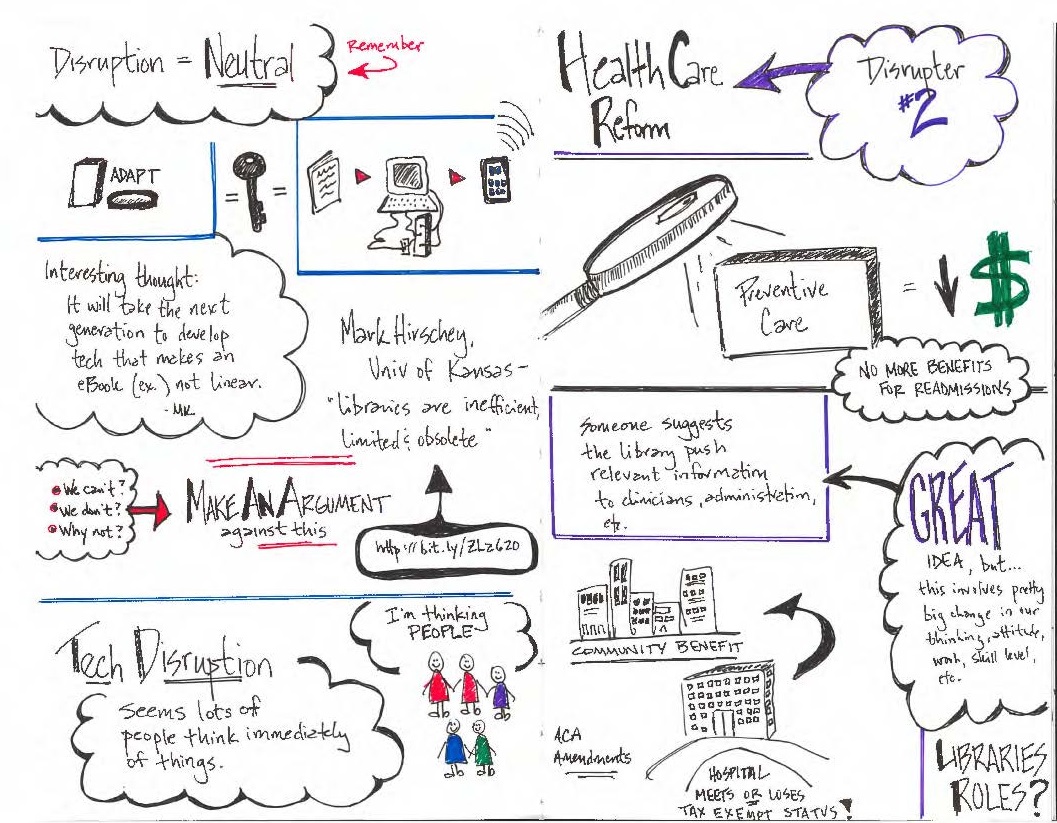
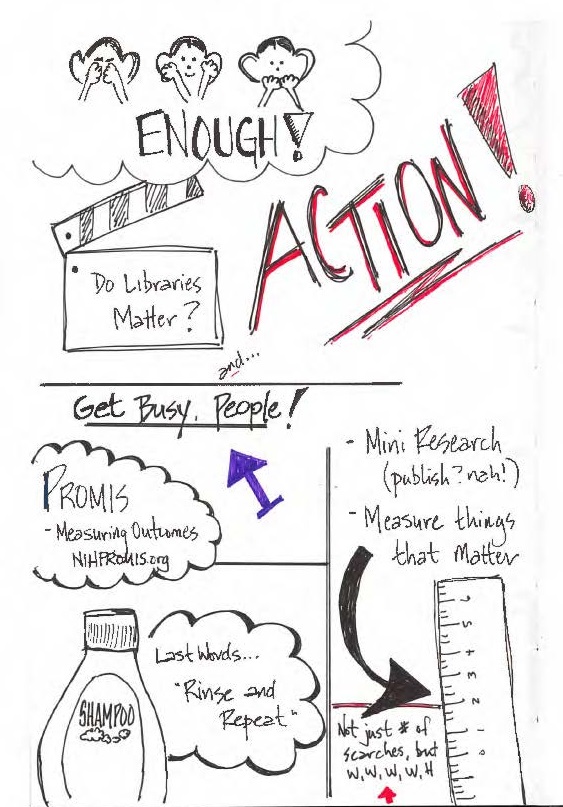
I started a post yesterday, but it wasn’t coming together for me in my usual word-flowing way, so I put it aside with every intention to finish it today. Today, however, found me in an all-day continuing education class taught by one of my profession’s well-known and well-followed clinical medical librarians, Michelle Kraft (aka The Krafty Librarian). Michelle has been at the forefront of social media for as long as I’ve been a librarian, using whatever tools were available at the time to spread a wealth of good information to the masses. This kind of innovative spirit made her a great choice of the NAHSL CE Committee when they sought a speaker for a course on “The Evolving Librarian.”
Per what is now my usual practice, I took sketchnotes during the class. With Michelle’s permission, I share them here. Hopefully, you can follow along with no annotation from me, after all, if you can’t, they aren’t very good notes. And besides, it’s late on a Friday afternoon. I only have so much typing left in me for the week. The only comment that I will make is that the notes represent a combination of Michelle’s thoughts and my commentary. Feel free to guess which is which:
What a few weeks it’s been! Regular readers of this blog know all about the changes in my library of late. Suffice it to say, the load of emotions and thoughts and tasks have kept the wheels spinning, both literally and figuratively. The result, in terms of this week’s blog post, is a bunch of bits and pieces – a collection of some of those thoughts and experiences that hopefully you find worthy of reading and/or commenting.
Missing the Forest for the Trees
First, let me give you an update on my informationist work with the mammography study. It seems like it’s been too long since I’ve done that. September marks a year that I’ve been embedded in the research team. I have about 5 months to go on the grant funding and a whole slew of deliverables to deliver between now and then. Thankfully, the project coordinator has taken it on as a priority to make sure that I get all of the things done that we said I’d get done, thus she is putting me on the agenda every week from here on out, encouraging me to keep everyone on task with the things that they need to do to insure my success. I realize that Mary Jo has to be the ideal project coordinator for any informationist and/or embedded librarian to come across when looking for success in this new role. All along, the team has been welcoming and encouraging of me, but a good coordinator keeps everyone accountable to everyone else, and thus to the overall goal of the research project. As I mentioned during last night’s weekly #medlibs tweetchat, it’s this level of accountability that distinguishes librarian support from librarian embeddedness.
Which brings me back to the one deliverable that has stumped me from early on, the data dictionary. As I’ve described in previous posts, the data for the mammography study comes from various sources. Helping team members to communicate more efficiently and effectively about the data was Aim 1 of my role. We envisioned that a comprehensive data dictionary would be the key to reaching this goal and so I set about collecting the different codebooks and related documentation, compiling them into a single file with the hope that I’d be able to easily see overlap in terms, discrepancies between definitions of the same terms, gaps in terminology, etc. It seemed simple enough.
What I found, however, was less than simple. I found a lot of tools that already existed, yet weren’t being used. As an example, the codebooks were there, yet weren’t always referenced during data requests between team members and the analyst. People continued to use their own chosen vocabulary, despite the ongoing confusion that it caused. More than once I’ve heard the phrase, “So and so uses ‘x’ to describe ‘y’, but we all know what s/he means.” If you think about it, we all operate like this to varying degrees. If/when you work or live with another person long enough, you figure out what s/he means regardless of what s/he is saying. Except when you can’t figure it out. And that’s when the communication breaks down. It’s why we have dictionaries and standards in the first place, particularly when it comes to technical research.
I literally went for months, scratching my head and being utterly confused (and often exasperated) over the amount of time spent talking about the algorithmic logic behind exclusion variables and which flags turned off or on in the system when. I couldn’t for the life of me figure out how the data dictionary that I was putting together was going to help make that hang-up in the study go any better.
Until this week.
Finally, during a conversation with Mary Jo about the dictionary that involved sharing the work with her and walking through my understanding of it, along with hers (something that I see now I should have done MONTHS ago), she mentioned that if I could add to the dictionary how each variable functions within the system, it would be a really helpful document. FUNCTION! It was like a light bulb went off. I’d been so stuck on names and definitions that I either never heard this word or I had completely missed the concept, all the previous months. For whatever reason, this dimension to the dictionary had escaped me. I went back to the spreadsheet, added the columns for the different functions that we identified, and began working through the different scripts, assigning each variable its proper function. Now the goal is to have it all together by next Tuesday so that I can present it to the group for feedback and evaluation.
Going Out on a Limb
“We all hear that it takes 20 years for something new to be implemented in medicine, but how long does it take us to de-implement something?” I’m paraphrasing a cardiologist who spoke something to this effect in a meeting that I attended this week. Basically he was asking, “How do you stop doing something once you know it no longer works?” It’s a great question and cuts at the heart of all of my personal curiosities and interests around human behavior and why we do (or don’t do) the things that we do. I wrote in my notebook, “The Challenge of De-Implementation” and tucked it aside as a possible question for thought – perhaps even some kind of research project – in the future. It’s certainly pertinent in my profession right now.
When do we take the chances that we need to take? What finally prompts us to stop doing what we know no longer works? What’s worth giving up and what is worth fighting for when it comes to health sciences libraries and librarianship as a profession?
Money Doesn’t Grow on Trees
In the mid-90s, at arguably the peak of their success as a band, REM released a less-successful, commercially speaking, CD entitled, “Monster.” It’s not my favorite, yet I did find myself pulling it off the shelf this morning to listen to one song in particular during my morning commute (I generally have about a 3-song commute). “King of Comedy” has a catchy little closing refrain,
I’m not king of comedy, I’m not your magazine, I’m not your television, I’m not your movie screen I’m not commodity
(King of Comedy, Berry/Buck/Mills/Stipe, 1994)
The irony is, of course, that the band was very much a commodity by that point. Like it or not, their huge success made them no longer individuals, per se, but an entity that could be bought and sold. What happened to REM is pretty much what has happened to information over the past couple of decades. With the rise of the Internet and the ease with which we can/could find and share and access information, its power and profitability has grown in ways likely no one ever imagined. Once something freely shared by say, your local library, is now out there generating a bunch of money for Google. “But Google is free!” you cry. Really? We gave up a lot to be bombarded with advertising, with product, with noise; to have personal information about ourselves be retrieved and resold to others for a profit. We are commodity.
What does this have to do with libraries? Oh, I’ve just been thinking about the move towards entrepreneurship in our profession. I’ve been thinking about just what is it that I’m selling to patrons. What is the real value of me as an embedded librarian – is it me or is it my skill set? I know that it’s a combination, but is one piece worth more? I once heard the story of a law firm in Chicago that, upon acquiring Westlaw, decided that they no longer needed a law library and the librarian who worked there. She was, like many of our colleagues, let go. Within a few months, however, the firm came back to her, offering her the position she once held. They realized that her value was actually more than the resources she provided. She considered their offer and rejected it, opting instead to hire herself back to them as a consultant (with no library), charging them much more for the work that she had always done.
You might think this is a great lesson in entrepreneurship and I can’t argue that it’s not, at least not for this individual and her personal value (financial status), but what does it say about the direction that health sciences librarians could take? Is our allegiance to the library, to the research team, or to ourselves? Again, I know that there is no one answer and that we hold a certain amount of loyalty to each, but if we do move towards a more independent and consultant-type model as embedded librarians, what will be the ramifications on the library – and on our profession – as a whole? There are pros and cons for being a commodity.
The Power of Branching Out
I love social media. For those who have rejected the power of blogs, Twitter, Facebook, et al for both professional and personal gains, I give you another chapter in the story, “Sally Meets Fantastically Cool People Through Twitter.” If you missed the previous chapter on my Twitter friendship with Rosanne Cash, you can catch up here. This past week involved finally getting to meet the one and only Amy Dickinson; the voice behind the syndicated advice column, “Ask Amy,” the author of the NY Times bestseller, The Mighty Queens of Freeville, and a regular panelist on the always funny NPR news quiz show, Wait Wait Don’t Tell Me.
I started tweeting back and forth regularly with Amy Dickinson about a year or so ago. I liked her as a writer and humorist, and followed her on Twitter. She tweeted something funny one day, I tweeted back, she back to me, and so on. Eventually, she started to follow me on Twitter, too. I became a fan of hers on Facebook. I offer up comments to the letters that she posts online. We got to know each other about as much as a librarian from Worcester gets to know a somewhat famous personality via these outlets.
Last Friday night, after appearing on the panel of Wait Wait that taped at Tanglewood the night before, she gave a book talk at the Lenox (MA) Public Library. I had a gig scheduled with my band, but after a week (more like a month, but a really horrible week) of dental trauma, I was a scratch in the band lineup. Rather than sitting home yet one more evening, wallowing in my tooth pain, I decided that I’d drive out to Lenox, a nice, quiet 2-hour ride from Worcester, and take the opportunity to meet – and especially thank – Amy in person.
Like my desire to meet Rosanne, I think it’s really special if/when we ever get the chance to say “thank you” to those people who fill up a bunch of our hours, days, even years. For me, these special people are most often writers and musicians (or a combination of both). Think about it. When I read Amy Dickinson’s memoir, I spent hours with her. She took the time to write a story and share it. I took the time to read it. Like taking the time to listen to a song and learn the lyrics, you have to give up something of yourself (a lot of your time) to accept all that the artist has given. As the hours unfold and you read an author’s book, particularly a memoir, you come to know them. It may be a little one-sided, but you still know them.
I got to the talk and Amy saw me walk in. She recognized me from my pictures on Twitter and Facebook. I recognized her from the same, plus the fact that she was at the front of the room, next to the podium. We made eye contact and waved to each other. She gave a great talk, funny as expected, and answered a bunch of questions about her work as a columnist and a radio personality. I had my hand up to ask a question and finally, at the very end of the evening, she looked my way and wrapped up by saying, “I need to introduce Sally.” And then… Amy Dickinson introduced me! Really. Before I could ask my question, she told everyone all about how we met via Twitter, how I was a librarian with a wonderful blog (she said that), how I’d offered her some help in terms of pointing her towards reputable folks in health care for reference in her letters, and how I was the first friend that she’s made completely through social media. Amy Dickinson called me her friend.
Several years ago, before the age of social media, I gave a talk where I introduced the “top ten” people that I wanted to be a personal librarian for. I did actually have a radio personality on my list, though (sorry, Amy) it wasn’t Amy Dickinson. It was Terry Gross. I think even Amy would take that gig. Who wouldn’t want to look up all of the cool stuff about all of the fascinating people Terry Gross interviews on Fresh Air?! Still, never did I imagine at that time that a day would come when I actually would be a bit of a personal librarian to the stars. But there was Amy, last Friday night, telling the audience about how powerful social media is in its ability to connect us with people and resources and ideas like we never could before. She said that while she’d been a bit late coming to it, she now sees what a rich tool it can be to help you do your job – be your job writing advice, sharing good information with others, promoting yourself, or connecting with people.
This blog has helped me share a lot of ideas and experiences with an awful lot of people over the past year. It’s helped me to reach some folks that I never would have reached in traditional means like writing journal articles or even posting on listservs. My presence on Twitter has connected me with researchers, science writers, other librarians across many disciplines, and even a few musicians and writers that I admire immensely. It’s not the one tool that will make or break my success as an informationist, but it’s certainly proved more than worth its value to me. Amy Dickinson introduced me as her friend. I rest my case.
“The only thing in life that is permanent is change.” Someone said that. I’m not sure who, but I surely know that I didn’t think it up on my own. Regardless of who first uttered the truism, its truth remains unchanged, change after change after change. The only thing that we can ever really count on staying the same is the fact that things will always change.
I write this not because the summer season is coming to a close and new students are arriving at my university, but because new chapters are beginning here in the library where I work. I went on vacation a few weeks back aware that some restructuring would happen during my time away. I returned to learn the details – at least as many as we know so far – of the reorganization of services, roles, missions, and personnel. It’s not really a very easy time here at work right now. I’d be less than truthful if I said differently. The restructure means the loss of jobs for some, changing roles for others, and a very different way of thinking about the library for those of us still here. As my library director, Elaine Martin, stated in her presentation to the staff, we are now in a time where we will focus on 4 Rs:
Reject outdated notions and ideas of what libraries are.
Rethinkhow we do things – EVERYthing, if need be.
Redo our modes of operation, focusing on those areas that are now our priorities.
Rejuvenateour careers, our mission, and our professional goals as we move forward into a very new world.
If you’ve been a follower of this blog over the past year, you know that my thoughts and beliefs about my profession and the work that we do fall pretty much in line with these “Rs” that my director is calling the staff to focus on now. I’ve been saying for a long time that I believe our ways of doing many things in the library have left us outdated and irrelevant. We need to change and, as was noted by my director, not in small ways. We’ve been tweaking for years. We’ve been cutting out nickels and dimes as needed. But now… now we need to do something much bigger, much more radical, and much more progressive. And for all of the talk that I’ve talked over the years, when the change really hits, it’s not always so easy.
How did we get to this place? Anyone who works in academic and/or health sciences libraries surely knows the answer to this question. At my own institution, we’re facing a $20 million deficit that results in 5% across the board cuts to all departments. The sequestration at the Federal level affects us via major cuts to NIH-funded research. We’ve also lost money from the state government. Our clinical partner, UMass Memorial Health Care, faces their own financial crisis and this, of course, has repercussions on us. Couple these revenue losses with unceasing (and way too often, unfounded) astronomical increases in journal subscription costs and key clinical resources and… well, this is where we are. It’s where many of us are.
At the same time, we cannot ignore the fact that people use libraries very differently than they once did. In our setting, students, faculty, researchers, and clinicians do not need/want to check out materials. The resources that they need most are available to them online and if not, they pressure us to make them available that way. Fewer people come to the library needing library assistance. Note that this doesn’t mean that our gate count is down and/or that we’re a quiet, deserted enclave on campus. We are an incredibly busy place, but the reason that our patrons come here is not necessarily related to the fact that librarians and/or library staff are here. By and large, they come to use the non-human resources that we provide. Yes, THAT is a frightening thought when you’re a human resource. And yes, it is a driving factor in the changes we’re now making.
For a number of years, library administrators have been able to refine and retune services, dropping many things that were at one time standard operations in favor of more efficient and less costly alternatives. However, there comes a point when there is nothing left to cut in these areas. There’s very little left to “stop doing” so that we can focus on new things. There comes the time when some really big changes have to happen. There comes that time when the cost of fixing your old car just doesn’t beat out buying a new one. Here in my Library, we reached this point. We’re trading in our old model for something new.
In short, a half-dozen colleagues that I have worked with for many years now, will not have jobs at the end of next week. To say that these are difficult decisions and that this is a difficult time in the library is an understatement. Neatly stated, the work is no longer there – circulation, cataloging, binding, interlibrary loan, and even ready reference – to financially justify employing full-time staff to manage it. It is really difficult to make an argument against these facts. But neat and tidy justifications are never such when people are involved. Despite the number of times that it is said, truthfully, that the decisions are not personal, they are. People are losing their jobs. This cannot not be personal. Everyone recognizes this.
I’m not sure what all of these changes will mean for me directly. Fact of the matter is, no one really knows. Not here in my library, nor in our profession as a whole. We’re a work in progress, this profession, and no one is quite sure how all of the new ideas and roles and work will play out. Still, I believe that more often than not, it’s a lack of risk taking that does a person – or an institution – in. “Nothing ventured, nothing gained.” Another good quote from someone other than me.
There are an awful lot of BIG questions facing health sciences libraries today. Our changes highlight this fact. I have to say that the one question that keeps milling around in my head during this particular time is this – Does a librarian really need a library any more? While it’s pretty clear that our patrons certainly need library resources, do they still need the human resources of the library when they come here? I like my cubicle as a place to sit and work, but does it need to be here in the library? With a heightened emphasis and dedication upon embedding librarians in research projects and teams, in curriculum and classrooms, and in physical sites outside the library itself, are librarians themselves now another library resource that can be divorced from the library? I know that my library isn’t the first one to experiment with embedded models and thus it’s unlikely that I’m the first librarian to ever think about this question, but right now, it’s what I’m wondering. For me, it’s the biggest question that I wait to see answered in the coming months and years as we explore new ways of doing things here at my library.
Time will give me the answer to this question, as well as to others I have. And in the meantime, I’m remembering to tell myself that the changing day-to-day aspects of work that may cause some bumps and bruises and slight headaches along the way, these are but that – bumps, bruises and headaches, and simply part of my job. In times of change, it’s good time to remember to keep all things in perspective. (Note: I’m speaking only for myself and not minimizing the much bigger unknowns that some of my colleagues face. To do otherwise would be a very callous thing to do.)
Elaine Martin has graciously offered to make her presentation available for readers to view, in hopes that it provides clarification and further detail as to the changes made, as well as a reference for others in similar positions at this time. Additionally, in next week’s post, I will describe the new programs and models that we are launching during this transition, along with a presentation from Elaine on that topic. Stay tuned.


 “The only thing in life that is permanent is change.” Someone said that. I’m not sure who, but I surely know that I didn’t think it up on my own. Regardless of who first uttered the truism, its truth remains unchanged, change after change after change. The only thing that we can ever really count on staying the same is the fact that things will always change.
 A Librarian by Any Other Name