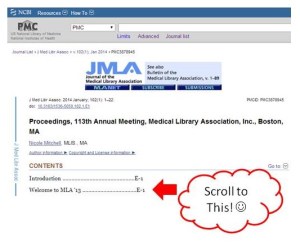
 Before I even get started with this week’s post, let me first draw your attention to this little bit of awesomeness, after all, it’s not every day that you (well, at least I) get to see yourself in print. I feel that I just have to do a little shout out. Plus, my poetic welcome to the attendees of MLA 2013 may well be the most valuable legacy that I ever leave to my profession.
———-
Back to the reality of our work at hand, I had a few experiences this week that got me thinking about where and/or how dissemination of knowledge fits into our role as knowledge and information management professionals. The first of these occurred during the weekly meeting of the mammography study team. This week’s meeting was different in that it involved bringing together not only the primary members of the team, but also the players from the technology aspects of it, specifically the programmers from Claricode, and the IT people from Fallon Insurance Company and Reliant Health Care. These individuals have played a key role in the study related to developing the software platform used to collect telephone interview data (the CATI system), pulling necessary data from insurance and health records, and coordinating the disparate data sources into a tracking database that can, ultimately, provide the data for analysis. It’s been no small task from the very beginning of the project. In fact, the very issues raised in the bringing together of these people to accomplish the necessary technological aspects of the study are the ones that led to Aim 2 of the informationist supplement grant that brought me to the study:
Aim 2: Assist investigators in identifying and reporting information technology issues that have arisen in the implementation of the study that may be of use to others.
Initially, we thought that the deliverable for Aim 2 would be a white paper; an outline of the different issues, along with references to the literature, that could be shared with both the clinical research and IT communities, with hopes that the information would prove helpful to those who sought to do this type of collaborative work in the future. In short, the team believes that they have learned some things, including some mistakes that others might want to avoid. However, as we began talking about the topic and I began searching the literature for relevant articles, I found that not much existed that touched on just what we were trying to articulate. This fact led us to discuss whether or not a white paper was the best way to go with this topic/issue. Perhaps a symposium, a meeting that could actually bring the different players – clinicians, researchers, computer programmers, software developers, etc. – together to share insights and brainstorm ideas for how we could all work better together. But this thought got us to wondering more about just who we’d invite. Who are the real stakeholders in this situation? Who would find this interesting? Do clinicians want to talk to developers? Do programmers have the faintest interest in problem-solving with medical researchers? We weren’t sure, so we decided the best way to begin would be to simply bring all of us together – all of the people who have worked on this project for the past 5 years – and see if this group, at least, could identify topics, issues, and/or projects in this area worth moving forward on.
In short, we found out that the answer is YES!
That’s good news. We could easily list off any number of “lessons learned” and “things to consider next time.” Everyone agreed that we have knowledge that can be useful to others. Excellent!
Now let me tell you about a couple of other experiences of the week before I tie them all together. This one happened yesterday when a group of us from my library were taking part in a webinar for the current eScience Institute run by Duraspace, the Council on Information Library Resources, and the Digital Library Federation. The Institute is a continuation of a project funded by the Association of Research Libraries that began several years ago. It’s objective is to help research libraries assess the data and/or cyber-infrastructure needs of their universities, mostly through conducting environmental scans, surveys, needs assessments, and the like. It involves interviewing key stakeholders in each library’s respective institution, thus providing a better picture and/or road map for planning library services in the areas associated with data management. Our cohort consists of about 25 other libraries. Combined with the previous years, approximately 120 libraries have taken part in this initiative.
As we listened in, someone in our group asked, “Do we share our findings with the other libraries?” Our leader typed the question into the chat box and the answer we received was along the lines of “You can, if you wish.” Now this is, to me, well… well, it’s strange. I’ll just say it. Strange. It’s strange because of every profession on the planet, which one is best associated with sharing? I’m thinking that it’s us. Libraries. Librarians. Librarianship. We are founded on the principle of sharing. At least in part. One of the biggest forces driving the movement of libraries into data management is the concept (for some, mandates) of data sharing. We, of all people, know the benefits of sharing. That’s why we’re advocates here. So to me, it’s kind of strange to find a whole bunch of libraries involved in a project where all of the information, data, and most importantly, knowledge discovered in the process of going through these exercises isn’t being readily shared. Why? How can this be? Maybe I just misunderstood.
Also yesterday, my library’s journal club met and discussed the article, “The New Medical Library Association Research Agenda: Final Results from a Three-Phase Delphi Study,” (Eldredge, Ascher, Holmes, and Harris). The paper reports on the process undertaken by the researchers to identify the leading research questions in the field of medical librarianship as they were identified by members of MLA’s Research Section, as well as leadership within different levels of the organization. As we looked over and discussed the list of questions in the article, many people noted that they remain the same questions that we’ve been asking for years, e.g. questions of the value of librarians, the value of libraries, the information needs of our patron groups, etc. The comment was also made, both in our group’s discussion and in the paper, that some of these questions may well have been answered already. To this thought I commented, “Well evidently not well enough, if those with vested interests and notable involvement in our profession still have them.” Or maybe less cynically, my comment could have been, “Perhaps so, but if this is the case, we haven’t done a very good job of sharing that knowledge, because we still have the questions.”
All of this leads me back to a bigger question that’s become quite clear to me of late as I continue to observe or be a part of these type experiences, i.e. How do we share what we know with others?
To me, this is a HUGE need in the world of knowledge and information management where librarians can help. Quite honestly, I’m not clear on all of the ways that we can help, but I absolutely believe that there is a place for us here. We are experts in gathering and organizing information. We have the skills that allow us to make that information accessible. We know how to evaluate materials, weed out junk, and build strong collections (notice how I never use a certain trendy word in describing these activities). These are all foundations to sharing information and, ultimately, knowledge.
However, it’s the next step where we need to bring our own skills up to the task. It’s the next step that’s woefully missing in the whole “knowledge sharing” world. To me, that step is dissemination. Better put, effective dissemination. That is where the sharing of knowledge happens and I’m not sure that anyone is doing the best job at it today.
Researchers within their own institutions don’t know what their colleagues are doing; what their colleagues are discovering. How can we help them with this? They want to know. They tell us this. But so far nobody has been able to create the resources or the tools or the environment to make this happen, at least not in a seamless, integrated way. Libraries have tried, but as one of our Library Fellows said to me, “We have a ‘Field of Dreams’ mentality. We think that if we just build the resource, everyone will use it.” I agree. We are quite capable of building resource guides and special collections, but unless people use them, the information they contain just sits there. The knowledge that they are capable of spreading is trapped. A “Help Manual” is of no help when no one reads it.
I said to that same Fellow, “I have really no idea how to solve the problem yet, but that’s always the first step. Recognizing it.” But I do really believe that if we can become adept at whatever all of the skills are that we need to build and implement resources that fit into the workflows and the paths and the processes of our patrons, we will have discovered an entire new area of work for our profession. Part behaviorist, part ethnographer, part programmer, part librarian… likely a combination of these and more. It’s no simple problem to solve, but it’s an awfully big key to sharing and as we have long been the leaders in that act, I see no reason why we should stop now.
*Interested in thinking about this more? Here’s a podcast and a paper that I’ve assigned as the material for the February journal club in my library.

 A Librarian by Any Other Name