Tag Archives: infographics

A Little of This, A Little of That

30 Oct

I’ve been out and about and busy juggling many things this month – library conferences, speaking engagements, and day-to-day work. All of it finds me neglecting my poor blog. Let’s see if I can’t remedy that a bit today. Continuing with the theme I began with my last post, here are some great finds that I’ve come across over the past weeks:

Rob Peterson of Dun and Bradstreet offered a nice blog post last month, highlighting 14 Data Visualization Tools to Tell Better Stories with Numbers. It provides a concise overview of which type of visualization is best for the job, along with links to online tools for each. Remember, if you only have a hammer, everything looks like a nail. Keep more than one tool in your toolbox.

I’ve printed off the instructions for How to Make a Timeline from a Google Spreadsheet. They’ve been sitting on my desk for weeks, but I know I’ll find the time(line) to give it a try. Timelines can be such a wonderful way to tell a story.

Print Friendly was recommended to me via some blog and/or list that I follow. I’ve discovered that I use it so very often since. It’s terrific for printing out webpages without all of the ads and photos and whatnot. If you must print, it offers a greener way of doing so.

Thanks to the great folks at both UMass Amherst and UConn, plus the Boston Library Consortium, I was finally able to attend a hands-on workshop on Tableau. I tried unsuccessfully to teach myself how to use it for awhile. (This is due more to my lack of time and focus than on any of Tableau’s tutorials and help guides.) I knew that I’d like it, if I got around to using it. And yesterday, I published my first test visualizations. Woot!!

The American Society of Cell Biology recently shared an article about NIH’s new tool to calculate Relative Citation Ratio. iCite allows users to compare citations, offering an alternative (read, better) to the standard journal impact factor. It’s nice to see NIH supporting the idea that the measure(s) of research impact are broader than we’ve long accepted.

I’m a big fan of Shaun Usher and his projects, “Lists of Note,” “Letters of Note,” and “LetterHeady.” While perusing his site recently, I came across the collection of videos called, “Letters Live.” The art of letter writing is sadly fading, but its beauty thankfully revisited through this wonderful collection of actors reading the correspondence of the famous and infamous. Enjoy!

One of the library conferences that I attended this month was the annual meeting of the North Atlantic Health Sciences Libraries (NAHSL). I was on the planning committee for the conference and one thing that I decided, on a whim, to do was create NAHSL BINGO, a game that attendees could play throughout the meeting. It was filled with typical sightings and/or sayings one sees/hears during these events (knitters? cell phones going off? someone complaining about the room’s temperature?). To create the cards, I Googled “bingo card generator” and found a great one here. Bookmark it for fun and games emergencies.

At that same meeting, perhaps one of the biggest audience gasps came when the librarians from Yale University’s medical library unveiled their brand spanking new tool to help the poor soul tackling systematic reviews … the Yale MeSH Analyzer. Geeky librarian souls, rejoice in its awesomeness.
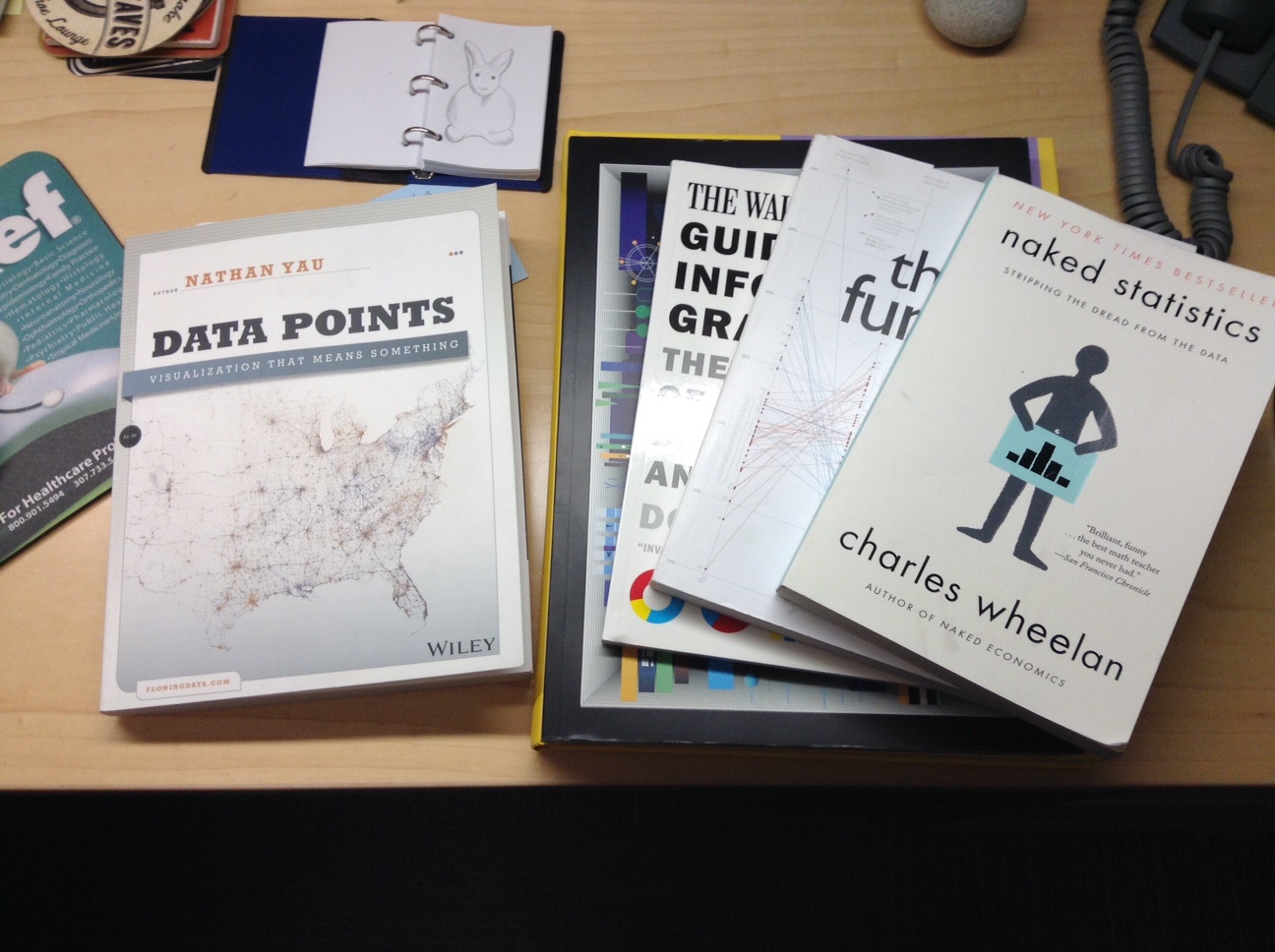
My Desk

Lastly, this week’s What’s On My Desk Right Now? Nathan Yau’s, Data Points; Charles Wheelan’s, Naked Statistics; Albert Cairo’s, The Functional Art; Dona Wong’s, The Wall Street Journal Guide to Information Graphics; and the hot-off-the-press The Very Best American Infographics of 2015, edited by Gareth Cook. Oh, and a drawing of a bunny that I doodled while on a lengthy conference call a few weeks back. Sense a theme?

Until next time… doodle on!
Share and Share Alike

1 Oct

One of my favorite books from the past few years is Austin Kleon’s, Steal Like an ArtistI’ve mentioned it in several previous posts (search “Austin Kleon” on the site and you’ll find them), mostly because I continue to pop back to it on a regular basis. It’s filled with plain, simple, good thoughts to inspire your creative side. I also follow Austin on Twitter. Awhile back, he declared that he was going to shift from immediately tweeting out lots of ideas, project updates, and interesting things he came across online to putting them all in an indexed version that he’d send out via his Tumblr account on Fridays. Of course, as soon as I saw this announcement I signed up for his email list and ever since, his Friday email to me has become something that I look forward to.

My new role as an evaluator finds me doing a lot of things that I’m hard pressed to chronicle as I once did for my work in the library world. In part, I think it’s because I spend a great deal of time learning new things and/or putting newly learned skills into action. It takes time and energy that ultimately takes away from my abilities to come up with interesting musings for this blog. That said, I’m not about to give up my blogging habit. It means too much to me. After lots of thinking about how to revitalize it, the thought came to me to take Austin’s advice and steal an idea … from him!

Thus, I’ve decided to shift the pattern of own blog a bit – at least for awhile – and turn it into a way to share with you, my readers and followers, some of the cool and interesting and inspiring and, dare I hope, helpful things that I come across weekly in my work and play. So here we go … here are a few things from the past several weeks (I’m cheating already, but it’s the start of a new thing and thus allowed). Enjoy!

  1. It only seems fair that I give a tip of the hat to Mr. Kleon to start. Besides his books, I also enjoyed watching the video from a terrific talk that he gave to an audience at Google a few years ago. It’s a wonderful summary of his theory on stealing and some inspiring words to anyone seeking to get out of the way of themselves when it comes to creativity.
  2. Juice Analytics is a data analysis and design firm in Atlanta that provides visualization services to businesses and organizations. They also freely offer a number of great resources for learning these skills, including white papers, video tutorials, and the book, Data Fluency (not free, but well worth the $21.59 price tag for my Kindle version). One of the best resources on their freebie page is “30 Days to Data Storytelling,” a guide to … well, it’s pretty self-explanatory, isn’t it? It’s a list of videos, tutorials, articles, etc., a few a day for 30 days, to help you understand how to use data to tell your story. Good stuff.
  3. Back at the end of the summer, just as school was ready to gear up, Slate published a series of blog posts during one week under the banner, What Classes Should I Take? The list is fascinating and the posts very well written. Two that I liked in particular were, The Secret Technique for Learning How to Code: Step 1. Don’t Be Intimidated, by Victoria Fine, and What are the Odds: To Learn to Think Critically, Take a Statistics Class, by Laura Miller. These two are most relevant to anyone in the library, information, or evaluation worlds. I also found the advice to take Art History, Public Speaking, and No Class at All, quite valuable. The entire series was great.
  4. The Noun Project – Icons for Everything – is pure awesomeness. A gazillion free icons to drop and drag and plop into place OR inspire you to make your own.
  5. One thing that I do often in my job is doodle pictures to tell the story of a particular group of researchers or a research center. Fancy word, infographics. Since I started sharing some of these on this blog and other places, several colleagues and friends have asked for advice on tools to use to make them. I tend to draw my own in Illustrator and/or Powerpoint, but there’s a handy list of 10 Free Tools for Creating Infographics on the Creative Blog website.

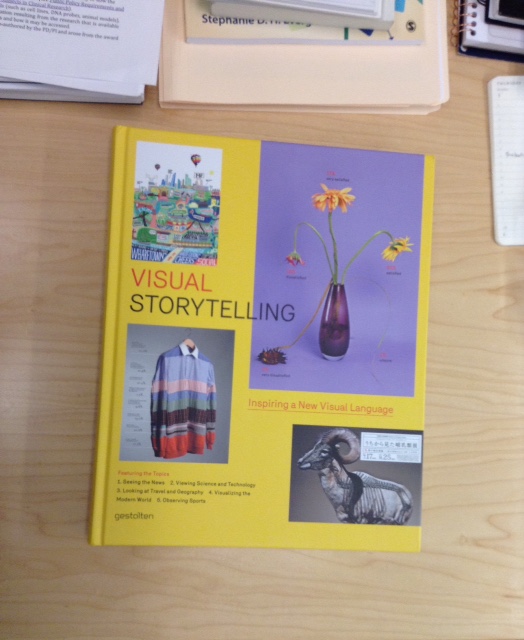
Finally, I think I’d like to add one consistent thing for each of these lists/posts. I’m going to call it, What’s On My Desk Right Now. Right now, it’s this:

Visual Storytelling

Visual Storytelling: Inspiring a New Visual Language, edited by Klanten, Ehmann, & Schulze, and available through Gestalten. I learned about this book after stumbling upon an interview with Jonathan Corum, the graphics editor for science at the New York Times. He’s one of many featured in this book and I can’t wait to dive into it. Now. Lunchtime reading!

Fancy Doodles

23 Jul

One of my favorite parts of my still relatively new job as an evaluator is being able to tell the stories of our programs not only in words, but also in pictures. Regular readers of my blog know how much I enjoy and value sketching, doodling, and drawing as part of my work process, and I’ve enjoyed sharing my sketchnotes over the past few years here on my blog, but my new role allows me to create infograms for each newsletter produced by the UMass Center for Clinical and Translational Science. I thought I’d share some here.

When I had to report on the current work of our funded clinical scholars, I decided to highlight how a small group of people (6) can lead to much larger groups and connections and ultimately, outputs such as subsequent funding and peer-reviewed papers. Turning those facts into pictures, I came up with this:

Slide1

For those curious, I used PowerPoint to draw this graphic. The dollar signs and presentation screens are clip art, but the rest I was able to draw by hand. You can draw pretty much anything with triangles and rectangles and circles. 🙂

Next, I had to report on the progress of another group of funded researchers – our Pilot Project Program Awardees. I took the information given to me via lengthy written reports and turned it into this graphic to show the importance and value of Team Science. For this one, I tested out the infographic site, Easel.ly. It allows you to do many things via their free version.

PPPSummaryUpdateSpring2015

Most recently, the Principal Investigator for our Center wanted to know about the funding of these Pilot Projects since we began doing so, back in 2007. What could we say about this program, since we initiated it? I decided one thing worth evaluating was our return on investment. Since 2007, the UMCCTS has awarded around $5 million to fund research that promotes collaboration between basic science and clinical researchers, provides seed funding for ideas to grow, and advances translational science. What’s been the return on that investment? Turning back to PowerPoint, I created this graphic:

PPP Investment

It’s a challenge to collect and analyze the data behind these images, but in many ways the bigger challenge is to figure out which story is the one to tell and how best to tell it. It’s a skill of an accomplished evaluator, something that I can’t really call myself only 8 months into the job, but I’m happy to report that it’s both interesting and rewarding to work towards such a goal.