Tag Archives: evaluation

Stay Put!

6 Mar
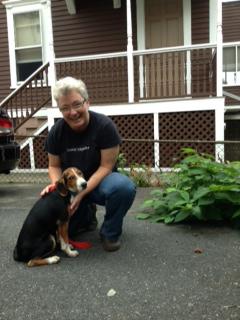
Sit, Eliza. Stay.  Our puppy on her first day home, Aug 2013.

Sit, Eliza. Stay.
Our puppy on her first day home, Aug 2013.

I read a couple of good blog posts this morning, over on the Medical Library Association’s blog, “Full Speed Ahead.” The first was by MLA President, Linda Walton, called, “The Time for Change is Now.” It offers a nice summary of the organization’s new strategic goals, each of which contains some level of a call for action. Like many professional organizations, MLA is challenged to find its purpose and goals in the ever-changing world of libraries, health care, and information. The second post is by MLA’s new Executive Director, Kevin Baliozian. “Words I Can Do Without” lays the foundation for what became the very strategic plan outlined in Linda’s post. Wondering what Kevin’s “no say” words are? SPOILER ALERT: They are “try” and “continue.” Again, you can see that MLA and it’s leadership are focused on moving forward, shedding the “same old, same old,” and making the organization as relevant and important to health sciences librarians and information professionals as its storied history shows it to be in the past. 

I serve on the Executive Board of my regional chapter of MLA and we are engaged in much the same type of work. What do we continue doing? What do we cast aside? Who do we reach out to? What defines us and makes us different, unique, worthy of a colleague’s membership dues and energy? Important questions, all.

I’ve got nothing against change. I think it’s important to take stock on a regular basis and adjust accordingly. In my new job as an evaluator, that’s one of the main focuses (foci?) of my work. More, it’s one of the main reasons for my work. I evaluate the research cores and programs of the UMCCTS to track their progress and to make corrections; to identify where changes need to happen. 

But all of this said, I do have one cautionary note about change: Change for the sake of change is no change at all.

I once counted the number of times that I moved between the ages of 20 and 30. I don’t remember the exact number today, but it was around 18. Eighteen moves in 10 years. I also had a number of jobs during that time. I changed all of the time, BUT I went nowhere. I never stayed in any one place long enough for it to feel like home and I never stayed in any job long enough to become very good at it. And it’s the latter that I sometimes fear when it comes to the bigger picture of organizational and/or professional change.

The other day, someone called me to ask for some “librarian expertise.” I told him that I no longer worked in the library, but I could still certainly help him because I still have librarian expertise. I have it because I stayed in a job for 10 years. My job in the library did not stay the same for 10 years, but I stayed true to a certain core ideal – to help the students, clinicians, and researchers of the Medical School with their information needs, whatever those needs might be. Whether I was building consumer health websites, answering reference questions, teaching how to better search PubMed, or building data dictionaries for research teams, in each I was staying true to that ideal. 

As we search and investigate and try on new roles as librarians – at the individual, institutional, and professional organization level – I hope that we stay true to our ideals. It’s a big challenge, but not impossible. It doesn’t mean we don’t change, but that we purposefully change. Change is expensive. It costs time to learn new things and time to become an expert. It costs time to raise the awarenesses of the people we serve regarding the things we now do. It costs people jobs, when roles and tasks disappear. It costs people their identity, when they’re tied closely to one in particular. 

In the past 2 months, I have changed jobs, moved offices twice, watched my mother-in-law pass away, and (just about – almost ready to sign the papers) bought a house. I seem to be forgetting another big thing, but that’s probably an innate defense mechanism, because let me tell you … all of this change has been exhausting. It takes a toll on a person physically, mentally, and emotionally. We all know this. So it’s all the more important to make sure that we undertake change that’s worth the expense.

I’m enjoying my new job, though it’s stressful to not be an expert anymore and I’d be lying if I said that I don’t miss the library. I’m going to love our new house, something that I’ve never had before in my life. And I do so love having an office for the first time, even if it’s across the campus from all of my old colleagues. All good changes. All worth it.

In the same way, I think that many of the changes that we’re talking about and making in the world of health sciences libraries and beyond are great – necessary and worth the cost. But I do wonder about some and I question their true connection to our ideals. Are we scrambling to change because we don’t know what else to do? Are we forced to change for reasons that have nothing to do with our work, e.g. budgets, space, etc. All very real forces of change, but I worry that sometimes the changes that they force aren’t necessarily in our best interest.

Change is difficult. Change is inevitable. And perhaps most importantly, change requires good leadership – whether you’re leading an organization or just trying to lead yourself in the right direction. In that respect, I feel pretty good about my professional organization. I paid my dues for another year. 🙂

 

Making Mistakes

15 Jan

The button has been pushed and our proposal for a Clinical Translational Science Award from the National Institutes of Health is out of our hands. Let the review process begin! 

My part of the writing and work has been done for a few days now, so I’ve been spending much of the past week doing many things that I likely would have done when I started this new job, if only I hadn’t jumped into the grant writing fire. I’ve read all of the Center’s newsletters for the past few years, I’ve taken lots of notes and done a bunch of documentation related to who’s who for each of our core components. I’d drawn a lot of pictures and graphs and maps to help me understand the landscape. My informationist role in the Library prepared me well for these latter tasks, as I’d been embedded in projects and made it my job to know what was going on around the University. Still, it’s a lot of putting names to faces to departments to projects. It’s a lot to learn.

I also need to learn a lot about the role of an evaluator. I knew enough to get the job, but now that I have it, I know that I need to learn a great deal more before I’m proficient in the task(s). I’ve been reading a lot of articles from evaluation journals. I tracked down several good books on program evaluation, and a couple on evaluating biomedical and health research, in particular. I’ve subscribed to professional listservs, been reading daily blog posts by evaluators, and joined a professional organization to have access to needed resources. Lastly, I’ve been working through a few self-guided mini-courses to make sure I’ve got the basics down pat and that I understand the terminology that I’m reading elsewhere. So far, so good.

And I’m planning. It’s true that I worked with the section writers and leadership of the CCTS to develop evaluation plans for the different components of our proposal. In other words, I’ve already written a whole bunch of plans stating what I’m going to do over the next few years. That said though, there’s planning and then there’s PLANNING. The all-caps version is where I am now. I have plans to collect and track certain metrics to answer certain evaluation questions, but now I really need to plan out how I’m going to do all of that. The logistics. It’s a great challenge. It’s interesting and I’m learning a lot. I cannot complain.

A torn page from a book. I found this on the sidewalk one day during a walk. It's hung over my desk ever since.

A torn page from a book. I found this on the sidewalk one day during a walk. It’s hung over my desk ever since.

One clear thing that I’ve read – and thus learned – over and over in my study ’til now is that the practices of measuring and evaluating are continuous. You need to plan for them from the beginning and, depending upon your goal, assess at different points along the way. It’s pretty much like life in general. If you make that New Year’s Resolution to lose weight, you need to make a plan and part of that plan involves devising a means to track your progress along the way. If you want to go on a trip to Europe, you need a plan to save the money and a way to keep track of what you’ve saved, so you’ll know when you’re ready to pack your bags. 

I am a reflective person by nature. I majored in philosophy during my first time through college. I went to seminary where you hone your spiritual reflection skills well. I’ve spent time with therapists, here and there in life. I’ve been writing this blog for the past few years as a way to reflect upon and keep track of my changing roles as a librarian. For me, it’s a really helpful practice because it keeps my awareness of where I am and what I’m doing and what I’m learning at the forefront. Annual evaluations (and/or quarterly reports) don’t work for me without keeping track of things along the way. This blog helps with that.

I recently re-read something that I wrote last fall for a different blog, Hack Library School. I was interviewed, along with several other medical librarians, about our work. One of the questions asked was what advice I’d give to current students studying library science and my answer, in part, was:

Sell yourself! One of the things that I see happening in settings like mine (an academic medical school and research center) is that there is never a shortage of work for a person who can match his/her skill set to existing needs. And there are LOTS of existing needs. The key is to really know what you know how to do, know what you need to learn how to do (and learn it – ESPECIALLY if you’re weak in the sciences), and then know how to show people that what you bring is uniquely useful to them. I don’t necessarily think that this means you wait around and look for job openings in medical libraries, but that you also keep your eye on other parts of the health care system or biomedical research where what you can do fits. People looking for help often don’t think of a librarian as one who could do the job for them, but I think that’s mostly because we haven’t done the best job of selling ourselves. Know yourself, have confidence (even if you have to fake it at first), and put yourself in places that offer you opportunity.

One thing I could add to this is that developing a practice of self-reflection, evaluation, and/or tracking yourself – however you do it – will put you in a much better position to sell yourself and/or match your abilities to opportunities as they arrive. This is exactly what happened to me last November and it landed me in a great new role. My CV didn’t say a thing about being an evaluator, but I was able to map pretty much every aspect of it to the qualifications needed for the person in this post. The discipline of weekly reflection via this blog made that task easy.

We always encounter times in our lives where evaluation is forced upon us, whether it’s that mandatory annual review or a major life event. My mother-in-law is in hospice care now and nearing the end of her life. It’s a time of reflection for her and everyone in the family. “Did I live a good life?” is likely the ultimate evaluation question. You hope for the answer, “Yes” and you hope for lots of reasons to be sure of your answer, since it’s basically too late to change much. Driving home last night after visiting with her, I thought a lot about how all of these things fit together. There’s no need to wait until the program is over, until a career is over, or until a life is over to ask, “Did I do a good job?” When we plan to track, measure, reflect, and evaluate along the way, I’m fairly certain we’re better off in the end. 

The Great Candy Cane Caper

29 Dec

There I was merrily absorbed in the holiday spirit, running my daily Jingle Bell 5K and sharing a candy cane a day with my dear blog readers, when all of the sudden …

SCREECH!!!

It may be more appropriate to say that my two feet hit the gas pedal – VAROOOOOOM!!! – than the brakes, but regardless of how you see it, my holiday streaks were tossed off the rooftops and my blog posting has been MIA for 2+ weeks now. That said, I refuse to let 2014 close without one final post, so here goes:

If you read my last post (12/15), you know that as of that date I began a new job as a Research Evaluation Analyst for the University of Massachusetts Center for Clinical and Translational Science. I still work at the UMass Medical School campus (right down the hall from the Library), still enjoying all of the relationships I’ve built over the years. In fact, it’s those very relationships – both around the campus and in the larger academic medical library world – that helped me land this job. And while it’s immensely different in so many ways from the work that I’ve been doing for the past years as an embedded research librarian and informationist, it’s also a position that will allow me to expand on many of the skills I honed during that time.

So what am I doing now? That’s a question pretty much everyone, with the exception of my new colleagues in the UMCCTS, has asked. Right now, I’m working madly with the rest of the grant writing team, pulling everything together before the January 15th proposal deadline. The UMCCTS is funded through a Clinical and Translational Science Award from the National Institutes of Health, a 5-year grant that expires this year. As you can imagine, I came on board at one heckuva time to come on board. I’ve been playing catch up and keep up at the same time; reading accepted, past proposals from other universities, reading articles on the state of evaluation of the CTSA program as a whole, reading articles on different evaluation research from individual CTSA awardees, and reading the many different components of our own proposal in their many different iterations. 

And I’ve been writing; writing a section on the measurement and evaluation program for our Center as a whole, writing annotated versions of the evaluation pieces for the individual components, writing tables and charts, and writing my list of all the people that I’ll send Christmas presents and/or cards to after the middle of January. What I’ll be doing after the grant goes in (and, fingers crossed, gets awarded) is working on all of the evaluation pieces and projects that I’ve spent these weeks describing. I’ll also be working actively with other CTSA award sites, in particular their evaluation teams, on collaborative research projects that will help us determine the effectiveness of the program on a national level. It’s in this latter part that I’ll get to maintain a number of librarian connections, as well as build some new networks of colleagues (and, if evaluators are like librarians, friends).

Do I like it? That’s the other question I get of late. Honestly, I don’t know yet. I like the subject of evaluation and measuring the impact of research. I like the bits that I was able to dabble in while working in the Library. I like research. I like reading and learning new things. I like seeing UMMS from a different perspective. I like the people. I even like the change of pace, even in its whirlwind form. I’m glad that I followed-up on an opportunity and that it’s come to be what it is right now, but it’s still awfully early in the change; too early to give a definitive “thumbs up” or “thumbs down.” 

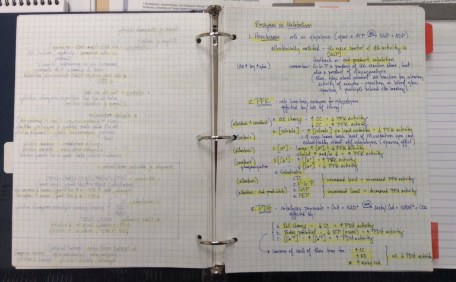
My highlighted, coffee-stained notebook from that year of hard study. Despite the years, I've never been able to throw it out.

My highlighted, coffee-stained notebook from that year of hard study. Despite the years, I’ve never been able to throw it out.

However, what this early experience reminds me most of is being in graduate school. In particular, it reminds me of the amount of time and effort and work that was involved in learning all of the systemic and cellular physiological mechanisms of exercise for the two courses I took on that subject. I can clearly remember one very bright, sunny, Saturday afternoon in late fall, sitting at the conference table in the room on the 2nd floor of the health sciences building (outside the grad students’ office) with my good friend and classmate, Suzanne Connolly (say it with an Irish accent), working our way through every little step and every confounded enzyme and every change in positive or negative ions to open this or that Calcium channel … all to make one heart beat happen. I can remember talking it through over and over, drawing pictures on the white board, trying to get it, to understand the process, to put all of the pieces together in my head until finally …  BLING!! … the lightbulb went on. And I remember feeling REALLY satisfied. Because it was hard. It was hard, but I’d stuck with it until I got it. And I think that’s why this study day memory stands out so clearly in my memory bank.

I’ve felt that way at other times, too; learning a particular riff on the mandolin or learning to cross-country ski. It takes focus and effort. And it’s about learning, not necessarily about competence. I was (am) a very competent librarian. There was certainly a period of time, early in my career, when I had to put forth a good bit of focus and effort to learn something new, but whenever you’ve been doing something for a good while, the amount of effort you have to expend towards the work decreases. You may still spend the same amount of time and you may still have the same amount (or even more) tasks to attend to, but the amount of effort is different. You’re efficient at what you do. You may not be completely on auto-pilot, but you can probably get to and from work without always remembering the drive.

My first couple of weeks (less a 2-day Christmas break) have been about learning. I’m a long way from being a competent evaluator. The learning curve is steep and challenging, but when I feel overwhelmed, I remember that study day and I remember piano recitals and I remember cruising along on the successes that came from the hard work of learning to be a good librarian. I remember the satisfaction that came with those experiences and I trust that in time, I’ll enjoy the same in my new role. 

Between here and there, I’ll keep sharing the journey. After all, a librarian by any other name is … still a librarian.