Let’s Ask the Expert

26 Mar

Normal Distribution

The research team has a new statistician; not a new analyst, but new statistician. If you look at it as a pecking order, the statistician oversees the analyst. Our former statistician retired recently, leaving the team to find a replacement. The University has a relatively new Quantitative Health Sciences Department and many of the services once procured through individual department statisticians are now going through QHS. Or at least this is how I think it’s going. These are things that I don’t necessarily need to know and as I have plenty of things occupying my “need to know” gray matter right now, I can just follow along here.

The significance of the new team member, to me, was that it generated the need for a meeting so that he could be brought up to speed on the project. This meeting happened this afternoon. I believe it was good for him (as well as the Chair of the Quantitative Methods Core, his boss, also in attendance). I know that it was good for me. I’ve now heard the project and its various aspects described on a number of occasions, and each time gain some new insight. Today, that insight was that I have a pretty good grasp on where the data for this study comes from, the different sources that generate it, how it’s stored, where it’s stored, who’s managing it, and so forth. I also had a pretty clear understanding of where the problem spots and/or issues with it are (mostly gone over, yet again, in today’s morning meeting).

I decided to pay close attention during the meeting on the questions that the statistician asked. I imagine that these are the kinds of questions that an informationist, embedded librarian, or anyone concerned with data management and planning would ask a research team. Here are some that I noted. If you’re doing an interview with a researcher about his/her data, are you asking these questions?

  • Is the data in one place or multiple places? 
  • Do the different sources merge together easily?
  • Are the variable names consistent across the sources?
  • Where is the merged data stored and how?
  • When and/or how often do you do data pulls from the sources?

Additionally, the statistician said that he wanted to be walked through the process. He wanted to generate a visual for himself of how everything works together. I found this request confirmation of much of what I’ve been reading and thinking about in terms of how we best see, understand, and communicate systems and processes. Visuals are important. I remember meeting with one of the chief programmers a few months back and how helpful it was when he pulled out a marker and drew us a picture on the whiteboard to explain all of this.*

*NOTE: If you’re interested in the art of explanation, check out The Art of Explanation by Common Craft founder, Lee Lefever. I’m pretty sure I mentioned this a few posts back, but in case you missed it… Also, Common Craft has made wonderful templates of their cut-out characters available for free to download and use in your own creations. Give it a try and see how well you do at explaining a concept or problem. Make a little video and share it with me.

So, if you’re keeping up with the process of the research study, the next step for the statistician is to collect data from the first cohort and start to play with it; see what it shows so far; see if it identifies any gaps of missing data and/or holes in the process that need to be addressed. It’ll be a couple of months, at least, before we hear back, but it was obvious that the team was excited about this move.

A few questions that I’m left with, following today, are:

  • What’s the difference between an analyst and a statistician?
  • What is my role, if any, in this aspect of the study?

One last interesting aside – When we went around the table to introduce ourselves and I said, “I’m from the library, serving as the informationist,” Dr. Barton, the Director of the Quantitative Methods Core said, “Oh, good.” I’m the only one who got an “Oh, good.” I’ve no idea what he meant by it, but I like to see it as a positive sign that my library is engaged in this kind of work. Regardless, it was a nice gesture.

17 Mar

This is a post from my personal blog, but I’m sharing it on the “Librarian Hats” blog for my librarian friends who might want to see some fun work on parade!

salgore's avatarblahg, blahg, blahg...

I have several sketchbooks traveling the country (and Canada) this year through projects of the The Sketchbook Project (Art House Co-op) of Brooklyn, NY. If one comes to your town, I hope you’ll take the chance to seek it and its many friends on the road trips.

The Memoir Project

500 handwritten books from writers and illustrators around the globe.

  • Brooklyn – June 28-30
  • San Francisco – July 26-28
  • Washington, DC – August 16-18

The Mysterious Maps Tour Mobile Library Tour

The Mystery Maps Tour asks you to make original maps of real and imagined places.

  • Providence, RI – June 13
  • Portland, ME – June 14
  • Montreal, Quebec – June 17

The 2013 Sketchbook Tour

11,000 sketchbooks on the road starting March, 2013. Check ’em out!
Brooklyn, Austin, Atlanta, Toronto, Chicago, Portland (OR), San Francisco, Chicago, and Los Angeles.

View original post

What does success look like?

15 Mar

In her memoir, The Mighty Queens of Freeville, author, columnist, and occasional panelist on NPR’s “Wait, Wait… Don’t Tell Me!,” Amy Dickinson, writes, “I am surrounded by people who are unimpressed with me.” It’s perhaps my favorite line in a book that I really liked. The self-deprecating humor of famous folks. It’s funny. As I was walking from the parking lot to the library this morning, I couldn’t help but think that it’s been a bit of a surreal week for me as I’ve had encounters with some incredibly successful people. To paraphrase Ms. Dickinson, “I am surrounded by impressive people… and I remain impressed by them.”

It’s a testament to the world we live in, the social media aspect of it in particular, that I had the week that I had…

Friday, March 8 - Brattleboro, VT

Friday, March 8 – Brattleboro, VT

Rosanne Cash

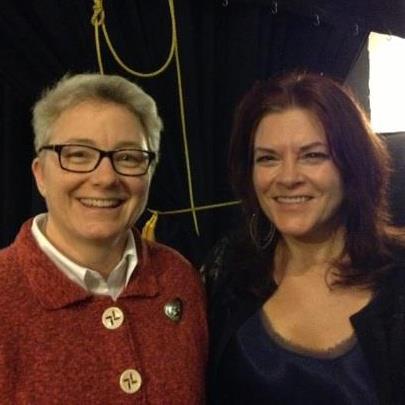
Last Friday, my spouse and I traveled to Vermont to see Rosanne Cash and John Leventhal in concert. This was not the first time I got to meet Rosanne. We became acquainted via Twitter about a year and a half ago. I followed her. We tweeted back and forth to one another a few times. She started following me. In November of 2011, I got tickets to see her perform in Fall River, MA and asked if she’d be so kind as to let me say hi to her after the show. Ever gracious, she did. The same happened last Friday. Kind and funny and smart and one of the greatest singer-songwriters of our time, she gave me a hug, joked about our mutual love of ironing (remembering this from our previous meeting), talked about librarians… it’s one of those moments I’ll cherish. And then, perhaps even more unreal, the next morning as Lynn and I were walking down Main Street, we heard from behind us, “Hello, ladies!” Turned around and there was Rosanne. We chatted for a minute on the sidewalk in Brattleboro, VT like some kind of old friends. Pinch me.

Sherry Pagoto

Bright research star here on our campus, #Plankaday Nation co-founder, author of the #1 health blog of 2011 (FUdiet), and one of my biggest advocates for the new work I’m doing on campus, Sherry Pagoto and I hung out in her office on Tuesday to work on the details of a proposal that will allow me to work on her President’s Award grant. She took me on a few years ago as an exercise physiologist for one of her studies and today is a fantastic champion of me as an informationist. We  have a Nobel Laureate on campus, a few Howard Hughes investigators, and some really outstanding leaders in biomedical and health sciences research. How I got lucky enough to have one of them in my corner… well, pretty lucky!

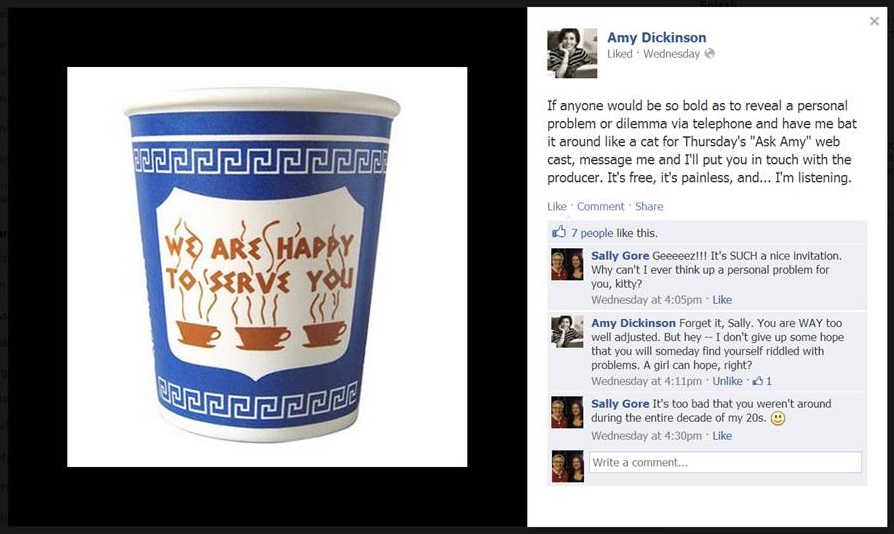
Facebook chatting with Amy, Wednesday, March 13.

Facebook chatting with Amy, Wednesday, March 13.

Amy Dickinson

As mentioned earlier, I’m also a fan of Amy Dickinson, the Amy of the syndicated advice column, “Ask Amy.” We also “met” through Twitter and I take part in the discussions she tosses out on her Facebook page. She’s promised to take part in my “Jam 51” birthday party, if she can. Maybe the folks in Freeville are unimpressed, but not me. I’m counting on the face-to-face meeting in the future. In the meantime, I’m working up some turmoil in my life so that I can call into her Thursday noontime webcast from the Chicago Tribune. And look! She’s hoping for the same. 🙂

Suzy Becker

I had lunch yesterday with my uber talented and brilliant friend, Suzy Becker. Suzy is an author and a cartoonist and a teacher and one of those people you’d hate if she weren’t so darned nice. We talk over chicken shawarma sandwiches about girl’s high school basketball, her next book, her latest class at the Worcester Art Museum, her innate aptitude for Twitter, Lynn’s and my trip to Brattleboro, the PBS documentary “Makers,” why no women have sports talk shows, and the fact that she’s been on the Diane Rehm Show three times (3 times?!). She gives me a lucky horse shoe as a belated birthday present. I’m going to hang it in my new studio. She leaves to get her kid to the dentist on time and I walk home, still thinking about talking to Diane Rehm and helping someone with a Ford Foundation grant and knowing someone who’s putting together a new radio show and… lunch with me?

So “Lean In” on This

As I think about my week and how it intersected in different ways with 4 unbelievably successful women, I notice how not a single one of them fits the mold of “success” that Sheryl Sandberg espouses in her book, “Lean In,” that coincidentally also had a big week. Sandberg has been all over the air waves, sharing her thoughts on why women have not achieved success equal to men, despite now years of “equality.” We need to lean in, be more aggressive, change our priorities. Maybe. If you want to be the CEO of a gazillion dollar enterprise. Me, I’m glad for the successful people that I know (or at least have had the chance to briefly meet) in my life. And incidentally, not a one of them fits Sandberg’s definition of success.

Tip #1 in Daniel Coyle’s, “The Little Book of Talent” is “Stare at Who You Want to Become.” These are some of the people that I stare at. Despite their respective success – and a few of them are darned successful! – I’m not star struck. (Well, maybe a little.) No, just grateful to see and know and have people in my life to stare at, so that I can model the things that they do that bring them success.

How about you? How was your week? Did you find inspiration from anyone? Do you look to certain people to be your models of success?

(As an aside, just as I was finishing this post, my friend and colleague, Lisa Palmer, showed me pictures of her trip to Italy – when Pope John Paul II blessed her in 1983. I think it may have been some divine message for me to stay humble. I am surrounded by people who are unimpressed with me.)