Waxing Philosophical

17 Sep
Old Friends

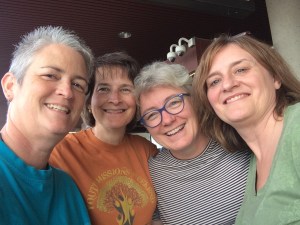
(l-r) The Reverend Donna S. Mote, PhD, The Reverend Kelley Milstead Woggon, yours truly, and The Reverend Dina Carroll

I spent last weekend with old friends; old in the sense that we’ve known each other for a long time, not that we’re old. None of us are ready to admit that (though we did laugh a good bit at some of our creakiness and memory loss). The four of us met 29 years ago when we arrived in Louisville, KY to go to seminary. Four+ years of finding one’s way in that environment can make for long-lasting relationships. That said, we’d not seen one another in forever and thus the weekend was filled with catching up and sharing memories and as mentioned previously, lots and lots of laughs.

While I moved on vocationally to a career in libraries, my three friends have all remained working in ministry. One is a hospital chaplain and administrator, another a hospice chaplain, and the third is an Episcopal priest who works for the diocese of Atlanta in, of all places you might say, the Hartsfield-Jackson Atlanta International Airport. The Vicar of ATL, my friend, Donna, calls herself. (And a reminder to all of my readers, should you ever find yourself in need of a friendly face or helping hand in that airport, look her up.)

Throughout the weekend, as we shared about the work that we each do, I couldn’t help but notice some similarities. I also can’t help but notice that this happens to me often. I have a tendency to look for shared experiences and common ground. I prefer it over differences and, personally, think that while we focus an awful lot in our day-to-day world about our differences and uniqueness, we actually have much more alike with one another than we ever have different. Regardless of what we do or what we believe or how we dress or the color of our skin or the languages that we speak or the … the list goes on, of course.

The Vicar had a tendency to say, “Jesus has left the church,” in reference to her ministry at the airport. The same could be said for my friends who provide comfort at the bedside of sick or dying patients, and their families and loved ones. Each time Donna made this statement, I thought to myself, “How often have I heard, ‘Librarians need to get out of the library’ over the past years?” No matter what you may think of god or religion or Jesus or librarians, the point is the same; when you work with something as ubiquitous as either spirituality or information, or even more, the human needs around such, your ability to do your work becomes pretty limited when you confine it to a particular space.

I’ve written before in this blog about how the conversations and discussions within different labs, research teams, committees, and such that I sit in on around campus so often focus on the same topic – communication. Better put, they focus upon issues related to the difficulties around communication and connectedness. “Nobody knows what we do.” “We need a better website so that people can learn about us.” “We offer so much, yet people don’t know it.” “I need help with (fill in the blank), but don’t know where to begin to figure out how to find the person or place to help me with it.”

Growing up, both of my parents taught school; my mom at the elementary school level, my dad, high school. Since I also went to school and I had teachers, I pretty much knew what my parents did. Yet, whenever I watched television and the TV dads went to the office, I didn’t have a clue what that meant. They put on their suits, picked up their briefcases, and headed out to do something all day. But what? What did “going to the office” mean? It was a big mystery.

And I think it remains that way for a lot of us who work and live in a very silo-ed world, be it academia or research or medicine. We live in our small worlds, often unaware of what’s happening down the hall or on the third floor. But the trend that I see over and over, is that the mystery isn’t very mysterious at all. The basic needs that arise in much of our work are the same for everyone. They’re common ground.

I see this because I’ve been a librarian outside of a library for a bunch of years now. Just like church, people used to bring their troubles to the library. Both were quite central places in people’s lives. But it’s less the case today and while both the library and churches, as places, still have a place in our worlds, the needs that they used to fulfill within their walls are now often (not always, but often) found outside of them. And more, those of us who work to serve and/or meet those needs… we often (not always, but often) will find our patrons or our parishioners beyond them, too.

Out we go!
Illustrated Podcasting

2 Sep

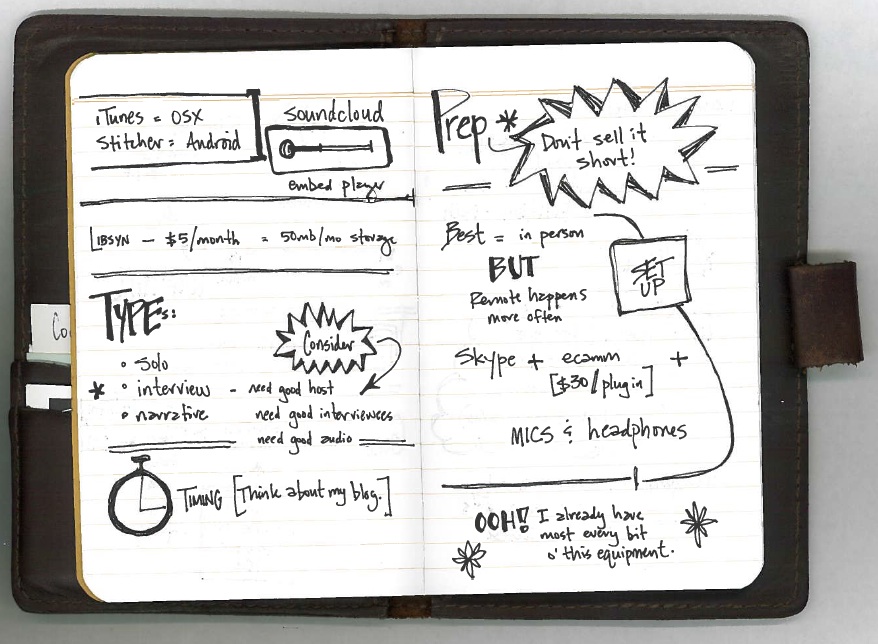
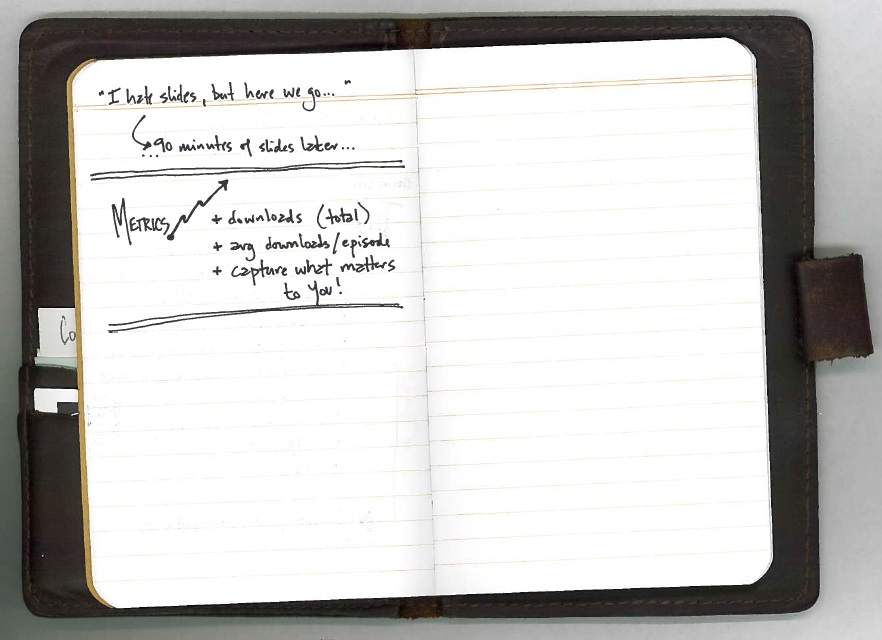
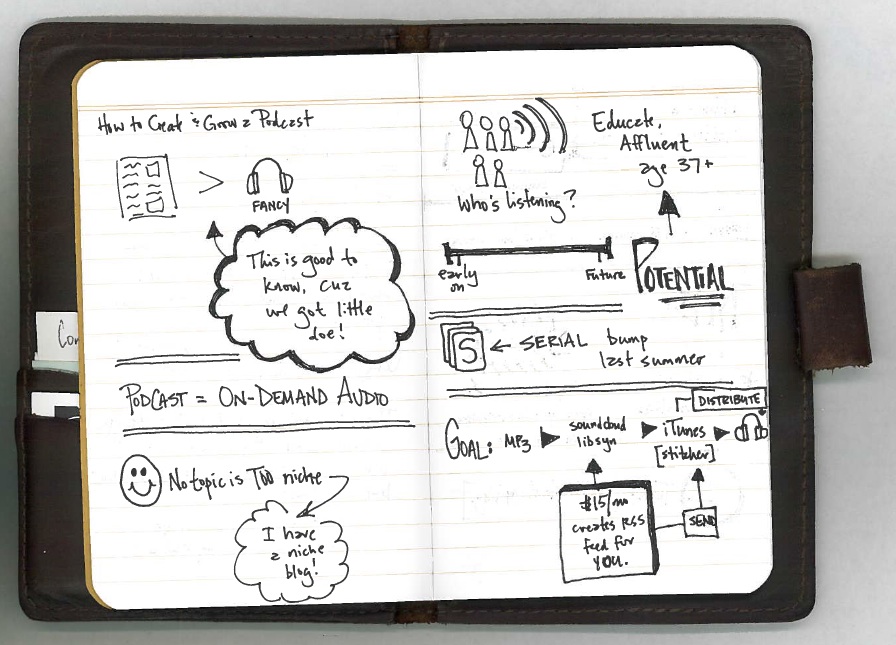
My podcasting workshop last night wasn’t quite all that it was advertised to be, but I definitely learned a lot and feel pretty prepared to tackle the task. I was hoping to leave the class with a finished and distributed episode (per the course description). I like classes and workshops that promise such. It wasn’t to be, but for the $17.50 fee, plus the bonus of catching up with my friend, fellow librarian, blogger, beer connoisseur, and baseball lover, Dan, before, it was more than worth it. I sketched my notes, per usual, and share them here. And soon, catch the podcast I’m going to create!

PodcastClass_1

PodcastClass_2

PodcastClass_3

PodcastClass_4

For those keeping track of my office supplies, these sketchnotes are drawn in a FieldNotes brand ruled memo book, carried in my “never go anywhere without it” handmade “Everyday Carry” cover, with a refillable Pentel EngerGel pen that I’ve managed to hang on to for several years now. I hope that I never lose it, as both Rosanne Cash and Amy Dickinson have used it to pen a few words to me. It’s a treasure.

Learn Something New Every Day

27 Aug

My spouse recently got a call from a couple of faculty members in the computer science department at the college where she teaches. Lynn teaches in the art department; graphic design, motion design, typography, and the like. The computer science guys wanted to explore the possibility of her teaching a course in data visualization. Knowing that I have both an interest in the topic, plus the need to fumble through learning it (and using the new-found skills) for my job as an evaluator, she asked me what I thought about the opportunity.

Lynn knows enough about data visualization to know there’s a computer programming aspect to it. The computer science guys know enough to know there’s a design element to it. They all know that there’s math involved, specifically statistical analysis. I also suggested that it involves writing and/or journalism. She was hesitant – and rightly so – to jump on board without thinking and talking it through, because what she is an expert in is only one area of a multi-disciplinary field.

“It’s team science,” my boss, Nate, said when I shared the story with him. Exactly. And in many ways it’s an example of how the ways we traditionally teach, research, and work need to be re-examined and re-worked.

Too often, I find, we search for collaborators within our own circles of expertise. Librarians collaborate with other librarians. They might be from different types of libraries or different library departments, but often we’re all librarians. Researchers collaborate with other researchers. Scientists with other scientists. In some ways, it can be argued, this is team science (or team-based work), but it falls short of the ideal.

At it’s best, team science brings together experts from across different disciplines to work on problems that simply cannot be tackled by any one group. Think about a health problem like obesity. It’s huge and as such, touches upon so many different aspects of life. Addressing it requires everyone from geneticists to behavioral psychologists to nutritionists to exercise physiologists to public policy makers to urban planners to educators to medical doctors to parents to science writers to … it’s probably easier to identify the experts not needed than those who are. The point being that some of the most successful efforts at addressing obesity are those that bring as many of these fields of expertise together, to work together towards a solution. (The UMass Worcester Prevention Research Center is an example, close to home for me.)

But back to data visualization, what I’ve found is that those who do it best are either freakingly gifted (there’s always an Edward Tufte in any area) or they’re smart enough – and talented enough – to assemble good teams for the work. As I’m seeking to discover the best resources to learn and practice the skills for this job, I’m continually reminded to look across lots of different disciplines. I look to evaluators (Stephanie Green and Chris Lysy), graphic designers (Nigel Holmes), business intelligence consultants (Stephen Few), journalists and journalism professors (David McCandless and Alberto Cairo, respectively), artists (Manuel Lima), statisticians (Nathan Yau), doctors (Hans Rosling), and the people in my very own Quantitative Health Sciences Department. I read things by people who are good presenters, experts in visual communication, and those skilled in improvisation. In other words, while I’m limited in resources to actually form a real team of experts to do data visualization for the UMCCTS, I’ve learned enough to seek them out from across lots of corners so that I can do a better job. (I’m also lucky enough to be working in an environment where people don’t mind me trying things out on them. It’s a benefit of being in academia.)

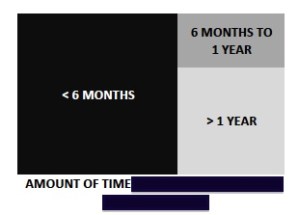
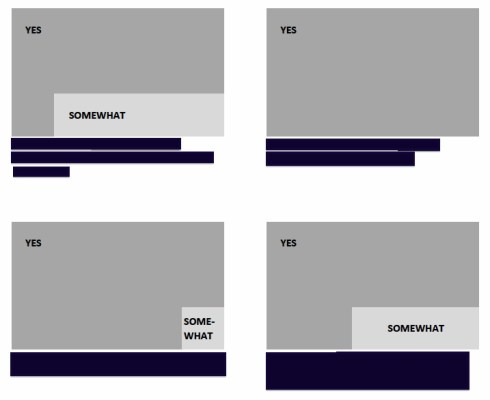
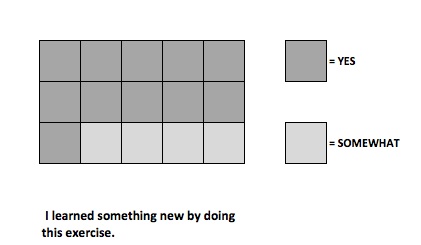
Thanks to Chris Lysy’s (DiY Data Design) weekly creative challenge, this week I practiced using design icon arrays to report on the findings of a course evaluation with a small (n=15) class size. We get so hung up on “big data” that it’s easy to forget the real challenges of working with and presenting the results from small data sets. I really enjoyed taking this challenge and putting it to use. Here are a couple of examples. For the sake of privacy, I’ve redacted the questions being reported.

Time

Sample Arrays

Now, here’s one lesson that I learned for the next time that I use this visualization device. I need to make them like this:

better copy

This example allows me to better show that each response is represented by a single box, thus 11 people answered “Yes” and 4 answered “Somewhat.” Live and learn. Every day.

Next Tuesday, I’m taking a workshop on creating podcasts. It’s something that I’ve wanted to try and I found a 2-hour, evening class in Boston. Stay tuned to see what that new learning might bring.