Archive | Skills RSS feed for this section

ACCESSories

12 Sep

For years, I lived on Lower Flying Point in Freeport, Maine, one of those fingers of land that stretches out into Casco Bay. You can get to Lower Flying Point one of two ways; Flying Point Road off of Bow Street, which is off of Main Street in Freeport (turn right at L.L. Bean) or Flying Point Road by way of Pleasant Hill Road by way of Highland Road by way of Maine Street in Brunswick, ME. You can probably tell, just by the description, that the former is the fastest, straightest route.

One summer, Mill Stream, which ultimately flows into and becomes the Harraseeket River, flooded. REALLY flooded. Over the banks and over the surrounding fields and over Bow Street/Flying Point Road. In its flooding, it took with it the very large culvert that ran underneath the road and, with the culvert also went the road itself. For weeks after, the only way to get to and from home was the very round-about and out-of-the way route through Brunswick. People were good sports about it, even though it was a major inconvenience and added as much as a half-hour to one’s commute, and when the road was finally re-opened, we hung balloons and had a party. Access restored.

In her book, Access to Medical Knowledge: Libraries, Digitization, and the Public Good, Frances Groen identifies three values that lie at the foundation of professional librarianship:

  • Providing access to information
  • Preserving the accumulated knowledge of the past
  • Helping the public understand how to use information

(Read a review of the book by Janice Kaplan in the July 2007 issue of JMLA.)

I’ve required the students in my Health Sciences Librarianship course at the University of Rhode Island to take part in one of the Thursday night #medlibs Twitter chats. Last night was an option and several were there, asking great questions and sharing in the discussion. The topic centered on the role of librarians in the clinical setting and was led by Julia Esparza, a Clinical Medical Librarian from LSU Health in Shreveport, LA. Julie asked some really pertinent questions around what it takes to have confidence in this role, what people most enjoy about it, and what some of the unique challenges to it are. My students expressed real surprise at how much clinical medical librarians can be involved in the hospital setting, particularly when it came to thinking about them being part of rounds, i.e. being at the patient’s bedside with the rest of the clinical team. To paraphrase… “What do patients think about that?” “How would I feel about it, if I was a patient?” “How does that make a patient feel, that a doctor has to look to a librarian for help finding information?”

Great questions, every last one of them! 
The medical profession is layered (and layered and layered) with levels of myth and entitlement and very entrenched beliefs about the respective roles of doctors and patients. Given our incredibly complex healthcare environment and the limitations of physicians in terms of how much time they have to spend with patients, there’s been a push for patients to become educated about their health, diseases, care, etc. Patients need advocates, be they a family member, friend, or stranger. It’s simply unwise to step into a situation involving yours or a loved one’s health, knowing little to nothing of what’s going on. But it happens all the time. Medical librarians, particularly those focused on consumer health resources, are tasked with providing access to the information that the public needs to be better prepared here. From the admonishment, “Don’t Google for Health Information!” to showcasing sites likes MedlinePlus to attending health fairs… medical librarians (and public librarians) are busy here, staying true to the values “Providing access to information” and “Helping the public understand how to use information.”

So how does this fit with librarians being a part of teams in the clinical setting? I argue that it’s merely an extension of the same. They are there to make sure that the doctors AND the patients have access to the information that they need, and they are there to make sure that everyone knows how to use it. But what does that mean? Providing access is one thing, but what does it mean to help someone understand how to use information? Doctors are there to diagnose, we all agree with this, but for the patient who doesn’t understand the information presented to them, does the librarian, perhaps, have a role in helping them understand it? After all, doesn’t understanding how to use information depend upon understanding what the information means in the first place?

Not being a clinical librarian, I really only have opinions here – not much actual experience or evidence to fall back upon. However, if I translate this setting to my own, i.e. the research team, and think of my role as a librarian there, are there any parallels? I think so.

There’s a debate among those who take part in systematic reviews and in-depth searches regarding how much a librarian should do. Do we simply develop and execute the search strategy, and then pass off the results to the rest of the team for review? Are we breaking some rule if we review the articles, too? Is it taboo for us to write synopses of papers, evaluations of them, or give our own thoughts upon whether or not they are worthy of inclusion in the study? Can we take the lead in writing more than the methodology of a systematic review? Can we make suggestions, share informed opinions, and discuss the topics at hand that extend beyond the subject of librarianship? 

For me, the answer to these questions lies at the heart of what it means to truly be embedded in the setting, be it research or clinical. It’s about being an equal part of the team and while each member has his/her level and/or area of expertise, to be more than an accessory, you need to step up and be equal – equally responsible, equally accountable, and equally invested. If I can explain some information to someone, to me that is part of helping someone understand how to use it. It’s a core value. To stop short of this because I believe that it’s not my role or not my responsibility, that’s falling short of what I believe is my professional place. 

I was in the hospital last month and while there, I overheard my medical team (just docs, no librarian) in the hallway talking about my EKG. The resident and attending doc were explaining to the medical student about the length of my QT segment and what my R wave progression might be telling them. I wanted to yell out into the hallway and tell them that I’d had a couple of semesters of cardiac electrophysiology as an undergrad and grad student, and ask if they might wish to come in the room and talk to me about it. But I didn’t. I listened to what they said about me in the hallway and then listened to what they said to me when they came to my bedside. And they were, as you can imagine, quite different.

After last night’s chat and then thinking about the questions and observations of my students, I wondered how this experience might have gone differently if a medical librarian was there. And then I realized that a medical librarian WAS there. Granted, I was the patient and really in no mood to make it a teachable moment, but that’s what it was. I could have talked to the doctors and let them know that I knew how to use the information they weren’t sharing with me. I could have said that as a medical librarian, it’s my job to make sure people know how to use the information they have. It’s not just my job to provide access to it. If this means explaining something – or making sure the clinician explains something – in a way that the patient understands it, then that’s what I do. I like to think that our role is a heckuva lot more than simply being a culvert.
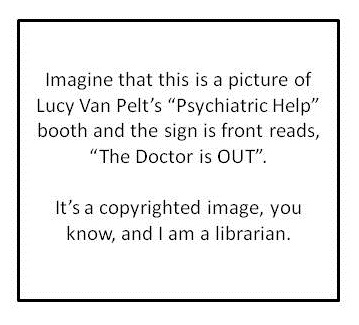


The Doctor is Out

10 Jul

Psychiatric BoothAdmit it. We all know a lot better, a lot of the time. People know that sitting around all day isn’t the best thing for one’s health, but here we sit. We know that the label says there are 6 servings of macaroni and cheese in the box, but it really divides better by 2 or 3. We know that being distracted while driving isn’t the safest thing, but we text and we do our makeup and we fiddle with the radio and we play our ukuleles while we drive, anyway. And when it comes to information and data, of course we know that it’s best to back-up our files in multiple places and formats, to name our files a certain way so that we can find things easily, and to write down instructions and practices so that we, or others, can repeat what we did the first time. Of course we know these things because let’s be honest, it’s common sense. But… we don’t.

Personally, I get incredibly frustrated at librarians who think we’re adding something important to the world of data management, just by teaching people these notions that really are common sense. I think that there’s something more that we need to do and it involves understanding a thing or two about the way people learn and the way they behave. In other words, lacking a behavioral psychologist on your research team, librarians would do well to study some things from their camp and put them to use in our efforts at teaching, providing information, helping with communication issues, and streamlining the information and/or data processes in a team environment.

I’m preparing to teach a course in the fall and thus I’ve been reading some things about instructional design. In her book, Design for How People Learn, Julie Dirksen explains that when you’re trying to teach someone anything, it’s good practice to start by identifying the gaps that exist “between a learner’s current situation and where they need to be in order to be successful.” (p. 2) Dirksen describes several of these gaps:

  • Knowledge and Information Gaps
  • Skills Gaps
  • Motivation Gaps
  • Environment Gaps

More, I believe she hits the nail on the head when she writes, “In most learning situations, it’s assumed that the gap is information – if the learner just had the information, then they could perform.” I know that I fall into this trap often (and I bet that I’m not alone). I believe if I teach a student how to conduct a solid search in PubMed, that’s how they’ll search. I show them a trick or two and they say, “Wow!” I watch them take notes. I help them set up their “My NCBI”  account. We save a search. They’ve got it! I feel like Daniel Day Lewis in the movie, There Will Be Blood, “I have a milkshake and you have a milkshake.” I have knowledge and now you have the knowledge. Success!

Now if you do any work that involves teaching students or clinicians or researchers or anyone, you know not to pat yourself on the back too much here. I teach people, my colleagues teach people, all of our many colleagues before us (teachers, librarians at undergraduate institutions, librarians at other places where our folks previously worked) teach people. We all teach the same people, yet we keep seeing them doing things in their work involving information that make us throw up our hands. How many times do we have to tell them this?! 

Well, maybe it’s not in the telling that we’re failing. This is where I think understanding and appreciating the other gaps that may exist in the situations, addressing them instead of simply passing along information, could lead us to much more success. And this is where we could use that psychologist.

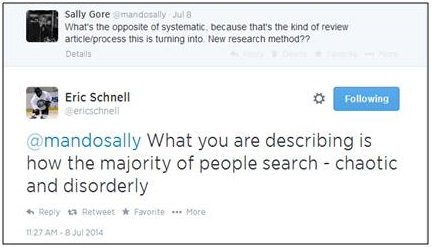
Earlier this week, I tweeted that I was taking suggestions for what to rename the systematic review that I’ve been working on with my team, for it is anything but systematic. A’lynn Ettien, a local colleague, tweeted back the great new name, “Freeform Review.” I loved that. Another colleague, Stephanie Schulte, at the Ohio State University, offered up a really helpful link to a paper on the typology of reviews. But it was what my colleague, Eric Schnell, also at OSU, tweeted that led me to this blog post:

Schnell

BINGO! Every person on my team knows what the “rules” are, but they keep changing them as we go along. I spend time developing tools to help this process go more smoothly, but still get a bunch of notes emailed to me instead of a completed form. I give weeks to developing a detailed table of all of the elements we’ve agreed to look at. Except this one. Oh, and this. Oh, and should we also talk about this? I put my head down on the table.

But Eric is exactly right. This is how most people deal with information. This is how we work. And it’s not a matter at all of people not knowing something, but rather it’s a problem of people not doing something. Or better put, not doing something differently. Sometimes people do lack knowledge. Many times, people lack skills – something that a lot of practice can fix. But an awful lot of time, what we really need to address are the gaps that have nothing to do with knowing what or how to do something.

Why won’t my people use the forms I’ve created and the tables that I’ve prepared? They said that they liked them. They said they were what they wanted. So… what’s the problem? I think it’s something that each of us who works in this field of information wrangling needs to become proficient at, i.e. learning to see and address all of the gaps that exist. At least the ones we can.

And I, for one, am still learning. 


Interesting People Want to Know

15 May

Sally and AmyA couple of weeks ago, the phone rang in my cubicle. It was an outside call and I didn’t recognize the number, but when I picked up the receiver to “Hey, Sally!”, the voice was quite familiar. I hear it most often on the radio, usually telling funny stories or making wise cracks at the weekly news stories on NPR’s “Wait Wait… Don’t Tell Me.” It was the syndicated advice columnist, author, and humorist, Amy Dickinson on the other end of the line. She had sent me a note a day or so earlier, asking if she could call me and ask me some questions about librarians. Yes. That’s right. The advice columnist asked me if she could ask me for advice. I’d be lying if I didn’t say that it was a darned thrilling moment. I love Amy’s columns, her bits on the “Wait Wait” panel, and her social media presence on Twitter and Facebook. I loved her memoir about a small town and strong women. And when I had the chance to meet her in person last summer, I found that she was as lovely in person as in the media. Funny. Engaging. Downright nice. The kind of person that you like to say that you know. At least I do. And now, here was Amy asking me questions while I sat at my desk in the library. “Don’t blow it,” I thought to myself, “This is the closest you’re ever gonna get to being Kee Malesky.”

It turned out that Amy had been invited to speak at a conference of librarians in Detroit and upon hearing that many in the audience would be academic librarians, not the public librarians a popular author might be more comfortable with, she called me for some background info, some of my thoughts and opinions on how technology was changing libraries, changing reading habits, changing everything related to information. While we were chatting, Amy told me a story about how she was once sitting on an airplane next to a librarian and found it kind of odd that the librarian didn’t seem much interested in the fact that Amy was a writer. How could a librarian not be interested in someone who wrote a book? Don’t we all love books? Isn’t that why librarians become librarians?

The truth is that I have plenty of colleagues who cringe at the very suggestion of connecting our work with books. The stereotype is killing the profession, or so they believe. Maybe. And it’s also true that my work has very little to do with books. Most of my colleagues don’t do a lot of work involving books. But still, I don’t particularly mind the connection. I love books. I love writers. I love people who write for a living in any form. I wish I was one of them. If Amy Dickinson sat down next to me on a plane, she’d probably soon wish that she’d never opened her mouth. I’d talk her ear off, I’m sure.

But the librarian > book > author disconnect that Amy experienced wasn’t what bothered me so much about the story. What bothered me more was that it was a story of a librarian not finding another person interesting. Granted, lots of people (myself included) don’t like to talk to strangers on a plane. We like to travel in peace and quiet. We’re generally absorbed in work or a puzzle or… heavens! … a book. I understand this completely. Still, there was something about not being interested that stuck with me.

Last night, I went to an author reading at the Medical School. I wasn’t planning on it, but I walked right through the pre-talk cocktail party as I was leaving work and noticed it was a small crowd. I decided to stick around and support the event and my co-workers who’d worked hard to put it on. I don’t attend these events often and I wonder why, because every one that I’ve been to has been really interesting. They are hosted by the Humanities in Medicine Committee, so they always have a humanitarian theme, or put another way, they focus often on the human side of either being a doctor or being a patient. And they’re always, as I said, interesting. Last night was no different.

I looked around at the many empty chairs and I also took in the demographics of the audience – older and almost entirely male. There were no medical students. There were no younger docs. And it was a shame, because it was a story about the importance of doctors being interested in the people that they care for, in the importance of knowing their patients. Sadly, it didn’t seem a topic of much interest.

When I got home, I told my spouse about the evening and I told her the story that Amy had shared with me about her encounter with the librarian and I asked, “Do you think we’re just not interested in one another anymore? Do you think we’re too overwhelmed with our own lives to care much for what others do? Do you think we’re all too tired? Do you think we’re self-absorbed?”

“Yes. Yes. Yes. And yes.” That was Lynn’s reply.

When I think about the skills that make an informationist successful, one of the most important is curiosity. I didn’t necessarily become a librarian because I love books, but I became a librarian because I LOVE looking stuff up. I find lots of things fascinating. I find what people do to be interesting. Watching the screen saver images of brain scans on a PIs computer, I can’t help but ask, “What’s that?” It’s my nature. And one thing that I’ve learned as I’ve worked with researchers over the years is that, by and large, they really do enjoy telling you about what they do. They like explaining the science. Maybe they don’t have time to give you a primary introduction, but most of them can tell you a pretty good story or two that explains the experiments they’re doing and the questions they’re asking and the problems that they’re trying to solve. 

As I was leaving a meeting with the PI for the new study that I’m working on, I told him that I was really enjoying learning about all of the issues around data citation, DOIs, and things particular to neuroimaging. “It’s a lot of new stuff for me,” I told him. His reply was, “Good. I was afraid it would be boring; just the same old thing that you do all of the time.” He’s an interesting person and it seemed obvious that he knew how awful not doing something interesting can be.

I’m heading to Chicago in the morning for the annual meeting of the Medical Library Association. I’ll be blogging (probably sketchnotes) about the plenary speakers and link those posts to here, so that you can follow along, if you wish. In the meantime, I hope you meet someone interesting today. And that someone meets an interesting you.