Thanks to those who shared their thoughts and comments regarding this topic. It’s clear that we all feel pretty fortunate to have one or two people in our lives who inspire us, who we look to for support, who we admire despite their flaws. In fact, sometimes it’s the fact that they have flaws that make them the most appealing.
So as promised, I’ll reveal my own hero. I’m definitely no different in that I have several people – or parts of different people – that I depend upon for guidance in work, in play, in life in general. However, a few years ago I crossed paths with someone who really did change me in a bunch of ways. I don’t know if she knows this. I’m fairly certain that she didn’t set out to do such. Still, when I trace back over the time since we met, something shifted in my perspective and thinking and level of creativity that day.
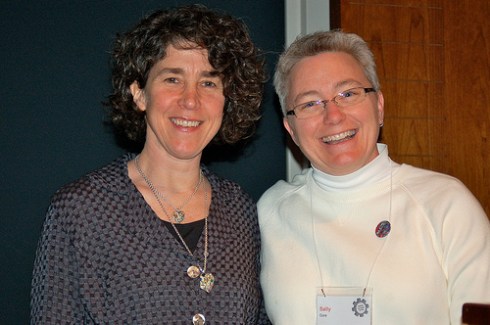
Suzy and me. (Thanks to Brandy King for taking this picture at the MAHSLIN Annual Meeting a couple years back.)
My friend, Suzy Becker, is a self-described authorstrator – an author, illustrator, cartoonist, humorist, teacher, mentor, speaker, entrepreneur, all-around creative soul AND a pretty darned good person in general. I met Suzy after my spouse, Lynn, sat next to her at an open house for upcoming classes at the Worcester Art Museum (they were both teaching that term), came home, gave me Suzy’s business card, and said, “I think you should take her class. I think that you’re from the same tree.” As it turned out, Lynn and I both took Suzy’s class that fall. It was a day-long workshop on writing/drawing your illustrated memoir. I loved it. That was November 2010 and I literally have not stopped drawing pictures, thinking about creativity, and seeing how all of those things fit into my work (and life) since. I was already a writer, so I’m not giving Suzy credit for that, but she did inspire me to write more and to write differently. In a good way.
There’s something else that happened when we met, though, that has also played an integral part in how I approach work (and again, life). Suzy was/is, by far, the most accomplished person that I have ever known. In particular, she’s the most accomplished person my age that I’ve ever known. That’s different than being one who has achieved a lot. She’s done both, but I’ve known plenty of achievers and it’s not the same as being accomplished. For me, achievers follow a certain trajectory. Accomplished people complete and/or fulfill certain aspects of their lives, whether or not they set out to do such. Perhaps it’s merely semantics, but for me the subtlety is significant. For me, accomplished people make the most out of situations. They may well set personal goals for themselves, but they truly embody the idea that the journey is as important as the destination.
To me, Suzy Becker is an incredibly accomplished person and taking Daniel Coyle’s advice, I stare at her to see who I want to become. I also take Jessica Hagy’s advice, admiring the real and imperfect, and noting what Suzy does well and what she doesn’t do well. And I learn from it. As I said to a group of librarians at the University of Rochester’s medical library during a workshop I led back in January, “Whenever I start to think that I’m really good at something, I look at Suzy. It keeps me humble, because never in a million years will I be accomplished like that.”
But you know, you never get any better at anything if you always look to those you’ve already surpassed. You don’t run faster by always picking races where you’re a lot faster than anyone else. You don’t get better at playing the mandolin if you stay in the beginner’s class. Heck, you don’t even get better at answering questions, teaching classes, giving presentations, or any of the many things we do in our work unless you challenge yourself to do so. And sometimes the best place to find that challenge is in another person.
The other interesting thing that happened when I met the accomplished Suzy Becker is that I realized a really accomplished person is a pretty regular human being. She knows and/or has met a lot of people that I admire tremendously. She moves and operates in a different world than I do, yet it’s just a regular world, too. Now what this realization did for me, you might find kind of odd, but it gave me an incredible amount of confidence to contact other accomplished people (as well as a bunch of over-achievers, people that you really need to know in our work). I met Rosanne Cash and Alison Brown. I shook the shaker egg onstage with Ruth Moody. I tweet regularly with Amy Dickinson. And I’ve found a place in the departments and projects of researchers that I admire and enjoy working with.
Knowing a really accomplished person also gave me confidence to accomplish my own dreams. I joined a band. I have a piece of sculpture in an art show that opens this Saturday. I’m standing up on the big stage at the Hynes Convention Center on Sunday morning and giving a grand “howdy do!” to everyone attending the international One Health conference. I write this blog every week and a bunch of people read it. I’m taking a class on how to be a rockstar scribe.
And none of it is much about achieving anything. Not a bit of it matters much on an annual review. It’s more about making work and life something that’s fulfilling. For me. And the funny thing that I’ve noticed is that when my life came to be about fulfilling more than achieving, a lot of other people that I know (and don’t know) have enjoyed it, too. And that’s been perhaps the best part.
So big thanks to Suzy for allowing me to stare at her – whether she knew it or not. (And I sure hope she’ll still answer my email!) And check out her books. You’ll enjoy them. I guarantee.
Tags: accomplishment, achievement, hero, Mentoring, Suzy Becker
 A Librarian by Any Other Name