Archive | Bits and Pieces RSS feed for this section

Pre-Drone Deliveries

4 Dec

I saw my first “Best Of” list for 2013 today. It was from this past Sunday’s New York Times Sunday Book Review, the 100 Notable Books of 2013. It goes without saying that there are plenty of books and authors worth checking out on this list. A few I’ve read: Andre Dubus III’s, Dirty Love and Jamie Quatro’s, I Want to Show You More (I saw these two together on a panel at this year’s Boston Book Festival), and Megan Marshall’s wonderful biography, Margaret Fuller: A New American Life. Several also appear on my “to read” list: Five Days at Memorial, by Sheri Fink and The Goldfinch, by Donna Tartt, to name a couple.

Over the past year, I’ve mentioned a number of books that I like and find useful for my work. Since it’s that time of year (and because the blog post that I started to write for this week was depressing me), I thought I’d list a few favorites that I read in 2013, that currently reside on my Kindle, and that I’ve not noted previously. They weren’t all published in 2013, but they landed on my virtual bookshelf within the past twelve months, thankfully before the start-up of drone delivery.

innovation generationInnovation Generation: How to Produce Creative & Useful Ideas,

by Roberta Ness

Roberta Ness, MD, MPH, is the Dean of the University of Texas School of Public Health. This book is based upon the course, “Innovative Thinking”, that she teaches at the School. It gives practical examples and a host of exercises that the reader can do to develop his/her own habits for thinking more creatively, whether you’re a scientist or not. (Published: 2012)
The Science of Serendipity

The Science of Serendipity: How to Unlock the Promise of Innovation,

by Matt Kingdon

I often think how one of the things we’ve lost in moving scholarship to the desktop article level is the random act of finding relationships between unrelated things, aka serendipity. When an article was physically bound next to others, your chances of seeing something besides the one thing you were looking for were greatly enhanced. Strolling the stacks led you to also notice the other journals and/or books nearby, each filled with ideas that could unlock a whole new train of thought. Kingdon’s book is written for the business world, but I found it highly insightful for learning about how ideas and products are often born out of seemingly random connections. The key to success, he argues, is learning how to see these connections and then move them to the level where things happen. (Published: 2012)

100 Things

100 Things Every Presenter Needs to Know about People

by Susan Weinshenk

If you read my blog with any regularity, you know that I write a lot about how to design and deliver presentations. This book adds to that topic, but also brings in some science about how people listen and take in information. We know that the best presenters are those who can give their audience what it wants. This book gives some tips (100 of them) on how to become better at doing just that. (Published: 2012)

reinventing discovery

Reinventing Discovery: The New Era of Networked Science

by Michael Nielsen

Librarians talk a lot about our possible role(s) in eScience as it relates to data. For me, though, the more interesting place to work is in the other side of eScience, i.e. networks. Nielsen’s book is a fascinating read into how science happens today via vast networks of people and talent and interests, all connected by the internet (and subsequent techie tools that harness its power). Read this book along with David Weinberger’s, Too Big to Know, and you’ll likely never think about knowledge and discovery in quite the same way again. (I also recommend wearing headgear while reading them. The ideas can make your head explode.)  (Published: 2011)
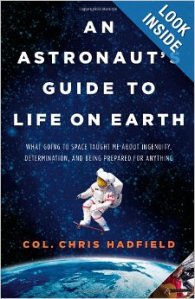
An Astronaut's Guide to Life on Earth

An Astronaut’s Guide to Life on Earth: What Going to Space Taught Me About Ingenuity, Determination, and Being Prepared for Anything

by Colonel Chris Hadfield

Canada’s best known and likely best loved astronaut offers up a memoir filled with lots of lessons for all of us stuck on Earth. This book just came out in late October. I downloaded it and read it over a weekend on my couch. It’s a virtual page turner. If you love space (I sure do!) or just a great story about someone doggedly reaching his goals (imagine wanting to be an astronaut when your country doesn’t even have such things), give this one a go. You’ll enjoy it. Follow @Cmdr_Hadfield on Twitter, too. Great stuff!

Now it’s your turn. Share some of your favorites from the past year. One can never have a “to read” list that’s too long.
Sustainability: It Means More than “Tit for Tat”

19 Nov

Two innovative and inspired doctoral students at my University saw a problem and decided to do something about it. There is too often a disconnect between scientists and the public. The public struggles to understand what scientists are doing and unfortunately relies too often upon unreliable and unfounded sources for explanations. Scientists, for their part, do a fairly poor job of communicating what they do in a manner that makes sense to the average person on the street. To help address this gap here in our community of Worcester, these students secured sponsorship from NOVA and last summer started Science Cafe Woo. Their tagline? “Come listen to what scientists do while having a fun evening too!”

For the past several months, I have taken in the fun, sitting in the booths at the Nu Cafe in Worcester and listening to scientists from our local universities tell fascinating tales of how they spend their days. It is a wonderful opportunity for the community to gather in a non-academic setting, a non-research environment, to listen to, ask questions of, discuss with, and even debate people who often do work on the community’s dime (lots of government-funded research happens in our community). At the same time, the scientists get the chance to share their work with the community; to take on the challenge of explaining it in a way that non-scientists will get. It’s truly a win-win. AND it’s incredibly popular. I’ve arrived on more than one night to find it standing room only. For me, the entire experience – from the students’ initiative to start the Cafe, to the researchers’ willingness to talk, to the community’s positive response – has been a joy to observe and take part in.

This month, the featured speaker was Dr. John Baker, Associate Research Professor in Biology at Clark University. Dr. Baker teaches in the Environmental Science major at Clark, a nationally-recognized program that produces graduates who are “working is such wide range of areas as environmental regulations of pollution, water and wetlands conservation, clean technology, hazardous waste cleanup, public health protection, environmental planning, field and laboratory studies of endangered species and conservation planning.” (program website) His talk was called, “Ecology, Evolution, and the Most Misunderstood Word in the World.” The word? Sustainable 

This file is in the public domain because it was solely created by NASA. NASA copyright policy states that "NASA material is not protected by copyright unless noted".

This file is in the public domain because it was solely created by NASA. NASA copyright policy states that “NASA material is not protected by copyright unless noted”.

Sustainable forestry. Sustainable design. Sustainable agriculture. Sustainable energy. The word appears in many places and many contexts, and is generally accepted as the behavior where you consciously replace what you use as you use it, so that whatever it is that you’ve used can continue. Cut down a tree, plant a tree. Even Steven. Tit for tat. Except, according to Dr. Baker’s argument (and a pretty darned persuasive one, in my opinion), such behavior is not sustainable. It is not “sustainability” as sustainability is defined. 

One example that he provided made his point clear to me; when you cut down a tree in a forest, you take much more than the mere carbon-offset that it provided. Replace the tree with another and yes, you replace its role here, but what you don’t – what you can’t – replace are all of the other disturbances that occur in the ecosystem by removing that tree. Dr. Baker explained that when a tree naturally dies, it falls to the ground where, over time, it decays and is reabsorbed into the soil, giving to the soil the nutrients it requires to really keep the forest sustainable. Disturbing the ecosystem of the forest is what cutting trees does. It changes the system entirely. Maybe we won’t see these changes for tens of thousands of millions of years, but to suggest that our practice of replacing trees is really a practice of sustainability, Dr. Baker argued, is false. 

“I’m not a fatalist, I’m a realist,” he said. It may well be a hopeless endeavor that we’re attempting, this whole “save the planet” venture, but the professor’s point – the one that I took from his lecture, anyway – was that we don’t do ourselves any good by lying to ourselves through talk and behavior(s) that claim we’re doing something that we are really not doing at all.

In my experience as an embedded librarian, I hear a lot of talk and questions regarding the sustainability of this kind of work. I couldn’t help but think about this tonight as I took in what Dr. Baker was saying. I wonder if the role is being seen akin to a tree in our library forests – send us out and replace us with another librarian in the library. Even Steven. Give us one new job, take away one we used to do. Tit for tat. But just like the trees and the forest described above, is this really addressing the issue of sustainability? Other staff may well provide the librarian equivalent of carbon-offsets (on paper), but in the ecology of the library, is that all that needs to be replaced? I find the questions fascinating. I’m not sure if the forest metaphor applies to the library, but I do think that thinking of the bigger system – the ecology of the library – is a worthwhile pursuit. It may yield some insight and answers for us as we try to move forward in this arena.

Similarly, it’s interesting to think about this in the context of how the librarian and libraries have been replaced in our educational and healthcare systems, overall. What have we been replaced with? Open databases, journal articles at the desktop, Google (I’m positive that someone is thinking “Google”) and gadgets. Is it an even swap? Does the overarching goal of solid biomedical research and safe healthcare practice suffer in these trades or do they disturb something bigger in the evolution and ecology of our “environment”? What do you think? Can we make a stronger argument for our value when we think of the bigger picture? I’d love to hear what others have to say. I hope you’ll comment below.

Knowledge: It Knows No Bounds

31 Oct

Freshly back from the annual meeting of NAHSL, frantically meeting deadlines before trekking off to APHA this weekend, I wanted to at least share a little bit from the former on my blog this week. It was a terrific meeting, complete with thoughtful, thought-provoking, and engaging speakers, wonderful food and entertainment with friends and colleagues, and the not-to-be-outdone location of Falmouth, MA, right on the water. One great benefit of our region is we’ll never run out of lovely spots to hold our meetings!

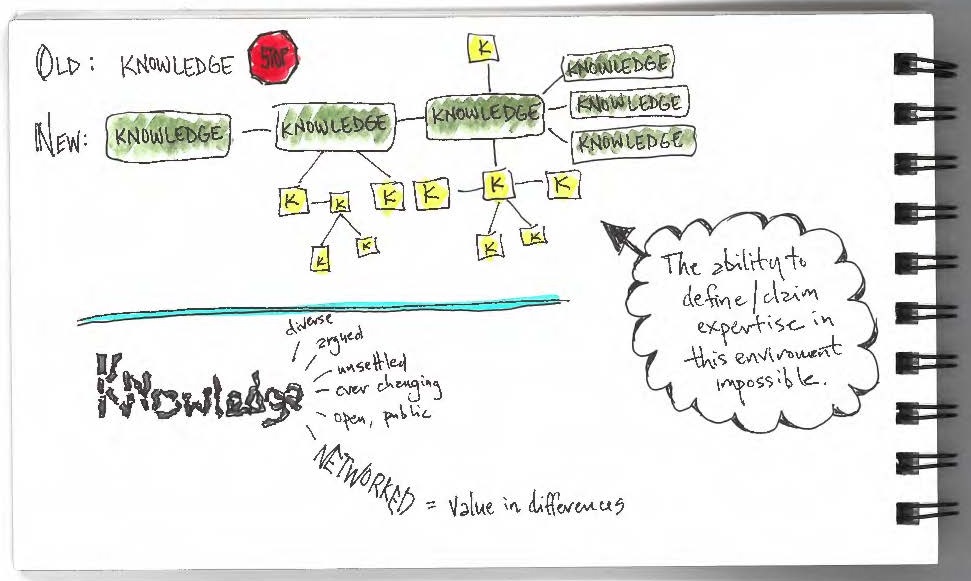
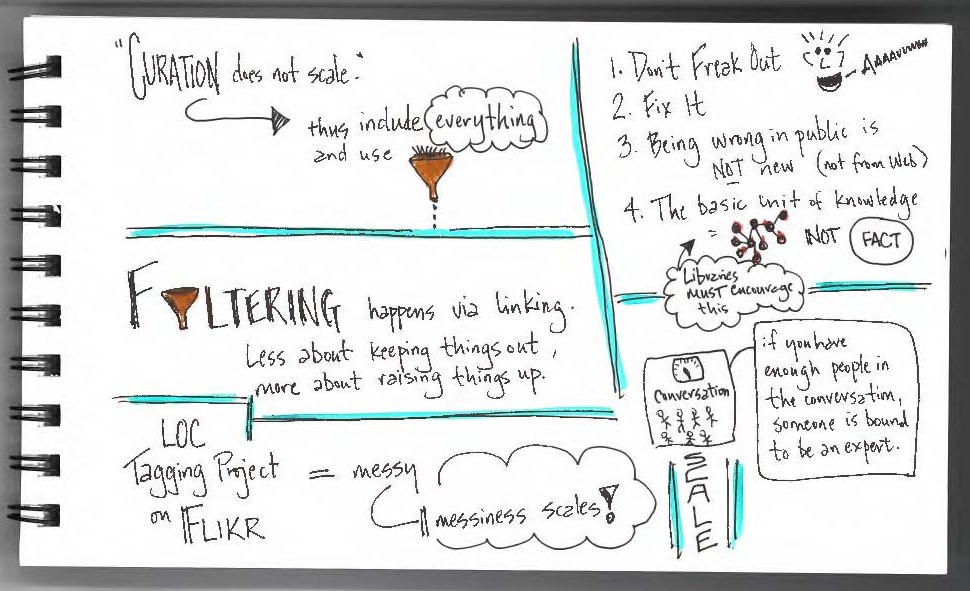
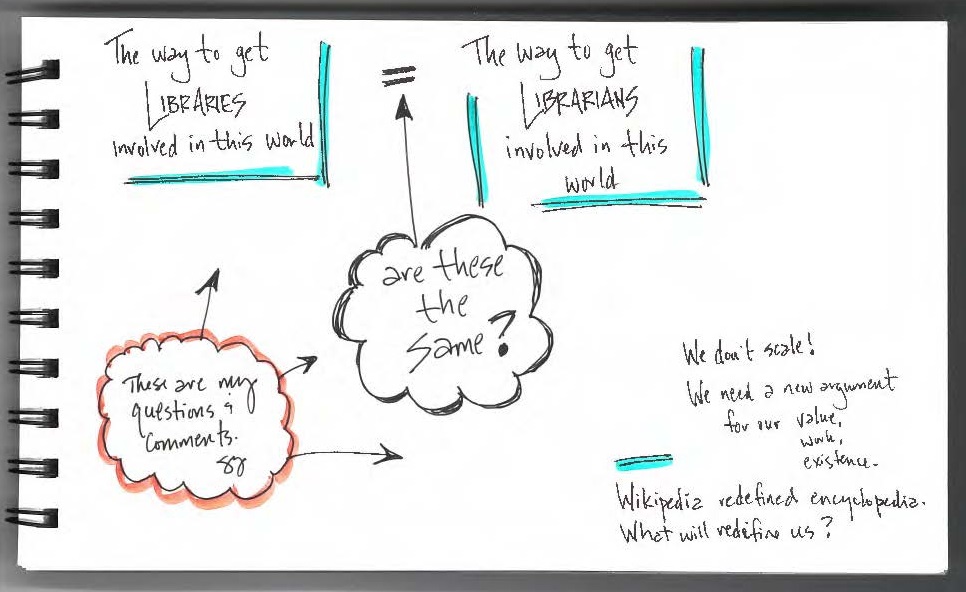
Too Big to Know As has become my practice, I did some sketchnoting during the conference. Since I wrote an earlier post mentioning his book, I thought I’d share my notes from David Weinberger’s Plenary Talk here. Entitled, “Library as Platform?” it took much of the content of “Too Big to Know” and put it into the context of the role of libraries (and librarians) at this time. “Too Big” was one of my favorite books from last year. I really enjoyed getting to hear the author share the thoughts and ideas in person, and as you can see by my notes, it left me with several of my own:

Weinberger_Page_1 Weinberger_Page_2 Weinberger_Page_3 Weinberger_Page_4 Weinberger_Page_5