Archive | Bits and Pieces RSS feed for this section

Librarians in Cars Driving Places

29 Mar

Have you ever watched the web series, Comedians in Cars Getting Coffee? It’s a funny show created by the very funny comedian, Jerry Seinfeld. Much like his classic television show, it’s kind of about nothing – just Jerry and some talented and funny comedians riding around in vintage cars, having coffee, and talking about whatever. I like it.

I also like The Late Late Show’s host, James Corden’s, carpool karaoke bits where he picks up famous folks and they ride around singing to songs on the radio. (My all-time favorite is the one with the Red Hot Chili Peppers. Honestly … LAUGH OUT LOUD funny! I had to watch it again while writing this. Excuse the snickers.) 

And then there’s the sportswriter, Tony Kornheiser’s daily podcast, This Show Stinks. I started listening to it early this year during my afternoon walks. For many years, Kornheiser wrote a column in the Washington Post. Whenever it was about the Washington Redskins, my grandmother clipped it out and sent it to me. I’ve been a fan ever since. I love the podcast because it centers on discussions around sports, politics, culture, odd news stories. A regular, rotating crew of columnists, politicos, sports people, movie critics, and more join in for what’s always an entertaining hour or so. 

I think the common thread of interest for me is that each of these venues allows me to be something of a voyeur, a fly on the wall of the room (or car) with people I wouldn’t mind hanging out with. They’re always smart and funny and they create these shows that allow me to feel like I’m part of the group. Even when I’m clearly not. Not in that league. Not by a long shot.
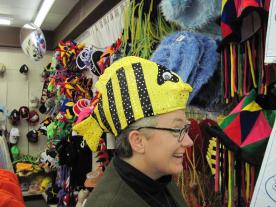
ozarkland

Fish hat. Ozarkland. Yes!!

I was thinking about Comedians in Cars this morning while walking my dog. I got to thinking about a few times when I’ve been riding in cars with other librarians and how those drives turned out to be as interesting and fun as any of these shows or podcasts. I remembered the time that Kristi Holmes, Director of the Galter Health Sciences Library at Northwestern University, and I rode all the way across Missouri together. At the time, Kristi was working at the Becker Medical Library at Washington University in St. Louis. We were both attending a conference in Kansas City, so I flew into St. Louis, Kristi picked me up at the airport, and we drove across the state together. On the way to Kansas City, we stopped off at the fantastically awesome, Ozarkland, and laughed ourselves silly at all of the kitchy souvenirs. On the way back, we stopped off at a for-real western wear store where I bought my very first pair of boots. Kristi grew up on a ranch. She was the perfect guide for this shopping adventure. And in between, we talked and talked. And we became friends.

Another time, early in my stint at the Lamar Soutter Library, I was invited to give a talk at  Cape Cod Community College. Donna Berryman, Senior Associate Director at the Edward G. Miner Library, University of Rochester, was the Outreach Coordinator for the New England Regional Medical Library (NN/LM, NER) at the time, thus we were co-workers. Donna also had to attend this event at CCCC, so we rode along together. We talked about libraries, librarianship, books, movies, our lives, our families, where we were from, how we grew up… in other words, in those hours in her car, we also became friends. Life-long friends.

I guess that I was thinking about these experiences this morning because I recently engaged in an online discussion about the importance of professional organizations. They’re dwindling, in case you were unaware. Membership is down at every level – national organizations, regional organizations, state and local organizations – and for a variety of reasons. If you, like me, have long been involved in a professional organization, particularly in leadership roles, you’ve likely felt the pressure that comes with trying to maintain an organization with fewer and fewer resources, as well as struggling with the emotional feeling of “we’re failing.” 

But we’re not failing. We’re changing, but not failing. The trick is to get in front of (or ride) the change in such a way as to prevent failure, i.e. change in ways to remain relevant, important, worth the investment of people’s scarce time and money. That’s the challenge.

My adventures riding in cars with librarians strikes at the heart of what professional networks and professional organizations are all about – relationships. Though I don’t work in a medical or health sciences library anymore, I maintain the professional relationships that I developed through car rides, meetings, shared office space, virtual spaces, and social media because they are invaluable. They provide every opportunity for support, professional growth, sounding boards, collegial spirit, and yes … friendship.

I think it’s really difficult to translate to anyone new to a profession (or even one who’s been at it awhile and sees the retirement door ahead) the value of the relationships that come from sharing a profession – from sharing rides in cars, both literally and figuratively. But I believe maybe it’s something that those of us invested in organizations need to work on, if we want to hang around awhile longer. Going it alone is hard and it’s also not the best thing for the overall health of a profession. People together makes a profession.

Like that Dam in California… Overflow!

14 Feb

oroville_dam_spillover_2017-02-11Not to make light of the scary news out of California this week regarding the eroding of Oroville Dam, but some of the images did make me think of my overflowing bookmark list of things to share with with my readers. So many! So here goes:

There’s much about Fake News in the real news lately, including the role that librarians can play (see the PBS NewsHour story, Why These Librarians are Protesting Trump’s Executive Orders, by Elizabeth Flock) and can’t play (see Information Literacy Won’t Save Us; or, Fight Fascism, Don’t Create a LibGuide, by IJClark) when it comes to media literacy. I find there to be interesting and credible arguments on both sides, but more than anything, I’m heartened by the rekindled notion of the importance of our profession in the discussion.

Somewhat related is Mattie Quinn’s story for the website, Governing; For the Poorest and Sickest, Librarians Often Play Doctor. As a medical librarian, I found this story of particular interest.

A few useful resources:

  • Think Outside The Slide has a nice list of free resources to make PowerPoint presentations more effective. 
  • MapBox provides a platform for adding maps to your mobile apps. While it’s a paid service, there is a level available for free that you can try.
  • Back in October, I attended a terrific workshop on bibliometrics and research assessment, co-hosted by the NIH Library and the Maryland Chapter of the Special Libraries Association. The materials are now available online. You’ll find a couple of really good keynote talks, plus a whole bunch of interesting posters by colleagues in the field. Great stuff!
  • ProPublica the independent, nonprofit, investigative journalism outfit has created a number of applets using IFTTT, that work with different media tools (Evernote, Pocket, mail, calendars, etc.) to keep you up-to-date on different aspects of U.S. politics, including when the President signs a new law, when Congress schedules a vote, and a weekly/daily Congressional digest. These are great for staying informed and, if one is so inclined, for activism.
  •  The International Consortium for Health Outcomes Measurement (ICHOM) is a non-profit organization devoted to bettering health care systems worldwide by “measuring and reporting patient outcomes in a standardized way.” On their website, you can find a lengthy, growing list of Standard Sets for a variety of medical conditions, along with literature on how to read, interpret and use the findings.
  • Finally, WordCounter.net needs no explanation. It’s a handy online tool. 

I really enjoy following the website, StatNews. I find it to be a thoughtful, credible source for current news on health and medicine. If you’ve yet to discover Stat, here are a couple of stories that I recently read to introduce you to their work:

Another interesting health care-related story is Martha Bebinger’s story (WBUR), What if We Really Knew Where to Get the Best Cancer Care: The Prostate as Case Study. It gets one to thinking about what we know, what we don’t know, what we can know, and what we might not want to know when it comes to health data and medical treatments. 

If you’re fascinated with space and all things astronaut related, as I am, you likely know about the really cool “Twin Study” that’s been ongoing at NASA using the identical twins, Mark and Scott Kelly, as subjects to study the longterm effects of space travel – findings that also inform down-to-earth subjects like aging, muscle growth, and other aspects related to gene expression. The first findings were published on the NASA website in late January and they contained both some expected and unexpected results.

And finally, if you missed the best story of 2017 so far, I share it with you here now:

Four-year-old Daliyah Marie Arana’s being “Librarian for the Day” for the Library of Congress.

As I said, best story of the year so far. 

New Year, New You (Me)

11 Jan

Happy New Year, everyone! I hope you enjoyed the holiday season and that 2017 will be good to you. I always enjoy a new year. It’s like a clean slate, an open field, the first day of school. And I don’t so much make resolutions as I make lists. I make lists in my new planner. (This year, I’m trying out a nice model from Baron Fig.) I list things that I might want to do, songs that I want to learn, books that I want to read, concerts that I want to attend, movies that I want to see, etc. I add to the lists throughout the year, but it’s not quite the same as starting them up on a blank page in a new calendar at the beginning of a new year. It screams, “Possibilities!”

My list-making this year also reminds me of how unsettled I feel right now. The political climate is unsettling, for sure, and there seems so much uncertainty and fear throughout the world. These things don’t particularly help me address my own anxiety, but they’re also not the only thing contributing to it. This I know. I just feel I’m ready for something new, something different, some kind of change. I think I’m ready for a new me. 

For a good while, I was finding myself frustrated with me because I kept thinking/believing that I’m not the person that I once was and I liked the person that I once was. I kept thinking/believing that if I could just go back to be my “old self,” I’d feel great – happy, fulfilled, energized. But then I started reading this book:

miller

It was recommended to me by a young woman who used to tend bar at a neighborhood pub that I frequent. It’s a young person’s bar and I’m not a young person, but I like to pop in on my way home from work once a week or so, often on Thursdays when my wife goes to yoga, and I have a pint and I read. Young people don’t go to bars until later at night, so it’s generally quiet when I’m there, conducive to reading and/or watching whatever sports show is on. 

Anyway, Taylor, the bartender, evidently noticed my habit and found it interesting. She was there last Thursday with some friends and came over to me to say “hi” and ask what I was reading. (I was reading another great book, The Lonely City.) We talked about the holidays and the new year, and somewhere along the way I must have hinted about my unsettledness. In response, she recommended Donald Miller’s book. She said she just knew that I’d like it. She said that she was re-reading it herself right now. I told her I’d get it, read it, and we could have a book club-type chat the next time we saw each other. She liked that. The bartender working last Thursday, Nate, liked the idea, too. Maybe we’ll get a book club going – early in the evening, of course, before the young people (besides these two) show up.

I’m about half-way through at the moment and so I’ll not offer up a review of “Thousand Years” just yet, but I will tell you this much – and I’ll tell you why I know Taylor told me that I’d like it. It’s a memoir – kind of, sort of – that tells the story of how the author learned to write a screenplay and in doing so, discovered it was the perfect metaphor for writing one’s life. If you want to live a good story, you have to write it. Said another way, if you’re not living the story that you want to be living, you need to write yourself a better one. The book follows along in such a way that as the author learns about how a story is structured (character construction, story arc, inciting incident, etc.), he starts writing not only the screenplay, but a whole new life story for himself. And then the reader is inspired to do the same. And I am. It’s inspiring! 

It makes sense that Taylor recommended the book, because what I was saying to her about liking the person that I once was, but maybe not so much the one that I am now, and wanting to go back to that “old me” – well I’m reminded in reading this book that we don’t ever go backwards. We only go forwards. It’s the only direction that we can go. And I also realized that the person back there in my past that I like, that person was always going forward. That me was always moving, changing, growing. That’s what I like about that me. I’ve been in a rut too long. That’s what I don’t like. That’s what’s unsettling. Change isn’t unsettling. Stagnation is.

It’s time to write some change back into my life.

Earlier during this lunch break, I read (in the chapter about inciting incident), “Without an inciting incident that disrupts their comfort, they (humans) won’t enter into a story.  … The character has to jump into the story, into the discomfort and the fear, otherwise the story will never happen.” (p. 104-105)

I think of how often people are afraid to write in a new journal or notebook, for fear of messing it up. And I always think, “How silly! What else is a journal for?” Donald Miller’s book has me thinking, “What else is life for, if not for writing a good story to live.” 

So I’ve added to my New Year’s lists the line, “Write yourself a better story.” We’ll see what happens!

What’s on your list for 2017? How will your story go? I hope you’ll share along the way.

Soundtrack for writing your story, courtesy of Catie Curtis. It’s been playing steadily during my morning commutes: