The Pursuit of Happiness

14 Nov

I am in the midst of reading a book by this guy:

Shawn Achor, Good Think, Inc.

I’m reading his book, The Happiness Advantage, because I was so intrigued by his TED Talk (above) when I watched it over the weekend, that I almost immediately used one of my credits at Audible.com to purchase it. So yes, okay, this means that I’m not really reading the book, I’m listening to it. However, I was so taken by listening to it, that I’m picking up a copy of it today from my local bookstore. I need to take notes. I need to write in the margins. I need margins.

I’ve read a good bit about positive psychology over the years. I’ve read the works of Martin Seligman and Carol Dweck and Mihaly Csikszentmihalyi, among others. I’ve also read Norman Vincent Peale, though admittedly, he’s in a different camp altogether. Sort of. The power of our minds is fascinating to me. I’m always asking or wondering why some people succeed at things while others fail, why some people see possibilities where others see roadblocks, why do some see the glass half full, the sky as the limit, and life as a journey, never a destination? Are we simply born with certain propensities towards certain mindsets, or is it possible to learn how to see the world in a way that helps us focus on the possibilities, the journeys, or the sky?

We had a terrific meeting of informationists here last week. All eight NIH-funded projects were represented. Each person had the chance to share about her (yes, all women) project. It was fascinating to hear everyone talk about the research teams of which they’re a part. It was fascinating not only because of the science, but because the many different things we see that people are doing in this role. We spent Thursday morning, as a group, discussing our projects and tasks, seeking to identify those common to all of us; trying to determine the list of services that might emerge from the informationist role so that a library with such a staff member could say, “We can do this… this… this… ” when speaking to researchers.

So, you may be wondering, what are these things (and what in the world do they have to do with happiness). While there is certainly a lot of variety, it does seem like everyone is providing some of the same things to their research teams:

  • Literature searching and creating tools to aid in searching
  • Bibliographic management
  • Knowledge management
  • Training in information literacy, including improving searching skills

Looks like a pretty standard list of library services, doesn’t it? I wonder if this is because for most researchers approached by a library with the request to embed an informationist into their research team, their initial thought was/is, “library – librarian – librarian skills”. And that’s okay with me. These ARE areas of expertise for me and for others in my profession. It’s what we know.

The NIH-funded supplements are different, however, in that they also required recipients to provide some service, skill and/or expertise in the area of data and here, we seemed to diverge. While they all fall under a big umbrella of “data management,” what this means is… well, you decide:

  • Creating or documenting workflow to organize and manage research data
  • Constructing and/or providing metadata
  • Creating a controlled vocabulary
  • Creating a data dictionary
  • Addressing data privacy and security issues
  • Advising on repositories and other data storage/archiving tools
  • Recommending data preservation and sharing strategies
  • Abstracting data from the literature
  • Recommending strategies for capturing, storing and accessing  data
  • Evaluating, refining and recommending data entry and querying tools

While these tasks involve, for most everyone, some learning curve, the fact that they also differ so greatly struck me as a pretty clear sign that we are making our way into pretty new territory. When librarians go to researchers and say that we can help them with their data, the discussions that evolve around what that help looks like seem to be across the board. What this means for the future, i.e. for our ability to definitively say that an informationist does “X, Y, and Z,” remains to be seen. The services may well be individualized – unique to the library and/or librarian filling the role. They may well be dependent upon what needs the researchers have and whether or not those needs fit with the skills of the library staff at the time.

I imagine that there was a time, once upon a time, when librarians first learned how to do reference. There was a time when library school curricula had to be developed to teach librarians the art of the reference interview, the nuances and peculiarities of all of the reference sources available, how to deliver answers in a concise manner, how to teach patrons to search for themselves. The skills that librarians needed had to be identified and then taught to a workforce. I imagine that this is where we are now, in the world of “informationisting”. We’re not really clear, yet, just what this role entails, at least not entirely. We’re not yet sure how it will fit within the traditional structure of the library. The jury has really just left the courtroom and I’m thinking that the deliberations might take awhile.

And so now you REALLY might be wondering what the heck any of this has to do with happiness. Well, if you haven’t yet watched Achor’s talk, do so now. But if you just can’t be troubled at the moment, let me try to summarize…

People spend an awful lot of time pursuing success, believing that when they achieve success, they will find happiness. Achor’s “happiness advantage” states that this idea, however, is backwards. He posits that we find success easier, faster, and better when we start out happy. Being happy, he claims (and cites a great deal of research to support his theory), makes people think clearer, be more creative, be better at problem solving, and a whole host of other attributes that lead us to success. Negativity, neutrality and fixed thinking (see Carol Dweck’s work) lead people to … well, to the same old place they’ve always been. Maybe that’s okay in a whole lot of situations, but for a profession seeking to deal with the constant barrage of change, it’s not going to prove very useful. Indeed, it may well prove to be librarianship’s biggest downfall.

Someone made a comment after last Thursday’s follow-up meeting that the room was filled with very confident people. Studies in entrepreneurship show that confidence, more than any other attribute, is the best determinant of success for people seeking to start their own businesses or ventures. In many ways, that’s exactly what this adventure in embedded librarianship is seeking to do, i.e. to create new businesses, new models of service, new ventures for librarians. We need confident people in these roles. Not delusional people, mind you, but confident ones. Confident, positive and yes, happy, people.

Gotta go pick up my copy now!

Don’t Forget to Change Your Clock

5 Nov

It seems appropriate that I spent part of Saturday, the day that we set our clocks back an hour and returned to standard time (goodbye, sun! <sniff>), at the Worcester Public Library, picking out some books on time management. I think it’s a pretty lame idea, time management, and most writing on it is shallow and trite, however I did come across one that resonated with me. Laura Vanderkam’s, 168 Hours: You Have More Time Than You Think, is, so far, terrific. What I like about it is Vanderkam’s premise that we have a tendency to think we’re a lot busier than we really are. If you know me or have read some of my other blog posts (both here and on my home blog), you’re aware of the fact that I find the “I’m so busy” and “I’m too busy” and “I just have SO MUCH to do” laments of this day and age overused.

The badge of honor busy-ness is worn out on me, mostly because I just can’t believe that I’m the only person in the world who, most of the time, isn’t busy. At least I don’t feel that way. Busy, that is. I have a full life and enjoy pretty much all of it. Like most folks, I have places to be and things to do and deadlines to meet (sometime several at one time), but I rarely say that I’m “busy”. Granted, that’s a conscious act. I stopped using the word awhile back when it was used, one time too many, by a friend as an excuse not to have lunch. I thought to myself, “Why don’t people just come right out and say that they have something else that they’d rather do?”

Thus, I was overjoyed when I found a like-minded spirit within the first few pages of 168 Hours. Just as I suggest to individuals trying to lose weight and become more active to keep a diet and exercise journal, Vanderkam suggests tracking your time to really see where and how you’re spending it. I’m a BIG fan of tracking. It’s proven the most effective way to lose weight (and maintain weight loss) that we have. Diet recall isn’t all that great. The same holds true for time. What we think we ate and how we think we spent our time are often vastly different than the truth. Tracking helps us see the real picture.

As Vanderkam points out, we have 168 hours each week. That’s a lot of hours to fill. Am I really using them all? I started tracking today, so I’ll let you know what I find out in just a couple of weeks. If you want to join me, you can download free pdfs of Vanderkam’s time-keeping spreadsheets by signing up for her newsletter, and you can find her book at your local library or bookstore.

The other book that I borrowed is called Building & Running a Successful Research Business, by Mary Ellen Bates. Bates is well known in the world of business research and has written extensively on how to become an independent information professional. A lot of this particular book’s content falls outside of my current role as an informationist, but I checked it out so that I could look more closely at the chapters Are You a Potential Independent Info Pro?, Work and the Rest of Your Life (time management, again), and the sections on deliverables and entrepreneurship, in general. These topics  are very much relevant to the work I’m doing and I felt I could learn a tip or two from reading them.

You might have guessed by now that managing my time and tasks as an informationist is the biggest struggle I’ve faced so far. The rest of my job did not go away when I became a part of the research team. I’ve been able to pass off a few things, but mostly I feel like the 10 hours each week that I’m to give to the research study are just 10 more hours added on to my work week. [Note: My decision to track my time is the first step in figuring out (a) if this is a valid feeling, and (b) where my priorities really lie, as depicted by how I spend my time.]

In Bates’ book, I came across a page with a box titled, “What About the Home Front?” (p. 46) Though she’s directing her thoughts here towards independent professionals striking out on their own, I couldn’t help but see the ties between the literal “home front” and the “home front” that is one’s library. As more and more librarians move out of the library, becoming embedded in different projects and centers, many of the questions Bates suggests that the independent professional ask are the same as those that library directors and informationists need to ask themselves as they move in this direction. Replace “spouse or partner” with “administration and colleagues,” “household chores” with “daily responsibilities,” and you’ll see what I mean:

  • Is my spouse or partner fully supportive of this venture?
  • Does my spouse or partner respect the time I spend on my business? Does he or she understand that I have regular hours that I work?
  • What household chores can we outsource?

Additionally, I need to heed Bates’ call and make an assessment of my own abilities to set boundaries for myself, stick to them, set the expectation that others stick to them, and learn how to deal with distractions (see another book that I checked out, 18 Minutes by Peter Bregman, for thoughts on this).

This week (Wednesday and Thursday), we are welcoming the other recipients of the NIH informationist grants for two days of learning and sharing. On Wednesday, we’ll host a day-long professional development program for the region, focusing on the role of libraries and librarians in the research process, Embedded with the Scientist. Thursday, the informationists will gather for a morning of discussion, asking questions, and planning ways that we can support one another, as a cohort, in the future. The answers to the questions from the “home front” are ones I hope to hear from my colleagues. I wonder if they’re facing the same issues as I am, the same difficulties in trying to juggle tasks, and set and maintain boundaries. I wonder if their colleagues in their libraries are supportive of what they’re doing. I wonder if they have some helpful hints that I can take away and put to good use in my work.

I really look forward to finding out – and I’ll report back on the meeting at the end of the week.

Dressing Up for Halloween (and work)

31 Oct

Dreams DO come true! At this past weekend’s Boston Book Festival I fulfilled my lifelong dream to dress up as a cartoon character. I don’t mean the Halloween costume kind of character, but a real character. The kind that you find at Disney World or King’s Dominion or sporting events; Mickey Mouse, Huckleberry Hound, Finz of my beloved Worcester Sharks.

It started when I received an email, the long-anticipated reply to my volunteer application:

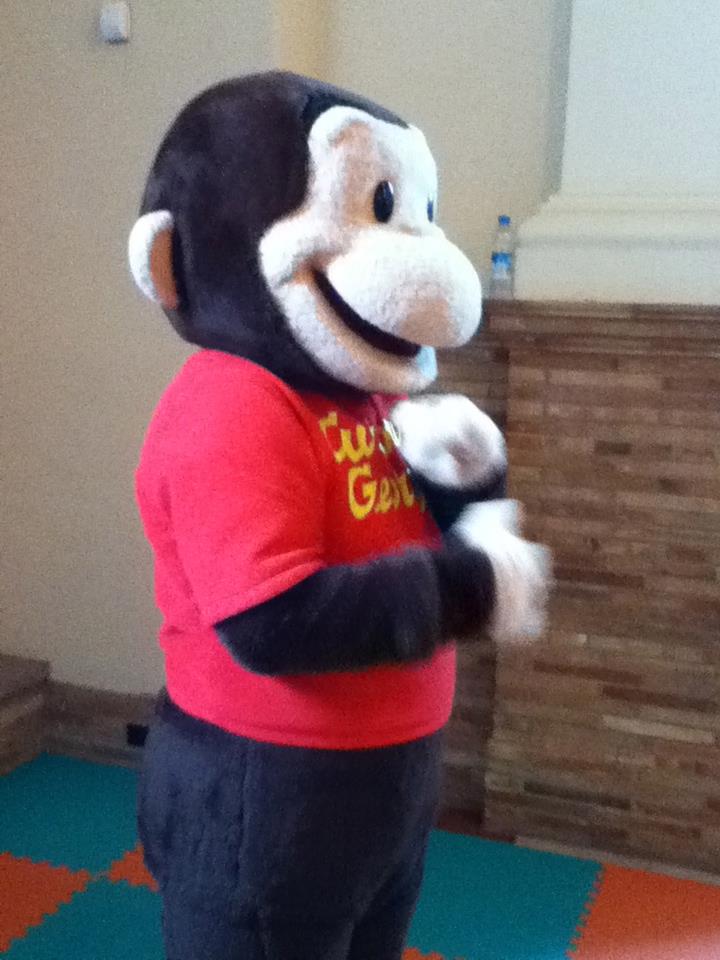
My reaction was an email reply to Sarah at the BBF saying, “OH MY GOSH! OH MY GOSH! OH MY GOSH!! I can’t believe I got picked to be a character. It’s like a lifetime dream come true! Thank you!!” a response that neither hid nor exaggerated my excitement. Really. This was a big deal for me. Several weeks passed before I learned my assignment (Curious George). I watched YouTube videos to prepare myself – method acting, you know. I practiced George’s dance moves and tried to absorb his mischievous nature. I dodged a last-minute change in schedule that tried to thwart my big day, and come 3:45 on Saturday afternoon, I donned the sweaty padded under-suit, the furry overcoat, the bright red t-shirt with “Curious George” in yellow script across the front. I put on the big feet, the expressive hands, and, of course, the head, and I headed up from the basement level of the Boston Public Library to the awaiting throng of children and adults alike.

Curious George appears at the Boston Book Festival

For the next 45 minutes, I posed and waved and hugged and had my picture taken a hundred times or more. I wasn’t Sally in a Curious George suit. I WAS Curious George.

We’re hard-pressed to think of a superhero who gains superpowers without the aid of some transformation. Superman dons a cape, Batman a bat suit, the Hulk emerges from an angry Dr. Bruce Banner, and with a clink of her bullet-proof, Athenian gold wrist bracelets, Diana Prince becomes Wonder Woman. The ordinary becoming extraordinary is a common thread between most of these characters. Clark Kent needs glasses, but when he is Superman, he has X-Ray vision.

What does this have to do with being an informationist? Am I suggesting that I jump into a phone booth on my way to meetings with the research team? Hardly. When’s the last time that you saw a phone booth? No, embedded librarians have no superpowers, at least none that I’m aware of yet, and alas, we don’t get to wear any special costumes.

Still, think about it. What is it about a costume that can change a person?

What’s the importance of a medical student getting a white coat?

It changes perceptions – both those of the student, as well as any patients and/or family members s/he comes into contact with. A first-year med student, one month into his/her studies, knows no more about medicine than most of us with average intelligence and a bit of background in our own health. Yet, with that white coat on, the one with the embroidered name and the school emblem on the chest, the student is suddenly something more than a young adult lugging around a too-heavy backpack of laptop, books and notes. With that white coat on, the student is, in the eyes of the patient, someone who knows something of what’s in those books. S/he is someone to be trusted with a person’s health. It is an empowering and powerful thing, that jacket.

In a really wonderful TED Talk, neuroscientist Beau Lotto and 12-year-old student, Amy O’Toole, share the story of the Blackawton Bee Project, a research project conducted by Lotto and 25 students from the Blackawton School in Devon (UK). Their work, Blackawton Bees, was published in Biology Letters, making O’Toole and her 8-10 year old (at the time) classmates the youngest peer-reviewed, published scientists in history. When you have 15 minutes, watch this video.


The purpose of Lotto’s seeking out the primary school students and doing research with them was not, however, to set any new world record. Instead, it was to demonstrate his theory that science is for everyone and it is merely our perceptions of science (and scientists) that prevent us from being open to and accepting of this fact. As he pointedly states,

Perception underpins everything we think, we know, we believe, our hopes, our dreams, the clothes we wear, falling in love, everything begins with perception. Now if perception is grounded in our history, it means we’re only ever responding to what we’ve done before. But actually, it’s a tremendous problem, because how can we ever see differently?

Lotto goes on to talk about how hard it is to create new perceptions because doing so involves asking questions that, in turn, create uncertainty. And as much as we talk about wanting change, particularly in this election time of year, let’s face it… we do not like it. Human beings do not like change. We do not like uncertainty. Lotto argues that this is part of us, as a species. He says, “Now, uncertainty is a bad thing. It’s evolutionarily a bad thing. If you’re not sure that’s a predator, it’s too late.”

To put all of this in the context of being an informationist, if the perception of librarianship, both by librarians and our patrons, is rooted in our past experience(s), we’ve more than a bit of work to do to get others, and ourselves, to ask the questions that prompt the uncertainty that will ultimately lead to a new, more accurate perception. And to make it all the more difficult, we must do this without any superpowers and, for most of us, no costume changes.

There are many who argue that all we need to do to change the perception is call ourselves something other than librarians. As much as I respect this idea, in my opinion it falls short. I believe it holds some merit and is worthy of discussion, but think that it is only the beginning – the very beginning – of a longer, harder, more arduous process. The Blackawton Bee Project didn’t try to change what people called scientists, but rather, what people perceived scientists to be.

I propose that the next steps in librarianship’s pursuit of changing the perception people hold of it are found in the story of the Blackawton kids. By choosing children, Lotto demonstrated that their intrinsic abilities, i.e. their nature to play (as kids do), is the key to being a good scientist. Said another way, the key to being a good scientist is play, not age.

Play is “evolution’s answer to the problem of uncertainty,” says Lotto. Play involves five characteristics that correspond closely with the work of a scientist. Play:

  • celebrates uncertainty
  • is adaptable to change
  • is open to possible
  • is cooperative
  • and is intrinsically motivated

The Blackawton Bee Project was carried out to show that these five characteristics of play, things possessed by children, made them ideal scientists despite every preconceived perception held by the scientific community. Despite years of experience that said otherwise.

I’m just back from the annual meeting of the North Atlantic Health Sciences Libraries organization, the regional group of the national Medical Library Association. Being at the meeting, I missed the weekly meeting of my research team yesterday, so have some catching up to do there. But it’s these times of professional gathering, particularly among groups facing uncertainty, like medical librarians, that brings to focus more than ever our thoughts and discussions and anxiety over the uncertainty we see before us. And so I’m thinking this week about these things and about Beau and Amy and the other kids of the Blackawton Primary School, of the researchers who believed in the possibility of kids as scientists, and of Biology Letters who ultimately published their article. I’m also thinking about the teachers who didn’t think the kids could do the project, the funding bodies that wouldn’t fund the project, the open access journal that originally rejected (twice) the article that the kids wrote. And finally, I’m thinking about how to do my own scientific experiment; how to incorporate the aspects of play that describe so well both scientists and librarians like myself who are looking for the best way(s) to become embedded in their research teams.

We play to play, says Lotto. “Play is its own reward.” It seems a really fitting message for a day when adults dress up and tap into their childlike “trick or treat” selves. I’m going to start looking at my work as an informationist this way. It’s play. Enjoy it!