He Said, She Said (and who can possibly remember?)

13 Feb

One of the tasks I have as an informationist on the study team is to help improve communication. In fact, it’s Aim #1 in the proposal we wrote to the National Library of Medicine for the grant: “Develop tools to improve data specification and communication.” For most of the past month or so, I’ve been working on a data request form. Back and forth and back and forth we go with iterations of it. Last week, it finally went through a test-drive as one of the principal investigators used it to request several analyses from our analyst. (Isn’t it convenient for an analyst that s/he does analyses? So clear. An analyst analyzes. A librarian… librarianizes? We should be so lucky.)   It’s back in my hands now to make a few more tweaks based upon her feedback, but it’s coming along nicely. Hopefully, it will become a well-used tool in the future, making the communication of statistical analyses between requester and analyst  more efficient.

As I sat in on yesterday’s meeting, I heard in the conversation another area where a tool would help improve communication between team members. Much of the history of this study can be found in email correspondence. Often, someone will say something like, “I remember that we changed such and such to so and so back in 2010,” and the indication is that somewhere in the virtual mound of emails of 2010, there exists documentation of this change. Everyone remembers the email, the discussions during team meetings, the outcome, etc. but the details are sometimes lacking. When it comes to writing articles, however, a lot of these details become very important pieces of information needed to describe exactly what happened and when. I began to wonder if we had a searchable archive of all of the email involved in the study, would it be a useful tool for the team. I posed the question later in the afternoon (via an email, of course!) and heard back from several people that they agreed.

To figure out how to accomplish this task, I began searching for things like communication log software, email exporters, and tools for Outlook. I also revisited Zoho Creator to see how and if it could work to create a database for these things. Basically, my thinking was to export pertinent fields like date, sender, and body of the email; index them (using tags); and make them searchable. Then, if someone was curious about the development of the phone counseling system, s/he could do a search for “MCRS” in all of the emails and receive a nice, chronological report of everything communicated about the process during the software development. “This is good!” I thought.
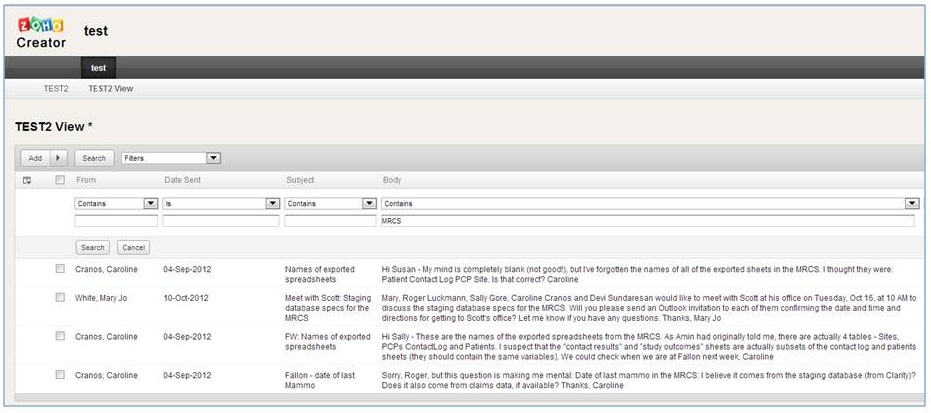
Screen Capture of search results.

Screen Capture of search results. A mini test.

I set to work downloading the add-on tool for Outlook that I decided on, Code Two Outlook Export. It was pretty straightforward, no hiccups or frustrations. Then I practiced exporting the “Informationist” folder in my email inbox. The export gave me a csv file that I then opened in Excel. I didn’t get exactly what I wanted, so I tried a few other export field options until it looked right. At this point though, I could tell there will be a good bit of cleanup to do in the Excel file. We have a lot of stuff in the body of emails – stuff that runs all together in an Excel cell. I decided to delete content in the body of the emails that was irrelevant and/or redundant. This helped a lot. Once I had the spreadsheet the way I wanted it, I then uploaded it into a new application in Zoho Creator, did some more tweaking here and there, and eventually got something that worked!

Admit it. It’s always a rush when you create something, isn’t it? 

I sent some screen shots to the team members and asked for feedback. Already I’ve heard from several who think it’s a great idea! It will take some doing to collect and cleanup several years of emails related to the study from everyone involved, but I think it will be a real help. Also, the system will be in place for future studies. As a matter of fact, I already have laid out in my mind how I can use this with the new CER group that I’m going to be embedded in soon. As their email list is fairly new, it will be a much easier start-up.

If you decide to try either of these tools – or if you’ve instituted a similar email archive to help with communication within a group – I hope you’ll share your experience in the comments section here. It will be great to hear what works for others.

Hop on the bus, Gus!

6 Feb
Really, she was both. Be both.

Really, she was both. Be both.

Quick update (as promised) on my post from last week. As you might recall, I had a meeting scheduled with the folks from the Community Engagement Research (CER) Section of our Center for Clinical and Translational Science. I’m delighted to report that it went really well! Members of the team came with both with ideas in mind and a willingness to listen to my own thoughts. I came away from the hour with several concrete projects; suggestions that I now take to my library director for her approval and input on next steps. Together, we need to figure out some of the nitty-gritty before I jump right in. We need to think about things like how much time I can realistically give to this work, how I should track my time, how I should track the tasks, and other things that will help us down the line when we hopefully move from my being supported financially by the library, to being supported financially by researchers and their grant funding. Planning this out now will definitely help in the future.

As this was my first real shot at this new aspect to my embedded role, I want to capture a few things I’ve learned so far and share them here, in hopes that they might help others traveling the same road:

  • Go with What (and Who) You Know: When charged with the task of drumming up business for you and/or your library, start off by going to people you know. Go to people you have some kind of relationship with already. This is probably Sales 101 (a class that I never took in college), but it certainly makes for an easier – and affirming – event when you walk into a meeting where people are happy to welcome you straight away. I also found it helpful to me that I chose an area of research that I’m both familiar and comfortable with.
  • Plan Ahead: This applies to both sides of the table. I found that it was immensely helpful to me to write out a brief description of my new role, why I asked for the meeting, and some questions that I wanted the CER folks to think about before we met. I did this, you might recall, at the request of the person coordinating the meeting, but it turned out to be as useful, if not more useful, to me than to those that I wrote it for.
  • Hang Around: While my proposal was only one item on the meeting’s agenda, when asked if I wanted to stay after I finished my part, I said yes. Good thing I did, because it resulted in 3 more project ideas being hatched! While I listened to the discussions and planning of other items, I easily saw places where I could help – things that neither I nor the others in the meeting had thought of before. I would ask, “Have you thought about …?” and “Are you going to do …?” and in the asking, we discovered new ideas.
  • Follow Up: Even though I’m waiting for the meeting with my library director, I’m keeping the communication with the Team going. Yesterday afternoon, I wrote up my notes of our meeting and drafted a proposal to work on the things we discussed. I sent it to the Team members for comments and suggestions, and heard back last evening from one of the researchers who offered a couple of lines that helped clarify an item. Today, I followed-up with links to a report, a journal, and an article I found that were all relevant to one of the topics we discussed. (I also invited one of the researchers to my upcoming birthday party, but that might stretch the bounds of comfort for some of my readers here! For me, it’s part of the fun.)

All-in-all it was a terrific meeting, filled with possibilities, and it left me feeling pretty successful in my first sales pitch. Stay tuned as we move ahead!

What’s In Your Toolbox?

4 Feb

Last fall, the Graduate School of Biomedical Sciences here at the University of Massachusetts Medical School hired, for the first time, an Assistant Dean for Career and Professional Development. Cynthia Fuhrmann, PhD, has been on the job since September, working hard towards her charge of establishing an overall program for career planning for the doctoral students at our university. Dr. Fuhrmann comes to us from the University of California, San Francisco, a school that has proved to be a leader in the area of academic career development.

Why, you might ask, do students in such a specialized field need help deciding on a career? Haven’t they already done that? Isn’t that why they’re here pursuing graduate studies? The answer seems to be both yes and no. Many students do enter graduate school with some idea of the direction that their career will take. Most probably believe that they’re on the well-trod path of those who’ve gone before them, because for a long time, careers in science followed a pretty specific pipeline:

Undergraduate degree in a science  ->  Graduate degree in a science  ->  Postdoctoral training  -> Tenure-track faculty in academia

Like many other professions today, however, the path that we used to follow is nowhere near as clear-cut or as straight. Today’s doctoral students are just as likely to end up working for biotech companies, for the government, or for universities, or even some combination of these. They may end up doing research, creating new products or drugs, teaching, writing, policy-making, or any number of other things. In fact, as more and more students earn PhDs, the number of tenure track positions available to them lags significantly behind. Even if they enter their graduate studies wanting to stay in academia, the odds of doing such are against them.

The National Institutes of Health and other funding agencies have noticed this trend and are beginning to call on graduate schools and programs to better prepare their students for a broader career path. Students need to have ways to explore their different career options, develop the skills they need in these different areas, and gain relevant experience that will serve them well as they move into the biomedical workforce. Thus, schools like UCSF and now my own institution, UMMS, are designing programs, services, and educational opportunities to meet this growing need.

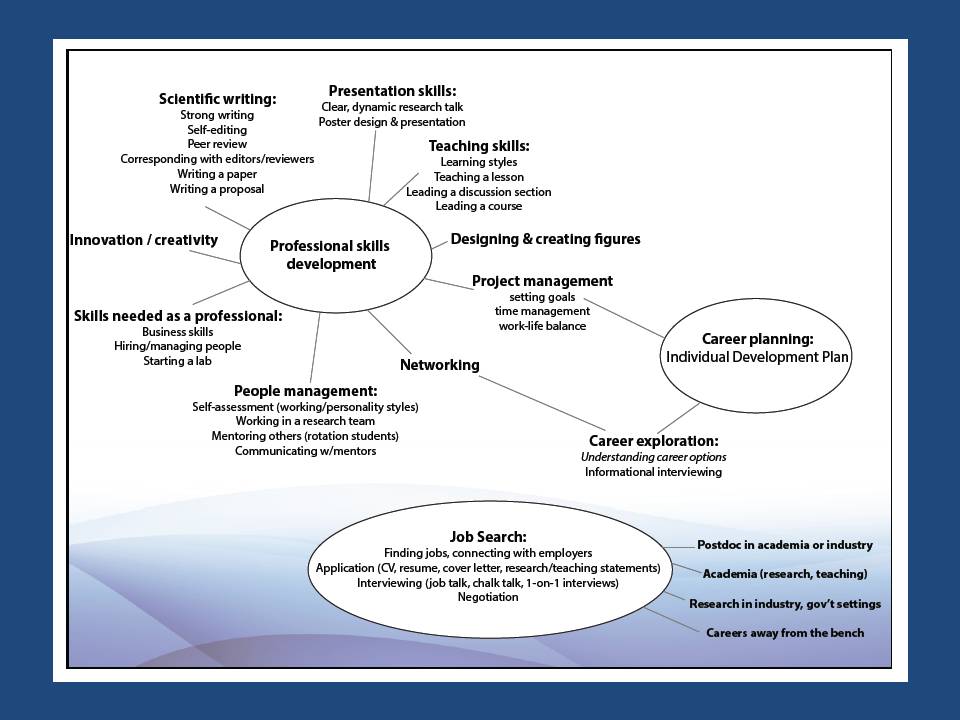
I had the chance to hear Dr. Fuhrmann speak last week. In her presentation, she outlined this need and her vision, goals and anticipated outcomes for her new position. I’d had some brief communication with her earlier and we have plans to work on a project together in the future, but this was my first opportunity to hear first-hand why the University created this new position and what will come out of it. A little more than half-way through her talk, she put up the following slide:

Fuhrmann_Skills Slide

Credit: Cynthia Fuhrmann, PhD
Used with permission.

As I read the different pieces, particularly the spokes off of the “Professional Development Skills” balloon, I couldn’t help but notice the striking resemblance between these skills and those that we’ve been talking about in our own profession. Strong writing and editing, including the ability to write proposals for projects or grants, are needed by young scientists. They’re needed by librarians and/or informationists, too. When graduates become researchers, they likely need to know how to present their work, their proposals, their findings. They likely need to know how to teach the subject(s) that they’ve learned. It’s expected of them. The same can be said for the librarian. It’s expected of us. We all need to know how to manage projects. We all need to know how to manage (or at least work successfully with) other people. We all need to become more creative and more innovative. In other words, we’re all in the same boat.

Will library and information science schools get on board with biomedical science programs and begin to develop the necessary programs to best prepare their graduates in these areas? And for those of us already working, can we or do we easily find the opportunities that we need to continue our professional development around these things? It’s true that you can learn a lot on the job, but it’s also true that simply standing in front of a classroom of students is not teaching. Juggling projects is not the same as managing them. Working with people via forced teams or committees doesn’t guarantee the best outcomes. Networking is more than talking to people at a party. We need to learn and hone the skills necessary in these areas that will bring us success. It needs to become a priority.

It’s my hope that as we continue to branch out in our own field, we will begin to see more clearly the skills we need for success and then, once we identify them, have the support of our institutions, our administrations, and our professional organizations towards meeting them. I hope we can expand our offerings of CE classes at professional meetings, bringing in courses that touch on some of these other skills. I hope we can be supported to go to different kinds of meetings and events outside of the usual suspects. And more than anything, I hope that we individually have the spark and initiative and excitement to do so. With these all coming together, we will surely strengthen both ourselves and our profession.

Special thanks to Cynthia Fuhrmann, PhD, for her insights related to this post and for sharing her presentation slides with me.