Last Tuesday morning, during the research team’s weekly meeting, a small group of us gathered and joked about how no one had a printout of the agenda. Mary Jo White, our Project Manager, always takes care of this. Mary Jo schedules the meetings, sets the agenda, organizes everything that needs to be organized. With a graduate degree in public health and years of research experience, she knows all of the ins and outs of managing a multi-discipline, multi-person, multi-site team. She keeps everyone on track and moving forward. When my Library Director and I first approached the team to ask if they’d be interested in putting together what ultimately became our successful grant application for an informationist, Mary Jo was integral in making sure everyone completed their part of the application correctly and on time, and she managed all of the communication between the different parties as we tried to make it sound just right.
Last Tuesday, Mary Jo was on vacation. We thought she was on the West Coast, enjoying time with college friends. We laughed at ourselves, for our dependence upon her to manage us. Roger, one of the principal investigators on the study, then took out his iPhone and read overtop of his glasses at the email she’d sent us before leaving; the email that gave us the agenda for the hour.
We’d no sooner begun the meeting when Mary, the other PI, received a voicemail message on her phone. It was from Mary Jo’s youngest son. Mary said, “Oh my god,” and left the room to listen to the message again. When she returned, she told us that the call was from Andy and he’d said that he was in the Emergency Room with Mary Jo. As it turned out, she was not in Oregon, but had been at the finish line of the Boston Marathon the day before.
By now, I’m sure all of my readers know the events that took place in my state last week. It’s been a world news story; a shocking event that the city of Boston, despite being stubborn and strong as nails, is still reeling from. In a world filled with violence, it is still not even fathomable that someone would set off bombs at the Boston Marathon. At least it was until last Monday.
Mary was unable to reach Andy and so we sat in the meeting, somewhat in shock, and tried to accomplish the tasks that Mary Jo had listed for us. Personally, I simply felt sick.
Later in the day, and in the days that followed, we learned that Mary Jo, her husband Bill, and their oldest son, Kevin, had all been standing within several feet of where one of the bombs exploded. They had each been severely injured. Mary Jo’s arm and wrist were shattered and she endured surgery to remove shrapnel. Kevin had a concussion, busted eardrum, and shrapnel. Bill was in ICU. His leg was damaged beyond repair and had to be amputated.
I resisted sharing this story on my blog for fear of sensationalizing what is already a sensational event, but it has been told in the news already and as I thought of it in the context of work, I realized that in it – even at this very early stage – there’s something to be learned and shared. Before I share that though, I want to say that this morning, as we gathered for our weekly meeting (again with no handouts and a sketchy agenda), the mood lightened considerably when we heard Mary Jo’s voice on the conference call. She’d called in simply to say hi and tell us how grateful she was for all of the thoughts and prayers (and food) sent their way. I surprised myself when I felt a tear well up in my eye. Hearing her voice was the best thing and though we did have other items to cover, none were as significant. She is healing, Kevin is healing, and Bill is healing. They each have a road of recovery ahead, but I’m so grateful that they are with us to travel it.
One of the goals for my being on the research team is to examine how an informationist fits in this environment. As such, I’ve read and thought a lot about how teams work and how individuals fit in them. A lot of what I’ve written over the past months is evidence of this. Anyone who’s visited the business section of a Barnes & Noble (or your local library) knows that there is no shortage of interest in and writing on this topic. There are countless gurus willing to give you a step-by-step approach to either building a successful team or dismantling a dysfunctional one. You can spend a lot of money on common sense packaged in a snazzy cover with a spiffy title. You could make a lot of money if you have the style and flair and hutzpah to pontificate on the subject. But when it comes to learning, the day-to-day experience of being on and working with a team will give you perhaps the greatest insight.
 “Absence makes the heart grow fonder,” so the saying goes. Of course, it’s a saying about love between two people, but it’s true of any sort of relationship. Teams are relationships and, nine times out of ten, well-functioning teams are a sign of healthy relationships. When someone is missing in the relationship, it shows.
I’m a big sports fan and as the sports teams of Boston rally around the city, maybe it’s not so out of place for me to think of my research team in the same way. Going with baseball, Mary Jo is on the disabled list right now. We’re without her. Just as the Yankees are without Derek Jeter, our team is without it’s anchor.
Yes, I know that it borders on anathema to use Jeter and/or the Yankees as my example here, but they DID sing “Sweet Caroline” at their game after the bombings, a display of sportsmanship and humanity that, quite frankly, made me fear the end of the world is near!
The project manager of a research team is akin to the captain. This is the person that knows what’s going on across the board. S/he is the go-between, the person that everyone communicates to and/or through in the process of the work. The project manager gets copied on every email, every memo. As mentioned earlier, s/he calls the team meetings, sets the agenda, keeps us moving in the right direction.
Principal investigators are the managers – sometimes the on-field manager, sometimes the general manager. They keep the big picture in mind, always. They know the bigger goal. They know the details of the day-to-day, too, but always within the context of the research question and how we’re getting to the answer. I’ve noticed that it’s one of our PIs who usually asks the question(s) that bring us back to why this study is being done in the first place. Like the manager of the ball club, the PI always says, “We’re here to win the World Series,” even if the World Series is about answering a question regarding the effectiveness of a particular intervention on getting women to have mammograms.
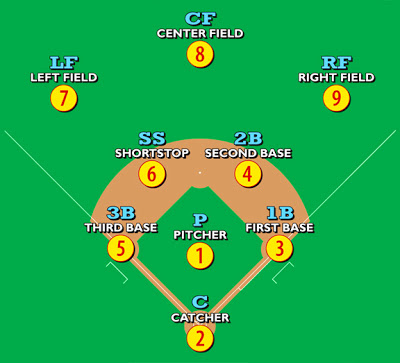
The analyst is the catcher. The analyst can look at the field and the position of the other players and say, “shift left” or “shift right”. The analyst is the one that the pitcher and the infielders look to when they wonder the history of the next batter or the next question for analysis. They know all of the variables. They know all of the holes. They know how to fix something in a hurry – on the fly – to get the next batter (or problem) out. Without a good catcher, you can get a lousy pitching staff, a bunch of passed balls, and a big ol’ mess of a defense.
On my particular research team, there are other specific players. There’s an individual who trains and manages the people who make the scheduling and intervention calls (instructor). She is like a bench coach; a one-time player who excelled at understanding the process. This skill allows her to create processes and systems that work, and then translate them clearly to the players. She does a lot of tweaking, but not enough to disrupt the mechanics of the whole motion. She works daily to solve the little problems so that none of them become big problems and a 2-game losing streak doesn’t turn into a lost season.
There are others on the team, too. There are equipment managers (IT gurus and programmers), the ones who keep the data and all of the systems that collect it up to speed. They know the nuts and bolts, and they get a lot of the blame when we bring the home uniforms for an away game. It’s a thankless job, for sure, but essential. Without them, we don’t take the field OR gather any data.
There are also several other coaches, managers, and front office staff (research directors, coordinators, and assistants) who oversee particular aspects of our team. They make sure that we have enough fans (subjects) coming through the gates. They insure quality customer service. They know all of the rules and are careful that we play by them, going back to the IRB whenever necessary. Their names are in the program, though few people know who they actually are or what they actually do. Until they aren’t there to do it.
And then there is me, the informationist. What’s my role on the team? Well, I’m still figuring that out. Am I like the designated hitter, a position introduced later in the game (actually, 40 years ago this season) that people still argue about in terms of its relevance to the game? Am I a late-season call-up, the player that gets added to an expanded roster? Maybe I get in for a pinch-hit, now and then. Maybe I get to pinch-run for the slow power hitter.
Ideally, I hope that in time I become the utility player; the invaluable player that can fill-in at multiple positions because s/he has multiple skills. The utility player is rarely an all-star, an MVP, or even a starter. But the utility player is the one who can be called on any day, in a variety of situations, to provide what is needed for the team. I like to think that a skilled informationist is one who knows the research process well enough to understand what’s going on where. S/he knows statistics well enough to understand the questions being asked and the discussion going on. S/he knows information management, information organization, information flow – s/he knows how pieces best fit together to form a knowledge base. Maybe s/he can’t throw a strike to third base from right field, but s/he knows when to cut the ball off and throw home, nailing the runner at the plate. And lastly, the informationist doesn’t mind sitting out a game. S/he doesn’t have the ego that gets bent out of shape when the team meeting goes long and s/he doesn’t get to have an at-bat, or give an update. S/he is ready next time. S/he is a supporting player, but one with a specific purpose and specific skill set, and thus, part of the team.
In all honesty, a team manages okay a lot longer without a utility player than without its captain. We’re going to flounder a little until Mary Jo gets back on the field with us, but we have a good team and we’ll stay afloat in the standings. I don’t doubt this. And as for this utility player, playing on a team with such a captain only makes me want to play harder.
Get well soon, Mary Jo!
Tags: team dynamics, team players, team roles, Teams, teamwork

 A Librarian by Any Other Name