Don’t Fence Me In

11 Sep

I just returned from the bookstore where I bought myself a few Tootsie Rolls (yes, my tooth is much better, thanks), my reward for sitting through a 90-minute webinar. This isn’t to say that the webinar wasn’t interesting, but more that I believe in positive reinforcement and extrinsic motivators. Walking to the store, I was thinking about the question that comes up so much in classes, presentations, talks, and webinars on the topic of emerging roles for librarians today, i.e. “How to talk to researchers about ___.” You fill in the blank. Most of the time lately, it’s “How do we talk to researchers about their data?” All three presenters during the webinar that I listened to today mentioned it and/or gave advice on the subject, and so I was thinking about it as I was on the hunt for my well-deserved, afternoon treat.

Our bookstore always has a cart or two outside of it with books that are marked way down. Passing it, the title, The Art of Conversation: A Guided Tour of a Neglected Pleasure, by Catherine Blyth, caught my eye. “Funny,” I thought to myself, considering what I’d just been thinking about.

In Chapter 2, “Small Talk, Big Deal,” Blyth gives us these five principles to follow when engaging in small talk:

  • Put others at ease
  • Put yourself at ease
  • Weave in all parties
  • Establish shared interests
  • Actively pursue your own

She then offers several rules as a strategy to follow. One is to “approach small talk like a treasure hunt.” “The most productive spirit is pioneering: sincere, curious, light, humorous,” she writes. The other rule is, “Start in neutral.” By this, she means that one of the best ways to be prepared to talk to people is to have a mind filled with a whole host of interesting thoughts and ideas; news items, books you’ve read, music you enjoy, fashion tid bits, and cultural affairs. In other words, be well-versed in a whole host of relatively safe, non-controversial topics. “Keep it light: an observation, question, a thread to weave to something new.”

Now, you might think that these rules are all fine and good for the next cocktail party, but I advocate that they are also EXCELLENT tenets to apply when asking the question, “How do I talk to researchers (clinicians, docs, students, etc.) about data?” About anything. Here’s why… despite the fact that we all live in a harried, time-sensitive, pressure cooker of a working world, most everyone still enjoys an expression of kindness and friendliness. Such expressions accomplish the first two principles – they put both you and the person that you’re talking to at ease. With that in place, everything else that follows becomes a whole lot easier.

BAD_Mar2

Complementary Colors

Similarly, small talk allows you to be inclusive of everyone. It lets you discover those things, sometimes completely unrelated to work (but sometimes not) that allow you to build a conversation that, ultimately, puts you in the best place to achieve your goal(s).

Which brings me to the bigger point – the one that I was thinking about before I picked up this book. When we go into a meeting or a conversation with an agenda, i.e. “I’d like to talk with you about your data management needs,” we’ve already eliminated about 7/8 of the services that we might be able to offer this patron. I agree that it’s good to have a few things in mind when you approach the person that you wish to pitch your services to, but go in with too tight of an agenda and you’ll likely miss a bunch of opportunities to do things and to meet needs that are being unmet. You want to provide data services, but maybe the researcher really needs help with disseminating his/her research findings in more creative ways. When you engage in some small talk, when you “start in neutral,” you’re much less likely to get hung up when the person says, “that’s interesting, but…”

Ladies and gentlemen once kept commonplace books, magpie hoards containing scraps of literature, historical facts, bon mots – any bauble that snagged the owner’s fancy – that were consulted and memorized before engagements, lest opportunity arose to flourish them and impress the company. (The Art of Conversation, Catherine Blyth, p. 51)

Consider your work, your toolbox of skills and knowledge, to be your “magpie hoards.” (I’d never heard this expression before, but I love it.) Review those things that you do and that you know, often. Take stock of yourself. Then, when someone is telling you about his/her research project, your much more likely to be prepared to know just when, where, and how you can insert yourself and your skills into the process. If it’s what you may have initially intended, great. If it’s something else, that’s great, too. Bottom line, you found the way to integrate yourself into the work of the person you wish to help. You’ve experienced success.

You might recall that a few posts back I mentioned that I have a new boss. After answering questions about this project and that project and the many iterations of “What do you do?” that a new supervisor needs to ask her team members, I finally sat down last Friday afternoon and wrote out a list of all of the projects I’m currently working on, along with any relevant documentation that explains my role(s) on each, and emailed it to her. I also wrote down the teams that I serve on in the Library and the Med School at large, professional organizations I serve, places that I’ve been invited to speak, classes that I’ve been invited to teach. It was a good list and when I finished I couldn’t help but notice the extent of it. I don’t say this as a way of saying, “Look at all of that stuff I have to do!” but more, “Look at all of the things that I do!” It was a really varied and interesting list and for me, that’s pretty important. I like to do a lot of different things. I like to be involved in a lot of different projects. It makes my job a lot more enjoyable.

And I think that this is key when it comes to finding success in the role of an informationist or embedded librarian (likely in a whole bunch of professions). The art of conversation involves being interesting and interested – the more, the better. So go ahead and have your goals and agenda, but keep them on the back burner the next time you’re tasked with talking to a potential patron. Instead, engage them in conversation – even a little small talk – about something(s) you like or know or think they could relate to. Ask them questions about themselves and their work. Ask them if they play a musical instrument or what they think about the scraggly beards that the Red Sox players are partial to this year or if they saw that article in Science News about caffeine and its effect on brain growth in mice (this would be a good one while waiting in line for coffee). You absolutely have no idea where these topics can lead you or the value that they can bring to what you’re trying to accomplish. My bet is that you’ll have better results and if not, you’ll have had the chance to enjoy the “neglected pleasure” of chatting with another interesting person who shares your world.

Trees, Forests, and Other Fall Metaphors

6 Sep

What a few weeks it’s been! Regular readers of this blog know all about the changes in my library of late. Suffice it to say, the load of emotions and thoughts and tasks have kept the wheels spinning, both literally and figuratively. The result, in terms of this week’s blog post, is a bunch of bits and pieces – a collection of some of those thoughts and experiences that hopefully you find worthy of reading and/or commenting.

Missing the Forest for the Trees

First, let me give you an update on my informationist work with the mammography study. It seems like it’s been too long since I’ve done that. September marks a year that I’ve been embedded in the research team. I have about 5 months to go on the grant funding and a whole slew of deliverables to deliver between now and then. Thankfully, the project coordinator has taken it on as a priority to make sure that I get all of the things done that we said I’d get done, thus she is putting me on the agenda every week from here on out, encouraging me to keep everyone on task with the things that they need to do to insure my success. I realize that Mary Jo has to be the ideal project coordinator for any informationist and/or embedded librarian to come across when looking for success in this new role. All along, the team has been welcoming and encouraging of me, but a good coordinator keeps everyone accountable to everyone else, and thus to the overall goal of the research project. As I mentioned during last night’s weekly #medlibs tweetchat, it’s this level of accountability that distinguishes librarian support from librarian embeddedness.

Which brings me back to the one deliverable that has stumped me from early on, the data dictionary. As I’ve described in previous posts, the data for the mammography study comes from various sources. Helping team members to communicate more efficiently and effectively about the data was Aim 1 of my role. We envisioned that a comprehensive data dictionary would be the key to reaching this goal and so I set about collecting the different codebooks and related documentation, compiling them into a single file with the hope that I’d be able to easily see overlap in terms, discrepancies between definitions of the same terms, gaps in terminology, etc. It seemed simple enough.

What I found, however, was less than simple. I found a lot of tools that already existed, yet weren’t being used. As an example, the codebooks were there, yet weren’t always referenced during data requests between team members and the analyst. People continued to use their own chosen vocabulary, despite the ongoing confusion that it caused. More than once I’ve heard the phrase, “So and so uses ‘x’ to describe ‘y’, but we all know what s/he means.” If you think about it, we all operate like this to varying degrees. If/when you work or live with another person long enough, you figure out what s/he means regardless of what s/he is saying. Except when you can’t figure it out. And that’s when the communication breaks down. It’s why we have dictionaries and standards in the first place, particularly when it comes to technical research.

I literally went for months, scratching my head and being utterly confused (and often exasperated) over the amount of time spent talking about the algorithmic logic behind exclusion variables and which flags turned off or on in the system when. I couldn’t for the life of me figure out how the data dictionary that I was putting together was going to help make that hang-up in the study go any better.

Until this week.

Finally, during a conversation with Mary Jo about the dictionary that involved sharing the work with her and walking through my understanding of it, along with hers (something that I see now I should have done MONTHS ago), she mentioned that if I could add to the dictionary how each variable functions within the system, it would be a really helpful document. FUNCTION! It was like a light bulb went off. I’d been so stuck on names and definitions that I either never heard this word or I had completely missed the concept, all the previous months. For whatever reason, this dimension to the dictionary had escaped me. I went back to the spreadsheet, added the columns for the different functions that we identified, and began working through the different scripts, assigning each variable its proper function. Now the goal is to have it all together by next Tuesday so that I can present it to the group for feedback and evaluation.

Going Out on a Limb

“We all hear that it takes 20 years for something new to be implemented in medicine, but how long does it take us to de-implement something?” I’m paraphrasing a cardiologist who spoke something to this effect in a meeting that I attended this week. Basically he was asking, “How do you stop doing something once you know it no longer works?” It’s a great question and cuts at the heart of all of my personal curiosities and interests around human behavior and why we do (or don’t do) the things that we do. I wrote in my notebook, “The Challenge of De-Implementation” and tucked it aside as a possible question for thought – perhaps even some kind of research project – in the future. It’s certainly pertinent in my profession right now.

When do we take the chances that we need to take? What finally prompts us to stop doing what we know no longer works? What’s worth giving up and what is worth fighting for when it comes to health sciences libraries and librarianship as a profession? 

Money Doesn’t Grow on Trees

In the mid-90s, at arguably the peak of their success as a band, REM released a less-successful, commercially speaking, CD entitled, “Monster.” It’s not my favorite, yet I did find myself pulling it off the shelf this morning to listen to one song in particular during my morning commute (I generally have about a 3-song commute). “King of Comedy” has a catchy little closing refrain,


I’m not king of comedy,
I’m not your magazine,
I’m not your television,
I’m not your movie screen
I’m not commodity

(King of Comedy, Berry/Buck/Mills/Stipe, 1994)

The irony is, of course, that the band was very much a commodity by that point. Like it or not, their huge success made them no longer individuals, per se, but an entity that could be bought and sold. What happened to REM is pretty much what has happened to information over the past couple of decades. With the rise of the Internet and the ease with which we can/could find and share and access information, its power and profitability has grown in ways likely no one ever imagined.  Once something freely shared by say, your local library, is now out there generating a bunch of money for Google. “But Google is free!” you cry. Really? We gave up a lot to be bombarded with advertising, with product, with noise; to have personal information about ourselves be retrieved and resold to others for a profit. We are commodity.

What does this have to do with libraries? Oh, I’ve just been thinking about the move towards entrepreneurship in our profession. I’ve been thinking about just what is it that I’m selling to patrons. What is the real value of me as an embedded librarian – is it me or is it my skill set? I know that it’s a combination, but is one piece worth more? I once heard the story of a law firm in Chicago that, upon acquiring Westlaw, decided that they no longer needed a law library and the librarian who worked there. She was, like many of our colleagues, let go. Within a few months, however, the firm came back to her, offering her the position she once held. They realized that her value was actually more than the resources she provided. She considered their offer and rejected it, opting instead to hire herself back to them as a consultant (with no library), charging them much more for the work that she had always done. 

You might think this is a great lesson in entrepreneurship and I can’t argue that it’s not, at least not for this individual and her personal value (financial status), but what does it say about the direction that health sciences librarians could take? Is our allegiance to the library, to the research team, or to ourselves? Again, I know that there is no one answer and that we hold a certain amount of loyalty to each, but if we do move towards a more independent and consultant-type model as embedded librarians, what will be the ramifications on the library – and on our profession – as a whole? There are pros and cons for being a commodity.

The Power of Branching Out

Sally and AmyI love social media. For those who have rejected the power of blogs, Twitter, Facebook, et al for both professional and personal gains, I give you another chapter in the story, “Sally Meets Fantastically Cool People Through Twitter.” If you missed the previous chapter on my Twitter friendship with Rosanne Cash, you can catch up here. This past week involved finally getting to meet the one and only Amy Dickinson; the voice behind the syndicated advice column, “Ask Amy,” the author of the NY Times bestseller, The Mighty Queens of Freeville, and a regular panelist on the always funny NPR news quiz show, Wait Wait Don’t Tell Me

I started tweeting back and forth regularly with Amy Dickinson about a year or so ago. I liked her as a writer and humorist, and followed her on Twitter. She tweeted something funny one day, I tweeted back, she back to me, and so on. Eventually, she started to follow me on Twitter, too. I became a fan of hers on Facebook. I offer up comments to the letters that she posts online. We got to know each other about as much as a librarian from Worcester gets to know a somewhat famous personality via these outlets. 

Last Friday night, after appearing on the panel of Wait Wait that taped at Tanglewood the night before, she gave a book talk at the Lenox (MA) Public Library. I had a gig scheduled with my band, but after a week (more like a month, but a really horrible week) of dental trauma, I was a scratch in the band lineup. Rather than sitting home yet one more evening, wallowing in my tooth pain, I decided that I’d drive out to Lenox, a nice, quiet 2-hour ride from Worcester, and take the opportunity to meet – and especially thank – Amy in person. 

Like my desire to meet Rosanne, I think it’s really special if/when we ever get the chance to say “thank you” to those people who fill up a bunch of our hours, days, even years. For me, these special people are most often writers and musicians (or a combination of both). Think about it. When I read Amy Dickinson’s memoir, I spent hours with her. She took the time to write a story and share it. I took the time to read it. Like taking the time to listen to a song and learn the lyrics, you have to give up something of yourself (a lot of your time) to accept all that the artist has given. As the hours unfold and you read an author’s book, particularly a memoir, you come to know them. It may be a little one-sided, but you still know them. 

I got to the talk and Amy saw me walk in. She recognized me from my pictures on Twitter and Facebook. I recognized her from the same, plus the fact that she was at the front of the room, next to the podium. We made eye contact and waved to each other. She gave a great talk, funny as expected, and answered a bunch of questions about her work as a columnist and a radio personality. I had my hand up to ask a question and finally, at the very end of the evening, she looked my way and wrapped up by saying, “I need to introduce Sally.” And then… Amy Dickinson introduced me! Really. Before I could ask my question, she told everyone all about how we met via Twitter, how I was a librarian with a wonderful blog (she said that), how I’d offered her some help in terms of pointing her towards reputable folks in health care for reference in her letters, and how I was the first friend that she’s made completely through social media. Amy Dickinson called me her friend. 

Several years ago, before the age of social media, I gave a talk where I introduced the “top ten” people that I wanted to be a personal librarian for. I did actually have a radio personality on my list, though (sorry, Amy) it wasn’t Amy Dickinson. It was Terry Gross. I think even Amy would take that gig. Who wouldn’t want to look up all of the cool stuff about all of the fascinating people Terry Gross interviews on Fresh Air?! Still, never did I imagine at that time that a day would come when I actually would be a bit of a personal librarian to the stars. But there was Amy, last Friday night, telling the audience about how powerful social media is in its ability to connect us with people and resources and ideas like we never could before. She said that while she’d been a bit late coming to it, she now sees what a rich tool it can be to help you do your job – be your job writing advice, sharing good information with others, promoting yourself, or connecting with people. 

This blog has helped me share a lot of ideas and experiences with an awful lot of people over the past year. It’s helped me to reach some folks that I never would have reached in traditional means like writing journal articles or even posting on listservs. My presence on Twitter has connected me with researchers, science writers, other librarians across many disciplines, and even a few musicians and writers that I admire immensely. It’s not the one tool that will make or break my success as an informationist, but it’s certainly proved more than worth its value to me. Amy Dickinson introduced me as her friend. I rest my case. 


The Future is Now

30 Aug

(This is the second part to last week’s post. If you missed that one, you can read it here.)

We said our goodbyes yesterday. We shared donuts, coffee, memories, and hugs, and then our colleagues of the past many years moved on. The next chapters in their post-LSL lives have begun. And for those of us still here, we’ve a bit of a blank page staring us in the face, as well. But like my former colleagues, our new journey isn’t completely without structure. There is a plan. There are ideas. There are theories that we will now attempt to put into action. As I’ve repeated often, no one knows all of the answers nor how it will all turn out, but in this post, I’ll shed some light on the big-picture plan, and where and how we hope it will lead us.

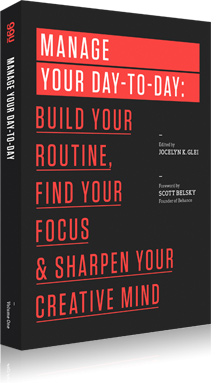
Manage Your Day-to-DayI’ve been reading a book this week entitled, Manage Your Day-to-Day: Build Your Routine, Find Your Focus, and Sharpen Your Creative Mind (ed. by Jocelyn K. Glie). It’s the perfect Kindle book for those times when you’re forced to spend hours in the dentist’s chair and on the couch, battling a nasty infection. It’s a great collection of tips from a lot of recognizable voices in the creative world. A product of 99U, the brainchild of Scott Belsky and his company, Behance, it’s a web-based clearinghouse of all things for creatives. Personally, I’m hanging my hat on the idea that creativity will be the thing that fixes and/or saves a lot of things in our society and workplaces, and if not, learning about it and adopting many practices of creatives makes me feel a lot better about myself and my work, so if for no other fact than that, I keep up.

But back to the book. The title “99U” comes from the quote by Thomas Edison, “Genius is 1% inspiration, 99% perspiration.” In the intro to the book, Belsky writes, 

For too long, the creative world has focused on idea generation at the expense of idea execution. … To make great ideas a reality, we must act, experiment, fail, adapt, and learn on a daily basis.

While he limits this thought to the creative world, I expand it to the world of libraries, education, and health care; three large and powerful institutions that merge in my academic health sciences library workplace. Implementation is always the sticking point. Putting theory into practice is hard work. It’s messy. It’s risky. And it’s bogged down at every step, it seems, by the roadblocks of resistance to change, fear of the unknown, or perhaps the most sinister bedeviller of all, apathy. So often, in an unceasing world of work stress, after awhile people simply no longer care. We just want to hold on until we can find the exit door to retirement or the winning lottery ticket. And that’s pretty sad, because for many of us, those options are no longer. Personally, I never imagine being retired. I don’t see it as a possibility in my future. But rather than let this be some kind of depressing bell toll on my work life, I’ve chosen instead to see it as a call that I’d better find and/or make my work life something that I darned well enjoy because I’m going to be doing it for the rest of my life. Whatever it may be.

So how does this fit with the changes in my library now? Well, for one, it’s a message that I’ve been reminding myself of daily. It’s not the easiest time to believe it, but I’m saying it anyway. I’m believing it anyway. I’m writing it here to those who read this blog, colleagues and friends, who are facing the same. As the current president of my regional chapter of the Medical Library Association, I’m preaching it to folks in the pews. They may be sick of hearing it now, but I’m going to keep on saying it… the future is now! If you honestly believe that health sciences libraries and librarians are of value in health care, then the time is now (actually, it was about a decade or two ago, but… better late than never) to put some of our big ideas, our new ideas, our challenging ideas, into practice. We must redefine who we are and what we do, in the mindsets of both ourselves and our patrons. This is not because there isn’t value in our past, but rather that our past is not going to make it in the now or the future.

Am I completely comfortable with this idea? Heck no! In fact, when I sit and think about how different my job is today, I can really struggle with the ideas that I both like the new work and that it feels like it’s taking me further and further away from what I once thought I’d do as a librarian. But that struggle is my struggle to redefine. And if it this is hard for me, I can only imagine how difficult the challenge is for someone without a 24-7 dedication to the institution of libraries and the profession of librarianship. Challenge. Capital “C”. 

At the Lamar Soutter Library, we’re bringing “4 Rs” to meet this “C”. This is a pretty different approach, i.e. a big change for a big challenge. It involves the nurturing of new librarians, those recently out of their graduate programs, by giving them hands-on, professional work in an area that interests them, i.e. health sciences librarianship. It brings together those of us with long term experience and expertise, with those who are fresh out of school, filled with energy and ideas and a desire to implement some of the things that they’ve learned. On paper, it’s a win-win. Those of us who need help in our new endeavors will get it through our library fellowship program. Library fellows will get a full-time, professional job where they can both learn and contribute from the get-go. And our profession, overall, will gain in the recruitment of new blood, new energy, new people to work and serve and hopefully, one day, lead. 

As like last week, my Library Director, Elaine Martin, prepared a presentation that describes the fellows program in detail. She’s graciously posted it on her slideshare account, making it available for others to view, utilitze and comment (Implementing the 4 Rs: Moving Forward and Defining a New Model of Librarianship). You’ll note that first and foremost, this change is about providing opportunities for new health sciences librarians. “Why?” you might ask. Why opportunities for them when we’re struggling to keep our own jobs? Well, maybe because if we don’t invest in our future now, there will be no profession tomorrow. People have been bemoaning the fact that we’re dinosaurs for too long. One way to silence those critics is to invest in the future. Was seeing people lose their jobs in order to make room for the future difficult. 110%. It was hard and it was sad and I didn’t cry crocodile tears yesterday when I said goodbye to one of my closest colleagues during my tenure here at LSL. The feelings of hurt are very real, but the hope for a different, more effective, more relevant future is what I’m holding on to now. And I believe that this program has a chance to get us there.

We’re placing an emphasis on research and professional development in these fellowships. We will address “mission critical areas” in their day-to-day training and work, but will also provide an environment where they will be expected to grow as professionals and this includes gaining experience in doing research. (I have tooted this horn forever, so you can guess that it’s a BIG happy spot in the program for me.) It is at last seen as a priority that, as a profession, librarians must be competent at doing the kind of research that will, over time, build the body of evidence necessary to prove our worth and value to evidence-based administrators. Enough with the “we search better.” Prove it. Enough saying that we have a place in getting health information into electronic medical records, that we have a role in data management. Get out there and do it and then do the research necessary to evaluate these programs so that we have something concrete to stand on when we sing our praises.

When are we going to manage doing this in already overloaded schedules? I don’t know! But I know that I like the idea of operating much more like the patrons that I serve (granted, they are researchers); constantly questioning, constantly researching, constantly watching and constantly stressing about where the next dollars will come from, the next grant opportunity will raise its head, the next opportunity, in general, will arise. As an exercise physiologist, I learned a lot about eustress; good stress. Eustress is the kind of stress that we need to help us grow. Muscles need to be stressed in order to get stronger. So do our minds. There may well be something to be said for embracing this kind of stress in our work today. Stability is grand while it lasts, but over time, it leads to a sense of complacency and entitlement that may well prove our downfall. Maybe it’s good to have a little stress, not so much in the area of work overload, but in that of pushing ourselves into new areas, knowing that if we don’t, we’re done. 

To close, I want to return all the way back to the beginning, where I mentioned that book. I’m reading that book because I absolutely know that one of the skills I have got to master in my role as an informationist, as an embedded librarian, is efficiency. I have to learn to set boundaries, plan a schedule and stick to it, take care of the big things first, and know how to say “yes” and “no” appropriately. I need to be a whole lot better at managing multiple, complicated projects at the same time. I need to articulate reasonable goals (in time and in skill) for myself and those I seek to work with. I need to take the time to know (even catalog) the things that I do really well, utilize them the most, and improve on the areas where there are gaps that can prevent success. 

I once heard a doc say that the hardest thing about developing and implementing an EHR system is that it’s like trying to change the engine of a 747 while it’s in mid-flight. You can’t stop what you’re doing long enough to make the changes because you risk crashing the plane. But you have to figure out how. So do we. 

And now I’m off to a meeting of one of our Transition Teams, the one charged with coming up with how we will provide needed reference services without staffing a service desk, a pager system, or an “on call” librarian system of any kind. Our recommendation to the Management Team is due October 1. Out of the box thinking, folks. Let’s go!

NOTE: If you or someone you know is interested in applying for our new fellowship program, the announcement is now available on the Human Resources site of the University of Massachusetts Med School. If you have any questions, you can feel free to contact Elaine Martin and she’ll be more than happy to answer your questions.