I loved going back to school. Summers off were fun, of course – lounging at the swim club, riding my bike everywhere, family camping vacations, basketball camp. Carefree days that seemed to last so much longer than days today. But fall is my favorite season and the end of summer always meant a new school year. And a new school year meant … new school supplies!! New notebooks, new pens and pencils, new packs of paper, new zip folders, and a new lunchbox. I loved the list, the shopping, the putting everything together. New clothes were okay, but new school supplies? Now we’re talking!
I still love office supplies. I love to go to Staples (though I visit so infrequently now that they’ve closed nearby stores). We have cabinets in the back staff room of my library with boxes of paper clips, staples, folders, sticky notes, pens and pencils, highlighters, spiral notebooks. Sometimes when I’m waiting for my lunch to reheat in the microwave, I’ll just poke around to see what’s new there. Sometimes I’ll take a new pencil, just to sharpen it.
All of this is prelude to describe my absolute joy and delight when Craig Robertson, PhD, associate professor of communications at Northeastern University, delivered this year’s Leiter Lecture during the opening plenary session of the Medical Library Association’s annual meeting in Detroit a couple weeks back. The title of his talk was the title of his latest book, The Filing Cabinet: A Vertical History of Information.
You can only guess how drawn I was, immediately, to the talk. I learned that the filing cabinet was invented in the 1890 by Library Bureau, a business founded by Melvin Dewey (yes, the same) to build and provide supplies to libraries. I learned that the filing cabinet was – and still is – a key technology. While we might not see the long rows and banks of filing cabinets that once filled offices, the concepts of files, folders, and tabs that we make use of daily with our computers are concepts straight outta the filing cabinet.
More interesting, Robertson traced the history of sexism in business and information professions through the history of filing cabinets, from their height, to the size of the drawers, to advertising images showing women doing the filing (even disembodied female hands filing) while men sit at their desks, waiting for the information. I learned about “deskilling” in the office setting, about Barney Google (Google!), about capitalism and the economization of knowledge. It was a brilliant talk that left me wanting more, so of course I bought the book! (Even got it autographed.)
I’ve spent countless hours as a librarian thinking about the repercussions of our predominantly female workforce operating in a male-driven world. I’ve thought about how people (more often men) do the very same type of work but call it “information management” or “information technology.” I’ve thought about how calling the work something else and then building a male-dominated workforce around it yields a higher paying profession. I’ve thought about the gigantic wave of data and data science, and how male-dominated (and higher paying) these professions are to date. Filing cabinets were for women; computers for men. Or so it seems. (Caveat: I am speaking in grand terms here. Please don’t yell back at me that women are not represented at all in Silicon Valley.)
Tracing the history of these trends through the filing cabinet is fascinating to me. I enjoyed the lecture tremendously and can’t wait to read the book in full. I’m obsessed.
Merriam-Webster’s “Word of the Day” yesterday (something I get in my email each morning) was the word “officious.” Honest, I didn’t know all of the meanings to the word. My initial thoughts were along the lines of something to do with official folks, and sure enough that IS a meaning. The unofficial meaning. But the official meaning is, “volunteering one’s services where they are neither asked nor needed : MEDDLESOME.” And I have to admit, it is/was oh-so-appropriate of a word following my time at last week’s annual meeting of the Medical Library Association (in conjunction with the Special Libraries Association).
We met in Detroit, Michigan – a place I’d never visited beyond the airport – this year. Detroit is a city working very hard to build back, showcase, recreate its heritage as a place of invention, innovation, and inspiration in industry, music, and more. I’m really happy that we decided to hold our meeting there this year. I truly enjoyed exploring the city and would love to return for another couple of weeks to experience all that I could never see and do in a few days outside of the meeting. But I did get to a Tigers’ game, ate Buddy’s pizza, had breakfast at The Dime Store, tried MULTIPLE Coney’s (Lafayette being my favorite), sipped fancy cocktails at The Shelby (speakeasy), and more. AND I soaked up content from one of the best MLA meetings that I’ve attended in a long while.
Last year, we met in-person in New Orleans (like this year, a hybrid meeting) and it was great. I vaccinated in every way possible and packed my bags for the Crescent City fully prepared (and accepting) that I’d catch COVID. And I didn’t care. When else was I going to get to go to one of America’s greatest cities for a work event? When was I going to hear the amazing music and eat such incredible food? I weighed my pros and cons, did my risk assessment, did the math and came to the evidence-based conclusion of “Hell yeah!” I was going all in. And that sentence, despite its somewhat flippant tone, is the complete truth. After 2+ years of a global pandemic, following each and every swaying guideline, going to work in a medical school attached to a hospital both unvaccinated and vaccinated, I was DONE with that expletive virus. Yes, I know it wasn’t done with us, but in terms of everything we teach our medical students, when it comes to evidence-based practice, I was 110% ready to put my actions behind my teaching.
And I went to New Orleans and had an amazing time (can’t wait to return). The meeting was good and the culture of the city better. I won’t trade it for nothin’. Some attendees DID get COVID, despite everyone following the masking rules and other regulations put in place by the City’s public health department. But thankfully one of the requirements for attendance was current vaccination status and so while some people did catch the virus, no one got terribly ill. THE POINT OF VACCINATION.
A year later, we were set to head to Detroit. COVID is further behind in the mirror, thanks to global scientific efforts to develop vaccines. Are people still catching the virus? Yes. But the devastating death tolls are factually (very much) on the decline and life as we knew it pre-2020 is popping back up like crocuses in spring. And quite frankly, this is something to be celebrated. In each and every way. We are, as a global society, putting the pieces of our collective self back together.
And in this context, I headed off to Detroit, SO looking forward to attending a professional meeting in as close to “normal” sense as I’d known in the past 3+ years. It was a celebration of survival – physical, mental, emotional. We made it!
I arrived on Monday and slowly bumped into friends/colleagues (frolleagues). I shared some hugs, some laughs, some sort of difficult-to-describe elation at returning to normal. It was – AND IS – a moment of celebration and gratitude. As medical librarians, how can we not be grateful for the unfathomable efforts in science and healthcare that got us to today? Maybe we had a small part. Maybe not. But regardless, we got here. We watched biomedical research and medical practice – the disciplines that we support in our work – come together in perfection and deliver us a vaccine in record time. Despite politics, misinformation, crazy-assed everything, we are here today – a society that successfully addressed the pandemic and, despite countless losses, came out the other side.
And during the opening session of our meeting last week, with all of these thoughts and feelings built up in my heart and mind and spirit, I tweeted this:
It WAS wonderful. It was a celebration to be back together. It was a feeling of huge accomplishment – or maybe relief – that we made it through. We were still here.
But no sooner had I tweeted this that others on Twitter (known and unknown) felt the need to judge, to draw attention (to themselves or us, I still don’t know), to all-the-way-back-to-yesterday’s-vocabulary-word, be OFFICIOUS. Meddlesome. Offering their opinions and their advice, and quite frankly NOTHING asked of them, to my tweet.
Why? Because the attendees of this year’s meeting informed themselves of the current rates of COVID in Detroit, they informed themselves of the current guidelines provided by public health officials – local, state, federal, international. They opted to weigh the risks/benefits of attending. They behaved in manners that allowed them to do so as safely as possible (masking if needed, current on vaccinations). The fear-based judgement to my simple tweet of celebration remains a mystery.
Because my tweet was one of celebration. For all of the rightfully-so precautions that our society took over the last few years to survive a global pandemic, the same that linger even today in the negative, “COVID SPREADER!” responses to my tweet, the reality is that the social isolation caused by COVID was as debilitating as the physical toll. We human beings are social creatures. We NEED contact with others. Some surely more than others (count me in that camp – I take daily medication to keep my mental health in check), but bottom line, the saying is true: No one is an island. No human survives alone. We need one another. The mental health tolls of this pandemic are no less costly than the physical.
And so, yes, measure yourself and your situation; take into account your experience with the virus; take in the whole of your health – physical, mental, and emotional; and seek out the facts – public health data, group behavior, policies and practice. And then make for YOURSELF the best decision(s). Weigh the risks/benefits. Practice what you preach as medical educators.
And stop judging others when their conclusions do not match your own
I end this with a story that’s been on my mind since all of this started last week (because what happened on Twitter last week really did put a damper on what was a wonderful week). When I was home for Christmas break during my junior year of college, my mom died suddenly in a car accident. It was devastating to every layer of my being and it it sticks with me to this very day.
That spring, my best friend and roommate had plans to go to London with her mom over Spring Break. It upset me in all kinds of ways. I wanted to go. I wanted to be with my best friend. I wanted to not be alone.
I wanted to go to London with MY mom.
But that wasn’t going to happen. It wasn’t possible. It was a fact of life. And when my best friend and roommate said to me, “I am going on this trip. I know your mom died, and you know how hurt I am for you. But my mom didn’t die.”, it was a moment of truth that I wish those Twitter naysayers could absorb.
We are struggling as a profession, as a society, as a species right now (except maybe in Florida or Texas) to reconcile being a people in existence that supports diversity and equity and inclusion. And all for the very best reasons. But to achieve such, we have to remember that life, in and of itself, isn’t innately fair. And we have to be able to accept our own decisions and limitations, in the same manner as we accept others. And/or vice versa. And please, for the sake of one another, learn to celebrate the good things in life. For yourself AND others.
I keep a note going each week with thoughts and ideas for this space. For some reason, earlier in the week I wrote down, “Cancelled meetings – what does this say? Apathy?” I don’t recall having any meetings cancelled this week, so I’m not sure what prompted the note. I do know, however, that I’ve had standing meetings in the past that often got cancelled. And after awhile, I’d wonder what, if anything, I was supposed to feel about that. I’m certainly not against cancelling a meeting rather than wasting everyone’s time if there’s nothing on the agenda, but I also wonder why one would feel compelled to schedule a standing meeting if s/he/they found it so easy to call off. I’d feel slighted, at times. I’d feel as if whatever I was doing and scheduled to report didn’t really matter. So why do it? Hence the thought of apathy. For whatever reason, I jotted this down. (For the record, my supervisor did cancel a meeting with me yesterday, but this note was jotted down well before that. And that meeting was called off for good reason.)
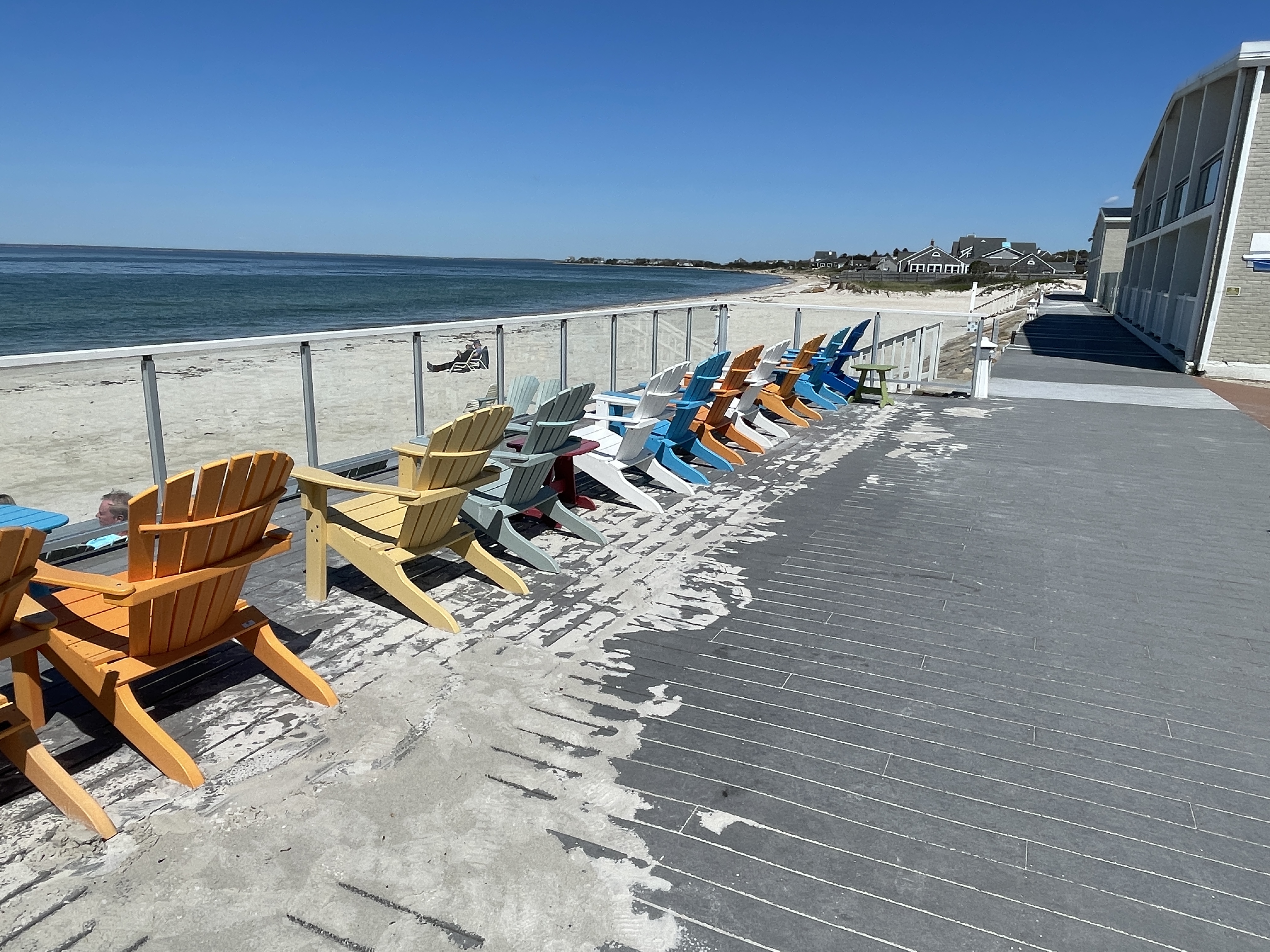
On Monday, a meeting that did not get cancelled was the annual conference of the Massachusetts Library Association. It was held in Falmouth, MA this year and as you can see by the picture here, it was an absolutely gorgeous day. Even better, the sessions were interesting enough to pull people inside on such a day. That says something! The session that I led on using creative freedom to build empathy and justice went pretty well. People were engaged and we had some thoughtful discussion. We also practiced some activities to help us both think more creatively and, in turn, more empathetically. I learned a lot putting the session together and was glad for the opportunity to lead it. It was also great to spend some time with librarians from other realms, i.e., not health sciences librarians. There were some academics, but mostly public librarians in attendance. There was much on the agenda about intellectual freedom and the fight that public and school librarians are having to fight now against insane stabs at censorship. Bless these folks on the frontlines.
The afternoon keynote on the day that I attended was given by Tommi Laitio, the inaugural Bloomberg Innovation Fellow for Bloomberg Center for Public Innovation at Johns Hopkins University. His talk was entitled, Learning Ground for Convivencia. Convivencia is a Spanish word that came into use in the Middle Ages to refer to the interplay between the religious, social, and cultural practices of Christians, Jews, and Muslims at that time. Laitio said that the closest English word is conviviality, but feels that this word doesn’t quite capture the sense of shared cultures and social practices that he’s studying in his research. Per the blurb on the Center’s website: “Laitio is currently conducting research on the topic of Partnerships for Parks and Libraries, which includes case studies in the following cities: Amsterdam, Netherlands; Fortaleza, Brazil; Los Angeles, CA; Mecklenburg County, NC; and Philadelphia, PA. His research explores the idea of conviviality and seeks to identify institutional and relational practices that recognize friction as a natural state of affairs.”
During the Q&A portion, Laitio was asked his thoughts on how libraries can balance friction with their charge to be safe places. I loved his reply, “I want libraries not to be safe places, per se, but rather to be BOLD places.” I feel this sentiment gets right to the heart of one of our greatest societal problems right now, i.e., our fractured state. We live in our own bubbles, communing almost solely with others who think like we do, believe what we do, value what we value, are educated as we’re educated, vote as we vote. That’s not a safe space. People arguing (in a healthy manner) their positions and beliefs, even passionately, is an essential part of societal discourse. And we’ve lost it in the United States. (Interesting, this very topic came up in my session.) We need the friction of differences. We like to speak about the importance of diversity, but too often forget that diversity can be really uncomfortable. And discomfort does not, in and of itself, mean unsafe. So let’s be BOLD. Let’s create spaces that welcome differing points of views, even, no especially, when they counter our own.
Laitio is from Finland and he shared with us that in his home country, libraries rank second only to drinking water as necessities for society. (Juxtaposed with the first keynote, The Evolving Movement to Ban Books and Censor Education, by Jonathan Friedman, Director, Free Expression and Education Programs, PEN America, I was once again envious of life in some real developed country.) Along with outlining his project and discoveries to date, Laitio spoke of Oodi, the Central Library of Helsinki. I was gobsmacked. Truly. Even now, when I visit the website again. This beautiful place at the heart of everything – culture, politics, literacy, physical and mental well-being – is the library. It got me to thinking of what amazing collaborations we can do when we expand our ideas of what libraries are, even libraries in academic medical centers. It was a great talk!
My last jotted-down-note was the website for Magazine Art, the collection of advertising in magazines throughout history, brought to us by the good people at the Internet Archive. From cars and trucks to household items to tobacco products and more… it’s a treasure trove of materials to remind us of the products we’ve used over the years and how they’ve been sold to us. Lots of fun.
I’m off to Detroit on Monday for the annual meeting of the Medical Library Association. I’m looking forward to seeing old friends, meeting new ones, taking in all of the great content, and visiting a new city. I’ve got a list of things I want to see: Tigers ballgame, Motown Museum, and the HandleBar. And hot dogs. I always look for the best hot dogs.
I’ll be blogging for MLA during the conference, but will be back here with a personal recap when I return. Until then…


 A Librarian by Any Other Name