Postcards from Chicago

2 Jun

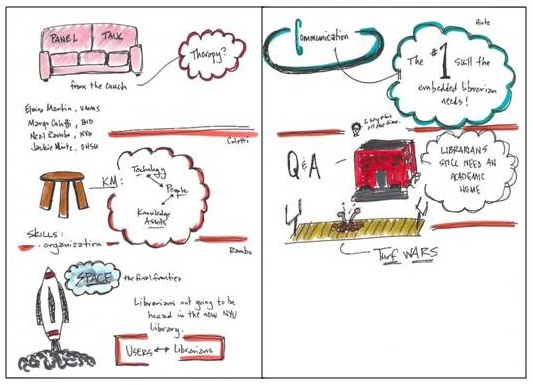
I was on vacation last week and the week before spent most of the days in Chicago, attending the annual meeting of the Medical Library Association. As always, it was a meeting filled with great ideas, innovations, inspiration, and an awful lot of fun with friends and colleagues that I don’t get to see nearly enough. I wrote about one of the plenary sessions, “Reshaping Our Professional Identity,” over on the blog of the North Atlantic Health Sciences Libraries, Inc. Check it out there!

MLA_Plenary4

As for my vacation, let’s just say I enjoyed some early dog days of summer.

Hanging out with Eliza


Interesting People Want to Know

15 May

Sally and AmyA couple of weeks ago, the phone rang in my cubicle. It was an outside call and I didn’t recognize the number, but when I picked up the receiver to “Hey, Sally!”, the voice was quite familiar. I hear it most often on the radio, usually telling funny stories or making wise cracks at the weekly news stories on NPR’s “Wait Wait… Don’t Tell Me.” It was the syndicated advice columnist, author, and humorist, Amy Dickinson on the other end of the line. She had sent me a note a day or so earlier, asking if she could call me and ask me some questions about librarians. Yes. That’s right. The advice columnist asked me if she could ask me for advice. I’d be lying if I didn’t say that it was a darned thrilling moment. I love Amy’s columns, her bits on the “Wait Wait” panel, and her social media presence on Twitter and Facebook. I loved her memoir about a small town and strong women. And when I had the chance to meet her in person last summer, I found that she was as lovely in person as in the media. Funny. Engaging. Downright nice. The kind of person that you like to say that you know. At least I do. And now, here was Amy asking me questions while I sat at my desk in the library. “Don’t blow it,” I thought to myself, “This is the closest you’re ever gonna get to being Kee Malesky.”

It turned out that Amy had been invited to speak at a conference of librarians in Detroit and upon hearing that many in the audience would be academic librarians, not the public librarians a popular author might be more comfortable with, she called me for some background info, some of my thoughts and opinions on how technology was changing libraries, changing reading habits, changing everything related to information. While we were chatting, Amy told me a story about how she was once sitting on an airplane next to a librarian and found it kind of odd that the librarian didn’t seem much interested in the fact that Amy was a writer. How could a librarian not be interested in someone who wrote a book? Don’t we all love books? Isn’t that why librarians become librarians?

The truth is that I have plenty of colleagues who cringe at the very suggestion of connecting our work with books. The stereotype is killing the profession, or so they believe. Maybe. And it’s also true that my work has very little to do with books. Most of my colleagues don’t do a lot of work involving books. But still, I don’t particularly mind the connection. I love books. I love writers. I love people who write for a living in any form. I wish I was one of them. If Amy Dickinson sat down next to me on a plane, she’d probably soon wish that she’d never opened her mouth. I’d talk her ear off, I’m sure.

But the librarian > book > author disconnect that Amy experienced wasn’t what bothered me so much about the story. What bothered me more was that it was a story of a librarian not finding another person interesting. Granted, lots of people (myself included) don’t like to talk to strangers on a plane. We like to travel in peace and quiet. We’re generally absorbed in work or a puzzle or… heavens! … a book. I understand this completely. Still, there was something about not being interested that stuck with me.

Last night, I went to an author reading at the Medical School. I wasn’t planning on it, but I walked right through the pre-talk cocktail party as I was leaving work and noticed it was a small crowd. I decided to stick around and support the event and my co-workers who’d worked hard to put it on. I don’t attend these events often and I wonder why, because every one that I’ve been to has been really interesting. They are hosted by the Humanities in Medicine Committee, so they always have a humanitarian theme, or put another way, they focus often on the human side of either being a doctor or being a patient. And they’re always, as I said, interesting. Last night was no different.

I looked around at the many empty chairs and I also took in the demographics of the audience – older and almost entirely male. There were no medical students. There were no younger docs. And it was a shame, because it was a story about the importance of doctors being interested in the people that they care for, in the importance of knowing their patients. Sadly, it didn’t seem a topic of much interest.

When I got home, I told my spouse about the evening and I told her the story that Amy had shared with me about her encounter with the librarian and I asked, “Do you think we’re just not interested in one another anymore? Do you think we’re too overwhelmed with our own lives to care much for what others do? Do you think we’re all too tired? Do you think we’re self-absorbed?”

“Yes. Yes. Yes. And yes.” That was Lynn’s reply.

When I think about the skills that make an informationist successful, one of the most important is curiosity. I didn’t necessarily become a librarian because I love books, but I became a librarian because I LOVE looking stuff up. I find lots of things fascinating. I find what people do to be interesting. Watching the screen saver images of brain scans on a PIs computer, I can’t help but ask, “What’s that?” It’s my nature. And one thing that I’ve learned as I’ve worked with researchers over the years is that, by and large, they really do enjoy telling you about what they do. They like explaining the science. Maybe they don’t have time to give you a primary introduction, but most of them can tell you a pretty good story or two that explains the experiments they’re doing and the questions they’re asking and the problems that they’re trying to solve. 

As I was leaving a meeting with the PI for the new study that I’m working on, I told him that I was really enjoying learning about all of the issues around data citation, DOIs, and things particular to neuroimaging. “It’s a lot of new stuff for me,” I told him. His reply was, “Good. I was afraid it would be boring; just the same old thing that you do all of the time.” He’s an interesting person and it seemed obvious that he knew how awful not doing something interesting can be.

I’m heading to Chicago in the morning for the annual meeting of the Medical Library Association. I’ll be blogging (probably sketchnotes) about the plenary speakers and link those posts to here, so that you can follow along, if you wish. In the meantime, I hope you meet someone interesting today. And that someone meets an interesting you. 

The Limitations of Self-Service Start with “Self”

9 May

I went to my public library last weekend. It was the first time that I’d been there in several months and “WOW!” was I in for some surprises. The first thing that I noticed was the space that used to be the Friends of the Library’s book store was now reconfigured and contained a really long series/system of conveyor belts and other such equipment. Bright red. My first thought was that they’d purchased an on-demand printer, the kind that prints copies of books that a library doesn’t have right there on the spot. “Cool!”, I thought. But then I saw a sign that explained that this was the new material return system. Quite fancy, indeed. 

Next, I walked the few steps forward into the main area and noticed the entire front desk was gone. The check-out stations, the reserve shelves, the people there to help… all gone. In its place was a cafe stand with coffee, tea, and assorted other goodies, some tables and chairs, and a very nice new bookstore for the Friends group. Then I saw an “Information Center” (round) prominently placed in the middle of the main entry. It was staffed with several people, each one of them helping patrons. I saw more self-serve check-out counters/machines for videos, DVDs, and books. I saw more stand-alone computer stations for searching the library catalog. In brief, I saw a complete “Do It Yourself” library.

The DIY movement is big, you know. You can check-out your own groceries. You can add channels to your cable package through your remote control. You can serve up your own yogurt at the frozen yogurt store. And of course, you can pump your own gas. This we’ve been doing forever.

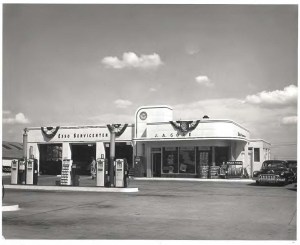
Back in the 50s and 60s, my grandfather, Granddaddy Gore, owned a service station in Alexandria, Virginia. It was right on Route 1, the main thoroughfare into and out of Washington, DC. I remember stories my granddaddy told of senators and members of congress, and often their drivers, stopping in for service on their way to and from work. We used to kid him that he knew everyone in Alexandria and it really wasn’t much of an exaggeration. Friendly and outgoing, Granddaddy Gore would strike up a conversation with anyone. When I delivered his eulogy, a number of years ago now, I said, “The world is a little less friendlier today, without Granddaddy in it.” 
Granddaddy Gore_ESSO Pics_Page_2

Gore’s Esso Servicecenter

I thought of my grandfather and his SERVICEcenter this past week after visiting my public library.  I thought of him again as I was putting gas in my car this morning and couldn’t get the darned gas cap off, spending a good 10-minutes prying the door open with a screwdriver. And as I thought about how much we’ve replaced with self-service in our lives, I thought about some of the things that we’ve given up for the sake of “convenience.” 

My own library has moved many once-mediated tasks to self-service. It makes good sense, economically. You really don’t need people to staff a desk and check-out books now and then. You don’t need a person to get a reserve item for a medical student. We’re an academic health sciences library. We don’t check out many books and we serve a bunch of people who are used to doing things themselves. Their way. And that’s A-OK by me. 

However, as I sat in a planning meeting for a symposium that the mammography study team is hosting in a couple of weeks and I listened to the discussion between the researchers, the representatives from Quantitative Health Sciences, the representative from Information Services, and the representative from the Library (moi) each offer our input and stake our claims to the aspects of data management we provide, I thought again about my grandfather’s servicecenter and what perhaps is an unplanned (and unwanted) repercussion to our self-service world… we do everything ourselves

"How can I help you?"

“How can I help you?”

Now don’t get me wrong, the idea of self-sufficiency is a good one, for sure. It’s good to know how to do things for yourself. It saves time and effort and money. It saves the hassle of fitting into someone else’s schedule. It saves the embarrassment of admitting you don’t know how to do something that you think you should.

But does it?

Are our efforts at doing everything ourselves really the most efficient? When multiple people end up duplicating work, are we really saving money? When you continually have to teach yourself something new, rather than going to someone who already knows it, are you saving yourself any time and/or any effort?

As I’ve written in the past, I believe that one of the biggest hurdles preventing us from making great strides in research (in many things) is communication. People simply don’t know what other people know. They don’t know what other people do. And when you don’t know these things and you live in a culture that promotes DIY behavior, that’s exactly what you end up getting, i.e. everyone doing everything for themselves. And more than a little frustrated in the process.

I once took an auto mechanics class in the adult learning program of a local public school system, just so I’d know how to change the oil in my car. And I did it. I changed the oil in my car. Twice. After crawling under my car, getting filthy dirty, trying to find the right place to recycle used motor oil, I figured that really this is a job better suited to the folks at the oil change place. The folks that do this every day. The folks that have the skills and the tools and the expertise to change my oil in under 30-minutes. I’m glad I learned how to do it, but I’m more glad that they exist to do it for me. 

Making a House Call

Making a House Call

As we find our places on research teams and in other settings that allow us the opportunity to say, “You know, I can do that for you. That’s really what I know how to do,” the more value librarians will add to the working order of things. When it comes to information, data, and knowledge management, there are a thousand steps to take and tasks to be done. No one group needs to do them all and surely no three groups need to be doing them all! I was incredibly frustrated when I first stepped out of that planning meeting, but afterward saw that it was a great opportunity to begin really dissecting these tasks and processes, and figuring out which of us does what part(s) best. Once we know that and can communicate it widely to the research community here, we’ll greatly improve the work we do. And I’m glad to report that we’re on our way in this task.