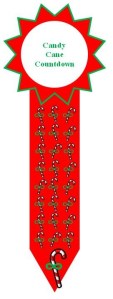
 When I was young, my brother and I each had a “candy cane countdown” calendar to help us count the days until Christmas. It was a long strip of red felt, with 25 pieces of bright green yarn attached, to which my mother tied a candy cane. The last candy cane, Number 25, was a bit bigger than the others, marking the importance of that day for us. I wish I had one of these today. I should make one for myself. I like countdowns. I crazily decided that instead of eating a candy cane each day this month, I’m going to run/walk a 5K each day until Christmas. I’m calling it my “Virtual Jingle Bell 5K Classic.” (Virtual meaning that I’m doing it by myself and on a treadmill, not that I’m making it up.) As I struggled up the steps to my third-floor apartment last night, my spouse asked, “Are you going to survive?” Good question, but so far I’m 2 for 2 and feeling like there’s not much getting in the way of me making it to the gym after work. I think 3 for 3 is a good bet.
While I was wheezing my way towards the 3K mark on the virtual course last night, I remembered my candy cane calendar and, struggling as well to figure out what to blog about lately, decided that I’m going to share a virtual candy cane a day here on my blog, for each of you to enjoy. An interesting tool, topic, article, website… one each day until we hit 25. Then for those who celebrate Christmas, you may open your presents. For those of other faiths and traditions, still consider this a present in the bigger spirit of all of the holidays that roll around this time of year.
Since I’m starting off on December 3rd, I’m going to have to serve up 3 canes. Don’t get a sugar rush!
 December 1 – Take 2 Cartoons & Call Me in the Morning
Regular readers of my blog know how much I love the use of drawing to retain and/or explain information. I’ve written a lot about visual communication, sketchnoting, and scribing as ways to bring the art of drawing into our work. It turns out, doctors and medical students are also into this. Or at least there’s a segment that sees the value. There was a great story in Vermont’s independent newspaper, “Seven Days,” recently about the cartoonist and recent MacArthur Fellowship winner, Alison Bechdel, teaching cartooning to medical students and faculty at the University of Vermont’s School of Medicine. Drawing from Life: Cartooning in the Medical Arts, is a great read. Check it out!
December 2 – Speaking of your Funny Bone
Another great resource that floated across the MEDLIB-L listserv recently was Graphic Medicine, a website “that explores the interaction between the medium of comics and the discourse of healthcare.” From cartoons to blog posts to podcasts to an annual conference, the site provides numerous ways to examine how comics and/or graphic novels can help people understand healthcare issues in ways much better than the traditional provider-patient discourse. I was psyched to see someone on MEDLIB-L chime in that she uses part of her collection development money to buy comics of this genre and that they are very popular!
December 3 – Art School Meets Medical School
I was so intrigued with the Graphic Medicine site, I poked around on it quite a bit and eventually looked into information about past conferences. I noted that one of the sponsors for the 2014 conference in Baltimore, MD was the Department of Art as Applied to Medicine at Johns Hopkins University Medical School. I was FASCINATED!! Here’s a department and program at one of the most prestigious medical schools in the United States offering … an art degree! More specifically, they offer education to “future medical illustrators through a two-year, accredited, Master of Arts program in Medical and Biological Illustration.” Graduates from their program go on to produce … well … comics (see above), but also illustrations for medical textbooks, research materials, graphic designs, and animations. Some students also specialize in making prosthetics (aka, clinical anaplastology) that, when you think about it, is really a pretty specialized type of sculpture. What I loved most about discovering this program is that the students within the art program learn anatomy and physiology side-by-side with the medical students. And really, what’s a better place to really learn anatomy than med school? I sometimes hear students in the biomedical PhD programs of UMass Medical School say that getting the chance to earn a PhD at a medical school was a big selling point for them when they were deciding where they wanted to go to school. I imagine art school students looking at MFA programs – particularly those with an interest and bent towards medical illustration – would say the same about the program at Hopkins.
Tune in tomorrow when I’ll offer up another treat, likely NOT related to the funny papers!
Tags: Alison Bechdel, cartooning, clinical anaplastology, graphic medicine, Johns Hopkins University Medical School, medicine, Seven Days, University of Vermont Medical School

 A Librarian by Any Other Name