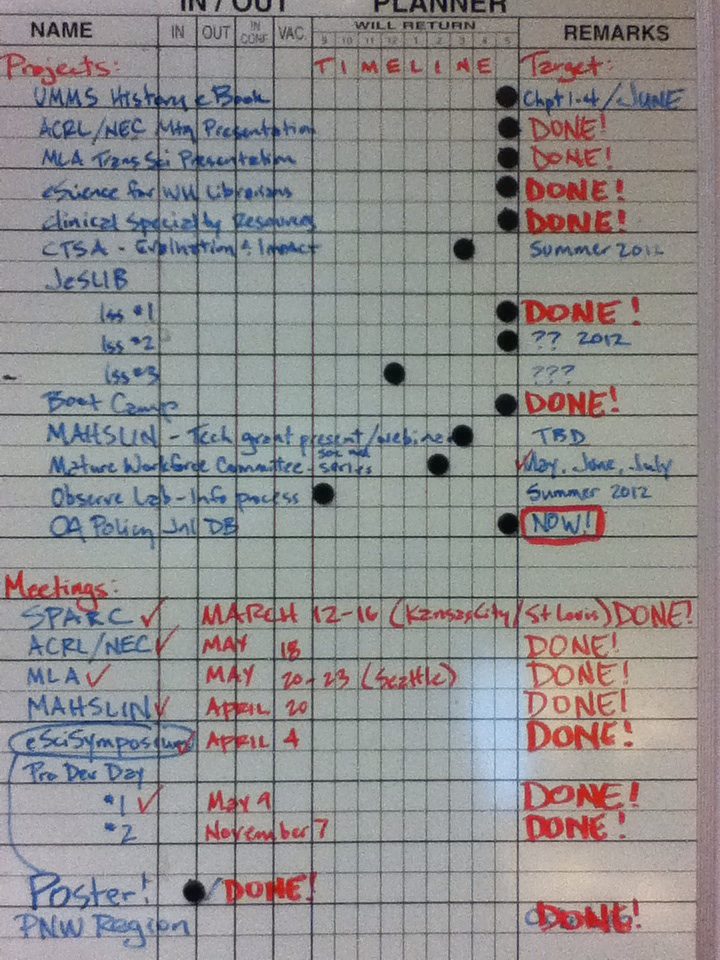
Closing the Whiteboard on 2012
I’ve only been at this informationist work for a few months, thus a true “Top 10” list is a bit of a stretch for my New Year’s post, but a few really terrific things HAVE happened, thus I figured coming up with some list warranted at least a college try. Here goes:
#10. An Invitation to the Party
I was invited to attend a retirement party for the project administrator of the research study I’m working on. What makes this special is that the invitation came before I officially became a part of the research team and while I wasn’t able to make it, it let me know that I was included in the group, by the group, before I ever even became part of the group. Inclusion, both physically and cognitively, is an important part of success in this arena.
#9. A Weekly Schedule
It took a little while, but eventually I was able to carve out some semblance of a regular weekly schedule that included the hours I’m committed to working as an informationist on the study. It’s not perfect yet, but we’re headed in the right direction. I imagine that balancing time and tasks between being in and out of the Library will remain a key focus in 2013.
#8. Office Space
Going along with a weekly schedule, securing a physical place outside of the Library to work on the project was also a coup. I was lucky in that the research team has other consultant-type people as members, thus having a research staff office was both known to be important and already existent. I’ve found that if/when I go into the Library on the days that I’ve scheduled myself to work on things related to the project, I too easily get pulled into other things. Staying away is important!
#7. Impromptu Conversations on Sidewalks
Being able to bring up my role as an informationist to researchers that I already know on campus is both easy and productive. I’ve had several conversations with individuals in the process of writing grants and as they tell me about their ideas, because I know them personally, it’s easy to say, “Have you thought about including an informationist on your team and/or in the proposal?” What I’ve also discovered is a lot of overlap between the researchers that I know. Part of this is expected (you do a lot of work in one department or division, and you tend to know many people who naturally work together), but it’s the unexpected connections that have been the biggest thrill. They’re also the ones with the greatest potential to build further collaborations. Cross-discipline research is really important in translational science and an informationist is very well suited to help build the bridges between the people and research currently happening in different areas.
#6. The Bucket List
During about the third or fourth weekly team meeting that I attended, I confessed that I was completely confused by the word “eligible”. It seemed to me that women were eligible for the study several different times. In other words, there were different levels of eligibility. I said, “I’m lost. Who is eligible for what, when?” In voicing what might appear like a weakness (after all, I was brought on board as the “expert” in communication), I hit on something that everyone was struggling with! Too many times, people were using the same word to describe different things. It was confusing not just me, but others as well. The result was my first tangible item to the team – a very simple list of what we would all agree to call each “bucket” of subjects. Producing something (an actual THING, in this case a list of words) was the first step to make me feel like I was a contributing member of the team.
#5. Presentation Proposal with a PI
It was a 2012 highlight that one of the principal investigators on the study agreed to submit a presentation proposal with me to the New England Chapter of ACRL’s next annual meeting. I hope it will be a 2013 highlight that we are chosen to present on our work together as informationist and researcher. The more that we can get researchers themselves to talk about the importance of embedded librarians and/or informationists in their work, the further we will advance in this area of our profession. I’m convinced of this.
#4. Informationist Invasion 2012
If you’ve been a regular reader of this blog, you know that in early November, informationists representing each of the NIH-funded awards gathered in Worcester, MA to share with science and medical librarians from New England about their new roles. “Embedded with the Scientists: Librarians’ Roles in the Research Process” was a big success! Personally, I was really happy to have the chance to meet my colleagues from around the country; to share ideas, talk about issues and roadblocks and how we might overcome them, to plan ways to support one another in our work, and to make new professional friends. Pursuing new directions is a lot easier with the support of colleagues.
#3. I Lost My Old Job
It’s nice to know that people care about you. When the announcement that my Library was (still is!) accepting applications for my current position as the Head of Research and Scholarly Communication Services, I got more than a few phone calls and emails from friends and colleagues. “Is everything okay?!” “Where are you going?” “What happened?” For once, I was happy to say that I’d lost my job. Even before we received the supplemental grant award, the management team of my Library saw that charging a librarian with the task(s) of becoming embedded in research teams was a direction we both wanted and needed to go. Receiving the grant only further solidified this commitment and my Director began to work the budget as she was able to move me into this new position, thus freeing me from the responsibilities of the former. To be successful in this area, we need such commitment. In today’s environment, creating new positions requires structuring budgets and workloads in ways we might not have thought before, but unless a Library is willing to do this, the work of the informationist, if it proves valuable, will ultimately be consumed by research departments or Information Technology, and the library profession will find itself missing out on a very relevant path.
#2. Supplemental Grant Award
It kind of goes without saying that there likely is no “Top 10 Informationist Moments of 2012” without the awarding of the NIH Supplemental Grant for the R01 study that I’m now a part of. It was not the beginning of the embedded librarian/informationist idea and/or role by any means, but as noted above, it solidified our movement forward into this new direction. My Director and the PIs stated, while we prepared the grant application, that we would pursue the project regardless of whether or not we got funded. This showed the level of commitment to it. But the fact that we DID get funding, opened doors that otherwise might have taken a bit longer to unlock. By offering these awards, the National Library of Medicine, through NIH, demonstrated that the role of the informationist in biomedical research is one worth supporting and examining to determine its longterm value. Sometimes professions need this kind of support to make big changes.
#1. Guest Lecture Invitation
You might think that #2 would be #1, and I admit that I went back-and-forth on deciding what moment I’m giving top billing to. What I ultimately decided is that moment #1 happened only yesterday, squeaking in just under the wire! I got an email yesterday morning from a researcher I’ve worked with in the past in a different capacity. She told me that she’s teaching a class this coming semester on Team Science. To avoid misquoting, I’ll share the text of the email:
“I’m teaching a class called Team Science in the Spring, the focus of which is to help students (in the MSCI program) to understand the importance of teams in science, how to build their research teams, and how to effectively function in teams. You have talked a lot about how many researchers and docs don’t understand the role of the informationist in their work, so I wondered if you might be interested in coming as a guest some time and talking about the role of the informationist on an academic team?”
Perhaps you can see why this invitation wins out in the “Big Moments of 2012” contest. Here is a pretty prominent researcher on my campus who gets it – or at least is willing to give me a shot to convince her, as well as a classroom of future researchers, of the important role librarians and/or informationists can play on research teams. Here is an opportunity to make my case that we are, in fact, part of the team. We’re not just a supporting cast on the sidelines.
Of course, I took her up on the offer right away. Stay tuned for a post in early March telling how it all goes.
So, while it’s only been a short few months in Informationist-landia, I feel confident saying that it’s been filled with more than a few memorable moments. In short, I’ve learned a great deal about the importance of building relationships, of harnessing the possibilities of existing relationships, of finding and exuding confidence, of setting boundaries and limits, of setting priorities, of finding balance, of speaking up, and of accepting change. And perhaps most importantly, I’ve learned the importance of articulating what I can do, what I can’t (or won’t) do, and what I’m capable of learning to do. Above all else, I believe being able to state these things clearly to a researcher is the way to open the door to their world, but it takes some work to be able to do that. Do the work.
In his book, Steal Like an Artist, Austin Kleon writes, “Ironically, really good work often appears to be effortless. People will say, ‘Why didn’t I think of that?’ They won’t see the years of toil and sweat that went into it.” To step into a new area professionally requires work. You need to take the time to read and explore and emulate and try and eventually find your own way; a way that is ultimately a blending of who you are and what you can do. This is the “you” that succeeds. This is what I learned, maybe more clearly than anything else, in 2012. I learned it in this new role as an informationist and I learned it in life. As I close the calendar on this year, I can’t complain much about that.
[Looking for a New Year’s book for yourself? Pick up a copy of Kleon’s book. You can read it over a cup of coffee on a Saturday (or a snowy) morning and you’ll come away with 10 pretty good tips (or more) for being creative in your work and in your life.]


 A Librarian by Any Other Name