Archive | Day-to-Day RSS feed for this section

Teaching Like a Ninja!

1 Oct

Massachusetts Health Sciences Library (1)I attended a really terrific continuing education event last Friday, co-hosted by the Massachusetts Health Sciences Library Network (MAHSLIN) and the Western Massachusetts Health Information Consortium (WHMIC). It featured two excellent speakers and a “sold-out” crowd.

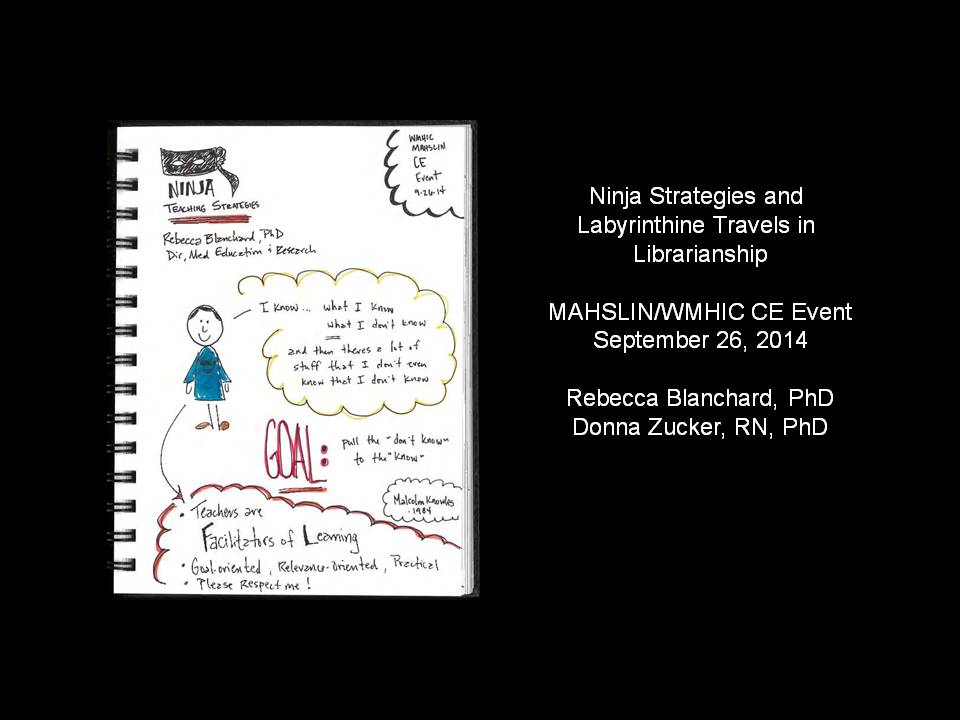
First, Rebecca Blanchard, PhD, MEd, from Baystate Health, Academic Affairs Division, led us through a session focusing on the idea of “stealth teaching,” i.e. teaching people without them knowing that they are being taught. This is a great approach to education and one particularly suited for those of us who work in harried environments and with people who generally have little time or attention to give towards learning something new. From one-on-one encounters to small group instruction to formal classroom teaching, we learned and practiced ways of moving people from the place where they don’t know and/or don’t even know that they don’t know, to a place of knowledge, all by ways that facilitate learning. Dr. Blanchard has coined her approach, “ninja teaching” and by the time the session was over, we’d all earned our white belts in ninja school! 

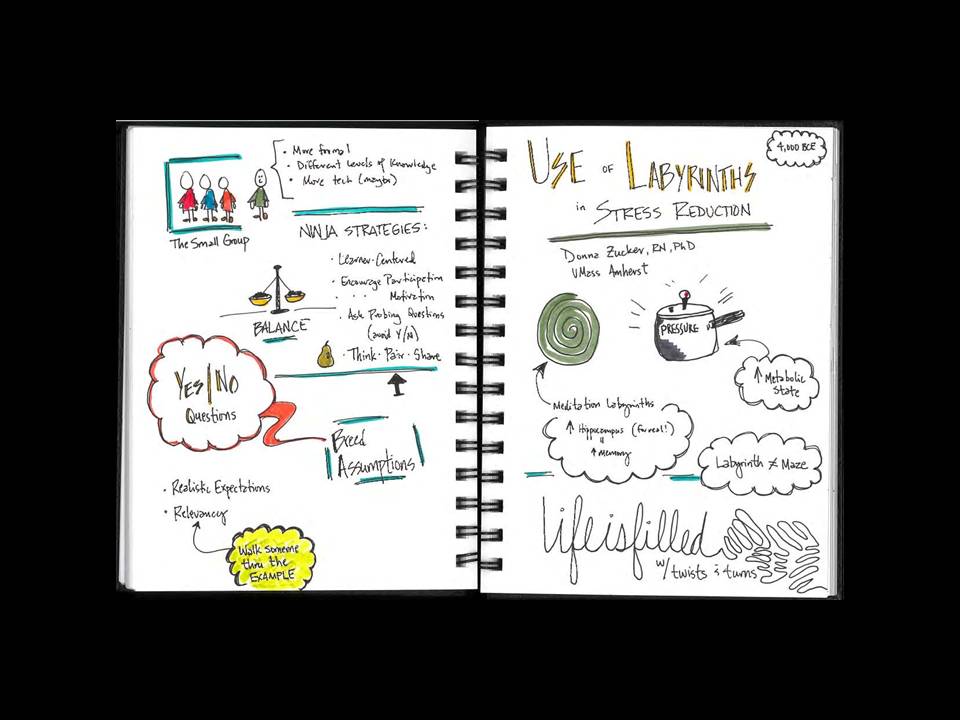
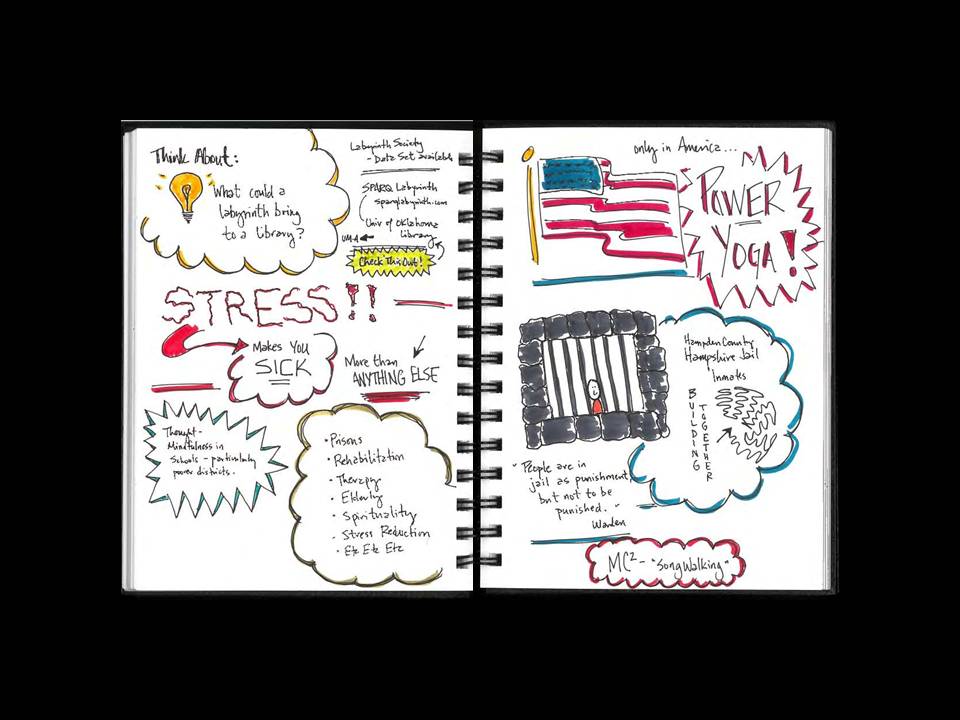
After learning about teaching, we enjoyed a time of stress reduction – a perfect thing for a Friday! Donna Zucker, RN, PhD, FAAN, from University of Massachusetts, School of Nursing taught us all about the use of labyrinths in stress reduction. We learned about the very long history of labyrinths and the practice of walking them, including their modern day use in clinical settings, health care, and rehabilitation. We got to see a short video about a project that Dr. Zucker is involved with at a county correctional facility, where the inmates built a labyrinth and use it for improving their own stress management skills, something that benefits them greatly when they return to society.

Perhaps the coolest thing … We learned about the use of labyrinths in libraries! Sparq Meditation Labyrinth is a portable, projected labyrinth that was developed by Matt Cook who works at the University of Oklahoma’s library. His project has been installed in his library, as well as at the University of Massachusetts – Amherst’s, W.E.B. DuBois Library. I found this FASCINATING! The science behind labyrinth walking and stress reduction abounds and it was really great to see libraries and librarians aware of the anxieties students face and using this incredibly unique tool to help them manage their stress. I’m going to keep up with this project. Who knows? Maybe we’ll get to install it in my own library one day.

Big thanks to Margot Malachowski of Bay State Hospital’s (Springfield, MA) library for arranging this event for her colleagues, and to MAHSLIN and WMHIC for supporting it!

Here are my sketchnotes from the day:
Slide1

Slide2

Slide3

Slide4

Slide5

Old Brains, New Tricks

5 Sep

ShallowsI recently had a very odd health scare that landed me in the hospital for a couple of days. That was a first. Lots of tests later, I’m pronounced A-OK. Hooray! One of the tests I had was an MRI of my brain. In his notes back to me via my health record, my doc told me that I have a very young brain for my age and ever since, my mantra has been, “I’m young at brain.”

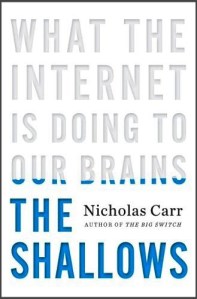
Our brains are fascinating things, aren’t they? I’ve been reading Nicholas Carr’s book, The Shallows: What the Internet is Doing to Our Brains, this week. A neuroscience page-turner, I tell you, as well as a great social critique of our techno-centric world. Our brains’ feature of plasticity is amazing. It ability to change and adapt and mold its neural pathways into all sorts of routes is amazing. I highlighted the following passage, thinking of how true it is both literally and metaphorically:

The adult brain, it turns out, is not just plastic but, as James Olds, a professor or neuroscience who directs the Krasnow Institute for Advanced Study at George Mason University, put it, “very plastic.” Or, as Merzenich himself says, “massively plastic.” The plasticity diminishes as we get older – brains do get stuck in their ways – but it never goes away. Our neurons are always breaking old connections and forming new ones, and brand-new nerve cells are always being created. “The brain,” observes Olds, “has the ability to reprogram itself on the fly, altering the way it functions.”

It seems like we’re hardwired for flexibility and change, despite how much we tend to not like it. Sometimes I reflect on a decade of being a librarian and it seems like one big change. Very little has stayed constant, aside from my physical location. I’ve remained in my same cubicle since the day that I arrived here, not something that everyone in my Library can say. But my job, focus, skill set, projects, responsibilities, colleagues… these have all changed, and generally more than once. Being a librarian is, in some ways, like being a brain. And plasticity best be a part of it. We’d better be able to reprogram and alter ourselves on the fly, too, if we want to be successful and/or remain relevant. 

Yesterday, I went to a lunchtime talk on campus. It was in the Faculty Conference Room, a large room with many round tables set up around the room. I saw a table of my colleagues across the way, but after I picked up my lunch, I sat the table next to them. I didn’t really even think about it. It’s become my “neural pathway” to mix and mingle at these events. It’s become my habit to meet new people and strike up conversations with them about what they do, wherever I go on campus. My empty table soon became filled up with 7 people that I’d never met before. They included the Associate Vice Chancellor for HR Diversity Management, someone from our Office of Communications, a recruiter for a research study, two lab researchers, and a student. I learned that our Associate Vice Chancellor studied engineering, of all things. “How did you get from engineering to human resources and diversity?” I asked her. “It’s all about solving problems,” she replied. 

I learned that we have a relatively new Vice Chancellor of Communications. I learned that one of our large, multi-site research studies that I know about is drawing to a close. I learned that people are curious about social media and how to use it in their jobs. All at my one table. And… everyone at my table met a librarian that they didn’t know before that lunch. And they learned a bit about the Library, too. We all made connections. 

This isn’t the way that I used to do my job. It’s not how I used to view and think about people throughout the Medical School, i.e. constantly making connections, both in my mind and in person. My “young for my age” brain has changed over time and I’ve learned to do these things almost second nature. And I’m sure that over more time, I’ll continue to let the plasticity of my brain do it’s thing. I’m willing to bet that old brains doing new tricks will keep ourselves, and our profession, healthy.

Postscript: After publishing this, I happened to see a tweet that said Nicholas Carr will  be a speaker at this year’s Boston Book Festival. I’ll be sure to try and catch him, if I’m not dressed up as a book character when he’s speaking!

All of the Data that’s Fit to Collect

28 Jul

My graduate thesis in exercise physiology involved answering a research question that required collecting an awful lot of data before I had enough for analysis. I was comparing muscle fatigue in males and females, and in order to do this I had to find enough male-female pairs that matched for muscle volume. I took skin fold measurements and calculated the muscle volume of about 150 thighs belonging to men and women on the crew teams of Ithaca College. Out of all of that, I found 8 pairs that matched. It was hardly enough for grand findings, but it was enough to do the analysis, write my thesis, successfully defend it, and earn my degree. After all, that’s what research at this level is all about, i.e. learning how to put together a study and carry it all the way through to completion.

During my defense, one of my advisers asked, “With all of that data, you could have answered ___, too. Why didn’t you?” I hemmed and hawed for a bit, before finally answering, “Because that’s not what I said that I was going to do,” an answer that my statistics professor, also in attendance, said was the right answer. Was my adviser trying to trick me? I’m not sure, but it’s an experience that I remember often today when I read and talk and work in a field obsessed with the “data deluge.”

The temptation to do more than what you set out to do is ever present, maybe even more today than ever before. We have years worth of data – a lot of data – for the mammography study. When the grant proposal was written and funded, it laid out specifics regarding what analysis would be done; what questions would be answered. Five years down the road, it’s easy to see lots of other questions that can be answered with the same data. A common statement made in the team meetings is, “I think people want to know Y” or “Z is really important to find out.” The problem, however, is that we set out to answer X. While Y and Z may well be valuable, X is what the study was designed to answer.

LOD_Cloud_Diagram_as_of_September_2011

“LOD Cloud Diagram as of September 2011” by Anja Jentzsch – Own work. Licensed under Creative Commons Attribution-Share Alike 3.0 via Wikimedia Commons

I see a couple of issues with this scenario. First, grant money is a finite resource. In a time when practically all research operates under this funding model, people have a certain amount of time dedicated, i.e. paid for, by a grant. If that time gets used up answering peripheral questions or going down interesting, but unplanned, rabbit holes, the chances of completing the initial work on time is jeopardized. As one who has seen my original funded aims change over time, this can be frustrating. And don’t hear me saying that it’s all frustrating. On the contrary, along with the frustration can come some pretty cool work. The mini-symposium on data management that I described in earlier posts was a HUGE success for my work, but it’s not what we originally set out to do. The ends justified the means, in that case, but this isn’t always what happens.

The second issue I see is one that I hear many researchers express when the topics of data sharing and data reuse are raised, i.e. data is collected a certain way to answer a certain question. Likewise, it’s managed under the same auspices. Being concerned about what another researcher will do with data that was collected for another reason is legitimate. It’s not a concern that can’t be addressed, but it’s certainly worth noting. When I was finished with my thesis data, a couple of faculty members offered to take it and do some further research with it. There were some different questions that could be answered using the larger data set, but not without taking into account the original research question and the methods I used to collect all of it. Anonymous data sharing and reuse, without such context, doesn’t always afford such, at least not in the current climate where data citation and identification is still evolving. (All the more reason to keep working in this area.)

We have so many tools today that allow faster and more efficient data collection. We have grant projects that go on for years, making it difficult to say “no” to ask new questions of the same project that come up along the way. We are inundated with data and information and resources that make it virtually impossible to focus on any one thing for any length of time.

The possibilities of science in a data-driven environment seem limitless. It’s easy to forget that some limits do, in fact, exist.