Archive | Day-to-Day RSS feed for this section

Welcome to New England

6 May

As the current chair of  North Atlantic Health Sciences Libraries, Inc. (NAHSL), the local regional chapter of the Medical Library Association, I was invited to give a welcome to the attendees of One Health, the “federated international meeting incorporating the 2013 Annual Meeting and Exhibition of the Medical Library Association (MLA ’13), the 11th International Congress on Medical Librarianship (ICML), the 7th International Conference of Animal Health Information Specialists (ICAHIS), and the 6th International Clinical Librarian Conference (ICLC).” Our meeting began Saturday evening, here in Boston, and I offered the following welcome yesterday morning.

I want to thank the many, many people who have stopped me in the rooms and halls of the Hynes Convention Center to tell me how much that they enjoyed my words. I had a great time writing the poem and am happy to share it, per your request, here. Enjoy!

Listen my colleagues and you may hear
The distant call of Paul Revere
On this early morn, the first Sunday in May
His voice and mine are here to say
We bid you good welcome, good times, and good cheer.

I say to you friends, “If you have traveled
By land or sea, from towns near or away,
Hang your hats by the doorpost, take heed the gavel
And receive its clamor as a signal to stay,
One if by land, and two if by sea;
This is the rule to follow if ye
Commence to go forth and take in the charm
Of every Middlesex village and farm,
And the sites of New England within a yardarm.”

We bid you grand welcome, with no muffled roar
Enjoy good sessions ‘long the Charles River shore,
And as the moon comes over the bay,
Be sure to get out, see the ICA,
Beacon Hill and the famous Common,
And the place where they tossed the tea to the bottom
Of the Harbor deep, and the fight was on.
History abounds in this fair city
Take it all in, to not be a pity.

Meanwhile, your peers from west on the Pike
Worcester and Springfield, and places alike
We too break the silence around these parts.
And muster our greetings, as we embark;
On sessions and speakers and meetings aplenty,
And nary an excuse for your stomach be empty.
For local arrangers, they await your call,
All set to give guidance on how to reach Faneuil Hall.

And do, if you can, climb the steps of Fenway Park,
With its old creaky chairs, it’s an historic landmark.
You’ll have a fun time, no matter the cost,
It’s still early May, the season’s not lost.
But don’t startle the pigeons that make their nests,
On the hanging rafters, above all the guests.
The roof gives you cover, the roof gives you shade,
And don’t fear the loud masses, it’s a Sox-loving brigade.
Catch a glimpse of the monster, green and tall,
Homers fly highest over that wall,
Then pause to watch, as the ball sails over the crowd
To bounce on the street aptly named Landsdowne.

Yes here you can visit churchyards a plenty,
Where famous figures, now lie deep and still,
Adams and Hancock and old Preacher Mather,
Who up in Salem caused such a clatter
I sprang from my bed to see what was the matter.

(Oops… wrong poem. Sorry.)

Their watchful eyes linger, even today
Keeping us true to their Puritan way,
And seeming to whisper, “All is well!”

But growing impatient, I feel the swell
Of my fellow NAHSL members, wishing I tell
The truth, my friends; that our region it spans
From shoreline to mountains, cross lots of farmland.
Boston’s but one place, and yes, it is louder,
Yet in Connecticut, you’ll find folks prouder
Mustering cheers for that team from the Bronx
Battle cries rising ‘tween Yankees and Sox.

From Stamford drive north, the coast you can trace,
Past Norwalk and Bridgeport, to New Haven and Yale,
Who’s hallways and dorms, a few presidents did grace.
You can stop off in Hartford and take in the site
Of the very room, very desk where Mark Twain, he did write.
See the tall ships line Old Mystic’s harbor,
It’s the same town from that movie that starred Julia Roberts.

And though it be small, the smallest of all,
Rhode Island can claim its own famous wall;
A cliff walk you wander and ogle without guilt,
Upon mansions like those that the Vanders-bilt.
Little Rhodie has beaches and islands, great jazz and folk fests,
That draw the likes of Dylan and Joni, Duke, Dave and the best.
For years they have gathered, the crowds on the lawn,
To take in the music from dusk til dawn.

But then there are those who live north of he-ah,
Where there’s moose in the mountains and lobstahs off the pie-ah,
Way up in Maine, or “down east” as we say,
They’ve got a history of women showing the way.
It started with Margaret Chase Smith back in ‘40.
Women in Congress from Maine proved no shorty.
From Olympia to Susan, the United States Senate
Knows the people of Maine through some very strong women.
And continuing right along in that vein, some 30 years almost it’s been,
With the whole world watching, we all got to see,
A small gal from Freeport break every myth,
Winning marathon gold, Joannie showed girls don’t quit.

Vermont and New Hampshire, too often it seems,
Get lumped in together, like they share the same themes.
But they’re really quite different, both equally proud
Of the unique qualities they’ve each been endowed.
Vermont has Green Mountains, good cheese and ice cream
And a strong little faction always wanting to secede.
They’ve got a good streak of tough independence,
Of “do it yourself” and “don’t be a nuisance.”
Quaint little towns and quaint covered bridges,
And people who can take it when the weather gets frigid.

New Hampshire, however, has mountains quite high,
With trails above tree lines, and peaks in the sky,
Wild rivers and bike paths, and even some beaches,
It’s got a penchant for drawing young folks in their fleeces.
It’s a place to play in the great outdoors,
It’s the first place I landed here, despite there being no Gore’s.
New Hampshire has snow like you can’t believe,
And in spring when it melts, the mud is obscene.
But despite its small size and no roads running East-West,
It’s a part of New England some claim is the best.

Now you know the rest. In the books you have read
How this country began when the British all fled.
How the Patriots showed them, no question at all
That they’d fight for their homeland, they’d answer the call.
And this spirit lives on in our region today,
New England’s quite proud of the ideals we convey.
We’re proud to be leaders in hi-tech and health,
We’re proud to have schools that embody such wealth.
We’re proud of old libraries. We’re proud of old art.
We’re proud of our nature, and being known for kind hearts.
We’re proud of FOUR champions – Sox, Pats, Celts and Bs,
We’re proud you can marry whomever you please.

And though recently shaken on a day we hold dear,
We’re most proud of those who stood up to fear.
For in that odd week, filled with hatred and terror,
The true spirit of Boston became clear as ever.
And all of New England showed all of the world,
How we still stand together, when darkness unfurls.

So throughout this week, as you visit us here,
I hope you’ll absorb every bit of our cheer.
Each bit of our history, each bit of our charm,
Each bit of our character, drawn from village and farm.
On behalf of the members of NAHSL, I say,
Welcome to Boston. Enjoy your stay!
And should you be sad when this meeting is over,
Come back and see us again in October!
Our annual conference will be on the Cape,
And I promise you now, that I will not rhyme another word.

Creative Commons License
Welcome to New England by Sally Gore is licensed under a Creative Commons Attribution-NonCommercial-NoDerivs 3.0 Unported License.
Based on a work at https://librarianhats.net/2013/05/06/welcome/ .
There is no “I” in TEAM (But is there a “U”?)

23 Apr

Last Tuesday morning, during the research team’s weekly meeting, a small group of us gathered and joked about how no one had a printout of the agenda. Mary Jo White, our Project Manager, always takes care of this. Mary Jo schedules the meetings, sets the agenda, organizes everything that needs to be organized. With a graduate degree in public health and years of research experience, she knows all of the ins and outs of managing a multi-discipline, multi-person, multi-site team. She keeps everyone on track and moving forward. When my Library Director and I first approached the team to ask if they’d be interested in putting together what ultimately became our successful grant application for an informationist, Mary Jo was integral in making sure everyone completed their part of the application correctly and on time, and she managed all of the communication between the different parties as we tried to make it sound just right.

Last Tuesday, Mary Jo was on vacation. We thought she was on the West Coast, enjoying time with college friends. We laughed at ourselves, for our dependence upon her to manage us. Roger, one of the principal investigators on the study, then took out his iPhone and read overtop of his glasses at the email she’d sent us before leaving; the email that gave us the agenda for the hour.

We’d no sooner begun the meeting when Mary, the other PI, received a voicemail message on her phone. It was from Mary Jo’s youngest son. Mary said, “Oh my god,” and left the room to listen to the message again. When she returned, she told us that the call was from Andy and he’d said that he was in the Emergency Room with Mary Jo. As it turned out, she was not in Oregon, but had been at the finish line of the Boston Marathon the day before.

By now, I’m sure all of my readers know the events that took place in my state last week. It’s been a world news story; a shocking event that the city of Boston, despite being stubborn and strong as nails, is still reeling from. In a world filled with violence, it is still not even fathomable that someone would set off bombs at the Boston Marathon. At least it was until last Monday.

Mary was unable to reach Andy and so we sat in the meeting, somewhat in shock, and tried to accomplish the tasks that Mary Jo had listed for us. Personally, I simply felt sick.

Later in the day, and in the days that followed, we learned that Mary Jo, her husband Bill, and their oldest son, Kevin, had all been standing within several feet of where one of the bombs exploded. They had each been severely injured. Mary Jo’s arm and wrist were shattered and she endured surgery to remove shrapnel. Kevin had a concussion, busted eardrum, and shrapnel. Bill was in ICU. His leg was damaged beyond repair and had to be amputated.

I resisted sharing this story on my blog for fear of sensationalizing what is already a sensational event, but it has been told in the news already and as I thought of it in the context of work, I realized that in it – even at this very early stage – there’s something to be learned and shared. Before I share that though, I want to say that this morning, as we gathered for our weekly meeting (again with no handouts and a sketchy agenda), the mood lightened considerably when we heard Mary Jo’s voice on the conference call. She’d called in simply to say hi and tell us how grateful she was for all of the thoughts and prayers (and food) sent their way. I surprised myself when I felt a tear well up in my eye. Hearing her voice was the best thing and though we did have other items to cover, none were as significant. She is healing, Kevin is healing, and Bill is healing. They each have a road of recovery ahead, but I’m so grateful that they are with us to travel it.

One of the goals for my being on the research team is to examine how an informationist fits in this environment. As such, I’ve read and thought a lot about how teams work and how individuals fit in them. A lot of what I’ve written over the past months is evidence of this. Anyone who’s visited the business section of a Barnes & Noble (or your local library) knows that there is no shortage of interest in and writing on this topic. There are countless gurus willing to give you a step-by-step approach to either building a successful team or dismantling a dysfunctional one. You can spend a lot of money on common sense packaged in a snazzy cover with a spiffy title. You could make a lot of money if you have the style and flair and hutzpah to pontificate on the subject. But when it comes to learning, the day-to-day experience of being on and working with a team will give you perhaps the greatest insight.

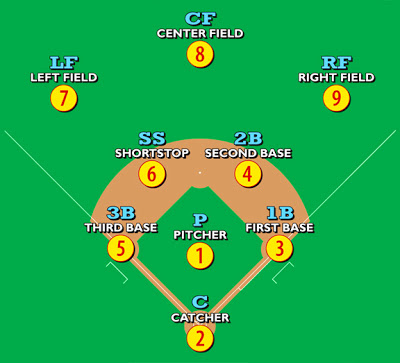
Baseballpositions copy“Absence makes the heart grow fonder,” so the saying goes. Of course, it’s a saying about love between two people, but it’s true of any sort of relationship. Teams are relationships and, nine times out of ten, well-functioning teams are a sign of healthy relationships. When someone is missing in the relationship, it shows.

I’m a big sports fan and as the sports teams of Boston rally around the city, maybe it’s not so out of place for me to think of my research team in the same way. Going with baseball, Mary Jo is on the disabled list right now. We’re without her. Just as the Yankees are without Derek Jeter, our team is without it’s anchor.

Yes, I know that it borders on anathema to use Jeter and/or the Yankees as my example here, but they DID sing “Sweet Caroline” at their game after the bombings, a display of sportsmanship and humanity that, quite frankly, made me fear the end of the world is near!

The project manager of a research team is akin to the captain. This is the person that knows what’s going on across the board. S/he is the go-between, the person that everyone communicates to and/or through in the process of the work. The project manager gets copied on every email, every memo. As mentioned earlier, s/he calls the team meetings, sets the agenda, keeps us moving in the right direction.

Principal investigators are the managers – sometimes the on-field manager, sometimes the general manager. They keep the big picture in mind, always. They know the bigger goal. They know the details of the day-to-day, too, but always within the context of the research question and how we’re getting to the answer. I’ve noticed that it’s one of our PIs who usually asks the question(s) that bring us back to why this study is being done in the first place. Like the manager of the ball club, the PI always says, “We’re here to win the World Series,” even if the World Series is about answering a question regarding the effectiveness of a particular intervention on getting women to have mammograms.

The analyst is the catcher. The analyst can look at the field and the position of the other players and say, “shift left” or “shift right”. The analyst is the one that the pitcher and the infielders look to when they wonder the history of the next batter or the next question for analysis. They know all of the variables. They know all of the holes. They know how to fix something in a hurry – on the fly – to get the next batter (or problem) out. Without a good catcher, you can get a lousy pitching staff, a bunch of passed balls, and a big ol’ mess of a defense.

On my particular research team, there are other specific players. There’s an individual who trains and manages the people who make the scheduling and intervention calls (instructor). She is like a bench coach; a one-time player who excelled at understanding the process. This skill allows her to create processes and systems that work, and then translate them clearly to the players. She does a lot of tweaking, but not enough to disrupt the mechanics of the whole motion. She works daily to solve the little problems so that none of them become big problems and a 2-game losing streak doesn’t turn into a lost season.

There are others on the team, too. There are equipment managers (IT gurus and programmers), the ones who keep the data and all of the systems that collect it up to speed. They know the nuts and bolts, and they get a lot of the blame when we bring the home uniforms for an away game. It’s a thankless job, for sure, but essential. Without them, we don’t take the field OR gather any data.

There are also several other coaches, managers, and front office staff (research directors, coordinators, and assistants) who oversee particular aspects of our team. They make sure that we have enough fans (subjects) coming through the gates. They insure quality customer service. They know all of the rules and are careful that we play by them, going back to the IRB whenever necessary. Their names are in the program, though few people know who they actually are or what they actually do. Until they aren’t there to do it.

And then there is me, the informationist. What’s my role on the team? Well, I’m still figuring that out. Am I like the designated hitter, a position introduced later in the game (actually, 40 years ago this season) that people still argue about in terms of its relevance to the game? Am I a late-season call-up, the player that gets added to an expanded roster? Maybe I get in for a pinch-hit, now and then. Maybe I get to pinch-run for the slow power hitter.

Ideally, I hope that in time I become the utility player; the invaluable player that can fill-in at multiple positions because s/he has multiple skills. The utility player is rarely an all-star, an MVP, or even a starter. But the utility player is the one who can be called on any day, in a variety of situations, to provide what is needed for the team. I like to think that a skilled informationist is one who knows the research process well enough to understand what’s going on where. S/he knows statistics well enough to understand the questions being asked and the discussion going on. S/he knows information management, information organization, information flow – s/he knows how pieces best fit together to form a knowledge base. Maybe s/he can’t throw a strike to third base from right field, but s/he knows when to cut the ball off and throw home, nailing the runner at the plate. And lastly, the informationist doesn’t mind sitting out a game. S/he doesn’t have the ego that gets bent out of shape when the team meeting goes long and s/he doesn’t get to have an at-bat, or give an update. S/he is ready next time. S/he is a supporting player, but one with a specific purpose and specific skill set, and thus, part of the team.

In all honesty, a team manages okay a lot longer without a utility player than without its captain. We’re going to flounder a little until Mary Jo gets back on the field with us, but we have a good team and we’ll stay afloat in the standings. I don’t doubt this. And as for this utility player, playing on a team with such a captain only makes me want to play harder.

Get well soon, Mary Jo!

Let’s Ask the Expert

26 Mar

Normal Distribution

The research team has a new statistician; not a new analyst, but new statistician. If you look at it as a pecking order, the statistician oversees the analyst. Our former statistician retired recently, leaving the team to find a replacement. The University has a relatively new Quantitative Health Sciences Department and many of the services once procured through individual department statisticians are now going through QHS. Or at least this is how I think it’s going. These are things that I don’t necessarily need to know and as I have plenty of things occupying my “need to know” gray matter right now, I can just follow along here.

The significance of the new team member, to me, was that it generated the need for a meeting so that he could be brought up to speed on the project. This meeting happened this afternoon. I believe it was good for him (as well as the Chair of the Quantitative Methods Core, his boss, also in attendance). I know that it was good for me. I’ve now heard the project and its various aspects described on a number of occasions, and each time gain some new insight. Today, that insight was that I have a pretty good grasp on where the data for this study comes from, the different sources that generate it, how it’s stored, where it’s stored, who’s managing it, and so forth. I also had a pretty clear understanding of where the problem spots and/or issues with it are (mostly gone over, yet again, in today’s morning meeting).

I decided to pay close attention during the meeting on the questions that the statistician asked. I imagine that these are the kinds of questions that an informationist, embedded librarian, or anyone concerned with data management and planning would ask a research team. Here are some that I noted. If you’re doing an interview with a researcher about his/her data, are you asking these questions?

  • Is the data in one place or multiple places? 
  • Do the different sources merge together easily?
  • Are the variable names consistent across the sources?
  • Where is the merged data stored and how?
  • When and/or how often do you do data pulls from the sources?

Additionally, the statistician said that he wanted to be walked through the process. He wanted to generate a visual for himself of how everything works together. I found this request confirmation of much of what I’ve been reading and thinking about in terms of how we best see, understand, and communicate systems and processes. Visuals are important. I remember meeting with one of the chief programmers a few months back and how helpful it was when he pulled out a marker and drew us a picture on the whiteboard to explain all of this.*

*NOTE: If you’re interested in the art of explanation, check out The Art of Explanation by Common Craft founder, Lee Lefever. I’m pretty sure I mentioned this a few posts back, but in case you missed it… Also, Common Craft has made wonderful templates of their cut-out characters available for free to download and use in your own creations. Give it a try and see how well you do at explaining a concept or problem. Make a little video and share it with me.

So, if you’re keeping up with the process of the research study, the next step for the statistician is to collect data from the first cohort and start to play with it; see what it shows so far; see if it identifies any gaps of missing data and/or holes in the process that need to be addressed. It’ll be a couple of months, at least, before we hear back, but it was obvious that the team was excited about this move.

A few questions that I’m left with, following today, are:

  • What’s the difference between an analyst and a statistician?
  • What is my role, if any, in this aspect of the study?

One last interesting aside – When we went around the table to introduce ourselves and I said, “I’m from the library, serving as the informationist,” Dr. Barton, the Director of the Quantitative Methods Core said, “Oh, good.” I’m the only one who got an “Oh, good.” I’ve no idea what he meant by it, but I like to see it as a positive sign that my library is engaged in this kind of work. Regardless, it was a nice gesture.