Archive | Day-to-Day RSS feed for this section

Add it Up

10 Oct

The theme for this month’s international Open Access Week celebration is entitled, “Redefining Impact” and will focus on alternative metrics (altmetrics) and the emerging realization that there are better ways to measure the reach of one’s research than simply how many times a published article about it is cited. Publication certainly has value, but in today’s world with so many faster, far-reaching, and varied means of communication, scientists and others in academia need to recognize – and track – how well their work is or isn’t getting to its intended audience (and, perhaps, beyond).

Similarly, with funding harder to come by and the cost of everything rising exponentially, e.g. healthcare, education, food, clothing and shelter, the pressure is on from administrators, funding bodies, and the general public for these expensive endeavors to demonstrate their value. If the NIH gives a scientist several million dollars to carry out research, the expectation is that the outcomes will be worthy of that grant funding. If you pay $100,000+ for a four-year education, you expect to walk across the stage four years later with more than a piece of paper claiming you have a degree. More and more, we want demonstrable value for our investments.
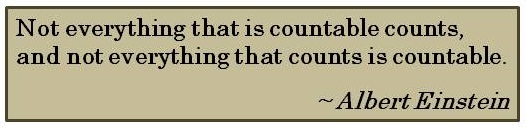
countable quoteIn such an environment, we have to begin to investigate these altmetrics. For libraries, the traditional practice of tracking gate counts, circulation statistics, reference transactions, collection size, and other straightforward numbers that measured … well … numbers, it is past time for looking at alternative means to really answer the question(s) of our worth. As Steve Hiller, director of assessment for the University of Washington Libraries noted in an article for Information Outlook last year, we need to ask, “What makes a library good?” We need to look at these traditional metrics and ask if they’re truly yielding measures that matter. (Information Outlook, 16(5), Sept/Oct, 2012) 

Yet, value is a difficult thing to measure in numbers, of course, and this is what makes the task so difficult and, often, elusive. There are many articles and blog posts and online discussions on the topic of assessing the value of libraries, written by people with much more expertise in the area than I have. If you’re interested, I’d recommend Megan Oakleaf’s white paper, The Value of Academic Libraries, that grew from the ACRL-commissioned study of the same name, as a starting point.

In this post, I want to ask instead how we measure not the value of libraries, but librarians. What are the altmetrics that we need to collect on ourselves to demonstrate that the work we do matters to our patrons? As an academic librarian, I’ve built my portfolio of those tools that we tell researchers to build themselves. I have my ORCID profile, my ResearcherID, and my ImpactStory. I’ve registered this blog with ScienceSeeker. I have a LinkedIn account. I put my presentations on SlideShare. I tweet prodigiously (@mandosally).

These things have been successful in raising my profile within my profession. They’ve garnered me a small band of loyal followers, invitations to speak at conferences and to be part of webcasts, the opportunity to teach classes to a number of library staffs, and the odd-but-thrilling connection with a few real celebrities. It’s all wonderful stuff and I wouldn’t trade a bit of it. But… what does any of it say regarding my value as a librarian to the research community that I serve here at the University of Massachusetts Medical School? How do I measure that? What altmetrics are there that I can track and collect and show to my administrators to prove to them that I am, in fact, adding value to the work of the people that I serve and thus, ultimately, to the library?

I thought of this question earlier in the week when I was putting together a traditional altmetric profile (how’s that for an oxymoron?) for a faculty member here. As part of OA Week, we want to give a presentation on altmetrics and my library profile just isn’t going to cut it for an audience of researchers, so I asked Dr. Sherry Pagoto if I could use her as a guinea pig to set up all of the previously-mentioned profiles for her. Her reply was, “Cool! Yeah, I’d love to see this data (I think!).  I’ve been wanting to set this kind of thing up but haven’t gotten to it, so this will be fun!” Later, when I had her ImpactStory profile pretty well done, I tweeted it (of course!) and it prompted this “transaction”:

Sherry ImpactStoryTo me, this is an unequivocal demonstration of my value as a librarian on that particular day. I did my job and I did it very well and I have the proof, in a tweet, of this fact. Great, isn’t it? But short of taking screen shots of tweets and email replies, short of catching conversations with grateful patrons on video and posting them to YouTube, short of saving notes and phone messages and journal entries describing “good days”, how do I systematically capture all of this “value”? It’s a challenge. It’s perhaps THE challenge that any and all of us who work in information, innovation, and intellect, and the service roles that operate in those realms, face. It’s perplexing.

This week I’ve been reading Kim Dority’s book, Rethinking Information Work, and I really resonated with her sentiment that ultimately we are all self-employed.

And believe it or not, this is good news. Because if we understand that regardless of our current employment situation we are solely responsible for the well-being of our careers (and paychecks), that means we can take control. We can focus not on lifetime employment, but on lifetime employability.

One thing that I often find myself saying to colleagues, particularly newer grads from library schools, is that when you successfully embed yourself in the work of your patrons, your own value – and your job security – rises much more than if you were only trying to prove your value to your library directors and managers. This is because, if you want to talk numbers, there are more of them than there are library directors and managers. The word gets out that you’re worth having around – that you can do this and that and the other thing that they never knew before. And suddenly, you have done for yourself what can’t easily be captured on any annual evaluation, but is worth much more. You have made yourself employable, regardless of any circumstance. In a time of tight budgets and job cuts and the very real struggles of librarians to keep their libraries open, this is likely the biggest asset you can have.

Perhaps for a long time, librarians depended upon their libraries for their value. We counted on the intrinsic value of the institution to give us worth. Perhaps today, however, it’s the institution that is dependent upon those of us who work in it to bring that value back. And this is why, I believe, we need to shift the discussion from measuring the value of libraries to measuring the value of librarians. Those are the altmetrics that I’m still waiting to see emerge.

The Talented Mr. Ripley in the Library with the Candlestick

25 Sep

I’ve had a rotten week or at least the kind of week where too many things haven’t gone the way I’d like them to go; online conference applications, insurance company coverage changes, my puppy. I say this as a preface to today’s post, stating that while I’m still the biggest cheerleader for library innovation and new roles, right now I’m tired. And it might show in my thoughts below.

Patricia Highsmith was a terrific writer who could create a story of suspense to rival the best; her novel, The Talented Mr. Ripley, the perfect example. If you never read the book, you might recall the movie adaptation that came out in the late 1990s and starred several pretty people – Matt Damon, Jude Law, Gwyneth Paltrow, and Cate Blanchett. It’s a story of a young man who so longs to live in a world of which he is not a part, that he befriends someone in the circle on false pretenses, and ultimately (SPOILER ALERT) murders him to assume his identity.

Lately I’ve been feeling a little Ripley-esque in my work.

Being a part of a research team is a great experience. As I’ve written numerous times over the past months, one of the things that defines the embedded informationist is having a place on the team. An equal place. Everyone brings his/her skill set and expertise to the team. As I’ve served on the mammography study team, the mHealth project, the Community Engagement Research Section, and a grant-writing team for a potential PCORI study, I’ve been more than welcomed as a true team player and one who brings needed knowledge and skills to the work. I love what I do.

But the truth of the matter is that not everyone on a team is equal. An embedded librarian, no matter how much s/he builds partnerships and collaborations over support roles, is still, by the nature of the work that we do, providing support to the work of the team. Information management, knowledge management, data management… it is all essential, but still something like the infrastructure of the team, i.e. a foundation for things to run more smoothly, efficiently, and effectively, but not in and of itself (necessarily), the driving force. That role(s) falls to the researchers. They are, ultimately, at the helm.

Every now and then I have the crazy notion to apply for our doctoral program in Clinical and Population Health Research. I’m too old and too in debt with student loans already to take on yet one more degree, but the thought intrigues me, particularly as I work so closely with the students and faculty in that program and teach them myself about how to search, access, and organize good information in their research. Once, when I was entertaining the thought more strongly than others, I asked a faculty member what she thought was the best part about having a PhD. “You get to decide the kind of work that you want to do,” she said, “Rather than always doing what others decide for you.”

It’s a significant point. Tom Ripley was never a true peer to Dickie Greenleaf, because he was not of the same pedigree. Doctors travel in the circles of doctors, researchers in the circles of researchers, and librarians in the circles of librarians. This isn’t to say that we don’t mix and mingle OR that we don’t need one another in our respective work OR that we don’t provide those necessary skills to make our respective work go better. But we do have different jobs and with them, different expectations, obligations, and/or constraints. We know our own worlds best and while we can do really, really well operating in another’s world, it still isn’t quite ours.

My Tom Ripley persona is no doubt brought on lately by my sense of being pulled in multiple directions. This is natural, I know, for anyone juggling multiple projects. It’s hard to stay on top of everything and it’s easy to feel overwhelmed. The same qualities of the work that make it so exciting and fun, e.g. variety in subjects and people and tasks, also make it feel, at times, like a tidal wave. After all, an embedded librarian is still only one person, and as is almost always the case, also a non-embedded librarian. In other words, you give a lot of yourself and your time and your focus to the teams of which you’re a part, but you’re also still a part of the library and with that comes a whole other plate of responsibilities and an environment that, even at its most flexible and/or autonomous, answers to a public and an administration that requires people to be at certain places at certain times.

It’s part and parcel of working with the public, something that is not necessarily an issue in research. Yes, some researchers work with the public. Clinicians certainly work with the public. But there is a schedule in those worlds often driven more by the former’s calendar than the latter.

Similarly, many of the researchers (particularly clinical researchers) that I know wear multiple hats. They see patients, they sit on teams, they teach, and they work for different departments. They also balance a lot of things. Yet, there is something different in their work, compared to mine. Or at least I feel that way today. (Maybe differently tomorrow.) One of the things that I think that’s different for these professionals, compared to librarians, is the understanding that continued education and professional growth is a given. It’s an expectation of your work. It’s part of your work. After all, if you don’t stay up-to-speed on your skills and your subject knowledge, you become somewhat dangerous, if you’re a doc, and/or irrelevant and unfunded, if you’re a researcher.

Librarianship, in many ways, was able to manage for a long time without being on the cutting edge, yet when information started flowing in the unfathomable volume and speed we see today, anyone working in the field of information who hasn’t kept up is pretty quickly getting swept aside by the torrential rush. We now HAVE to keep up. Heck, we have to keep ahead! And not only in our “dominant” field of librarianship, but also in whatever other areas we hold up as the “extra value” that we bring to our teams. Remember, the original idea of the informationist is a person with both library knowledge and skills, AND expertise in a clinical or research area.  (Davidoff and Florance, 2000)

The informationist who cannot afford to keep up his/her knowledge in both areas gradually becomes less and less effective in his/her work. And this, my friends, is where our professional circles lose their Venn Diagram overlap. Our emphasis is still very much weighted in favor of improving our librarian skills over the other knowledge/subject areas/expertise that we bring to the table. For those, we still need to do a lot of work outside of work, on our own time, on our own dime, and of our own initiative.

Now I don’t want to sound like I’m whining. I imagine that anyone who seeks to be really good at what s/he does, does this. I know that I’m never going to be a better mandolin player without practicing; without doing a lot of work at times that I could be doing something else, and for an amount of money that I could be spending on something else. But that’s me learning to play my mandolin, not me learning to do my job better. I know that researchers don’t have unlimited funds and/or time to go off willy nilly attending every conference or class that they wish, either, but I do think that in this age of multidisciplinary and cross-disciplinary research, librarians who want to support such projects need to find a way within our working lives to follow the lead of researchers and keep current in multiple areas.

Ahhhh… but that’s way easier said than done when we’re still part of a department that is dependent upon a core group of people, resources, and services to remain viable. Embedded librarians and informationists, unless they are full-time employees of a clinical/research department (or dare we one day go the way of consultants), still answer first and foremost to their libraries. At least this is still our expectation. I don’t know if, when, or how it could change, but in my own personal quandary, trying to figure out where we belong most now, I’ve been asking if it needs to change. And while I don’t believe that any change will help us completely shed our separate circle from the docs and PIs, I do believe that any and everything we can do to gain credibility in their circle is warranted. And few things do that better than being able to speak their language, not just librarian talk.


The Future is Now

30 Aug

(This is the second part to last week’s post. If you missed that one, you can read it here.)

We said our goodbyes yesterday. We shared donuts, coffee, memories, and hugs, and then our colleagues of the past many years moved on. The next chapters in their post-LSL lives have begun. And for those of us still here, we’ve a bit of a blank page staring us in the face, as well. But like my former colleagues, our new journey isn’t completely without structure. There is a plan. There are ideas. There are theories that we will now attempt to put into action. As I’ve repeated often, no one knows all of the answers nor how it will all turn out, but in this post, I’ll shed some light on the big-picture plan, and where and how we hope it will lead us.

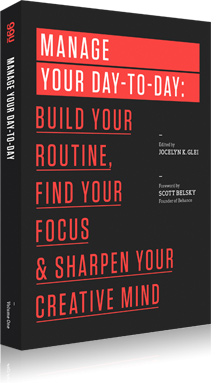
Manage Your Day-to-DayI’ve been reading a book this week entitled, Manage Your Day-to-Day: Build Your Routine, Find Your Focus, and Sharpen Your Creative Mind (ed. by Jocelyn K. Glie). It’s the perfect Kindle book for those times when you’re forced to spend hours in the dentist’s chair and on the couch, battling a nasty infection. It’s a great collection of tips from a lot of recognizable voices in the creative world. A product of 99U, the brainchild of Scott Belsky and his company, Behance, it’s a web-based clearinghouse of all things for creatives. Personally, I’m hanging my hat on the idea that creativity will be the thing that fixes and/or saves a lot of things in our society and workplaces, and if not, learning about it and adopting many practices of creatives makes me feel a lot better about myself and my work, so if for no other fact than that, I keep up.

But back to the book. The title “99U” comes from the quote by Thomas Edison, “Genius is 1% inspiration, 99% perspiration.” In the intro to the book, Belsky writes, 

For too long, the creative world has focused on idea generation at the expense of idea execution. … To make great ideas a reality, we must act, experiment, fail, adapt, and learn on a daily basis.

While he limits this thought to the creative world, I expand it to the world of libraries, education, and health care; three large and powerful institutions that merge in my academic health sciences library workplace. Implementation is always the sticking point. Putting theory into practice is hard work. It’s messy. It’s risky. And it’s bogged down at every step, it seems, by the roadblocks of resistance to change, fear of the unknown, or perhaps the most sinister bedeviller of all, apathy. So often, in an unceasing world of work stress, after awhile people simply no longer care. We just want to hold on until we can find the exit door to retirement or the winning lottery ticket. And that’s pretty sad, because for many of us, those options are no longer. Personally, I never imagine being retired. I don’t see it as a possibility in my future. But rather than let this be some kind of depressing bell toll on my work life, I’ve chosen instead to see it as a call that I’d better find and/or make my work life something that I darned well enjoy because I’m going to be doing it for the rest of my life. Whatever it may be.

So how does this fit with the changes in my library now? Well, for one, it’s a message that I’ve been reminding myself of daily. It’s not the easiest time to believe it, but I’m saying it anyway. I’m believing it anyway. I’m writing it here to those who read this blog, colleagues and friends, who are facing the same. As the current president of my regional chapter of the Medical Library Association, I’m preaching it to folks in the pews. They may be sick of hearing it now, but I’m going to keep on saying it… the future is now! If you honestly believe that health sciences libraries and librarians are of value in health care, then the time is now (actually, it was about a decade or two ago, but… better late than never) to put some of our big ideas, our new ideas, our challenging ideas, into practice. We must redefine who we are and what we do, in the mindsets of both ourselves and our patrons. This is not because there isn’t value in our past, but rather that our past is not going to make it in the now or the future.

Am I completely comfortable with this idea? Heck no! In fact, when I sit and think about how different my job is today, I can really struggle with the ideas that I both like the new work and that it feels like it’s taking me further and further away from what I once thought I’d do as a librarian. But that struggle is my struggle to redefine. And if it this is hard for me, I can only imagine how difficult the challenge is for someone without a 24-7 dedication to the institution of libraries and the profession of librarianship. Challenge. Capital “C”. 

At the Lamar Soutter Library, we’re bringing “4 Rs” to meet this “C”. This is a pretty different approach, i.e. a big change for a big challenge. It involves the nurturing of new librarians, those recently out of their graduate programs, by giving them hands-on, professional work in an area that interests them, i.e. health sciences librarianship. It brings together those of us with long term experience and expertise, with those who are fresh out of school, filled with energy and ideas and a desire to implement some of the things that they’ve learned. On paper, it’s a win-win. Those of us who need help in our new endeavors will get it through our library fellowship program. Library fellows will get a full-time, professional job where they can both learn and contribute from the get-go. And our profession, overall, will gain in the recruitment of new blood, new energy, new people to work and serve and hopefully, one day, lead. 

As like last week, my Library Director, Elaine Martin, prepared a presentation that describes the fellows program in detail. She’s graciously posted it on her slideshare account, making it available for others to view, utilitze and comment (Implementing the 4 Rs: Moving Forward and Defining a New Model of Librarianship). You’ll note that first and foremost, this change is about providing opportunities for new health sciences librarians. “Why?” you might ask. Why opportunities for them when we’re struggling to keep our own jobs? Well, maybe because if we don’t invest in our future now, there will be no profession tomorrow. People have been bemoaning the fact that we’re dinosaurs for too long. One way to silence those critics is to invest in the future. Was seeing people lose their jobs in order to make room for the future difficult. 110%. It was hard and it was sad and I didn’t cry crocodile tears yesterday when I said goodbye to one of my closest colleagues during my tenure here at LSL. The feelings of hurt are very real, but the hope for a different, more effective, more relevant future is what I’m holding on to now. And I believe that this program has a chance to get us there.

We’re placing an emphasis on research and professional development in these fellowships. We will address “mission critical areas” in their day-to-day training and work, but will also provide an environment where they will be expected to grow as professionals and this includes gaining experience in doing research. (I have tooted this horn forever, so you can guess that it’s a BIG happy spot in the program for me.) It is at last seen as a priority that, as a profession, librarians must be competent at doing the kind of research that will, over time, build the body of evidence necessary to prove our worth and value to evidence-based administrators. Enough with the “we search better.” Prove it. Enough saying that we have a place in getting health information into electronic medical records, that we have a role in data management. Get out there and do it and then do the research necessary to evaluate these programs so that we have something concrete to stand on when we sing our praises.

When are we going to manage doing this in already overloaded schedules? I don’t know! But I know that I like the idea of operating much more like the patrons that I serve (granted, they are researchers); constantly questioning, constantly researching, constantly watching and constantly stressing about where the next dollars will come from, the next grant opportunity will raise its head, the next opportunity, in general, will arise. As an exercise physiologist, I learned a lot about eustress; good stress. Eustress is the kind of stress that we need to help us grow. Muscles need to be stressed in order to get stronger. So do our minds. There may well be something to be said for embracing this kind of stress in our work today. Stability is grand while it lasts, but over time, it leads to a sense of complacency and entitlement that may well prove our downfall. Maybe it’s good to have a little stress, not so much in the area of work overload, but in that of pushing ourselves into new areas, knowing that if we don’t, we’re done. 

To close, I want to return all the way back to the beginning, where I mentioned that book. I’m reading that book because I absolutely know that one of the skills I have got to master in my role as an informationist, as an embedded librarian, is efficiency. I have to learn to set boundaries, plan a schedule and stick to it, take care of the big things first, and know how to say “yes” and “no” appropriately. I need to be a whole lot better at managing multiple, complicated projects at the same time. I need to articulate reasonable goals (in time and in skill) for myself and those I seek to work with. I need to take the time to know (even catalog) the things that I do really well, utilize them the most, and improve on the areas where there are gaps that can prevent success. 

I once heard a doc say that the hardest thing about developing and implementing an EHR system is that it’s like trying to change the engine of a 747 while it’s in mid-flight. You can’t stop what you’re doing long enough to make the changes because you risk crashing the plane. But you have to figure out how. So do we. 

And now I’m off to a meeting of one of our Transition Teams, the one charged with coming up with how we will provide needed reference services without staffing a service desk, a pager system, or an “on call” librarian system of any kind. Our recommendation to the Management Team is due October 1. Out of the box thinking, folks. Let’s go!

NOTE: If you or someone you know is interested in applying for our new fellowship program, the announcement is now available on the Human Resources site of the University of Massachusetts Med School. If you have any questions, you can feel free to contact Elaine Martin and she’ll be more than happy to answer your questions.