Tag Archives: librarianship

Iterations on a Profession

6 Apr

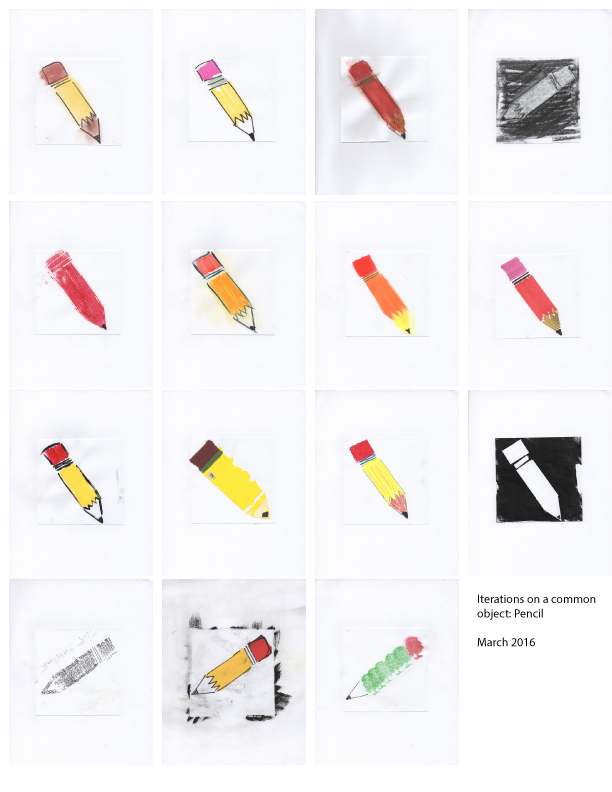
PencilsI’m currently taking a 4-week course, Fundamentals of Graphic Design, via the online learning platform, Coursera. In pulling together the content for the Data Visualization course that I’m developing for a local college, I realized that I need to include a crash course, i.e. one week in the basics of design, thus I thought taking this online course would give me some ideas for how to cover the topic myself. Plus, I could learn some things and improve my own skills. The first week we covered the image and the assignment was to create at least 10 iterations on an everyday, common object. You can see here my takes on a pencil.

Creating these images reminded me of my professional journey and in particular some of the struggles I’ve been feeling of late regarding where I fit in professionally. Since I started my career in librarianship, I’ve belonged to several related professional organizations – the Medical Library Association, the Association of College and Research Libraries, the American Library Association, the Special Libraries Association, plus regional chapters and state organizations associated with each of these. I’ve tried different groups at different times, looking for the best fit as my work changed. Among these, the one organization that I’ve invested the most time and effort (and felt the most a part of) for the past dozen years has been the Medical Library Association. It makes since, since I worked the first decade of my career in an academic medical library (and even today still work at the same medical school). Regardless of how many times that my job title and/or role changed within the Library, I still worked in a medical library and thus, MLA worked for me.

One of the things I’ve most enjoyed about being a member of MLA is attending the annual meeting. It’s where I get to see so many of my friends and colleagues, where I’m always renewed and energized by the sessions and speakers and topics, where I get to share some of my own work with colleagues, and where I remember where I belong professionally. It’s such a highlight of my professional life.

Last week, I withdrew my accepted posters from this year’s meeting and accepted the decision that I’d not be attending MLA 2016 in Toronto. I’d be lying if I didn’t say how sad the choice makes me. But it’s the choice that I had to make. As I looked through the content of the meeting this year, there simply wasn’t enough related to the work that I do as an evaluator for the UMCCTS. There aren’t any sessions devoted to librarians working with and/or as part of their CTSA offices. There aren’t enough talks about measuring research impact and evaluating programs (outside of evaluating library programs). Given that I’d be paying to travel and attend out of my own pocket, and knowing without enough related content offered I’d have to take personal vacation time to attend, I just couldn’t justify the expenses. And it makes me really sad.

Since I left the physical library to use all of the very same skills that I possess as a librarian, it’s become harder and harder to face the fact (or is it “harder and harder to ignore the fact”?) that most folks, even many I consider colleagues, don’t think of me as a librarian anymore. What makes it all the more difficult is my “new” professional home, the American Evaluation Association, hardly feels like home either. Despite the fact that our skill sets overlap in so many areas, despite the fact that I got the job I have today because I have the skill set of a librarian, it seems like evaluators are evaluators and librarians are librarians, and a librarian who happens be an evaluator is an odd duck, alone in the pond. 

I don’t wish to turn this post into a pity party. I enjoy what I do, I’m very proud to be a librarian, and I know that despite the inability (or at least difficulty) of our professional pigeon holes to expand, those of us willing to seek out new and different opportunities will find them. It’s not always easy, but it’s okay. Yes, I’m sad about the particulars of this year’s MLA annual meeting and I’m grieving a little, knowing I’ll not be having fun with friends in Toronto, but more than anything, the situation has caused me to think a great deal about the benefits, the purpose, and the future of our professional organizations. Why do we have them? What do they provide? Why do we belong? I’ve been part of executive boards of these very groups, asking these very questions for awhile. It isn’t new, but it did hit me differently this go ’round.

The instructor for my graphic design course said that when you do iterations, you need to push the boundaries; work with the image until you get right up to the point where it falls apart – where it no longer resembles the object you started with. I’ve been thinking a good bit if that’s not the perfect metaphor for my professional journey as a librarian. I’ve pushed many boundaries of the profession and now I wonder if I’ve pushed to the point that the image of me as a librarian has fallen apart.

Listen Up!

17 Jul

podcastI need to offer up a HUGE thanks to my friend and colleague, Kate Thornhill, Research and Instruction Librarian for Digital Scholarship at Lesley University’s Moriarty Library in Cambridge, MA, for recently turning me onto the terrific podcast, Lost in the Stacks. From WREK, the student-run radio station at Georgia Tech University in Atlanta, the show is hosted by Charlie Bennett and Ameet Doshi, along with Anthony Nguyen, Fred Rascoe, Lizzy Rolando, and Wendy Hagenmaier. All librarians at Georgia Tech University in Atlanta, they bring an hour-long program offering really interesting interviews with librarians focusing on all sorts of cool themes. But it doesn’t end there. In between the interviews and/or segments, they play some pretty groovy tunes, an eclectic mix of great songs. I just LOVE it!
I imagine that Kate sent me the info on this show because one of their most recent programs, Once a Librarian, Always a Librarian, offered up interviews with Elizabeth Keathley, Chief Officer and Digital Asset Manager at Atlanta Metadata Authority and author of Digital Asset Management, and Nisa Asokan, Editor at WebMD and Co-Owner, Manager of the music production company, Tight Bros Network. Being one who easily falls into the “Once a Librarian, Always a Librarian” career category, I appreciated so much the thoughts, ideas, and insights shared in this episode.

The first segment begins, “One thing you might notice about the job titles for both of our guests is that they do not have the word ‘librarian’ in them, however, both have degrees in library science.” I could offer you a nice summary of what Elizabeth and Nisa had to say about their jobs, their work, their titles, and their salaries, but I’m not going to do that. Instead, I’m going to tell you to seek it out and listen. It’s a wonderfully optimistic – and very true – view of a profession that opens so many doors to so many fascinating careers, if one wants them.

With other episodes in their archive like Beach Libraries, The DC Punk Archive, and Avoiding Dead Air, you can bet that Lost in the Stacks is going to easily find its place on my Friday afternoon playlist from now on. Thanks, Kate! And thanks to those bringing us this show.

Taking Inventory

7 May

I was invited to present a webinar to a group of military medical librarians. Originally, back in 2011 when I first got the invitation, I was going to offer up something related to eScience (based on a webinar I’d done for the NN/LM GMR around that time). A few hiccups along the way and the event got put aside for a few years. When the organizer came back to me late last year, I said that I was happy to still present, but that my job was different now. We decided upon the topic of transition in health sciences librarianship, i.e. how the profession is changing and how librarians within it can change, too. Here’s what I came up with:

USAMRIID 1

While my job title has changed many times over the past ten years, most noticeably last December when I moved from the UMMS Library to the UMass Center for Clinical and Translational Science, I still think of myself as a librarian. I’ve done many things under that umbrella – tackled all kinds of projects and honed many skills. That’s one of the best parts about being an information professional today. Information drives so much of everything. The more you can learn, adapt, refocus, redefine, etc., the better off you’ll be in terms of having a fulfilling and enjoyable career – either within the walls of a library or not.

USAMRIID 2

I heard a great presentation at MAHSLIN’s Annual Meeting last week by Jean Shipman, Director of the Spencer S. Eccles Library at the University of Utah School of Medicine (stay tuned for the sketchnotes). Besides the content – applying Lean process improvement principles to projects in her library – what I liked was how Jean structured her talk around 4 case studies. Her presentation followed another terrific one by Varang Parikh, Senior Process Improvement Specialist at UMass Memorial Healthcare. Varang covered the theory and then Jean offered some real-life examples from her library.

As I thought about how to structure my own talk, I thought about how there’s a lot of theory and a lot of talk about transitioning within the profession of librarianship. It’s helpful. What’s also helpful are some concrete examples, thus I decided to follow Jean’s lead and offer up myself as a case study for my talk.

I’ve worked for UMass Medical School for over 10 years. In that time, I can identify 5 distinct roles and/or jobs and/or titles and/or transitions within my career. I often tell people that this is the longest that I’ve ever worked at any one place, not to mention the longest that I’ve ever worked in any one profession. I think that the fact that I’ve been able to assume so many different roles is what’s made that possible. Who can get bored when you’re regularly doing something new?

So in my 10 years, I’ve been a consumer health librarian, a reference librarian, a research and scholarly communications librarian, an informationist, and now a research evaluation analyst. But remember what I said earlier, for me these are all facets of the same profession – librarianship and/or information science. They’re all about dealing with information, that’s the common denominator.

USAMRIID 3

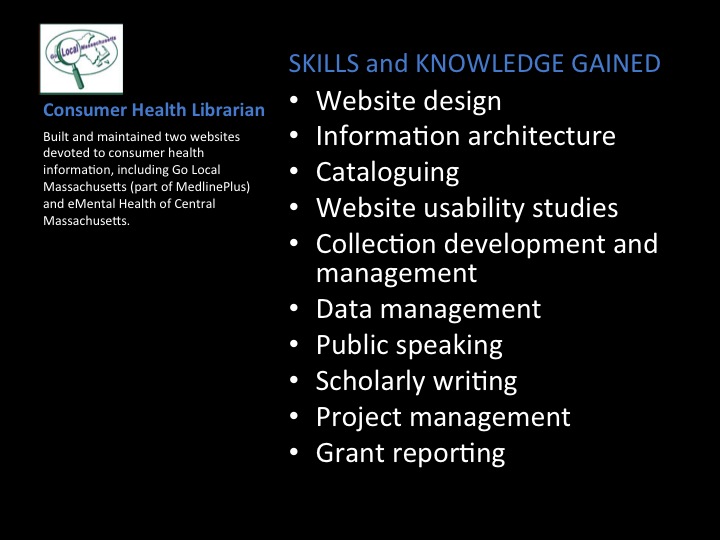
In each of these roles, I gained some knowledge and skills. I decided to take an inventory of these things, to see where they built upon one another or carried over from one role to the next. As a consumer health librarian, working on the projects, “MedlinePlus Go Local Massachusetts” and “eMental Health of Central Massachusetts,” I was able to both put to good use a  bunch of things I’d learned in library school (this was my first job after graduating), as well as add some new skills to my toolbox.

USAMRIID 4

The same thing happened, a couple of years later, when I got to move from being a grant-funded librarian to a full-time staff person. As a reference librarian (something I’d been doing all along, but now more formally), I added to my skill set, essentially adding to my value as a librarian.

USAMRIID 5

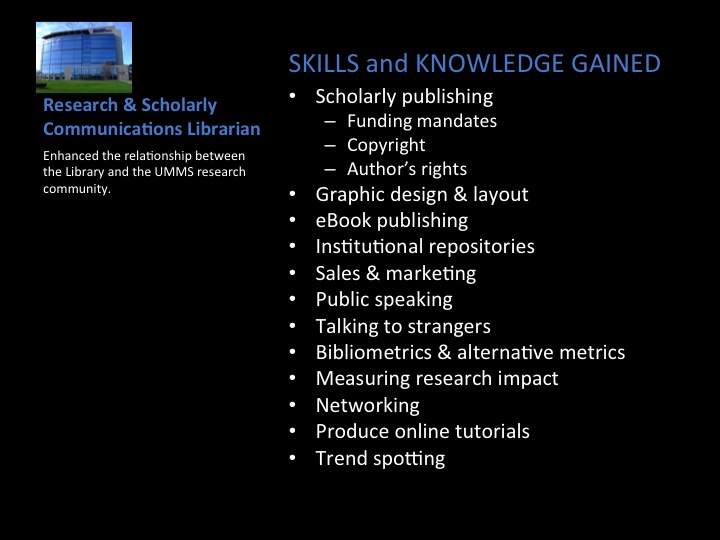
As a research and scholarly communications librarian, I had the chance to do more of the same. I also learned during this time that I didn’t like administration. I don’t do it well, at least not in the context where I was working. I recently saw a colleague who’s moved from administration to teaching and data services in her library. We talked about how it’s hard in our world to not be made to feel like you’re somehow failing and/or taking a step backwards to not be an administrator. Supervision and management, for better or worse, is seen as the one “promotion” in many a business, including higher ed. It’s too bad, since we all know that there are many, many ways to improve in your career without taking that path. But alas, it’s our world. And I share this as encouragement for anyone who’s happy and content finding their professional way along a path that doesn’t necessarily go up a corporate ladder.

USAMRIID 6

As in embedded research librarian and informationist, I gained a whole big grab bag of new skills. In many ways, it’s the transition that transitioned me most. If you read this blog with any sense of regularity, you know how all of these new skills and knowledge and projects emerged. And from them, I inventoried this nice list …

USAMRIID 7

When I added all of these lists together, when I took my inventory of all of the librarian skills I’ve gained the past years, I was amazed. Whenever I teach library school students, I encourage them to start their list now. I offer the same idea/advice to seasoned veterans. Think of all of the things you’ve done in your work and all of the resulting skills gained. Write them down. Take an inventory. You’ll be amazed, too.

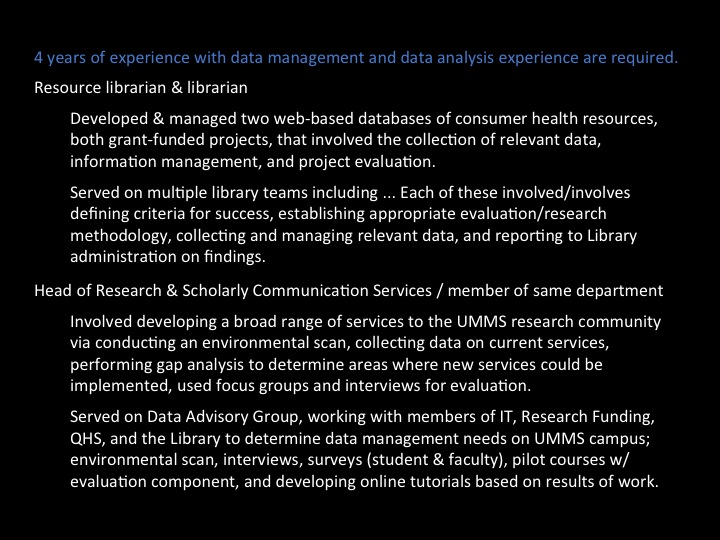
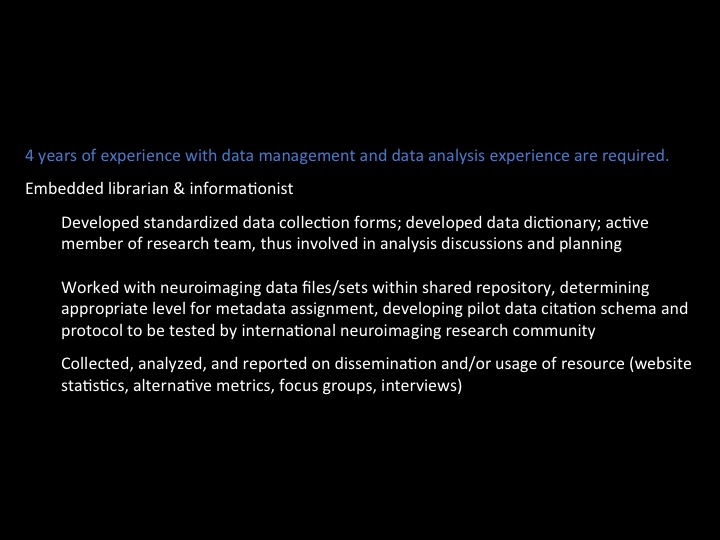
But more, my inventory was put to the test last year when I decided to take my skill set beyond the library altogether. When I applied for the position in the UMCCTS, I had to make the case that all of those library and information and data management skills made me well-prepared to take on the role of a research evaluation analyst. It wasn’t the easiest sell, either, but fortunately I’d also learned perseverance when it comes to making this argument. It’s something we’ve been doing for a long time now, as we’re continually put into the position of demonstrating our relevance and value. So, when our HR department asked me to map my very librarian-centric CV to the job requirements listed in the position announcement, I offered them this:

USAMRIID 8

This was the job listing.

And these were my “maps”:

USAMRIID 9

USAMRIID 10

USAMRIID 11

USAMRIID 12

All I did for these was pull pieces from my CV and put them with the requirements. It was a great exercise (beyond landing me the job), because it forced me to prove what I’d been saying for awhile – that the skill set of a librarian, by any name, is pretty darned valuable and can offer a person any number of opportunities.

USAMRIID 13

And of course, I’m still learning. My new job is filled with new challenges (opportunities for growth) that keep work interesting and fulfilling. For me, that’s the reward of taking the leap.

I left my audience yesterday with three takeaways:

USAMRIID 14

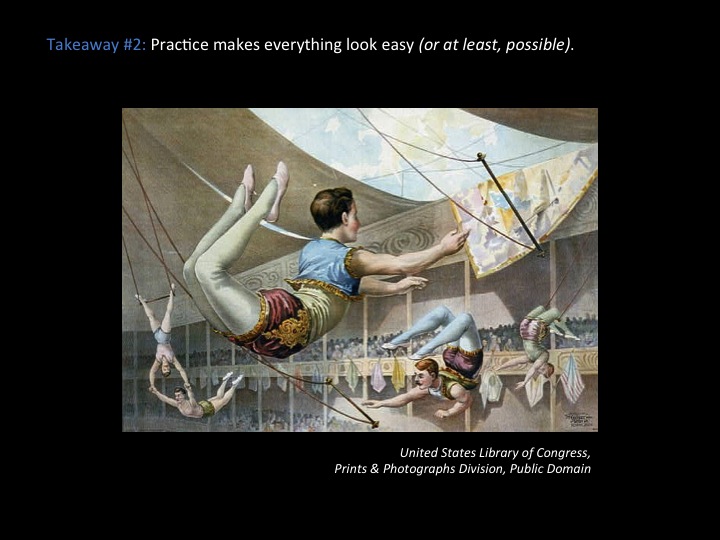
Nobody makes “The Flying Wallendas” varsity team without years and years of practice (and good genes). And the little Wallendas don’t start off by leaping off the high platform. Scaffolding, nets, safety gear … it’s all there. And it’s there for librarians, too. In fact, I think that the library profession has to be one of the most interwoven, networked, supporting professions out there. It is, after all, our nature to share and to help. And we do so for one another all of the time.

USAMRIID 15

Then eventually, you become so good at what you do that people don’t see the nets and the scaffolding. They only see you doing what you know how to do. And you know what else? It doesn’t matter what they call you, either. I feel most pleased when people simply say, “I call Sally because she can help.” It’s not “Sally the librarian” or “Sally the informationist” or “Sally the knowledge manager” or “Sally the evaluator.” Just Sally.

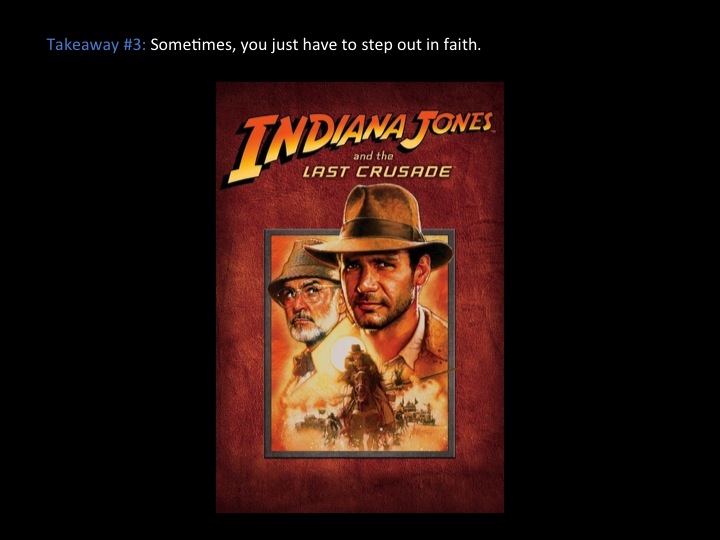
The last takeaway is “Step out in faith.” Just like Indiana Jones in “The Last Crusade.” Step out over the chasm between the library and wherever you want to take your skills and whether you see it or not, a bridge will appear under your feet to take you there safely. (If you don’t know this scene from the movie, seek it out. It’s a good one.)

So that’s what I shared with the group of librarians yesterday. I hope they enjoyed it and got something out of it. And by reading this, I hope you have, too.