The Potential to Have Potential

19 Dec

A quick keyword search of the word “potential” in the books collection at Amazon yields 35,937 results including such bestsellers as:

  • Boundless Potential: Transform Your Brain, Unleash Your Talents, Reinvent Your Work in Midlife and Beyond by Mark S. Walton
  • The Soul of Leadership: Unlocking Your Potential for Greatness by Deepak Chopra
  • The 15 Invaluable Laws of Growth: Live Them and Reach Your Potential by John C. Maxwell
  • Achieve Your Full Potential: 1800 Inspirational Quotes that will Change Your Life by Change Your Life Publishing
  • Your Best Life Now: 7 Steps to Living at Your Full Potential by Joel Osteen

Be it business, education, health and diet, parenting or investing, we are at no loss for advice on how to be our very best; how to reach our full potential.

The Merriam-Webster Dictionary defines potential as “existing in possibility: capable of development into actuality.” Potential is the promise of everything that we could do or be or become.

In 1998, the Indianapolis Colts of the National Football League used their first pick in the draft to select Peyton Manning. The San Diego Chargers chose second, selecting Ryan Leaf. Prior to this draft, there was a great deal of discussion and analysis ad nauseum regarding the professional potential of these two young men. In my opinion, it’s probably the best example one can offer to show that potential is just that – potential. It is not without significance, but alone, it really proves little of nothing in terms of what a person will become. Even the most casual of football follower likely knows that Manning is a future first ballot Hall of Famer. Ryan Leaf, last I heard (early in the summer) was, sadly, off to jail. Again.

DSC_0219

Bubble Rock, Mount Desert Island, Maine. Credit: dgrice

When I studied the concept of energy transfer in exercise physiology (probably physics, too), I learned about potential energy. It’s often described using the example of a boulder resting on the edge of a cliff or water at the top of a hill, before it goes over a waterfall (McArdle, Katch, and Katch, Essentials of Exercise Physiology, Lippincott, Williams & Wilkins, 2006). The boulder and the water have to fall, in order for any transfer of energy (potential to kinetic) to occur. If someone cements the boulder in place or builds a dam above the waterfall, the energy will remain potential. Nothing but potential.

As I slogged my way through David Haynes’, Metadata for Information Management and Retrieval yesterday (Note: The use of the word “slogged” is a reflection upon the reader more so than the author of the text.), I underlined several passages that refer to the library profession’s attention to metadata, the debate(s) over the differences between creating metadata and cataloging resources, and the emerging place of metadata in the curriculum and syllabi of courses within information science degree programs. Haynes’ book was published in 2004. The debate, he writes, began in the 1990s. When I read this last statement, I wrote in the margins, “And it continues today.”

Talk about potential. In fact, talking about our potential seems to be exactly what we’ve been doing in this area for 20+ years. Talking. However, inroads made in educational programs and an entire new field, information science, have risen from the discussions, and the more traditional skills of librarians are now being augmented with ones that prepare them to work as informaticists, informationists, and/or metadata librarians. Small cracks in the dam are appearing, as we start to really tap into the potential once trapped upstream.

With an old year ending and a new one about to be upon us, it seems appropriate to both think and write about potential. I walked into work this morning in front of a few med students on their way to an exam. They were jokingly (I took it as a good sign) quizzing one another on different aspects of diabetes that they’d been studying. The beginning of a new semester always marks a time of great potential – things to learn, assignments to be done, projects to complete. The end marks the time when we can measure how well one lived up to his/her potential. When you look back on the previous months, did you learn everything you’d hoped? Did you make the best use of all of your time? Can you now, at the end of the class, clearly explain to another person what the subject is all about? Did you reach your full potential or do you look back with regrets?

The end of a calendar year is the same. We make all kinds of New Year’s resolutions, often based upon things that we wished we’d accomplished the year before. This striving to be better is what drives the self-help industry. So many people so deeply desire to reach a higher height. We want to be more fit, lose some weight, remember people’s names. We want a promotion or a raise, a better job, something that makes us feel like we’re making the most out of our days and our talents. We have so much potential.

We have so much potential.

Do you ever wonder why there are so many folks ready and willing to tell/sell you how to reach your potential? Is it, perhaps, because we so seldom fall off the cliff? Is it maybe that we like the dams that we’ve built to hold us in place?

Leaving the library, inserting one’s self into a research team, taking the risk to say you’ll do something that you may not be the most expertise in… these are acts of falling. Learning new skills, seeking out new challenges, and redefining our profession release our potential energy. They involve movement and action. They involve change. Perhaps the reason so many people make so much money off of our desires to change is because deep down, we really don’t want to change. And so we don’t. And we buy another book or join another gym.

Carol Dweck, the well-known Stanford psychologist and researcher (and author of a few self-help books), has devoted her career to studying mindsets, particularly fixed versus growth. Libraries, from both inside and out, have been saddled with a fixed mindset. I say “from both inside and out” because it isn’t librarians alone who have a fixed idea of what a library is. In fact, from where I sit (in an academic library), it’s often our patrons who have the more permanent idea of what a library is and what a librarian does. We often say, “They don’t have a clue what we do!” (I’m not going to go into why this might be. Not in this post, anyway.)

In her book, Mindset: The New Psychology of Success (How we can learn to fulfill our potential),  Dweck explains why those with a fixed mindset have such a difficult time taking risks. The reason, she states, is because “effort is only for people with deficiencies.” She goes on to say:

When people already know they’re deficient, they have nothing to lose by trying. But if your claim to fame is not having any deficiencies – if you’re considered a genius, a talent, or a natural – then you have a lot to lose. Effort can reduce you. (p. 42)

Truthfully, I don’t know many librarians who believe they are geniuses. I do, however, know a profession that believes it’s greatest value is expertise, particularly expertise in locating, organizing, and providing access to information. But the truth is that this expertise is valued less and less today. In a world of networked knowledge, knowledge itself is redefined. Everyone is an expert. (For more on this, read David Weinberger’s, Too Big to Know.) And so perhaps the biggest challenge we face as librarians and/or informationists is the challenge to put forth the effort; to take the risk that comes with trying.

We probably all know a person for whom we have said or heard, “She has so much potential.” Who knows? Perhaps it’s been said about you. Too often, I’ve noticed, we hear or say that phrase with a tone of regret. “She could have done so much here.” “He could have been so successful.” The “could haves” and “would haves” of life are often tied to untapped potential and untapped potential is often tied to lack of effort and/or the fear of taking a risk. The higher the cliff, the harder the fall.

Libraries and those of us who work in them are filled with potential. It’s my own hope that when I come to next December and I look back on my full year as an informationist, I will see that I’ve fallen down a lot.

(Find out more about Carol Dweck’s work, particularly as it relates to students and learning, at Mindset Works.)
 

Making a List

13 Dec

Any gift-giving occasion often prompts us to make lists. The same can be said for markers in time, particularly the end of a calendar year. As we’re almost to the mid-point of December, it’s double-duty list-making time, as many are planning what to give others for the holidays, as well as making resolutions about what they might do or change or accomplish in the New Year. I grew up celebrating Christmas and making my yearly list to Santa Claus, asking for whatever I wanted him to bring me. I asked for a bicycle one year, a pogo stick another, a Hoppity Hop a third. These are things I remember. I also remember getting some really cool gifts that I never thought to ask for. Once, my dad gave me a small, square, metal box with plastic drawers, each filled with a treasure like brand new Pink Pearl erasers, scissors, a tiny stapler, and colored pencils and crayons. I still have that box. My mom co-opted it from me years after I’d received it and used it to organize her embroidery thread. That’s it’s purpose, still today. Other surprises include a djembe from my partner a few years back and sewing lessons last year. The latter was not a surprise, per se, but I was surprised that I could actually operate a sewing machine. It’s great fun!

In Informationist-landia, I’ve been making a list of things – services, skills, areas of expertise – that I can bring to a research team. We did this exercise, somewhat quickly, as we prepared the supplemental grant application that ultimately landed me on the breast cancer intervention study, but I’ve been working on it more since then. You might recall that the whole group of funded informationists did this exercise back in early November when we gathered here in Worcester. I shared that list in an earlier post. Now however, as I’m about to embark on this work full-time, I need to really become familiar with this list. I need to practice articulating it to those on campus with whom I hope to work. I wrote to a researcher just this morning and mentioned the change in my role. I also asked her if we could grab a cup of coffee sometime so that I can share more about how this role could benefit her and others in her department.

As much as I cringe at the thought of it, this is about selling something; specifically, it’s about selling myself. I don’t much like that thought. I’m fine with self-promotion and I have no real trouble talking to people, but there’s something about the word “selling” that leaves me queasy. It’s not really fair, as I know plenty of honest, decent, nice, funny, every-other-kind-of-pleasant-attribute-you-can-name people who sell things for a living, but for whatever reason, I can’t get past the image of myself with slicked back hair and a bit of a sleazy smile, pulling the wool over a researcher’s eye as I convince him/her that I’ll deliver 180 articles per gallon of coffee and index from A-Z in 4.2 seconds. Best deal this side of Pecos, Texas, pardner.

Considering I’m short on both Brylcreem and sleaziness (thankfully), I’m willing to consider sales in a different light. Fortunately, in just about a month, one of my favorite business authors has a new book coming out that will (fingers crossed) help me do just that. In January, Dan Pink (MLA members might recall him as our keynote speaker at the annual meeting in Washington, DC a few years ago) offers us, To Sell is Human: The Surprising Truth about Moving Others. Per the website, Pink’s book can help the employee “pitching colleagues on a new idea”. That is, after all, exactly what informationists and embedded librarians are doing. We’re trying to convince our patrons, our colleagues, that library services go well beyond access to articles, database searching, and inter-library loan. One item on my list: Dan Pink’s new book!

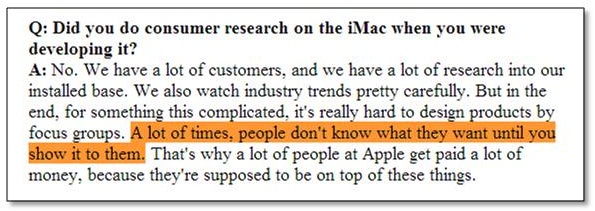
Another salesperson that comes to mind is likely one of the greatest of all times, Steve Jobs. Plenty has been written about Mr. Jobs, both during and after his lifetime, much of it detailing his brilliance at pitching new ideas, new products, entire new ways of living. He was a master. As I’ve been reading and thinking and writing about the task of convincing researchers of their need for an informationist on their teams, I’ve often thought of a particular, quite popular, quote from an interview with Jobs that appeared in a May, 1998 issue of Business Week:

Jobs Quote

It’s true, isn’t it? And it was the genius of Jobs and Apple that they consistently, over the years, give us things that we never knew we needed before we saw them, before we had them in our hands, before they became integrated into our lives. Can you remember typewriters and carbon paper? Can you remember dial-up modems? Can you remember not having a cell phone? Can you remember when music came on vinyl records? Can you remember when you had to actually buy a CD in order to hear your favorite band? Desktop computers and iPods and iPhones and email… we can’t function without them nowadays, but it really wasn’t that long ago when we didn’t have any idea that they were indispensable to our lives. But Steve Jobs and Bill Gates and other giants of Silicon Valley changed our world over the last few decades. They changed it for good, both in that it will never again be the same, and in the sense of making it better. Some things, anyway.

We may be lacking such a visionary in our profession today (or maybe not), but individually we can each work to have a vision of what researchers need in terms of information management and organization, data management,  information literacy, etc. We can formulate a vision of what we each bring to the picture and then, paint that picture for those we hope to work with. Maybe researchers just don’t know what they want from us yet. Maybe it’s our job to show it to them.

And now…

… as it is the time of giving and receiving, I wanted to share a story that is for me perhaps the very best example of receiving something that I didn’t know I needed before I got it. It’s also a story of the real meaning of this season – whether you celebrate Christmas or Hanukkah or Kwanzaa or even Festivus. Regardless, the Season is about sharing gifts with one another, be they material or otherwise. And oftentimes, the ones we least expect are the most special…

When I was in college, I worked in the dining hall. These were the days before Aramark or Sodexo or other large corporate big-box food service entities. They were the days when students still ran the dining hall; where we worked side-by-side with a handful of adults, cooking and serving and running the dish line. It was, in all seriousness, one of the most fun jobs that I have ever had in my lifetime. It was akin to belonging to a large fraternity. I did belong to a sorority in college, but D-Hall was a separate group. We had fun at work and we had fun outside of work. It was a blast.

After a year or so of working on one of the serving lines, I got promoted to the position of Cook’s Aid. The job was what it says, I was an aid to the cook’s in the kitchen. The cooks were full-time working adults. They supervised us, watched out for us, mothered us (in the case of Mary, the chief cook), and barked at us (in the case of the two guys who were retired Navy cooks). I loved working with them.

During my junior year of school, over the winter break, my mom was killed in a car accident. I went back to school a few weeks after it occurred, grateful for classes and a job that filled up time. When Christmas break was looming the following year, I was working one of my last shifts during finals when Robin, one of the cooks, found me as I was clocking out and took me to a break room where she gave me a small, fully decorated, Christmas tree. It was the kind that would fit on the top of my dresser back in the sorority house. She had tears in her eyes as she gave it to me and as she told me how worried she was that I was going to go home and find no tree. She knew how hard that Christmas was going to be. She knew that I needed a tree to get through it. I didn’t know that, but she did. And she was right.

It’s a story that really hasn’t much to do with being an informationist, unless you think about the fact that being an informationist means being a person. And sometimes people do the kinds of things that show us the very best of the human spirit. I wish everyone this spirit throughout the Season and into the New Year.

Thank you for reading my blog the past few months. I’ve received so many kind words and thoughtful responses to things I’ve posted. It’s a real gift.

~ Sally


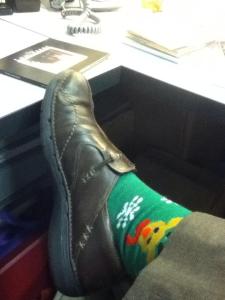
Walking the Walk (in festive reindeer socks!)

12 Dec

A message went out today to several listservs, announcing that my current position – Head of Research and Scholarly Communication Services at the Lamar Soutter Library, UMass Medical School – was open and that the Library was accepting applications from qualified candidates. If you, dear reader, are a qualified candidate looking for a really exciting opportunity, I’d advise that you give the post a look see and consider applying. Mine is a progressive, innovative place to work. We also have a great holiday party each year. In fact, we just had it today. Sorry you missed it!

New Holiday Socks for the Holiday Party

New Holiday Socks for the Holiday Party

The best thing I can say about my Library and its administration today is this… my current position is now open. What this means is that my library director and others in leadership here believe that the role of an embedded librarian is one so key to our future success that they’re willing to put someone on it (me) full-time. One of the issues shared by other informationists, as well as audience members, at the November professional development day, was that of sustainability. “How do you manage these new roles while doing everything else you’re already doing?” was a question asked by almost everyone in attendance. Well, one answer (it fits in with an earlier blog post that I wrote) is that you make those things that you feel to be important, priorities. It’s one thing to say something is important. It’s something altogether different to make the necessary shifts and changes required for it to happen. This is what we’re doing here in my Library.

So this is a short post today. I’m sitting here with my feet up, showing off my reindeer socks, and feeling way too full from a good lunch and a table filled with homemade goodies for dessert. It won’t last long, though. I have my work cut out for me finding new research projects to work on and convincing researchers of the expertise I can bring to their teams. It’s a really exciting time to stay put! And it’s a really great thing to work in a library where you can do new things without having to leave. We should all be so fortunate.