My week of birthday celebration is behind me now and what a week it was, filled with a party and a holiday and a lecture to a data management class and a professional group board meeting. One is hard-pressed to complain about a full, fulfilling life. Thanks to all of my friends and colleagues near and far who helped me celebrate well.
The full schedule left me with a bunch of notes in my notebooks, things that I don’t have the time to expound upon right now, but I want to offer as “odds and ends,” in case you might find something useful in any/all of them.
First, the word of the week appears to be EMPATHY. It’s come up in two different books that I’m reading; Dan Pink’s, To Sell is Human, and Lee Lefever’s, The Art of Explanation. I recommend both, by the way. Pink’s book offers advice on moving people, getting them to buy what you’re selling – a service, an idea, or an area of expertise. Lefever’s is about… well, it’s pretty self-explanatory … the art of explaining things to people. It’s an art, he argues, and thus something that we can learn to do. For both of the author’s, a significant key to success in these areas is empathy. Being able to put one’s self in the mind and shoes of another helps to get our point across.
It seems a pretty good message for me as I seek to find my place on research teams. The better I understand the people that I’m trying to sell on the idea that they could use an informationist on their team, the better my argument will be. Likewise, the better I can explain what the heck an informationist is in the first place, the better I’ll not appear to them as an alien from the planet Librarius.
I have the opportunity to give a lecture next week to students in our graduate program in Clinical Investigation. It’s a course on Team Science and the faculty member teaching it said to me, “You’re always going on about how it’s important to have an informationist on the team. Come teach my class one day.” It goes without saying that I’m working up my empathetic nature so that I can both explain and sell this group of clinicians and researchers on the idea. Stay tuned for a report of how well I do.
**********
I really enjoyed giving a lecture last week to the students taking the Data Management Planning class in Simmons College’s GSLIS program. It’s a small class and the majority of students are auditing it, as they are already professionals working in the field. We had a great discussion about the skills one needs to find success as an embedded librarian. I’ve posted my slides from the lecture to my Slideshare account. As you might imagine, they are more visual in nature than textual, but you may be able to get something from them.
**********
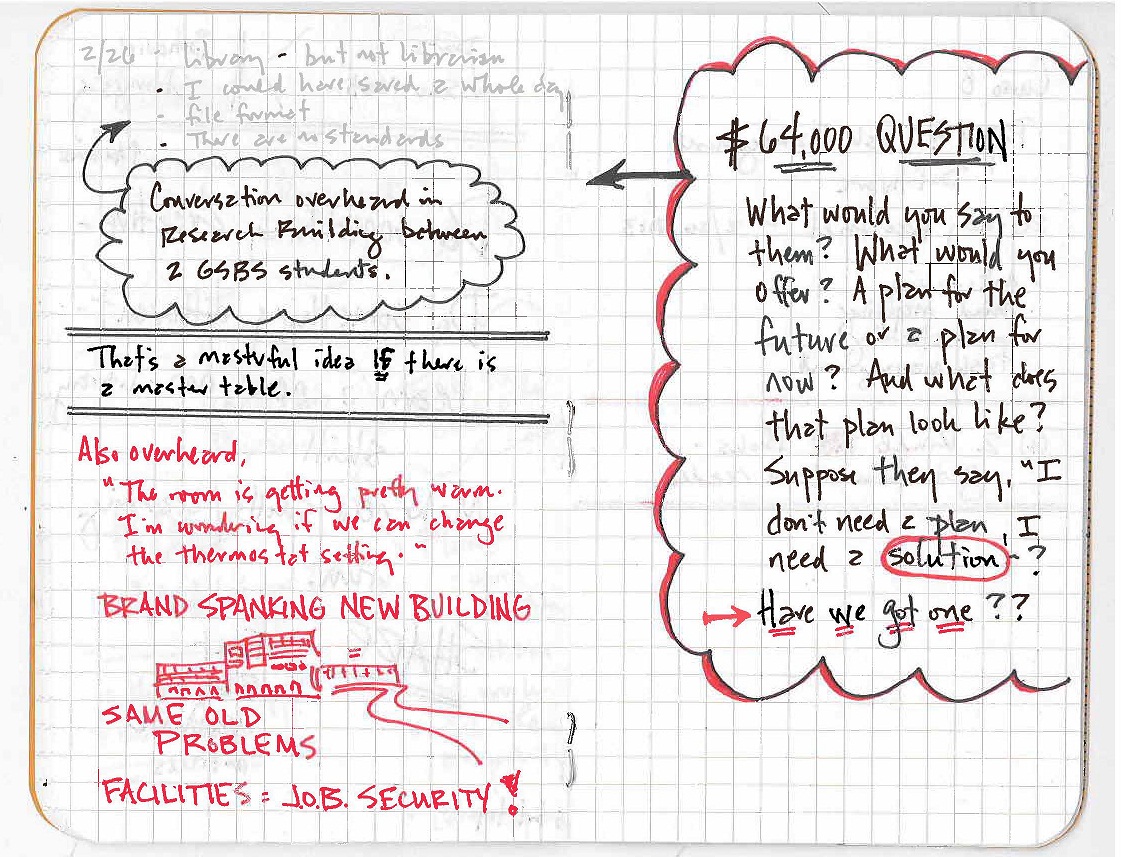
On my embedded days, when I’m not in meetings, I often search out a quiet spot somewhere on campus (not in the Library) where I can work uninterrupted. We have a new research building on campus and during this transition time when people are slowly moving in to the new lab spaces and the cafeteria has yet to open, there are many good places that fit the bill. Yesterday morning I was sitting in what will eventually be a bustling lunch area, preparing for the weekly team meeting, when a few students came and sat at a nearby table. Recalling an assignment that I once had for a writing class, I eavesdropped on their conversation and took a few notes. They looked like this:

Ignore the “Also overheard…” bit in red. I just found that really funny and worth a doodle. No matter how new an HVAC system, it seems we just can’t help but complain about the temperature in a room. Must be encoded in our DNA.
No, the part I want you to notice is what I heard the students saying AND the question it prompted me to write. I don’t have an answer for them. Do you? Is a plan the same thing as a solution? If I went up to them and talked to them about creating a plan for managing their data, would this be helpful? I’m not sure and my lack of sureness left me with the question, “Have we got a solution we can offer?” As you note, it could be “masterful,” if we can create it. (By the way, that was a quote from one of the students. Not my word.)
EDITORIAL: A Colleague emailed me after I first posted this, telling me that my notes didn’t make sense. He was right. Here’s a bit of clarification – They said, “I could have saved a whole day of work if there were standards and consistency in file formats.” Then one said, “That’s a masterful idea if there is a master table.” But such a table doesn’t exist and they don’t have time to go back and make one now. Do we have a solution for them that helps them now or can we just make suggestions for the future?
**********
Finally, I’ve been looking for a tool that will help me keep my projects and tasks and ideas and such in order. Now don’t get me wrong, I’m not about to trade in my notebooks. (As a matter of fact, I got a fresh supply of Field Notes journals on Sunday, courtesy of my wonderful spouse.) No, pen and paper and doodling will remain a staple for me, but I need an online tool to help me organize a working schedule and working demands that aren’t quite as routine as they once were. Yesterday, I stumbled across Curio 8 and downloaded the free 25-day trial to my Mac laptop. In a word, “Whoa!!” It’s pretty rare nowadays to find something that you can figure out how to use in about 10 minutes. It’s not a high-powered project management tool, but that’s probably to its advantage for me right now. I don’t need a lot of bells and whistles, but rather something that I can put into use quickly and easily. I have a feeling this is it. Is anyone out there using it? If so, I’d love to hear your feedback before I decide on purchasing. It’s not overly expensive ($100), but I like hearing from others before putting my money down.
That’s it for this week’s check-in. Oh! Except to say that I realized this morning that you can enlarge the font size on an iPad to make reading an ebook on it easier. Is this a new feature? Nah… but my 50 year old eyes are!
Tags: Dan Pink, data management, doodling, embedded librarian, empathy, explanations, informationist, Lee Lefever, librarianship, selling

 A Librarian by Any Other Name