You might recall a post that I did back in January where I shared my sketch notes from a lecture on team science. I went to another lecture in this series today called, “Communications 2:0: Strategies for Effectively Selling and Telling Your Story,” delivered by Edward Keohane, our Vice Chancellor of Communications. I drew sketch notes during it, too. My colleague, Michelle Eberle, was sitting next to me and when the session was over, she asked me about the notes and if I’d put them on my blog. So here goes… the notes, plus some words to recap the lecture:
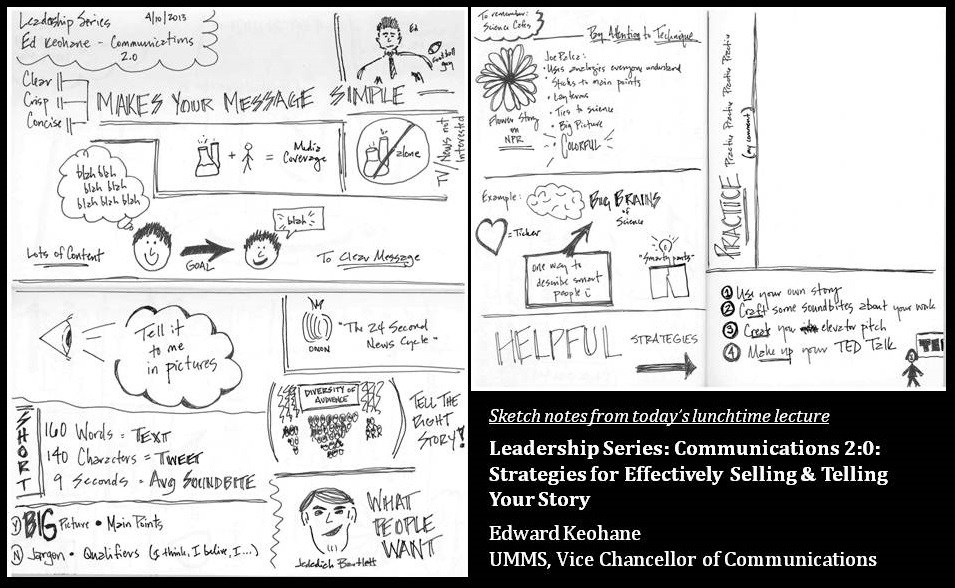
It was a terrific session, geared towards teaching faculty members, physicians, and scientists how to get the message of their work out to the public in a way that people will understand. Three main points that Ed hit at the very beginning:
- Be CLEAR
- Be CRISP
- Be CONCISE
He also noted some trends in the media’s coverage of science over the past few decades (it’s declined) and the fact that science, alone, rarely gets coverage. For reporting health science, you’ve got to have science that you can connect with people, then you’ve got something that they care about. Other things to remember and/or consider are your audience (gear your talk to them, taking into account who they are), stress the big picture, stick to main points, avoid jargon and qualifiers, and use language that is both colorful and words that people understand (or at least analogies that make sense). You can learn a number of good techniques for presenting science by listening to NPR’s science correspondent, Joe Palca. Ed made us listen to a few of his stories and indeed, Joe is very good at what he does.
Finally, Ed reminded us of the effectiveness of using your own story when trying to explain something. He suggested crafting a few sound bites about your work (or any topic that you want to share clearly with others) and practicing your elevator speech. And one that I thought was great… make up your own TED Talk! I liked this one a lot because I love TED Talks, but also because next week we’ll be showing part of the annual TEDMed event here at my workplace, including some time in the Library. And better yet, a few of us have signed on to give a TED Talk as intros to the session. I can’t wait for that (and thought it pretty timely, considering Ed’s recommendation).
Lastly, I made the comment from the audience that too often we forget one of the most important aspects of communication – PRACTICE! Speaking before people, giving a lecture, or being interviewed on the radio or television, these are all performances. To do it well, think of them as such and then remind yourself what it is that performers do to become good at their craft. They practice. A lot. People who are great at communicating have some talent, for sure, but they’ve also practiced their craft a lot. I guarantee it.
(The Leadership Series is sponsored by the UMMS Faculty Affairs Department.)

 A Librarian by Any Other Name