Ch-ch-ch-changes

23 Aug

Changes“The only thing in life that is permanent is change.” Someone said that. I’m not sure who, but I surely know that I didn’t think it up on my own. Regardless of who first uttered the truism, its truth remains unchanged, change after change after change. The only thing that we can ever really count on staying the same is the fact that things will always change.

I write this not because the summer season is coming to a close and new students are arriving at my university, but because new chapters are beginning here in the library where I work. I went on vacation a few weeks back aware that some restructuring would happen during my time away. I returned to learn the details – at least as many as we know so far – of the reorganization of services, roles, missions, and personnel. It’s not really a very easy time here at work right now. I’d be less than truthful if I said differently. The restructure means the loss of jobs for some, changing roles for others, and a very different way of thinking about the library for those of us still here. As my library director, Elaine Martin, stated in her presentation to the staff, we are now in a time where we will focus on 4 Rs:

  • Reject outdated notions and ideas of what libraries are.
  • Rethink how we do things – EVERYthing, if need be.
  • Redo our modes of operation, focusing on those areas that are now our priorities.
  • Rejuvenate our careers, our mission, and our professional goals as we move forward into a very new world.

If you’ve been a follower of this blog over the past year, you know that my thoughts and beliefs about my profession and the work that we do fall pretty much in line with these “Rs” that my director is calling the staff to focus on now. I’ve been saying for a long time that I believe our ways of doing many things in the library have left us outdated and irrelevant. We need to change and, as was noted by my director, not in small ways. We’ve been tweaking for years. We’ve been cutting out nickels and dimes as needed. But now… now we need to do something much bigger, much more radical, and much more progressive. And for all of the talk that I’ve talked over the years, when the change really hits, it’s not always so easy.

How did we get to this place? Anyone who works in academic and/or health sciences libraries surely knows the answer to this question. At my own institution, we’re facing a $20 million deficit that results in 5% across the board cuts to all departments. The sequestration at the Federal level affects us via major cuts to NIH-funded research. We’ve also lost money from the state government. Our clinical partner, UMass Memorial Health Care, faces their own financial crisis and this, of course, has repercussions on us. Couple these revenue losses with unceasing (and way too often, unfounded) astronomical increases in journal subscription costs and key clinical resources and… well, this is where we are. It’s where many of us are.

At the same time, we cannot ignore the fact that people use libraries very differently than they once did. In our setting, students, faculty, researchers, and clinicians do not need/want to check out materials. The resources that they need most are available to them online and if not, they pressure us to make them available that way. Fewer people come to the library needing library assistance. Note that this doesn’t mean that our gate count is down and/or that we’re a quiet, deserted enclave on campus. We are an incredibly busy place, but the reason that our patrons come here is not necessarily related to the fact that librarians and/or library staff are here. By and large, they come to use the non-human resources that we provide. Yes, THAT is a frightening thought when you’re a human resource. And yes, it is a driving factor in the changes we’re now making.

For a number of years, library administrators have been able to refine and retune services, dropping many things that were at one time standard operations in favor of more efficient and less costly alternatives. However, there comes a point when there is nothing left to cut in these areas. There’s very little left to “stop doing” so that we can focus on new things. There comes the time when some really big changes have to happen. There comes that time when the cost of fixing your old car just doesn’t beat out buying a new one. Here in my Library,  we reached this point. We’re trading in our old model for something new.

In short, a half-dozen colleagues that I have worked with for many years now, will not have jobs at the end of next week. To say that these are difficult decisions and that this is a difficult time in the library is an understatement. Neatly stated, the work is no longer there – circulation, cataloging, binding, interlibrary loan, and even ready reference – to financially justify employing full-time staff to manage it. It is really difficult to make an argument against these facts. But neat and tidy justifications are never such when people are involved. Despite the number of times that it is said, truthfully, that the decisions are not personal, they are. People are losing their jobs. This cannot not be personal. Everyone recognizes this.

I’m not sure what all of these changes will mean for me directly. Fact of the matter is, no one really knows. Not here in my library, nor in our profession as a whole. We’re a work in progress, this profession, and no one is quite sure how all of the new ideas and roles and work will play out. Still, I believe that more often than not, it’s a lack of risk taking that does a person – or an institution – in. “Nothing ventured, nothing gained.” Another good quote from someone other than me.

There are an awful lot of BIG questions facing health sciences libraries today. Our changes highlight this fact. I have to say that the one question that keeps milling around in my head during this particular time is this – Does a librarian really need a library any more? While it’s pretty clear that our patrons certainly need library resources, do they still need the human resources of the library when they come here? I like my cubicle as a place to sit and work, but does it need to be here in the library? With a heightened emphasis and dedication upon embedding librarians in research projects and teams, in curriculum and classrooms, and in physical sites outside the library itself, are librarians themselves now another library resource that can be divorced from the library? I know that my library isn’t the first one to experiment with embedded models and thus it’s unlikely that I’m the first librarian to ever think about this question, but right now, it’s what I’m wondering. For me, it’s the biggest question that I wait to see answered in the coming months and years as we explore new ways of doing things here at my library.

Time will give me the answer to this question, as well as to others I have. And in the meantime, I’m remembering to tell myself that the changing day-to-day aspects of work that may cause some bumps and bruises and slight headaches along the way, these are but that – bumps, bruises and headaches, and simply part of my job. In times of change, it’s good time to remember to keep all things in perspective. (Note: I’m speaking only for myself and not minimizing the much bigger unknowns that some of my colleagues face. To do otherwise would be a very callous thing to do.) 

Elaine Martin has graciously offered to make her presentation available for readers to view, in hopes that it provides clarification and further detail as to the changes made, as well as a reference for others in similar positions at this time. Additionally, in next week’s post, I will describe the new programs and models that we are launching during this transition, along with a presentation from Elaine on that topic. Stay tuned.

An Illustrated Vacation

12 Aug

As noted in my previous post, I was on vacation last week. Vacation is important. Sadly, too few of us are afforded it, take it, and/or enjoy it. Many lament that taking a vacation only results in more work, either before you go away (all of the prep involved in going away) or upon your return (the pile of email and phone messages and “to do” items that await). I know very few people who actually go away for a week or two and stay away, i.e. don’t check email, answer calls, follow-up on things. Somehow, we just feel like we cannot be away. And this is a shame, because time away is really important. We need breaks from our work and the stresses of the everyday work-a-day world. We need some time to do nothing. We need a change of scenery every now and then.

Determined to follow my own convictions, I went away last week (well, for 5 days, anyway). I checked email only occasionally and I don’t believe that I actually replied to any until I returned home on Thursday. Even then, I answered only a couple of them; ones that just really needed to be answered. I tried really hard to simply enjoy being away and to engage the parts of my brain and my body (physically, because I sit way too much in my job) that don’t get the attention they deserve when I’m working.

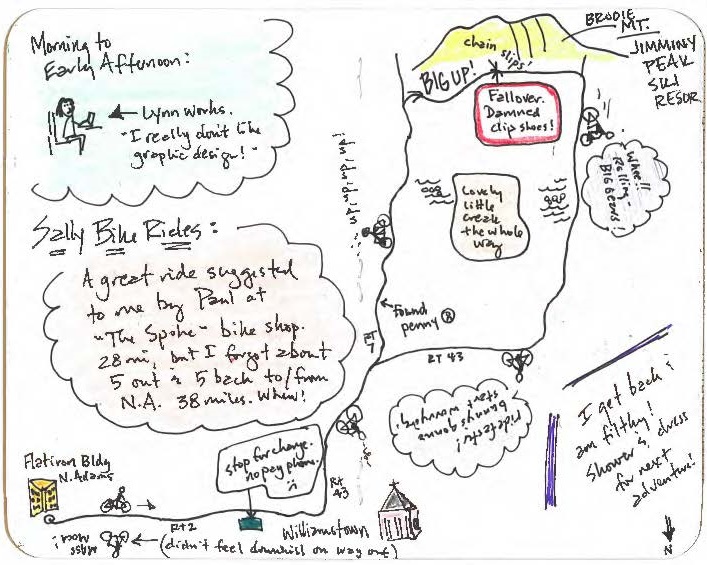
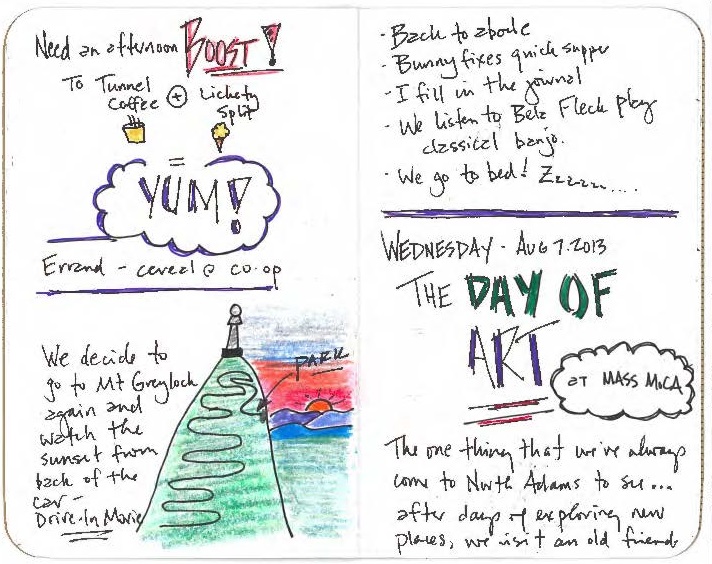
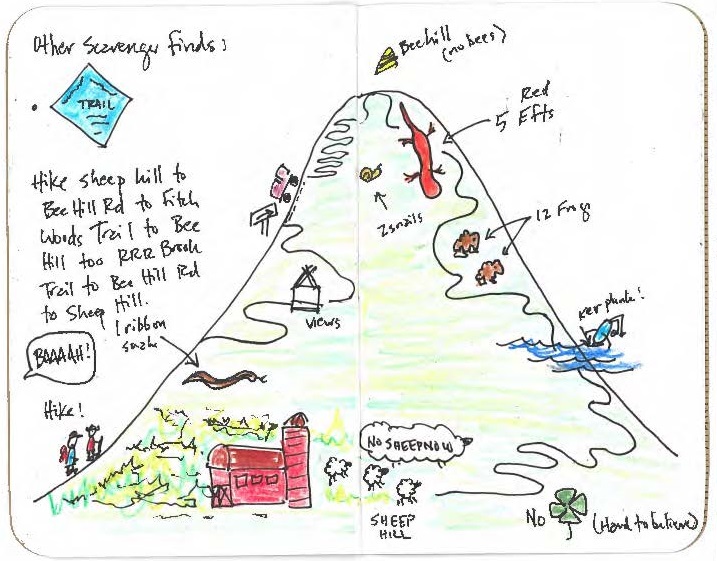
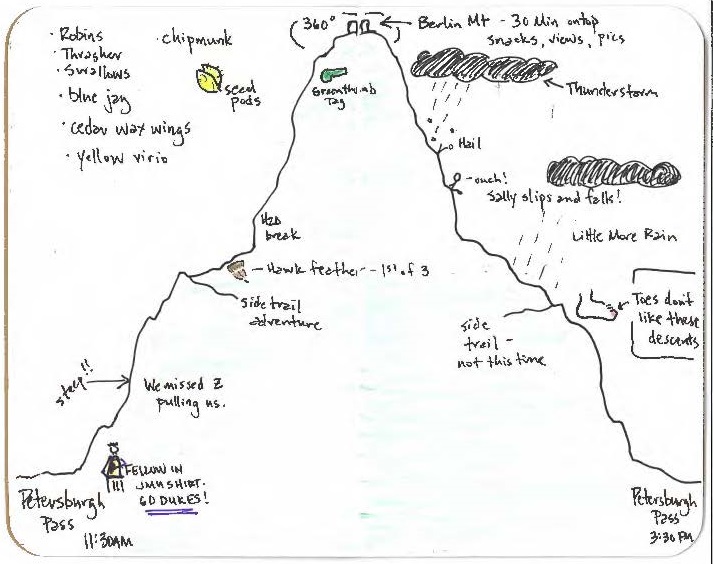
Not out of the ordinary, I took along a journal and recorded our adventures. What was different this time, though, was that I illustrated the week. I owe a great deal to Suzy Becker, Mike Rohde, Sunni Brown, the folks at AlphaChimp, and others who have inspired me over the past year+ to think with both words and pictures. If you follow my blog, you know that I’ve mentioned all of these people before. They inspire me with their illustrated memoirs, their sketchnotes, their doodles, and their scribing. I took them all with me, in a way, on my trip. Here’s a little bit of the result (a few selections from my notebook):

Vacation_Page_1 Vacation_Page_2 Vacation_Page_3 Vacation_Page_4 Vacation_Page_5 Vacation_Page_6 Vacation_Page_7

Fitting the Bill

2 Aug
Sweet, old Zeb loved to listen to the band.

Sweet, old Zeb loved to listen to the band.

This was a pretty rotten week. It started off fantastically as I met a bunch of my favorite colleagues for fun and games (aka brunch) in Boston, saw Alison Krauss give a freebie concert at Copley Square, and dusted off my old seminary skills to deliver a summer sermon at my church. And that was all on Sunday. But driving home from the big city, I began to have the worst toothache. I stopped at the rest area on the Mass Pike to take some extra-strength something or other, and by Monday, the throbbing reached that horrible place that it seems only toothaches and earaches can ever reach. Tuesday morning found me in my dentist’s chair for 3 hours undergoing an emergency root canal. The rest of the day and the better part of Wednesday was spent lying on the couch, praying that the penicillin would start working soon.

It did. Thankfully. Just in time to receive a phone call from my dad’s wife telling me that my dad was back in the hospital. He lives in San Antonio, Texas. I live in Massachusetts. As you might imagine, this doesn’t make for smooth and/or easy communication about all that’s going on for him.

And then my mother-in-law decided that it’s time for her to move to another state. This month. That took my spouse away for a couple of days this week and likely more in the weeks ahead.

By the time I went to the hospital cafeteria yesterday morning, simply looking for some nice, soft, scrambled eggs to eat, only to find that they’d pulled all of the breakfast foods and were setting up lunch (and it wasn’t even 10:30 in the morning)… well, I admit that I almost cried right there in the hallway. It seemed like just one too many things for the week’s pile-on.

And today marks the one-year anniversary of saying goodbye to our sweet, old dog, Zebediah. He was special in so many ways. We miss him a lot, still.

HOWEVER, not to be lost in this story of the sad and pitiful week is the fact that on Monday, after months of waiting and searching and hoping and juggling, we FINALLY filled my former position of Head of Research and Scholarly Communication Services at my library. Rebecca Reznik-Zellen joins us, bringing our staff up to the full-staff number of 3! It might not sound like much, but as the Schoolhouse Rock classic reminds us, “Three is a Magic Number.”

Rebecca comes to us from the University of Massachusetts Amherst where she was the Digital Strategies Coordinator for the W.E.B. DuBois Library. I’ve been lucky to call Rebecca a colleague for the past few years and feel even luckier now to have her as a co-worker. I once wrote a letter of recommendation for her and in it I summed up my feelings for her work abilities by saying, “If I was ever in a position to build a library staff, Rebecca would be the very first person that I would hire.” As you might imagine, I was pretty happy when she first talked to me about the possibility of applying for the position, and even more delighted when she applied and the search committee decided to hire her (let it be known that I was not part of that committee).

Of course, when someone is hired to take your former position – the one that you’ve been managing, along with your new role, for months on end – you naturally assume that it means at least part of your current workload will finally ease. Something in the back of my mind knew that this wasn’t likely the case with Rebecca’s hire, though. I’ve worked for my library director too long to know that while the job title remains the same, the person filling that role brings with him/her a set of skills that may well be utilized in a completely different way. Rebecca has a skill set much different from mine (hence the reason I’d hire her to be on my Fantasy Library Team) and thus the things that I did well when I was the Head of Research and Scholarly Communications aren’t necessarily the things she’ll do well.

Similarly, the department is at a very different place today than it was when I assumed that role. At that time, it was a brand new role and the kind of services that we needed to develop were based a lot upon establishing relationships, making contacts, and raising awareness of the things that the Library could provide while utilizing our current resources (like our institutional repository, my expertise in the issues surrounding the NIH Public Access Mandate, our push towards open access, etc.). Today, the Library has very solid relationships with many research departments on campus, the kind of relationships that have allowed me to move into the informationist and embedded librarian role that I’m so enjoying. We still have work to do in the promotion of our now-traditional services to this population, but it’s also time to begin boosting up the new areas and roles that we’ve hoped to do for awhile, namely, data services.

Enter Rebecca and her strengths in strategic planning, the issues around data, and the library/librarian roles here, and we have a terrific opportunity for expansion. But yes… expansion means just that, i.e. more work to do, not less. I pretty much have to accept that I’m not passing off my old job to someone else. That’s not how things work today in anyone’s work world. And complaining about it is nothing much more than a big waste of time and energy. Instead, what we need to do is find the ways to share roles, morph needs, kill two birds with one stone, so to speak (I love birds and would never do such a thing). That’s the challenge ahead.

In his book, Zig Zag: The Surprising Path to Greater Creativity, Keith Sawyer calls this part of “‘problem finding’, creative style.” (p. 25) He says that too often we get stuck asking the wrong questions and that the very first skill to master in developing greater, everyday creativity is to practice finding the right questions. In terms of juggling and managing my workload, both old and new things, the question of “How can I do all of this?” is likely not the right question. Maybe there’s a better solution in asking, “Do I have skills that I’m not taking advantage of?” or “Can I combine x with y when I’m teaching different topics?” or “Can I reach a larger group of people at one time?” or “Can these tasks be broken up into more manageable (i.e. share-able) pieces?” or likely dozens more. I don’t know, but I do know that there is plenty of work to be done and a seemingly limitless list of opportunities that we could take on.* And personally, I find this a much more advantageous position to be in than the one where you have not enough to do and can easily be dismissed.

I also read an interesting editorial last night written by Janice LaChance, the CEO of the Special Libraries Association, in the latest issue of their magazine, Information Outlook. Entitled, “The Promise of Skills and Expertise,” LaChance notes that when it comes to the roles that librarians and information professionals assume, there is much to be said for distinguishing between one’s education and one’s expertise, as well as one’s job title and job role.

Even though the market for jobs is sluggish, the market for expertise is thriving, and there will always be positions for people who know how to identify, use, disseminate, and analyze good information. By learning to highlight and use your expertise rather than depend solely on a job title, you can open doors to roles you may never have considered. (Information Outlook, Vol. 17, No. 4, July/August 2013, p. 2)

I’m seeing this first-hand in my current work. Rebecca was hired to fill the same job title that I held, but the role is quite different. Similarly, my title of informationist or an embedded librarian or a research librarian really is not much more than something to put on my business card or a way to introduce myself to a group. What matters more is what I bring to the role and how well that I can explain this to the people that I wish to form partnerships with.

Case in point, last week I went to a department to teach about issues related to the NIH’s Public Access Mandate. One of the PIs of the group walked in with a printout of the latest RFP from the National Library of Medicine for the next round of informationist grants. “I’ve seen this word, informationist, twice in one week now,” he said to me, indicating that he’d come across both that RFP and my signature line in an email within a few days. “What exactly do you do as an informationist?” he asked, and following the class, we had an introductory discussion about what I’ve been doing the past months in my new role, as well as some ideas he has about how he could use a similar person. Is it a collaboration in the making? I sure hope so, because it’s an awfully interesting project. But more importantly for this post, it’s a great example of how the opportunities to do new things and take on new tasks come to us all of the time. They are rarely limited to any particular job title or job description. And the expansion isn’t going to stop anytime soon.

I’m really happy to have a new co-worker on this adventure and look forward to the questions we’ll come up with together. The everyday work-a-day will continue to be full and yes, sometimes a little frustrating in that I can’t get everything done that I’d like to do, but in all honesty, the diversity of the role is why I became a librarian in the first place. Who wants to do the same old thing over and over and over again?

I’m on vacation next week. I may post a muse that emerges from my relaxation time, or I may just relax. We’ll see! 🙂

*In that same issue of Information Outlook, there is a thought-provoking (and inspiring, to me) article by Colleen Shannon, manager of technical intelligence at the Hershey Company in Hershey, PA, called “Stop Trying to Serve Everyone.” The story she tells of how she led her group to match its goals with specific corporate initiatives, thus becoming its own functional group as opposed to a support unit is pretty interesting stuff, and a pretty big shift in some of the basic principles of how libraries operate. It also happens to be a thinking that I fully support when it comes to providing embedded librarian and/or informationist services. In other words, I’m perfectly content providing in-depth expertise to a few, rather than a minimal level of service to many. But yes, such work has limitations, I agree.