Repeat After Me

22 Aug

Reproduction

Reproducibility is the ability of an entire experiment or study to be reproduced, either by the researcher or by someone else working independently. It is one of the main principles of the scientific method and relies on ceteris paribus. Wikipedia

I was going to start this post with a similar statement in my own words, but couldn’t resist the chance to quote Latin. It always makes you sound so smart. But regardless of whether these are a Wikipedia author’s words or my own, the point is the same – one of the foundations of good science is the ability to reproduce the results.

My work for the neuroimaging project involves developing a process for researchers in this field to cite their data in such a way that makes their work more easily reproducible. The current practice of citing data sets alone doesn’t always make reproducibility possible. A researcher might take different images from a number of different data sets to create an entirely new data set, in which case citing the previous sets in whole doesn’t tell exactly which images are being used. Thus, this gap can make the final research harder to replicate, as well as more difficult to review. We think that we may have a way to help fix this problem and that’s what I’ve been working on for the past few months.

At the same time, I’ve been working on a systematic review with the members of the mammography study team. This work has me locating and reading and discussing a whole slew of articles about the use of telephone call reminders to increase the rate of women receiving a mammogram within current clinical guidelines. It also has me wondering about the nature of clinical research and the concept of reproducible science, for in all of my work, I’ve yet to come across any two studies that are exactly alike. In other words, it doesn’t seem to be common practice for anyone to repeat anyone else’s study. And I can’t help but wonder why this is so.

I imagine it has something to do with funding. Will a funding agency award money to a proposal that seeks to repeat something; something unoriginal? Surely they are more apt to look to fund new ideas.

Maybe it has to do with scientific publishing. Like funding agencies, publishers probably much prefer to publish new ideas and new findings. Who wants to read an article that says the same thing as one they read last year?

Of course, it may also be that researchers look to improve on previous studies, rather than simply repeat them. This is what I see in all of the papers I’ve found for this particular systematic review. The methods are tweaked from study to study; the populations differ just a bit, the length of time varies, etc. It makes sense. The goal of this body of research is to determine what intervention works the best and in changing things slightly, you might just find the answer. What has me baffled about this process, though, is that as we continue to tweak this aspect or that aspect of a study’s methodology, when and/or how do we ever discover what aspect actually works and then put it into practice? 

Working on this particular review, I’ve collected easily 50+ relevant articles, yet as we pull them together – consolidate them to discover any conclusions – the task seems, at times, impossible. Too often, despite the relevancy of the articles to the question asked, what you really end up comparing is apples to oranges. How does this get to the heart of scientific discovery? How does it influence or generate “best practice”? I can’t help but wonder.

Yesterday, during my library’s monthly journal club, we discussed an article that had been recommended reading to me by one of the principal investigators on the mammography study. How to Read a Systematic Review and Meta-analysis and Apply the Results to Patient Care, is the latest User’s Guide on the subject from the Journal of the American Medical Association (JAMA). It prompted a lively session about everything from how research is done, to how medical students are taught to read the literature, to how the media portrays medical news. I recommend it.

Of course, there are many explanations to my question and many factors at play. My wondering and our journal club discussion doesn’t afford any concrete solution and/or answer, still I feel it’s a worthwhile topic for medical librarians to think about. If you have any thoughts, please keep the discussion going in the comments section below.

Hello Darkness, My Old Friend

12 Aug

[This is not an ordinary post for this blog, but this is not an ordinary day.

Photo by Charles Haynes, FLICKR, Creative Commons

Photo by Charles Haynes, FLICKR, Creative Commons


Robin Williams

July 21, 1951 – August 11, 2014

His death is a shock. The tributes from the many people who knew and/or loved him continue to spread across every form of media. People are sad. I am sad. Robin Williams’ death is sad. But it is the thoughts and images of his suffering, the unfathomable depth of pain, and the cruelty of depression, that leaves me heartbroken. Many people more qualified than I can and will speak to the disease that took his life. Many people will share of the importance of reaching out and finding help when depression hits and/or life becomes too much to bear. Asking for help is hard, though, and harder still when one is dealing with a disease that takes rational thought away. 

Maybe one small thing that can ease that barrier is knowing someone who knows what you’re going through. If you sense that there’s at least one other soul who experiences what you experience, maybe that person is a lifeline to another day. Maybe. And maybe this is why I’ve noticed a number of people sharing their experiences over the past 24 hours. Rob Delaney, Kathleen Edwards, Harvey Fierstein… these are just a few celebrities that I follow who I’ve seen post thoughts; telling readers or fans, in a way, that they are not alone.

I’m not a celebrity by any stretch of my imagination, but there is something about Williams’ death and the public reaction that makes me want to share a story, too. My story. For me, clinical depression is a palpable black cloud that hovers over my shoulder. It is a dark basement. A place of unhealthy solitude; of isolation. It is both terrifying and seductive and that, for me, is the crux of the cruelty that this disease can be. Sometimes, it can be exhausting to ward it off. Scarier still, is how it first appeared (from Ordinary Year, Chapter 1):

**********

So in the summer of 2009, I was in a healthy, well-established, loving relationship. I lived in a nice apartment, had nice neighbors, a dog and a cat, and interests both in and outside of work. I’d been sober for years. I dabbled in writing. I learned to play the mandolin. I reconciled with my brother, a relationship that had been damaged for a decade. I finally got to know my nieces and nephew, and the chance to start being an aunt to them. They wanted both Lynn and me to be in their lives. Things with my dad were so-so. We didn’t see each other very often, but I don’t see any of my family very often. Still, we were all okay. Everything was okay.

But every day, from late May through September, I cried. At some point, every day, I found it impossible to stop the tears from falling. I’d turn to the wall in my cubicle to hide my face, grabbing tissues and hoping no one noticed. I’d be in my car, driving to or from work, and start sobbing. I started to wonder if I was going a bit mad.

I knew that I was lonely for some of my old friends and so I decided to make a trip to Louisville to reconnect with some of them. I ordered my plane tickets and started to think about sitting at a patio table outside of a coffee shop, talking for hours with one of my closest confidantes, Dina. I thought about catching up with my good friend Kevin. I thought of taking Dina’s kids trick or treating. I looked forward to some time on my own, some time for myself. It would be a good, well-needed and well-deserved long weekend.

A few weeks before my planned trip, I was walking from the parking lot to the library, to work, when the thought crossed my mind that it might not be a bad thing if the plane I took from Providence to Louisville crashed. I had no plans to make it crash and I didn’t exactly wish for it to crash, but the thought of it crashing gave me such a feeling of relief. It would finally be over.

It scared the hell out of me.

**********

Thanks to medication and a few years of therapy, I’ve learned how to live with the darkness. I’ve learned how to recognize it. I’ve learned how to ask for help before that voice gets silenced. It’s heartbreaking when that voice dies. And it’s heartbreaking, the lives it takes with it.

To echo the message of so many others in health care, if you feel you’re struggling with depression, seek medical care. If you’re experiencing thoughts of suicide, there are people who can help. National Suicide Prevention Lifeline, 1-800-273-TALK (8255).

This, That, and a Bit of The Other Thing

8 Aug

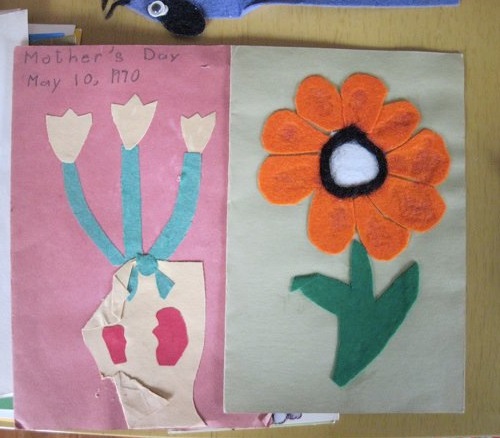
I like to make the cards that I give to people. Yes, I too often give in and buy the prefabricated ones, but even then, I try very hard to pick ones out that are blank inside, not substituting anyone else’s words for my own. I like the handmade touch. I have a small box with several cards that I made for my mom when I was a child. They are special. My mom treasured them enough to keep for herself and now, I keep them myself. Crayon-scribbled, “You are the best mom” accompanied by a cut-out, construction paper flower is worth saving.


A couple of cards that I made for my mom.

A couple of cards that I made for my mom.

Besides the sentimentality of handmade items, they also share the message that the sender took a bit more time to make something just for you. I’m not knocking the time one can spend searching the shelves at the Hallmark store for just the right message, but you must admit that taking the time to make that right message says just a little something more. 

I thought about making cards earlier this week when I followed along with a listserv discussion about the practice of sending weekly articles, messages, and updates to patrons. A number of participants shared some very helpful resources – aggregators, if you will – for delivering timely pieces. It’s both easy and resourceful to subscribe to them. They scour the internet for stories about the latest medical procedure, disease outbreak, trend in healthcare, etc., and send them right to your email inbox for quick reading. Some even annotate them for you, so that you don’t have to be bogged down reading more than seven paragraphs. The suggestion offered in the discussion was to share these feeds with administrators or doctors or researchers or whoever your target audience is. It’s a great idea, but as I thought about it, the practice reminded me of buying a greeting card instead of making one yourself.

Libraries and librarians have given up a great deal of their identity (their brand) over the past years. The full-text of articles are often accessed through third-party vendors or the websites of journals, despite the fact that it’s one’s library that’s often providing the resource. We buy catalogs developed by other companies, rather than developing homegrown management systems. We embed RSS feeds from other sources into our own websites.

And each and every one of these practices saves both time and money, but at what cost?

I got to wondering how much time it would really take to subscribe to a relevant aggegator or journal table of contents, or to set up a few alerts from custom-saved searches, or to put together several Twitter lists that follow sources specific to a group or department I serve. Then I could use these tools to create my own, customized delivery of an article or an interesting piece of news to the same. Think of the return on the investment I’d get by sending a personal note directly to someone with the resource attached, as compared to the same coming from an automated – and branded by someone else – source. Now, I can already hear some naysayers saying, “I don’t have time to keep up with that.” Maybe not, but I think it might be worth a try.

A full shelf of writing and reading, plus Finz. And an autographed baseball. And a holiday ornament. Librarians don't need to be organized at home.

A full shelf of writing and reading, plus Finz. And an autographed baseball. And a holiday ornament. Librarians don’t need to be organized at home.

Related, another thing that I often hear people say is that we don’t have time to read ____ (insert whatever it is that you don’t have time to read – blog posts, journal articles, interesting pieces from the news). Similarly, many say that we don’t have time to write _____ (insert whatever it is that you don’t have time to write – blog posts, journal articles, etc.). This a dilemma. To paraphrase Stephen King (the writer), if you want to be in the information business, you need to do two things above all others; read a lot of information and write a lot of information. How else can you stay on top of it? How else can you provide good information resources to those you serve? How do we call ourselves information professionals if we ignore the very thing that we’re supposedly experts in? We work in a fast-paced and rapidly changing profession. All the more reason to do those two things above all others. Read and write.

I write a post for this blog each week. Thanks to the kind words of many colleagues, not to mention usage statistics, I know that people read it. But I also read the writings of colleagues and other people who provide so much insight, interest, and entertainment to my work, that I can’t imagine how lousy I’d be at my job without them. With this stated, I’m sharing several really good things that crossed my radar over the past week. If you can find a moment or two to read them, you may find it worth your while:

  • Data Dictionaries, a blog post by Kristin Briney. If you’re charged with the task of managing data, at any level, Kristin’s blog is worth following and this particular piece is a great one to bookmark, because it’s really hard to find good posts and good examples on the topic.  
  • Your Two Kinds of Memory: Electronic and Organic, by Annie Murphy Paul. Medical librarians are forever grousing about a certain resource that’s ever-so-popular with doctors and medical students alike. Annie’s post offers an entirely different reason for concern.
  •  There’s a new series debuting on Cinemax soon about the early days of surgery in the United States. Period medical drama. “The Knick” is the creation of Steven Soderbergh and stars Clive Owen, so it surely has potential to be good. After ‘The Knick’: 7 Fascinating Books on the History of Medicine offers critique and … well, suggestions for further reading. (From the blog for the site, Word & Film.)
  • The Trouble with Medicine’s Metaphors is an article by Dhruv Khullar for the Atlantic. Khullar is currently doing a residency at the Massachusetts General Hospital and Harvard Medical School. Maybe it’s because I majored in philosophy, maybe because I love linguistics, maybe because I was in the hospital last week… for many reasons, I found this a great read.

Finally, I always read Amy Dickinson’s advice column. I need all of the everyday, practical advice that I can get. And my friend, Suzy Becker, wrote a most wonderful blog post to go along with the release of her latest book from Random House Kids this week. Author-Daughter Book Club just about made me cry in my cubicle. In a good way. Moms of sons and daughters, both, will enjoy it. I give shout outs to these two writers who, many days, make my day.