Politics is an Eight-Letter Word

26 Feb

A number of years ago, the librarians at Lamar Soutter Library, UMass Medical School, received the directive, “Get Out!” Our Library Director wanted us out of our cubicles and away from our desks. She wanted us to go to the people that we served. If people didn’t need to come to the Library anymore, the Library needed to go to them. And thus was born our embedded librarian program.

One of the very first lessons that I learned when I started getting out of the Library was that I needed to learn about politics. I remember going to my Library Director and asking if she could give us a lesson on the topic during one of our professional development meetings. Fortunately, she understood where I was coming from and from that point on, was open and willing to answering any questions any of us had regarding who was who and how things worked, politically, at the Medical School.

Our political system has become so broken the past few decades, it’s easy to think of politics as a dirty word. We think of corruption and conniving and backstabbing and the like. But the truth of the matter is that most, if not all, organizations and institutions exist in some sort of political atmosphere. If we’re lucky, it’s NOT a destructive framework, but it is an existing structure all the same.
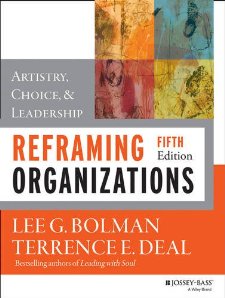
Reframing 5th coverWhen I was earning my library science degree from Syracuse, I had to take a course on management and one of the required textbooks was Lee Bolman and Terrence Deal’s book, Reframing Organizations: Artistry, Choice, and Leadership. The “Political Frame” is one of four organizational frameworks that they present and they describe it as follows:

The political frame views organizations as alive and screaming political arenas that host a complex web of individual and group interests. Five propositions summarize the perspective:

  1. Organizations are coalitions of various individuals and interest groups.
  2. There are enduring differences among coalition members in values, beliefs, information, interests, and perceptions of reality.
  3. Most important decisions involve the allocation of scarce resources – who gets what.
  4. Scarce resources and enduring differences give conflict a central role in organizational dynamics and make power the most important resource.
  5. Goals and decisions emerge from bargaining, negotiation, and jockeying for position among different stakeholders.

(Bolman & Deal, Reframing Organizations, 2nd ed., p. 163)

Now that I work in a different environment than the Library, I’m learning a different political landscape. Different people, different personalities, different programs, different priorities. I’m still in the same institution, so I have a slight head start, in that I at least know the people; by name and position, if nothing else. I also know, thanks to my years in the Library, that walking into situations without respecting the politics is not only naive, but can be downright disastrous to any efforts you’re attempting. It’s a really important lesson and a skill set that’s not necessarily taught in graduate school or in continuing education classes. That’s a shame, because when we pretend that politics doesn’t matter or that it’s a dirty game that we want to avoid, we’re setting ourselves up for trouble. Politics is an eight letter word. There’s no need to not talk about it.
In the Bleak Midwinter

12 Feb

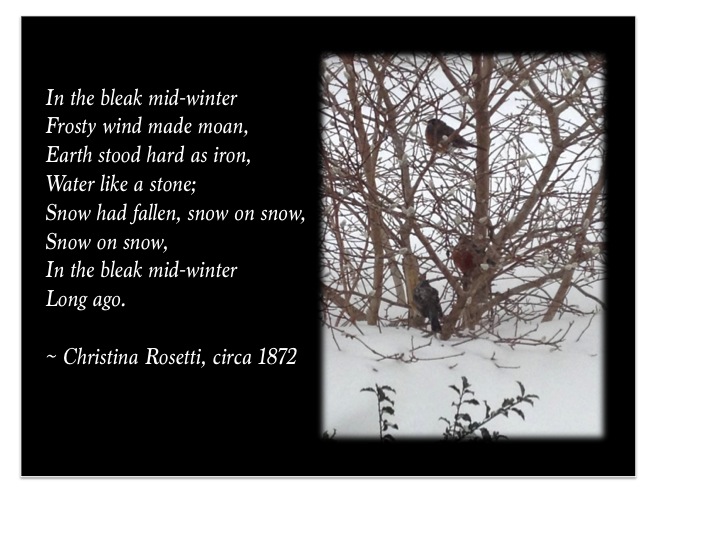
As I write this, it’s snowing here in Worcester, Massachusetts. If you’re not up-to-speed on the “Golden Snow Globe National Snow Contest Snowiest U.S. Cities” rankings, you’ve missed out on the story about my snowy city’s great claim to fame this season… We’re Number 1! 92+ inches and counting. Many folks are tired of it, but not me. I love the snow. I love winter. And I’m loving being in first place! Midwinter

Perhaps the thing that I love best about a snowy winter is that it forces upon us the time to sit still. Stay home. Be quiet. When I’m stuck at home during a blizzard, once I get past the elation that the Medical School is closed for the day and I don’t have to go to work, I hunker in on the couch with a blanket, my dog, something to drink, and either a good movie or a good book, and I revel in the fact that I have nothing to do but enjoy myself. I get this strange feeling that in another life, I must have been some woodland animal; not the kind that hibernates, but the kind that just knows how to hunker in for a day or two. I can do it, no problem at all. 

 For the record, in my 10+ years working at UMass Medical School, this is the first and only time that the school has closed. Twice now. I’m telling you, we’ve had some snow!

I remember reading Helen and Scott Nearing’s memoir, The Good Life, years ago and being struck by their choice of living. In spring, they planted. In summer, they tended to all of the many chores around the homestead. In fall, they harvested and prepared for the winter. And in the winter, they rested. They read and they wrote and they studied. It was the quiet time of year to do those very things.

Funny thing, though, is that while I love hunkering in at home on a snow day, I struggle with it at work on a work day. 

One thing about a new job is the requirement that it can put upon you to be quiet, to pay attention, and to read to learn a lot of new stuff. You know the joke about how librarians do nothing but read all day? Well, I’ve read more in my new role as an evaluator in two months than I likely read as a librarian in the past two years! And the strangest thing about that is how I’ve noticed I have to fight the urge to think that I’m not doing anything. Not being busy attending meetings and troubleshooting problems and answering questions and teaching classes and bouncing from thing to thing to thing … well, sometimes I feel downright guilty just sitting here in my office reading! Reading and planning – two things that I never had enough time to do in my previous job. Never. And now that I have the luxury to do so, I feel a little off my game.

But maybe that’s it. Maybe the fact that it’s ingrained into our workaday mindset and values that busy-ness means a jam-packed schedule is why I feel off. We measure productivity more by a full calendar than anything else. We measure our value in accomplishing stuff. Replying, “I’m free all day on Thursday and Friday,” meaning I don’t have any meetings on Thursday and Friday, makes me feel weird. Lazy. Guilty! I’ve realized that it really is a luxury, in this day and age, to sit and think and read and plan. On work time. 

Now that I’ve begun to plan out some projects, to schedule some meetings, to get out and DO something, I’m feeling better. More balanced.

And the fact that I’ve been doing just what I needed to do until now … that’s buried in the snow. 

The Lost Art of Being Frugal

29 Jan

Worcester, Massachusetts got slammed by a blizzard this week, bringing out the hearty nature in all of us New Englanders. What’s a little (34″) snow to dampen our spirits? I made a big pot of chili, watched a couple of movies, read a little, and hung out with my pets while the snow flew. Then yesterday, I joined everyone else in the neighborhood in the first great dig out of the winter. It’s what you do when you live here. No complaining needed. Born out of the spirit of the Puritans that settled here, New Englanders have a reputation for hard work and frugality. Granted, it’s been some time since the days of the Pilgrims, and regional distinctions fade as we’ve become a much more migratory society over the centuries, but we still think of Southern hospitality, Midwestern friendliness, Western pioneers, and hearty New Englanders. And yesterday, we hearty folks were shoveling. 

Joseph-Siffrein Duplessis [Public domain], via Wikimedia Commons

Joseph-Siffrein Duplessis [Public domain], via Wikimedia Commons

While we praise hard work and frugality, these traits also run counter to much that Americans dream to achieve today. Retiring early, becoming a millionaire overnight, achieving fame and fortune by winning a talent contest … these are the ideas behind bestsellers and top rated television programs. We talk the talk of hard work, pulling yourself up by your bootstraps, scraping and scrapping and saving for our dreams; these are the bedrocks upon which America was built and, thus, they remain a part of our societal DNA. As one of our Founding Fathers, Benjamin Franklin, said, “The way to wealth depends on just two words, industry and frugality.” In theory. But in reality, for more reasons than we can count, they are less and less the walk of America. 

Economists speak of “frugality fatigue” as a driving force behind folks living in debt. As a species, we aren’t always very good at delayed gratification. We want what we want now and we’ve built a society that feeds this human habit in so many ways. Thus, when we also hear the popular mantra “do more with less” in our workplaces and business, it’s not something that we necessarily want to hear. It becomes a very negative thing. It wears us out, after awhile. We get stretched too thin. We simply cannot do more and more with less and less. In this sense, frugality becomes our enemy.

But is it? Was Mr. Franklin wrong? Or is there a way to look at “do more with less” that prompts something beyond stress?

According to Navi Radjou, an innovation strategist in Silicon Valley, the answer to that question is yes. In his thought-provoking TED Talk, Creative Problem-Solving in the Face of Extreme Limits, he outlines his theory of frugal innovation. In this brief talk, he gives lots of examples of people living in conditions where resources are often extremely limited, yet rather than limiting their ability to solve problems, the situation actually enhances their creativity and results in solutions that they would likely never come up with in a land of plenty. 

They can magically transform adversity into opportunity, and turn something of less value into something of high value. In other words, they mastered the art of doing more with less, which is the essence of frugal innovation.

~ Navi Radjou

We hardly need to live in abject poverty to take advantage of this idea. Librarianship, and any profession struggling with finding its footing and value in tough times, can tap into the one resource that’s common in most every situation, human ingenuity. Radjou calls it our most abundant resource. We need to find ways and create situations that foster our ingenuity. Maybe, the pressure cooker of a “do more and more with less and less” work setting can be the impetus for this. Maybe not knowing what’s coming next, not knowing where we belong, not knowing how to define and/or redefine ourselves is just the environment we need to push us towards creative solutions.

In many ways, I’m glad that I’ve entered my new role as an evaluator without a lot of traditional knowledge and background in the subject. Yes, I’ve been reading and studying up on the basics, but lacking the resource of years of experience and know-how, I find that I’m able to come up with some different thoughts and ideas and solutions that I probably wouldn’t have come up with otherwise. It’s like the team that enters the big game for the first time. They don’t know enough to know to lose.

One of the great things about evaluating the impact of clinical and translational research is that nobody really knows exactly how to do it yet. This is what I tell myself. It helps me put aside any anxiety of knowing that I don’t necessarily know what I’m doing, and sets me free to try all sorts of things in doing my job. It’s my way of making the most out of my limited resources and thus practicing frugal innovation. And that can be downright exciting.