Do you REALLY want it all?

10 Apr
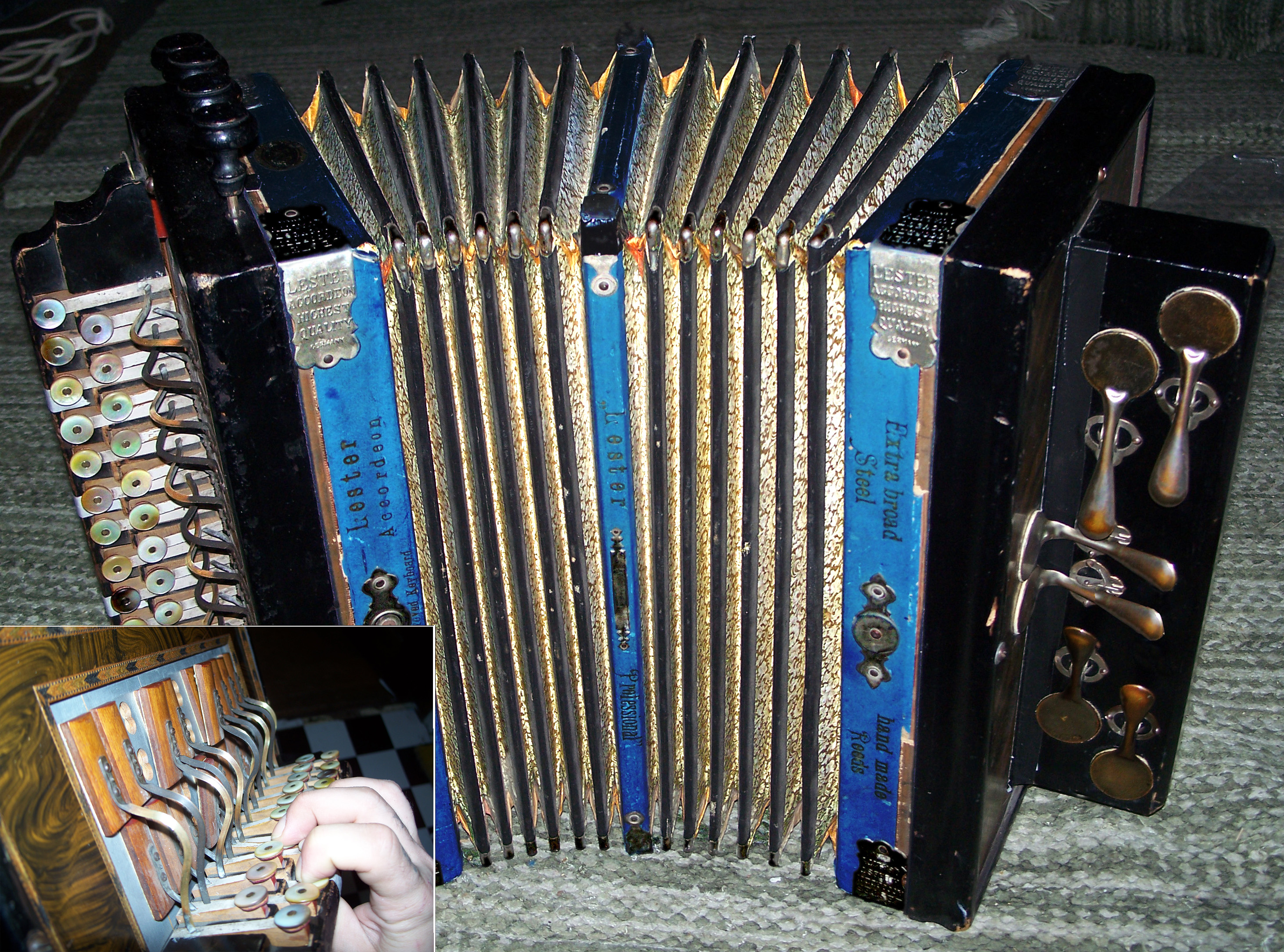
Feeling the Big Squeeze? Remember that even a squeeze box can make a pretty song.

Feeling the Big Squeeze? Remember that even a squeeze box can make a pretty song.

There’s a billboard across the street from my office building, promoting the hospital that’s affiliated with the medical school where I work. It features a friendly looking young woman with the words above her head, “I want it all.” The implication, of course, is that the medical center can meet all of the health needs of this person, indeed of anyone who uses the hospital and its network of health care providers.

This isn’t a criticism of their advertising campaign, but more just a few thoughts that come to my mind every time that I drive past that sign. Wanting it all is pretty much the American dream, is it not? Maybe it’s the dream of all people, everywhere. We all want whatever it is that we want, whether we necessarily need it or not. You may not subscribe to this belief personally, but you have to admit that it’s an awfully loud societal message.

From the perspective of a provider, be one a provider of health care services or a provider of information services, we want it all, too. We want to say that we can provide anything and everything to anyone and everyone who comes through our doors. Libraries, especially, have this idea deeply ingrained in their DNA. They exist for everyone.

But as we have become such a specialized world, I think we’d do well to face the facts that our ability to meet that mission anymore is dwindling, if not altogether extinct. I’ve been working on an evaluation of one of the research cores for the CCTS and in talking to those involved with it, I can’t help but notice they speak many of the same concerns that I long heard in my former home in the library; a handful of people simply cannot meet the needs and demands of everyone.

This imbalance causes us to rethink much of what we do, how we measure our success, and how we plan for the future. The reality of health care is that you really cannot have it all. A few weeks back, I was feeling really miserable and went to the walk-in clinic of the hospital next door only to learn that it’s really not a walk-in clinic, but rather a place for patients who see a certain group of doctors there. These patients can walk in for a last-minute appointment. If one is available. My doctor is a doctor within the same system, but while he has an office a few floors above the very clinic where I was seeking treatment, his clinical office is in another location, thus I wasn’t able to use the services provided there. Again, not a criticism of the provider network (though I am a big critic of the messed-up system that dictates these type decisions), but I share the story as an example of how claiming all can be provided to everyone ought to be a statement with an asterisk after it. Some restrictions DO apply.

One of the reasons that I chose to leave the library and work for the CCTS is that I felt the expectations in this new role were somewhat more realistic. Here was a defined group of programs and research cores for me to evaluate. It’s a lot, but still seems a manageable number. It allows me the ability to focus more, to feel less scattered, to feel less pulled, to feel less like I’m always falling short of meeting my goals, not because I’m not trying hard or working hard, but because I am only one person and trying to give time to everyone feels like a losing proposition. To me.

Sustainability is a key issue as we continue to work in institutions and businesses and governments that are constantly under the pressures of too little resources to meet all of the required needs. We are limited in people, certainly. Positions are cut or people leave posts and are never replaced. Everyone feels overworked as we try to fill holes and do more.

But we’re also limited by our current service models. Yesterday, I was able to attend the annual eScience Symposium hosted by the NN/LM NER. The afternoon session featured two speakers from different universities who described their particular programs for data services. Regarding their data repositories, one school allows self-deposit while the other offers a mediated service, i.e. researchers send their data to the library and then staff their deposit on their behalf, adding all of the proper metadata, annotation, etc. necessary in order for people to search and find the data sets in the said repository. During the Q&A, I asked the speakers about the differences between their models. I asked them some of the same questions that are asked in the process of evaluating research cores and programs:

How did you decide which path to follow? How did you decide which aspect of your repository to sacrifice; the quality of the content (enhanced by the mediation) or the ability to be a bigger service (because you’re not limited by the time/efforts of staff in the library)?

As one speaker said, “It’s a balancing act.” Indeed. And it’s also a clear example of how believing we can be all for all is misguided. It’s just not possible. We have to set priorities and make choices.

For good and bad, though, these are the realities of academic institutions, health care providers, research centers, and libraries. The one thing that we all really do have is the challenge to face these limitations, all the while trying to come up with the solutions for providing the best of whatever we can offer to as many as possible. Whether it’s what we really want or not, THAT is the “all” that we have.


Turning the Tables

27 Mar

Earlier today, a very nice first year medical student came by my office and apologetically asked me if I could tell her where the offices of our Institutional Review Board people are. I don’t work in the library anymore, you might recall, and now my office sits in a maze of other offices on the 7th (top) floor of the ambulatory care center of our medical complex and medical school. It’s not a place that anyone wanders past. Mine is not an office that someone might simply pop in for a visit. It’s out of the way. And as I said to my former colleagues in the Library and my friends on Facebook, I admittedly miss such interruptions. Not all of the time, mind you, but one of the greatest joys that I knew as a librarian was simply answering someone’s question and / or helping them in some way that made their day better. The student was SO grateful when I got up and walked her around the corner to the IRB folks. She thanked me several times. It was a flashback to those days of yore … oh, 3 months ago or so.

For ten years, I spent the better part of my working days answering people’s questions. Either answering them directly, looking for the answer for them, or helping them learn how to find the answer for themselves. All day long, the overwhelming majority of sentences spoken to me ended in question marks. Librarians answer questions.

Evaluators, on the other hand, ask them. This is what I’m quickly learning. We are the ones who need the answers, thus we’re the ones who ask the questions. How well did “X” intervention work? How much time was saved by implementing “Y” into the process? What does “Z” do for you that no other letter of the alphabet ever did for you before?

But I’ve also learned that there’s a speed bump; the researchers and clinicians and other users of the resources and services that I’m evaluating … well … they typically aren’t librarians. In other words, I don’t think that they like answering questions as much as any librarian does.

“It’s a simple survey,” I claim.

“It won’t take more than 5 minutes of your time.”

“The results will help us help YOU!”

“I’d be ever so grateful,” said Babe the Pig. (If you miss the reference, check out the movie.)

And still, getting people to answer questions is way harder than I ever imagined. I’m actually very good at talking to people, and usually pretty good at getting people to talk to me. It was one of the skills and characteristics that I honed as a librarian / informationist that I figured would be easily transferable to my new role. Not so much. At least not yet.

It could be the method – the dreaded survey. People don’t like them. Heck, I don’t like them. But in some cases it is the most appropriate and most efficient method for getting the data (answers) you need for the evaluation. I read and studied and asked about writing good questions. I worked with seasoned researchers to put my survey together. I piloted it with different groups and made all of the necessary tweaks based on the feedback I received. I picked my target audience carefully. And once I felt confident about the whole thing, I let it loose.

And then … I waited.

And waited.

And sent out a couple of reminders.

And broadened my audience.

And worked some different angles to reach people.

And waited some more.

I’m still waiting; waiting for the responses to grow to some level that will afford me some information needed to present my findings to a couple of different groups. It’s coming along, but golly it’s slow. And such a cumbersome process. Ask me a question and I’ll happily answer for you, straightaway. But waiting for others to answer me … well, the tables have turned, my friends.

A turning table playing a different tune!

A turning table playing a different tune!

Stay Put!

6 Mar
Sit, Eliza. Stay.  Our puppy on her first day home, Aug 2013.

Sit, Eliza. Stay.
Our puppy on her first day home, Aug 2013.

I read a couple of good blog posts this morning, over on the Medical Library Association’s blog, “Full Speed Ahead.” The first was by MLA President, Linda Walton, called, “The Time for Change is Now.” It offers a nice summary of the organization’s new strategic goals, each of which contains some level of a call for action. Like many professional organizations, MLA is challenged to find its purpose and goals in the ever-changing world of libraries, health care, and information. The second post is by MLA’s new Executive Director, Kevin Baliozian. “Words I Can Do Without” lays the foundation for what became the very strategic plan outlined in Linda’s post. Wondering what Kevin’s “no say” words are? SPOILER ALERT: They are “try” and “continue.” Again, you can see that MLA and it’s leadership are focused on moving forward, shedding the “same old, same old,” and making the organization as relevant and important to health sciences librarians and information professionals as its storied history shows it to be in the past. 

I serve on the Executive Board of my regional chapter of MLA and we are engaged in much the same type of work. What do we continue doing? What do we cast aside? Who do we reach out to? What defines us and makes us different, unique, worthy of a colleague’s membership dues and energy? Important questions, all.

I’ve got nothing against change. I think it’s important to take stock on a regular basis and adjust accordingly. In my new job as an evaluator, that’s one of the main focuses (foci?) of my work. More, it’s one of the main reasons for my work. I evaluate the research cores and programs of the UMCCTS to track their progress and to make corrections; to identify where changes need to happen. 

But all of this said, I do have one cautionary note about change: Change for the sake of change is no change at all.

I once counted the number of times that I moved between the ages of 20 and 30. I don’t remember the exact number today, but it was around 18. Eighteen moves in 10 years. I also had a number of jobs during that time. I changed all of the time, BUT I went nowhere. I never stayed in any one place long enough for it to feel like home and I never stayed in any job long enough to become very good at it. And it’s the latter that I sometimes fear when it comes to the bigger picture of organizational and/or professional change.

The other day, someone called me to ask for some “librarian expertise.” I told him that I no longer worked in the library, but I could still certainly help him because I still have librarian expertise. I have it because I stayed in a job for 10 years. My job in the library did not stay the same for 10 years, but I stayed true to a certain core ideal – to help the students, clinicians, and researchers of the Medical School with their information needs, whatever those needs might be. Whether I was building consumer health websites, answering reference questions, teaching how to better search PubMed, or building data dictionaries for research teams, in each I was staying true to that ideal. 

As we search and investigate and try on new roles as librarians – at the individual, institutional, and professional organization level – I hope that we stay true to our ideals. It’s a big challenge, but not impossible. It doesn’t mean we don’t change, but that we purposefully change. Change is expensive. It costs time to learn new things and time to become an expert. It costs time to raise the awarenesses of the people we serve regarding the things we now do. It costs people jobs, when roles and tasks disappear. It costs people their identity, when they’re tied closely to one in particular. 

In the past 2 months, I have changed jobs, moved offices twice, watched my mother-in-law pass away, and (just about – almost ready to sign the papers) bought a house. I seem to be forgetting another big thing, but that’s probably an innate defense mechanism, because let me tell you … all of this change has been exhausting. It takes a toll on a person physically, mentally, and emotionally. We all know this. So it’s all the more important to make sure that we undertake change that’s worth the expense.

I’m enjoying my new job, though it’s stressful to not be an expert anymore and I’d be lying if I said that I don’t miss the library. I’m going to love our new house, something that I’ve never had before in my life. And I do so love having an office for the first time, even if it’s across the campus from all of my old colleagues. All good changes. All worth it.

In the same way, I think that many of the changes that we’re talking about and making in the world of health sciences libraries and beyond are great – necessary and worth the cost. But I do wonder about some and I question their true connection to our ideals. Are we scrambling to change because we don’t know what else to do? Are we forced to change for reasons that have nothing to do with our work, e.g. budgets, space, etc. All very real forces of change, but I worry that sometimes the changes that they force aren’t necessarily in our best interest.

Change is difficult. Change is inevitable. And perhaps most importantly, change requires good leadership – whether you’re leading an organization or just trying to lead yourself in the right direction. In that respect, I feel pretty good about my professional organization. I paid my dues for another year. 🙂