Taking Inventory

7 May

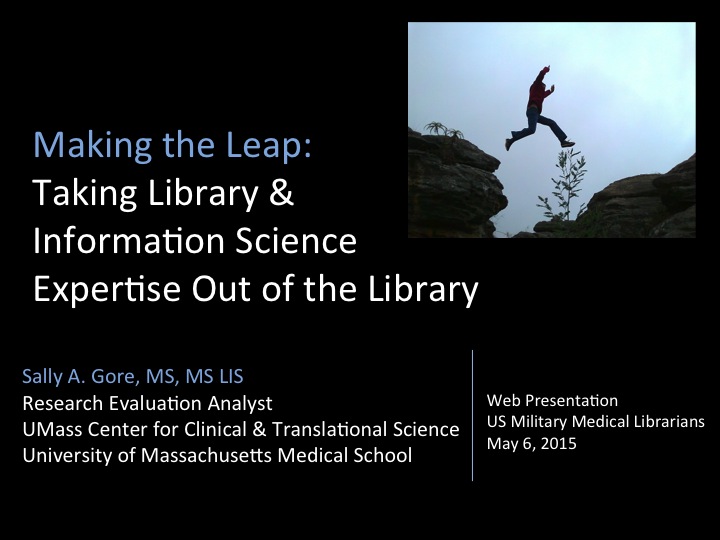
I was invited to present a webinar to a group of military medical librarians. Originally, back in 2011 when I first got the invitation, I was going to offer up something related to eScience (based on a webinar I’d done for the NN/LM GMR around that time). A few hiccups along the way and the event got put aside for a few years. When the organizer came back to me late last year, I said that I was happy to still present, but that my job was different now. We decided upon the topic of transition in health sciences librarianship, i.e. how the profession is changing and how librarians within it can change, too. Here’s what I came up with:
USAMRIID 1

While my job title has changed many times over the past ten years, most noticeably last December when I moved from the UMMS Library to the UMass Center for Clinical and Translational Science, I still think of myself as a librarian. I’ve done many things under that umbrella – tackled all kinds of projects and honed many skills. That’s one of the best parts about being an information professional today. Information drives so much of everything. The more you can learn, adapt, refocus, redefine, etc., the better off you’ll be in terms of having a fulfilling and enjoyable career – either within the walls of a library or not.

USAMRIID 2

I heard a great presentation at MAHSLIN’s Annual Meeting last week by Jean Shipman, Director of the Spencer S. Eccles Library at the University of Utah School of Medicine (stay tuned for the sketchnotes). Besides the content – applying Lean process improvement principles to projects in her library – what I liked was how Jean structured her talk around 4 case studies. Her presentation followed another terrific one by Varang Parikh, Senior Process Improvement Specialist at UMass Memorial Healthcare. Varang covered the theory and then Jean offered some real-life examples from her library.

As I thought about how to structure my own talk, I thought about how there’s a lot of theory and a lot of talk about transitioning within the profession of librarianship. It’s helpful. What’s also helpful are some concrete examples, thus I decided to follow Jean’s lead and offer up myself as a case study for my talk.

I’ve worked for UMass Medical School for over 10 years. In that time, I can identify 5 distinct roles and/or jobs and/or titles and/or transitions within my career. I often tell people that this is the longest that I’ve ever worked at any one place, not to mention the longest that I’ve ever worked in any one profession. I think that the fact that I’ve been able to assume so many different roles is what’s made that possible. Who can get bored when you’re regularly doing something new?

So in my 10 years, I’ve been a consumer health librarian, a reference librarian, a research and scholarly communications librarian, an informationist, and now a research evaluation analyst. But remember what I said earlier, for me these are all facets of the same profession – librarianship and/or information science. They’re all about dealing with information, that’s the common denominator.
USAMRIID 3

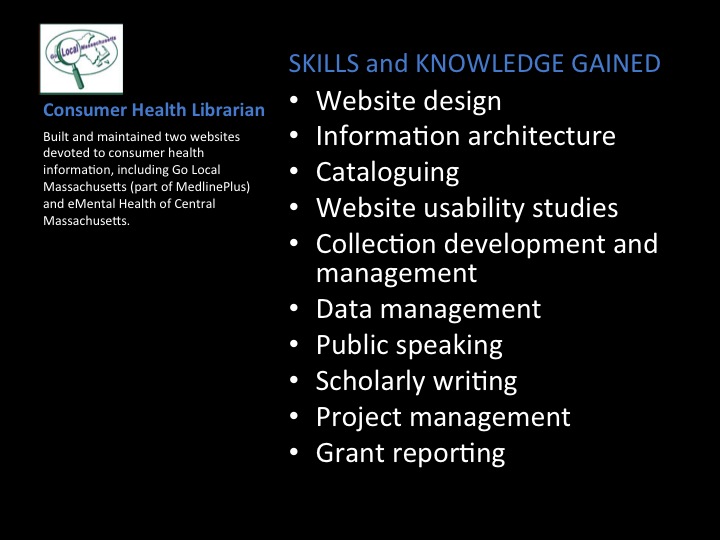
In each of these roles, I gained some knowledge and skills. I decided to take an inventory of these things, to see where they built upon one another or carried over from one role to the next. As a consumer health librarian, working on the projects, “MedlinePlus Go Local Massachusetts” and “eMental Health of Central Massachusetts,” I was able to both put to good use a  bunch of things I’d learned in library school (this was my first job after graduating), as well as add some new skills to my toolbox.

USAMRIID 4

The same thing happened, a couple of years later, when I got to move from being a grant-funded librarian to a full-time staff person. As a reference librarian (something I’d been doing all along, but now more formally), I added to my skill set, essentially adding to my value as a librarian.
USAMRIID 5

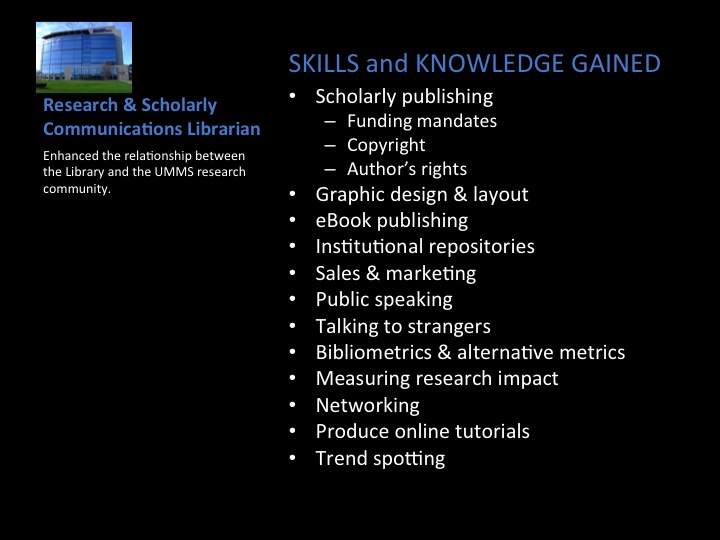
As a research and scholarly communications librarian, I had the chance to do more of the same. I also learned during this time that I didn’t like administration. I don’t do it well, at least not in the context where I was working. I recently saw a colleague who’s moved from administration to teaching and data services in her library. We talked about how it’s hard in our world to not be made to feel like you’re somehow failing and/or taking a step backwards to not be an administrator. Supervision and management, for better or worse, is seen as the one “promotion” in many a business, including higher ed. It’s too bad, since we all know that there are many, many ways to improve in your career without taking that path. But alas, it’s our world. And I share this as encouragement for anyone who’s happy and content finding their professional way along a path that doesn’t necessarily go up a corporate ladder.

USAMRIID 6

As in embedded research librarian and informationist, I gained a whole big grab bag of new skills. In many ways, it’s the transition that transitioned me most. If you read this blog with any sense of regularity, you know how all of these new skills and knowledge and projects emerged. And from them, I inventoried this nice list …

USAMRIID 7

When I added all of these lists together, when I took my inventory of all of the librarian skills I’ve gained the past years, I was amazed. Whenever I teach library school students, I encourage them to start their list now. I offer the same idea/advice to seasoned veterans. Think of all of the things you’ve done in your work and all of the resulting skills gained. Write them down. Take an inventory. You’ll be amazed, too.

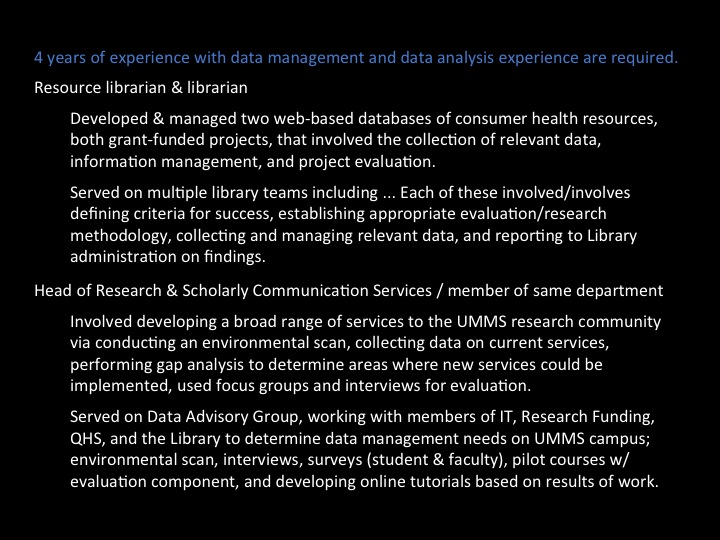
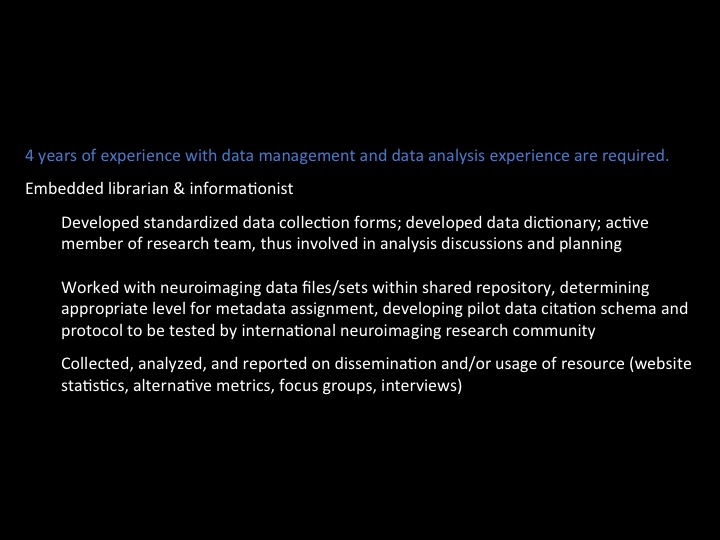
But more, my inventory was put to the test last year when I decided to take my skill set beyond the library altogether. When I applied for the position in the UMCCTS, I had to make the case that all of those library and information and data management skills made me well-prepared to take on the role of a research evaluation analyst. It wasn’t the easiest sell, either, but fortunately I’d also learned perseverance when it comes to making this argument. It’s something we’ve been doing for a long time now, as we’re continually put into the position of demonstrating our relevance and value. So, when our HR department asked me to map my very librarian-centric CV to the job requirements listed in the position announcement, I offered them this:

USAMRIID 8

This was the job listing.

And these were my “maps”:

USAMRIID 9

USAMRIID 10

USAMRIID 11

USAMRIID 12

All I did for these was pull pieces from my CV and put them with the requirements. It was a great exercise (beyond landing me the job), because it forced me to prove what I’d been saying for awhile – that the skill set of a librarian, by any name, is pretty darned valuable and can offer a person any number of opportunities.

USAMRIID 13

And of course, I’m still learning. My new job is filled with new challenges (opportunities for growth) that keep work interesting and fulfilling. For me, that’s the reward of taking the leap.

I left my audience yesterday with three takeaways:

USAMRIID 14

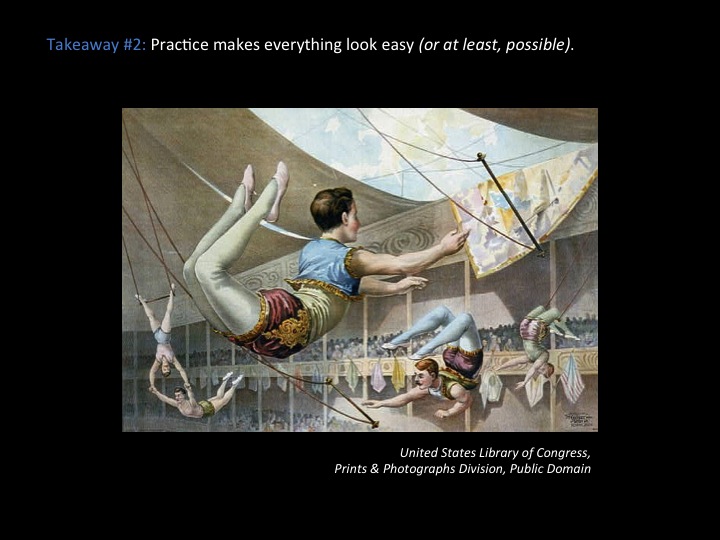
Nobody makes “The Flying Wallendas” varsity team without years and years of practice (and good genes). And the little Wallendas don’t start off by leaping off the high platform. Scaffolding, nets, safety gear … it’s all there. And it’s there for librarians, too. In fact, I think that the library profession has to be one of the most interwoven, networked, supporting professions out there. It is, after all, our nature to share and to help. And we do so for one another all of the time.
USAMRIID 15

Then eventually, you become so good at what you do that people don’t see the nets and the scaffolding. They only see you doing what you know how to do. And you know what else? It doesn’t matter what they call you, either. I feel most pleased when people simply say, “I call Sally because she can help.” It’s not “Sally the librarian” or “Sally the informationist” or “Sally the knowledge manager” or “Sally the evaluator.” Just Sally.

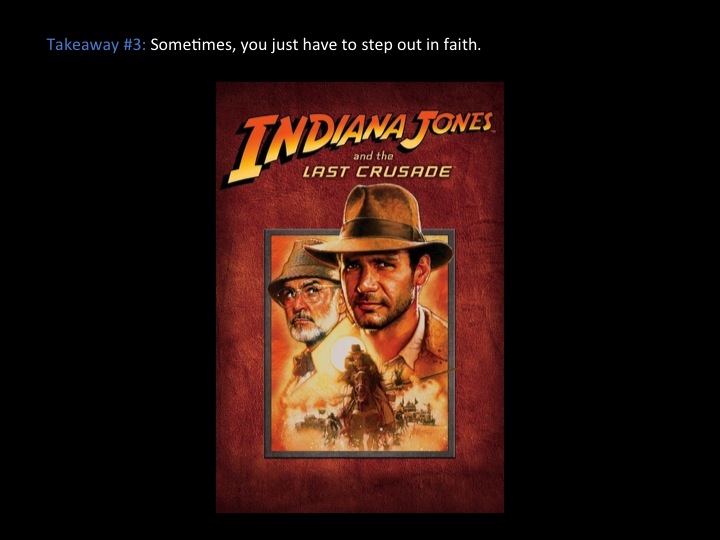
The last takeaway is “Step out in faith.” Just like Indiana Jones in “The Last Crusade.” Step out over the chasm between the library and wherever you want to take your skills and whether you see it or not, a bridge will appear under your feet to take you there safely. (If you don’t know this scene from the movie, seek it out. It’s a good one.)

So that’s what I shared with the group of librarians yesterday. I hope they enjoyed it and got something out of it. And by reading this, I hope you have, too.

Is Big Data Missing the Big Picture?

27 Apr

Forest_for_the_Trees

When I was defending my graduate thesis a number of years ago, I was asked by one of the faculty in attendance to explain why I had done “x” rather than “y” with my data. I stumbled for a bit until I finally said, somewhat out of frustration at not knowing the right answer, “Because that’s not what I said I’d do.” My statistics professor was also in attendance and as I quickly tried to backtrack from my response piped in, “That’s the right answer.”

As I’ve watched and listened to and read and been a part of so many discussions about data – data sharing, data citation, data management – over the past several years, I often find myself thinking back on that defense and my answer. More, I’ve thought of my professor’s comment; that data is collected, managed, and analyzed according to certain rules that a researcher or graduate student or any data collector decides from the outset. That’s best practice, anyway. And such an understanding always makes me wonder if in our exuberance to claim the importance, the need, the mandates, and the “sky’s the limit” views over data sharing, we don’t forget that.

I really enjoyed the panel that the Medical Library Association put together last week for their webinar, “The Diversity of Data Management: Practical Approaches for Health Sciences Librarianship.” The panelists included two data librarians and one research data specialist; Lisa Federer of the National Institutes of Health Library, Kevin Read from New York University’s Health Sciences Library, and Jacqueline Wirz of Oregon Health & Sciences University, respectively. As a disclosure, I know Lisa, Kevin and Jackie each personally and consider them great colleagues, so I guess I could be a little biased in my opinion, but putting that aside, I do feel that they each have a wealth of experience and knowledge in the topic and it showed in their presentations and dialogue.

Listening to the kind of work and the projects that these data-centric professionals shared, it’s easy and exciting to see the many opportunities that exist for libraries, librarians, and others with an interest in data science. At the same time, I admit that I wince when I sense our “We can do this! Librarians can do anything!” enthusiasm bubble up – as occasionally occurs when we gather together and talk about this topic – because I don’t think it’s true. I do believe that individually, librarians can move into an almost limitless career field, given our basic skills in information collection, retrieval, management, preservation, etc. We are well-positioned in an information age. That said, though, I also believe that (1) there IS a difference between information and data and (2) the skills librarians have as a foundation in terms of information science don’t, in and of themselves, translate directly to the age of big data. (I’m not fan of that descriptor, by the way. I tend to think it was created and is perpetuated by the tech industry and the media, both wishing we believe things are simpler than they ever are.) Some librarians, with a desire and propensity towards the opportunities in data science will find their way there. They’ll seek out the extra skills needed and they’ll identify new places and new roles that they can take on. I feel like I’ve done this myself and I know a good plenty handful of others who’ve done the same. But can we sell it as the next big thing that academic and research libraries need to do? Years later, I still find myself a little skeptical.

Moving beyond the individual, though, I wonder if libraries and other entities within information science, as a whole, don’t have a word of caution to share in the midst of our calls for openness of data. It’s certainly the belief of our profession(s) that access to information is vital for the health of a society on every level. However, in many ways it seems that in our discussions of data, we’ve simply expanded our dedication towards the principal of openness to information to include data, as well. Have we really thought through all that we’re saying when we wave that banner? Can we have a more tempered response and/or approach to the big data bandwagon?

Arguably, there are MANY valid reasons for supporting access in this area; peer review, expanded and more efficient science, reproducibility, transparency, etc. Good things, all. But going back to that lesson that I learned in grad school, it’s important to remember that data is collected, managed, and analyzed in certain ways for a reason; things decided by the original researcher. In other words, data has context. Just like information. And like information, I wonder (and have concern for) what happens to data when it’s taken out of its original context. And I wonder if my profession could perhaps advocate this position, too, along with those of openness and sharing, if nothing more than to raise the collective awareness and consciousness of everyone in this new world. To curb the exuberance just a tad.

I recently started getting my local paper delivered to my home. The real thing. The newsprint newspaper. The one that you spread out on the kitchen table and peruse through, page by page. You know what I’ve realized in taking up this long-lost activity again? When you look at a front page with articles of an earthquake in Nepal, nearby horses attacked by a bear, the hiring practices of a local town’s police force, and gay marriage, you’re forced to think of the world in its bigger context. At the very least, you’re made aware of the fact that there’s a bigger picture to see.

When I think of how information is so bifurcated today, I can’t help but ask if there’s a lesson there that can be applied to data before we jump overboard into the “put it all out there” sea. We take research articles out of the context of journals. We take scientific findings out of the context of science. We take individual experiences out of context of the very experience in which they occur. And of course, the most obvious, we take any and every politician’s words out of context in order to support whatever position we either want or don’t want him/her to support. I don’t know about you, but each and every one of these examples appears as a pretty clear reason to at least think about what can and will happen (already happens) to data if and when it suffers the same fate.

Are there reasons why librarians and information specialists are concerned with big data? Absolutely! I just hope that our concern also takes in the big picture.


Full Speed Ahead

16 Apr

“Make your mistakes, take your chances, look silly, but keep on going. Don’t freeze up.” ~ Thomas Wolfe, You Can’t Go Home Again

I came out of an 8 o’clock meeting on Monday morning with the thought, “Well, at least I still have the whole week ahead for things to improve.” They didn’t. Not really. Not until today. It’s been a difficult week.

One of the steepest learning curves of a new job is less often the tasks at hand, but more learning the people. People make life really great, really difficult, and everything in between. That’s pretty much how it goes, unless we live alone on an island. And no one lives alone on an island. Except Tom Hanks in that movie a few years back. Even then, he had Wilson. My work during the earlier part of the week was not critiqued by inanimate objects and/or sporting equipment. It was reviewed and editorialized and shredded to bits before being put back together into something that only marginally resembled what I started off with by people. I admit it … it hurt. And yes, it also made me a little angry.

I had to do a lot of self-talk to keep going. I said to myself, “If someone you know came to you and expressed to you what you’re feeling right now, you would tell them without hesitation that it takes a lot of courage to take chances, to try new things, to stretch yourself beyond your comfort zone.” But if you’re like me, you probably find it much easier to encourage others than to do the same for yourself.

There was, of course, nothing personal in the assessment of the work that I’d done. I had to speak before the Committee on Scientific Research Affairs to explain the findings of a user survey that I carried out for a core service recently. I was representing my department in what I was saying and those who are responsible for it just wanted to make sure that I said the right things, in the right way, to highlight the right points. Still, while it may not have been intentional, I couldn’t shake the feeling that I was being spoken to like I was a complete newcomer to this business, as if I had never presented anything to any audience ever before.

I walked into my house on Monday night and shouted to my animals, “DON’T THEY KNOW WHO I AM?!?!?!” (It’s good to have animals during moments like this. They never judge you for any angst-ridden, bruised-ego-induced outbursts.)

As I talked about it more with my spouse later that evening and then I paid attention to it more during meetings on Tuesday and Wednesday, I realized a couple of things. First, the folks that I work for and with now DON’T know who I am. I get invited to speak at conferences, be on task forces, elected to offices in the world of libraries because my peers in these organizations do know me. They know what I do well. They know how I say things, how I do things, how I believe certain things and express them. And yes, it is a nice ego boost when people like you and respect you for those very things; when they like you and respect you for yourself. But it takes awhile for people to get to know you. It takes work and efforts and showing up and volunteering and writing a blog post week after week.

I have none of this going for myself right now and let me tell you, it’s hard. It’s harder than I thought it would be.

But I also noticed a second thing about my new environs this week and that’s that there is a tendency for people to work collaboratively in a way that is more critical than perhaps I’m used to. On Tuesday morning, I worked for two and a half hours with a couple of docs (an MD and a PhD) on the same presentation. We talked through everything. Every piece – not just what I’d put together, but what they’d put together, too – was up for critique. Everything got moved around and rearranged. Parts got lopped off. I was struggling again to hear people telling me that I needed to say something this way, not that way.

Again, I wanted to shout, “I know how to talk to people, for <expletive> sake!!” But along the way somewhere, I was able to step back from my frustrations and hurt feelings a moment to realize we were all in this together. The process that I was a part of was simply the process that’s the norm for these people. The people who I don’t know and who don’t know me, but yet we work together now.

Yes, I do think that the steepest learning curve involves learning the new people. Coming out of yesterday morning’s presentation, one of my new co-workers said to me, “You’re pretty good at that.” I replied, “Yes, I know. And thanks for saying so.”

We’re getting to know each other. Full speed ahead!

Damn the torpedoes!

Damn the torpedoes!