Summer Sightseeing

20 Jul

I subscribe to #dataviz guru, Stephanie Evergreen’s blog and found this morning’s post about timelines really great.  I love timelines, both aesthetically and functionally. I particularly liked Stephanie’s idea to use a visual timeline to outline a day’s agenda:

Timeline

The next time I put together a presentation and am tempted to do that requisite “Here’s What We’re Going to Cover in this Talk” slide, I’m going to use this technique rather than some boring list of bullet points. For sure.

My friend and authorstrator, Suzy Becker, shared a wonderful article with me from the latest issue of Smithsonian magazine. The Surprising History of the Infographic will be required reading for the data visualization course that I’m putting together for next spring. And as I told Suzy, I’m changing my job title to “polymath.” I love it.

If you’re interested in joining me in this new old vocation, writer Nir Eyal’s post, Three Steps to Get Up to Speed on Any Subject Quickly may be of help. “Google once, take notes, then stop Googling and start sketching” was perhaps my favorite bit of advice.

And a few other good things I’ve come across and/or have been shared with me over the last couple of weeks:

15 Data Visualization Tools to Help You Present Ideas Effectively has a few listed that I’ve yet to try. I’m always up for trying new tools.

The Analog is a brilliant site for reviews of all things analog – you know, pens, paper, pencils and such. If you’re like me and read James Ward’s, The Perfection of the Paper Clip: Curious Tales of Invention, Accidental Genius, and Stationery Obsession in one sitting, you’ll love this blog.

Design Observer is also a beautiful and enlightening blog that I came across through a tweet to its posts, 50 Books and 50 Covers. Books can be art, in more ways than one.

Finally, July is always a month of celebrations and anniversaries. This very day marks the 47th anniversary of Apollo 11’s landing on the moon (Do you remember where you were?) and July 5th was the 20th birthday of perhaps the most famous sheep since Lamb Chop, Dolly. Yes, Dolly, “the first mammal cloned from an adult cell, was born July 5, 1996.” Scientific American’s story behind the story of Dolly is a fascinating summer read. Enjoy! 

‘Til next time…Sheep

How I Spent My Summer Vacation (Pt.1)

12 Jul

Well, truth be told, I’ve not had a summer vacation just yet. Still, things do seem to slow down a little bit at work during the summer months and I’ve taken advantage of the time to learn a few new things that will hopefully make me better in my job. I thought I’d share some of them, along with resources in case you wish to add some arrows to your quiver, too.

One of the biggest challenges that I face as an evaluator is being able to quickly (and often on the fly) answer questions about the different programs and projects of the UMCCTS. I struggle with rarely getting the same question twice – or at least my ability, yet, to hear the same question twice – and too often find myself scrambling to gather data from different sources, analyze it, and present it back to a particular stakeholder “by the end of the day.” Granted, I was certainly used to giving quick answers to questions from patrons when I worked in the library, but I had a couple of advantages there; (1) I’d worked for a number of years as a medical librarian, so I was pretty up to speed on the library’s resources and (2) the library was a nice, neat, set container of resources as opposed to any number of individuals and project leads and program directors and data gatherers spread across the campus. Praise be the library! It’s difficult to overstate the value of organization. But I digress…

My challenge now is to make my own library, to build my own collection of resources, and to keep them current so that those stressful “by the end of the day” requests are less so. Enter spreadsheets, pivot tables, and dashboards. I was hardly a novice Excel user when I started this work, but enough reading in the literature and best practices of evaluation led me to believe that I needed to expand my know-how about Excel in order to make things easier for myself. After my last scramble to fulfill a “just in time” request, I decided to get to it. I read two excellent books on data visualization that base most of their material on examples from Excel; Cole Nussbaumer Knaflic’s, Storytelling with Data, and Stephanie Evergreen’s, Effective Data Visualization. These are both great, hands-on books to get you going. I also came across Excel Campus, with one of the best series of video tutorials I’ve ever viewed. The 3-part series on building pivot tables and dashboards was just what I needed.

With these new skills, I’m able to take lengthy, unwieldy (to me) spreadsheets and turn them into several separate sheets with associated pivot tables for analysis and interactive dashboards that let me quickly see the who, what, when, and where of our different programs. It’s a work in progress, but I can tell already that it will be helpful for me and – hopefully – when I develop more tables based upon the questions of the Center’s staff, it will be helpful for them, too.

Next up, I wanted to learn how to create both an overlapping bar chart and a heat map. I was inspired to learn the former from a blog post that I read, coupled with the task I had of writing a report summarizing the evaluation results of our annual research retreat. You know, when you create a survey to evaluate an event (a class, a retreat, a workshop, etc.), you’re often stuck with a whole bunch of questions producing a whole bunch of bar graphs showing how much people appreciated this, that, or the other thing about the event. My survey for the retreat was no different, but I knew that there had to be a better way to present the findings – “better,” meaning a one-page document. Overlapping bar charts seemed perfect. As you can see, I was able to use this type of chart to combine the results of several questions into one visual, making things a lot easier to read and a lot shorter in format.

Feedback

Five charts become one with an overlapping/stacked bar chart.

Now the heat map. Why? Oh, I don’t know. It was last Friday and a quiet day. And they’re kind of cool looking, so … back to tackling R for analysis and visualizations. (My goal here is to be able to be comfortable with these tasks in Excel, R, and Tableau, thus I switch off between them, to hone some skills.) I’ve mentioned here before that I find Nathan Yau’s books and website, Flowing Data, to be essential to understanding and doing data visualization. To learn (better said, “follow the instructions”) to make a heat map, I used the example that he offers in his book, Visualize This, but he also makes this particular exercise available in his collection of online tutorials, so you can have at it, too, if you wish. As you can see, I did indeed follow the instructions and made a nice little heat map of NBA players’ stats.
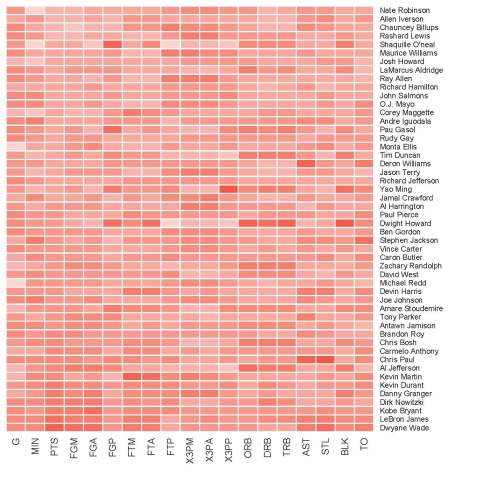
NBA HeatmapI also wanted to try making a heat map in Excel (easier said than done, though you can find resources online). I downloaded the data from my Jawbone fitness band that I’ve been wearing since December and made a nice map of my daily step count. Nothing fancy, but it worked just fine as a learning exercise.
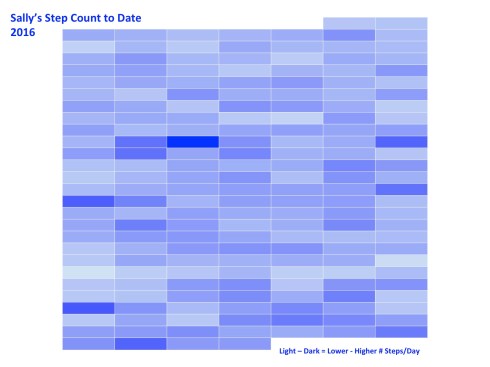
Step Count Heat Map

I still plan to tackle making heat maps in Tableau, as well as other dashboards and charts that will be useful. The tool kit is never full and the summer isn’t even half over yet.

Enjoy! 

If Pat Summitt had been a Librarian

28 Jun
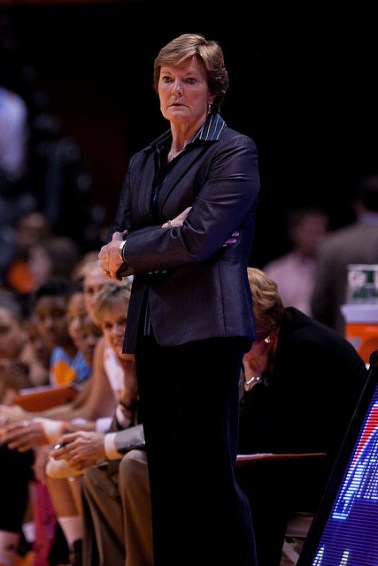
Summitt

Photo by Ben Ozburn/TNJN, Creative Commons

I wonder what kind of librarian – what kind of person – I’d be, if Pat Summitt had coached me. I wonder what kind of librarian Pat Summitt would have been. How might she have changed libraries, changed our profession, in the same way she changed women’s basketball and women’s sports forever? How would she challenge us? How would she push us? How would she make us see that we are never the best that we can be? That there’s always room to get better – to be better. To not simply settle for being pushed to the sidelines, but to stand up for the importance of our work. To constantly fight and change and fight and change, as is necessary, in order to push ahead. 

 I admit that this is a strange set of questions to be thinking about (Pat Summitt a librarian?!), but I’m a librarian and I so loved and admired Pat Summitt, and I grew up a tomboy and a gym rat and in the decades of great change in girl’s and women’s sports. And so these pieces come together for me this morning.

Pat Summitt, the legendary basketball coach of the University of Tennessee Lady Vols and honest-to-goodness trailblazer in girl’s and women’s sports, died this morning. She was 64 years old. I live in Massachusetts where women’s basketball is rightly dominated by the dominating University of Connecticut, but I grew up in Virginia and much closer to Tennessee. I played basketball in junior high and high school and I went to college when women’s basketball was just coming under the umbrella of the NCAA (it was still the AIAW during my freshman year). I am also closer in age to Pat Summitt than to the amazing players of today and so when I read the stories of her and see the video reels, I’m in tune with the trailblazer – the van driving, laundry washing, sandwich making Pat Summitt – and I note how far women’s sports have come from those days. And I’m grateful.

I had the great fortune to have a front row seat for a small part of those early days. I was a manager for the women’s team at James Madison University, coached at that time by another giant figure in the game, Betty Jaynes. JMU never played Tennessee during my years, but we did play Old Dominion and I got to see the likes of future Hall of Fame players, Nancy Lieberman and Anne Donovan, and their own great coach, Marianne Stanley. They wiped the floor with the Lady Dukes, but what an experience to be at those games.

I used to imagine playing for Pat Summitt. I was nowhere near a good enough basketball player to ever do so (I wasn’t even a starter on my high school team) and by the time I was imagining this, I was way too old for such a dream, but I imagined it all the same. I often wondered what it would be like to come under the tutelage – under the stare – of Coach Summitt. Mostly, I wanted to play for her because I am one of the most undisciplined people on the planet and I believe that if ever there was someone who could whip me into shape, it was Pat Summitt. I might be beaten down and die in the process, but still I wanted to give it a try. 

It will never happen now. I mean, it wasn’t going to ever happen before today, either, but now it really won’t ever happen. So I’ll just have to keep on imagining it.

I think of Pat Summitt, Betty Jaynes, and Kay Yow. I think of Joan Benoit Samuelson,  Roberta Gibb, and Kathrine Switzer. I think of Linda Cohn and Robin Roberts and Doris Burke. I think of Billie Jean King. Today, I think of these women who blazed trails for so many in a world still dominated by men. They have been role models to many, many young women and young men. And I’m grateful.

In a changing profession in a changing world, I’m remembering Pat Summitt and all of her fellow trailblazers today. I’m remembering that they changed the world for the better and that they can inspire me to do the same.