Be Ye Kind …

26 Jun

[The following post was written originally to appear on the blog of the North Atlantic Health Sciences Libraries chapter of the Medical Library Association.]

… and other lessons from the annual meeting of the Medical Library Association.
MLA17_LOGO_500X500I want to thank the members of NAHSL’s Professional Development Committee, as well as all of the membership of NAHSL, for the award that I received to cover the cost of registration to attend the annual meeting of the Medical Library Association that took place in Seattle, WA last month. As always, it was a wonderful opportunity to reconnect with old friends and colleagues, meet lots of new people, network with those who do similar work, learn some nuggets of gold to put into practice back home, and of course, to see and to share the work that we all do as medical and health sciences librarians – or in my case, a Research Evaluation Analyst, aka a “Librarian by Any Other Name.”

I experienced a few highlights of the meeting including participating on a panel discussion with colleagues from several other institutions to talk about our work measuring and tracking the impact of research. I also really enjoyed Julie Sollenberger’s Janet Doe lecture. I have the honor of knowing Julie a little bit, so her choice of topic – kindness and how practicing it shapes not only our work, but our very beings – was spot on. She is a wonderfully kind person – one who lives what she preaches. It was a special plenary.

For this post, though, I want to reflect on another plenary session, i.e. the McGovern Lecture, given this year by Julie Angus, a scientist, bestselling author, and winner of the National Geographic Adventurer of the Year Award for her accomplishment as the first woman to row across the Atlantic Ocean, mainland to mainland. When I first saw that she was one of the keynote speakers this year and I saw the title of her talk, “Rowing Across the Atlantic: Strategies to Reach Your Goals,” I admit that I said to myself, “What in the world does this have to do with medical librarians and/or libraries?” And in truth, much of her talk came across as canned, meaning it struck me as likely the same talk that she gives to any audience. Yes, she threw in a few library references, but it was pretty general in nature – your typical motivational talk by a motivating person. Don’t read this as negative criticism. I enjoyed the talk and I’ll likely borrow a copy of her book from my local library and read it. It’s a great story – and she told it well. And I did take away two important things from it – two points that made it into my notes:

First, was the importance Angus placed on baby steps. In her talk she said, “When people ask, ‘What’s the most important thing that you’ve brought out of this journey?’, undoubtedly, it’s the importance of baby steps. Eventually all of those baby steps added up and as a result, we achieved our dream.” This point reminded me of the words of another adventurer, the climber, Joe Simpson. (If you like adventure and you’ve never seen the dramatized documentary, “Touching the Void,” seek it out!) Stuck in a life-or-death situation during a climb, he says, “You have to make decisions. You have to keep making decisions, even if they’re wrong decisions. If you don’t make decisions, you’re stuffed.” (He’s British, in case you wonder the “stuffed” reference.) Baby steps and continuous decision-making are crucial not only in big adventures, but in day-to-day life. It’s how we get from Point A to Point B, how we continue to be relevant in a changing work environment, how we continue to find fulfilment in our work. Complacency, apathy, dullness in the daily work is a career killer – not only for an individual, but for an entire organization. THAT is a message I found quite relevant – a great take-away from the talk.

The second thing I noted was the discussion that I followed during the Lecture; the back-channel, if you will. Following the #MLANET17 Twitter stream, I discovered that while I was thinking Angus’ talk was a bit predictable, LOTS of my colleagues did not. She would say something and someone would immediately apply the thought or the message to something in his/her career or workplace. It was wonderful to see all of the connections people were making between the Lecture and their lives. I love following the Twitter stream throughout the conference, generally to see what others are learning in concurrent sessions that I’m not attending, but it was also a real treat to see a motivational speaker truly motivating an awful lot of the audience with her talk. It’s hard to argue that this isn’t just what the planning committee wanted when they signed her up and I credit them for the good pick.

I’m off to the Special Library Association’s annual meeting in Phoenix this coming week. I had a paper selected for presentation. It’s going to be interesting as I don’t know many people in SLA. It will be like going to my first MLA meeting many years ago now. I’m a little nervous, but the one thing that that eases my nerves is that I do know that it’s pretty hard to find a librarian conference that doesn’t leave me wanting for good stuff. I look forward to that – and again thank NAHSL for helping me get to Seattle. It’s a terrific benefit of belonging to and serving the organization.


The Good, The Bad, and The Ugly of Social Media

23 May

goodbaduglyThe following first appeared as an article for the Social Media column (edited by Lara Killian, AHIP) in MLA News, the monthly membership magazine of the Medical Library Association. Originally, I planned to simply repost it here without any additional thoughts or comments, but in the past 24 hours, a couple of things have occurred that make me wish to add just a quick note. First, I read the New York Times article, The Internet is Broken: @ev Is Trying to Salvage It. It’s an interesting piece about Evan Williams, a co-creator of Blogger, one of the founders of Twitter, and the founder of Medium. Much of the article focuses on the the struggles of the latter as a successful business model, but the underlying theme is about the Internet and what social media has fostered, negatively, in our society.
The second thing that happened was last night, someone who I’ve never encountered in my entire life but who clearly disagreed with something that I posted on Twitter, called me a paid troll, an idiot, and a waste of oxygen. I’m grateful that they stayed away from any comments about my body and my dead mother, but … I blocked the individual before he could think of that. I’ve used Twitter for years. I know that it has an earned reputation as a platform for bullying, for hateful comments, and for even inciting violence, but until last night, I’d been immune from any of that. Twitter is a way for me to aggregate news sources, share interesting and helpful information with friends and colleagues, see pictures of puppies, and even form a few new friendships. I’ll not shy away from it due to this incident, but I imagine that I’m not alone when I observe the horrid behavior of too many people today, virtual and otherwise, and shout, “STOP IT!” 

But enough with the commentary. Here’s the piece that I wrote about why I’m a blogger. It’s been one of the best professional and personal decisions that I’ve made. It’s the Good, to the Bad and the Ugly.

*********************

Way back in September of 2012, I started writing a blog, “A Librarian by Any Other Name.” I chose this name because my official job title had recently changed from “research and scholarly communications librarian” to “informationist.” I didn’t particularly care for the latter term, but it came with an administrative supplement grant from the National Library of Medicine, which was my impetus for starting to blog in the first place. I also chose what I thought was a fun name for my uniform resource locator (URL)—librarianhats.net—to capture the fact that librarians have many job titles, in part because we wear so many different “hats.”

I began my blog to track my experience and progress for the grant. I’m not very good with note taking in any traditional sense, but I do like to write a narrative and I enjoy the world of social media, so blogging seemed a good choice. It became a way for me to share not only with other members of my research team, but also with other librarians and/or interested readers. When the project ended, I realized that I’d developed an audience and that I really enjoyed writing for my followers, so I continued.

Since that first post, I’ve written 192 more and had 62,224 visitors from 156 different countries. Reviewing these statistics makes me feel both proud and humbled. I’ve received many kind words of appreciation, engaged in interesting discussions about blog post topics, and discovered lots of colleagues with similar ideas and in similar situations. As a direct result of contacts made through my blog, I’ve accepted at least 1 invitation each year to speak at librarian conferences, allowing me to travel to fun places and meet many wonderful people. All of this happened because I started writing about what I do and what I think about as a librarian, an informationist, and, most recently, an evaluator for the UMass Center for Clinical & Translational Science. I believe it’s one of the best professional decisions I ever made.

Want to start your own blog? Here are some lessons I’ve learned:

Be yourself

My blog is a mix of the professional and personal me. I found early on that it was difficult for me to write completely objectively, as I might do for a professional publication. Besides, this wasn’t the point of Librarian by Any Other Name. I wanted to share my personal experiences and thoughts, but in a professional manner. As such, I adopted a style that allows me to be myself: fairly informal, folksy, and hopefully funny at times, but also on point in regard to sharing content that my audience will find interesting and relevant. Finding your voice may come easily or not, but with time and practice, it develops.

Be consistent

In her piece, “Making Time to Stay Social,” Lara Killian, AHIP, notes the importance of making a schedule and sticking to it. This is important both for the writer and the audience. People follow a blog when it stays current. In the same way, they stop visiting when a site sits dormant for long periods of time. When I first started A Librarian by Any Other Name, I wrote and posted a new piece each week. When I finished the initial project and especially when I changed jobs a couple of years ago, I found it harder to maintain this schedule due to both time and material. Once or twice a month is now my norm. The key is to maintain engagement.

Be brave (if you want to)

Early on, I made the decision to announce every new entry to A Librarian by Any Other Name on multiple platforms. I wanted people to find it. I wanted to develop an audience. My primary audience—in other words, medical librarians—prefers receiving information via different means. Some subscribe; some follow on Twitter, Facebook, LinkedIn, or Google; and still others click from the link that I send in an email to several email discussion lists. Some may feel this is overkill, but the reality of social media platforms and information flow is that if you want an audience, you need to utilize multiple channels. You may have naysayers who think self-promotion is simply ego, but it isn’t. If you’ve taken the time and effort to write something that you want others to read, you need to tell them it’s there. After all, it’s social media, not a diary.

Final thoughts

Too often, we struggle in our profession to be visible. We feel that we are overlooked and undervalued, and that what we do is misunderstood. The easiest remedy for this is communication. Blogging is one means of accomplishing this goal—and a whole lot more.

Librarians in Cars Driving Places

29 Mar

Have you ever watched the web series, Comedians in Cars Getting Coffee? It’s a funny show created by the very funny comedian, Jerry Seinfeld. Much like his classic television show, it’s kind of about nothing – just Jerry and some talented and funny comedians riding around in vintage cars, having coffee, and talking about whatever. I like it.

I also like The Late Late Show’s host, James Corden’s, carpool karaoke bits where he picks up famous folks and they ride around singing to songs on the radio. (My all-time favorite is the one with the Red Hot Chili Peppers. Honestly … LAUGH OUT LOUD funny! I had to watch it again while writing this. Excuse the snickers.) 

And then there’s the sportswriter, Tony Kornheiser’s daily podcast, This Show Stinks. I started listening to it early this year during my afternoon walks. For many years, Kornheiser wrote a column in the Washington Post. Whenever it was about the Washington Redskins, my grandmother clipped it out and sent it to me. I’ve been a fan ever since. I love the podcast because it centers on discussions around sports, politics, culture, odd news stories. A regular, rotating crew of columnists, politicos, sports people, movie critics, and more join in for what’s always an entertaining hour or so. 

I think the common thread of interest for me is that each of these venues allows me to be something of a voyeur, a fly on the wall of the room (or car) with people I wouldn’t mind hanging out with. They’re always smart and funny and they create these shows that allow me to feel like I’m part of the group. Even when I’m clearly not. Not in that league. Not by a long shot.

ozarkland

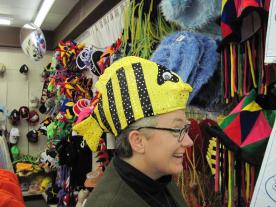
Fish hat. Ozarkland. Yes!!

I was thinking about Comedians in Cars this morning while walking my dog. I got to thinking about a few times when I’ve been riding in cars with other librarians and how those drives turned out to be as interesting and fun as any of these shows or podcasts. I remembered the time that Kristi Holmes, Director of the Galter Health Sciences Library at Northwestern University, and I rode all the way across Missouri together. At the time, Kristi was working at the Becker Medical Library at Washington University in St. Louis. We were both attending a conference in Kansas City, so I flew into St. Louis, Kristi picked me up at the airport, and we drove across the state together. On the way to Kansas City, we stopped off at the fantastically awesome, Ozarkland, and laughed ourselves silly at all of the kitchy souvenirs. On the way back, we stopped off at a for-real western wear store where I bought my very first pair of boots. Kristi grew up on a ranch. She was the perfect guide for this shopping adventure. And in between, we talked and talked. And we became friends.

Another time, early in my stint at the Lamar Soutter Library, I was invited to give a talk at  Cape Cod Community College. Donna Berryman, Senior Associate Director at the Edward G. Miner Library, University of Rochester, was the Outreach Coordinator for the New England Regional Medical Library (NN/LM, NER) at the time, thus we were co-workers. Donna also had to attend this event at CCCC, so we rode along together. We talked about libraries, librarianship, books, movies, our lives, our families, where we were from, how we grew up… in other words, in those hours in her car, we also became friends. Life-long friends.

I guess that I was thinking about these experiences this morning because I recently engaged in an online discussion about the importance of professional organizations. They’re dwindling, in case you were unaware. Membership is down at every level – national organizations, regional organizations, state and local organizations – and for a variety of reasons. If you, like me, have long been involved in a professional organization, particularly in leadership roles, you’ve likely felt the pressure that comes with trying to maintain an organization with fewer and fewer resources, as well as struggling with the emotional feeling of “we’re failing.” 

But we’re not failing. We’re changing, but not failing. The trick is to get in front of (or ride) the change in such a way as to prevent failure, i.e. change in ways to remain relevant, important, worth the investment of people’s scarce time and money. That’s the challenge.

My adventures riding in cars with librarians strikes at the heart of what professional networks and professional organizations are all about – relationships. Though I don’t work in a medical or health sciences library anymore, I maintain the professional relationships that I developed through car rides, meetings, shared office space, virtual spaces, and social media because they are invaluable. They provide every opportunity for support, professional growth, sounding boards, collegial spirit, and yes … friendship.

I think it’s really difficult to translate to anyone new to a profession (or even one who’s been at it awhile and sees the retirement door ahead) the value of the relationships that come from sharing a profession – from sharing rides in cars, both literally and figuratively. But I believe maybe it’s something that those of us invested in organizations need to work on, if we want to hang around awhile longer. Going it alone is hard and it’s also not the best thing for the overall health of a profession. People together makes a profession.