A Rose by Any Other Name…

9 Aug

Yesterday, I posed a question on my Facebook page:

question

I found the responses really fascinating and they got me to thinking a good bit about language, the words we choose, why we choose them, and the like. This is hardly a new fascination. I became a librarian, in part, because of my interest in cultural studies and linguistics; specifically, why research that involved females as subjects always stated such in publication titles, whereas the same involving males did not. Why were males the norm? Why could findings for men be generalized to the entire population, but the same never (or very, very rarely) be said for women? I was curious and it sent me down a path – and an independent study – that led me to discover that there are people within the field of library and information science who study this kind of thing. Who knew? And so I finished up my degree in exercise physiology and headed off to library school. Or something like that.

I asked the question about reading/listening to audiobooks because I was on the Audible website, trying to decide what audiobook to spend my monthly credit on and while reading the reviews, noticed that lots of reviewers referred to the experience of listening to an audiobook as “reading.”  A good number of my friends agreed, pointing out everything from the history of storytelling as a verbal act to the limitations of people with visual impairments. My friend and librarian colleague, Rachel, argued that it’s a “content/container issue,” that if we limit “reading” to absorbing a book through the eyes, then people with limited sight could never say that they “read” a book. It’s a valid point, though it also made me wonder if a person who’s hearing impaired would ever read a book and then say that they listened to it. Do people who are visually impaired recognize a difference between reading Braille and listening? And I also wonder about the neural pathways that form in the brains of individuals who have visual and/or hearing impairments, though that’s a topic that requires a lot more research on my part. It’s too much for discussion here.

People shared that they’re busy and/or have long commutes and if they didn’t listen to audiobooks, they’d never have the time to read anything. But still I wondered, why would you say, “I’d never read anything” when you admit that you listened? My friend, Matt, asked, “So what would be the right verb to cover either?” to which I replied, “How about just saying you listened when you listened and you read when you read?” Or something along those lines. Why do we need another word? Listening is listening and reading is reading. One is no better than the other, they’re simply different.

But do we really believe that? Do we believe that they’re the same? I did sense a slight tone of defensiveness about reading versus listening in some of the comments. I wondered if I didn’t unknowingly imply it when I posed the question in the first place. And I admit that I argued that we do place a lot of value in literacy, that we teach children to read for a reason. (For LOTS of reasons, actually.) So do I believe, deep down, that people who read books are just a little better than people who listen to them?

I wonder if I don’t think of reading as something that’s active, something we do, something we put some effort into, while countering it with a belief that listening is passive, somehow a little bit lazy? I think of the NFL Hall of Famer, Deion Sanders, who I once heard comment that he never quite understood the enthusiasm of fans; the exuberance of simply watching people play a game. “Playing is what’s fun,” he said, with a kind of, “Get up off the couch, lazy bones!” hint to it. I try to imagine everyone at work on Monday morning saying that they played for the Patriots the day before, instead of that they watched them. How nutty is that? Who would say that?

Maybe it’s some of this. Or … maybe I just prefer that people use the right word.

And it’s that last statement that’s stuck with me the most. A few friends commented that to say you’ve read a book when you’ve listened to it is lying. I find that a little harsh, though it’s exactly what White House Press Secretary Sarah Huckabee Sanders said about the president when people said he lied about the Boy Scouts calling him on the phone. “I wouldn’t say it was a lie. That’s a pretty bold accusation. The conversations took place, they just simply didn’t take place over a phone call. … He had them in person.” It’s harsh. It’s “pretty bold.” And does it really matter, anyway?

One can argue that there’s a pretty huge difference between the President of the United States lying and people lying when they say that they read something when they, in fact, listened to it. I’ll go along with that. But maybe it’s the times that we’re living in that made me ruminate on this topic for a good 24 hours. There’s an awful lot of excusing people for poor word choice nowadays. And some pretty big consequences in doing so.

Thanks for reading this post. When I turn it into a podcast, you can listen. 🙂
Summertime … and lazing about

21 Jul

The summer months at work are often filled with projects; nothing that needs to be done yesterday (too often, the pace of the rest of the year), but things that allow one to plan and process and maybe implement a newly-learned thing along the way. It’s the last part that often leads me to stumble across lots of interesting – even if unrelated – things. Looking for one thing, I find another and another and another. Serendipity. The best. So here are a few of late. Maybe you’ll enjoy them, too.

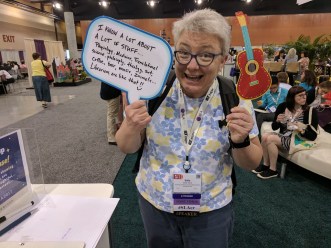
Showing off at the SLA NE booth in Phoenix.

A couple weeks back, I wrote a piece for SLA New England’s blog on different perspectives gained from stretching one’s self in different situations. You can read it here

*****

Being on a journey, stretching, growing – be it in one’s career or one’s life – anyone who reads my blog and/or knows me knows that this is the subject that intrigues me the most. I’m fascinated by the idea that life is a journey. I’m inspired by anyone who lives his/her life in such a way. I love the ideas of life-long learning, of following new interests, of seeking new paths. Ann Telnaes, the Pulitzer Prize winning editorial cartoonist for The Washington Post is a favorite of mine. In an interview with CTNexpo she says, “Have a plan, but be open because sometimes that’s not your destiny. Sometimes it’s something else.”  Yup! That’s it in a nutshell.

***** 

As an evaluator and a sports fan, I absolutely loved the article “Analyze This” by Sue Bird, a future Hall of Famer for the Seattle Storm of the WNBA. It’s just a perfect piece on the importance of data collection, data storytelling, and … the never-ending gender gap in everything sports-related.

Data helps drive conversations, strategy, decision making. But data on its own isn’t terribly interesting. It needs context. It needs a storyteller. Data helps tell the story of a player, a team, an entire career.

There’s a need to value data in the WNBA because there’s a need to value the stories of our league. Think about baseball, for example, or men’s basketball. Fans, players, executives and media value stats and information because it helps to tell a story that many are already invested in. And if they’re not already invested, then it gives them a reason to be. It helps GMs make decisions. It informs contract negotiations. It enables player development.

*****

Just for fun, here’s the Definitive Guide to Typography and Fonts – in one, handy infographic! Who doesn’t need this?

*****

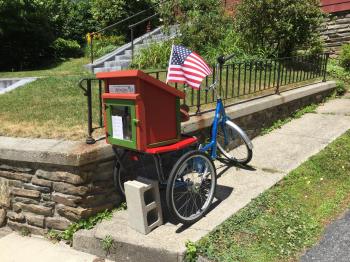
LFL

My Little Free Library

Finally, let’s do a quick summer reading list. We’ll call it, Sally’s Summer Reading List, since that’s what it is. Here are the books I’ve read and/or am reading of late:

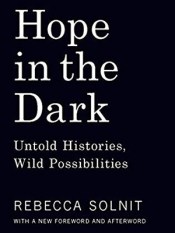
Hope-in-the-Dark-solnit-300-400
Early in the summer, I read both Hope in the Dark and Men Explain Things to Me by Rebecca Solnit. I came across her via an article she penned for The Guardian and am now a devoted fan. Both are examples of brilliant, thought-provoking, and sometimes humorous writing. 

Hornaday-Talking Pictures

Last month, Washington Post film critic, Ann Hornaday, published a wonderful guide to watching movies entitled, Talking Pictures. Not only does Ann provide a rich understanding of the different aspects of movie-making, but she teaches the reader how to enjoy movies with a critical eye. What makes a scene work? Why do you remember some movies forever and others are forgotten before you’ve left the theater parking lot? How do all of the pieces fit together – or not? It’s a terrific guide complete with suggestions, at the end of each chapter, of films to watch to accompany the lessons learned. It’s perfect preparation for the chilly months that will be here soon enough, those that find us in front of the fireplace, seeking a good movie for a Saturday evening.

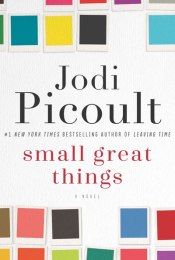
 small-great-things-hc-400wIf you’re looking for a page-turner with a point, you might want to read Jodi Picoult’s latest, Small Great Things. An unexpected death and the story that follows examine the issues of race relations, prejudice, and justice from the differing perspectives of the characters involved. I picked it as the book for an Action Book Club that I’m trying to get started in my community. It’s a good choice for that, as well as an excellent read.
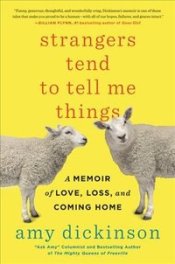
 strangeresFinally, I’m sure it’s no surprise to any of my regular readers that I pre-ordered Amy Dickinson’s latest memoir, Strangers Tend to Tell Me Things, about a year before it came out. It arrived in my mailbox on publishing day and I read it cover-to-cover in one sitting. True enough, that was in the spring and thus not a summer read, BUT I did purchase the Audible version this summer, just so that Amy could read it to me again. It’s Amy as good as ever (true, despite any bias I may have). Read it and enjoy.
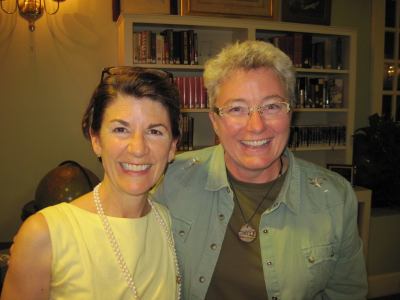
 

Sally and Amy

We need a new photo.

SaveSave

Miller’s Crossing (SLA 2017)

27 Jun

I SURVIVED

Hot on the heels (pun intended) of my post about the annual meeting of the Medical Library Association yesterday, I offer up some thoughts and sketchnotes on my time at the annual meeting of the Special Libraries Association that took place last week in Phoenix. Did you see the news from Phoenix last week? If not, well, it was hot. Really hot. But the conference was fantastic! Here’s why…

This was my very first time attending SLA and I have to say that I was impressed beyond impressed! The keynote speakers were inspiring, the sessions chocked full of useful takeaways, the colleagues that I met interesting and nice, the schedule (and the program, overall) was really creative, and my own presentation … it went pretty darned well, if I do say so myself. Kudos to the conference planning committee, the SLA staff, and the organization’s leadership for putting together a stellar event.

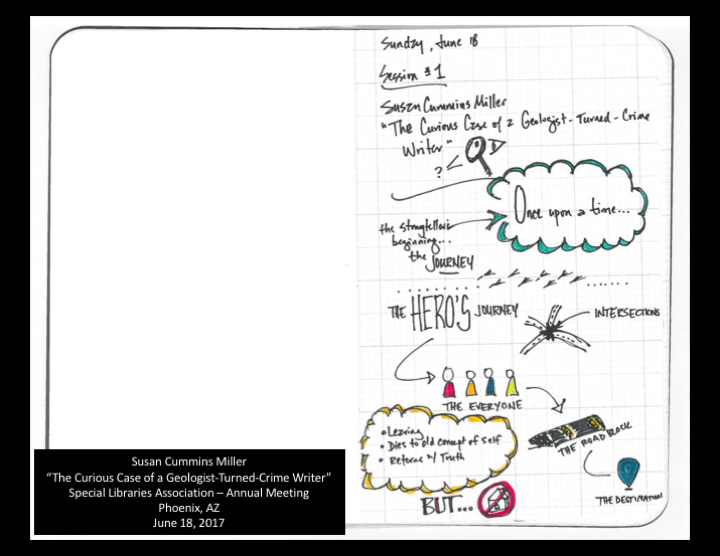
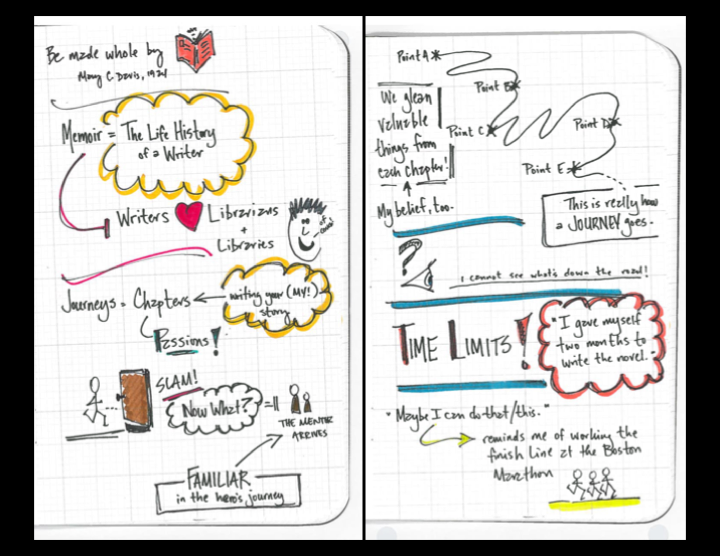
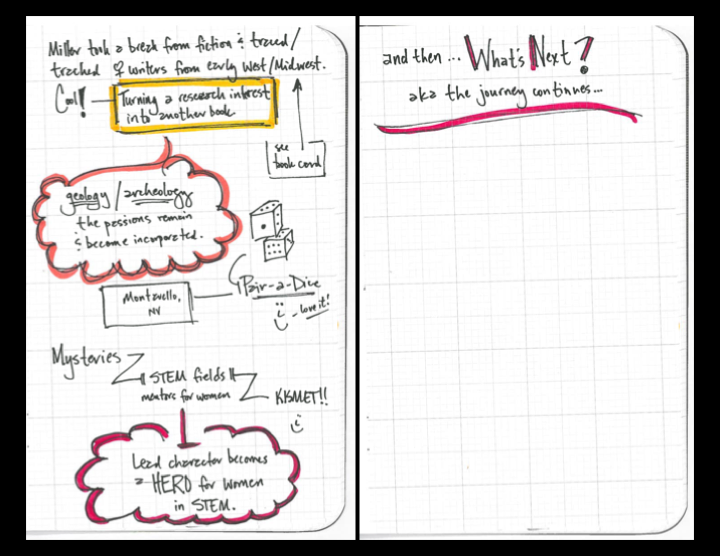
I took more notes than I’m going to share here, but I want to highlight a couple of sessions that kicked off the event for me and really set the tone for what I could and would expect over the few days. The very first session that I attended was a talk by the local author, Susan Cummins Miller, titled “The Curious Case of a Geologist-Turned-Crime Writer.” It was Sunday morning and my internal clock was still several hours off after traveling cross-country the day before, so honestly, it was that title that drew me to the lecture. It was just too interesting to pass up. What I received from attending was an incredibly personable – and to me, incredibly relatable – story about a person with many interests and the winding career path that often accompanies such. “The Life History of a Writer,” is the framework Miller used to tell her story, offering up a lot of tips and inspiration along the way. It was the perfect start to the morning.

Slide1

Slide2

Slide3

Following Susan Cummins Miller’s talk, I made my way to the first general session and the keynote presentation by Lulu Miller, a journalist and writer and the co-host of the NPR podcast, Invisibilia. [Tangent: I titled this post, “Miller’s Crossing” because of the shared surname of the two speakers and because that reminded me of the title of an excellent movie. An early Coen brothers’ film. Seek it out.] I will share at the get-go that I have attended LOTS of professional conferences in my years as a librarian and I have heard a number of great speakers over this time, but Lulu Miller’s talk may well be the BEST that I’ve heard to date. It also serves as the perfect model for anyone outside of the library profession who gets invited to deliver one of these talks. Why? Because she prepared it entirely for us, the audience. It was obvious from the very beginning. It wasn’t a talk that she had tucked away to be tailored to any audience. Nope. It was, start-to-finish, a message put together with no other group but a group of special librarians in mind.

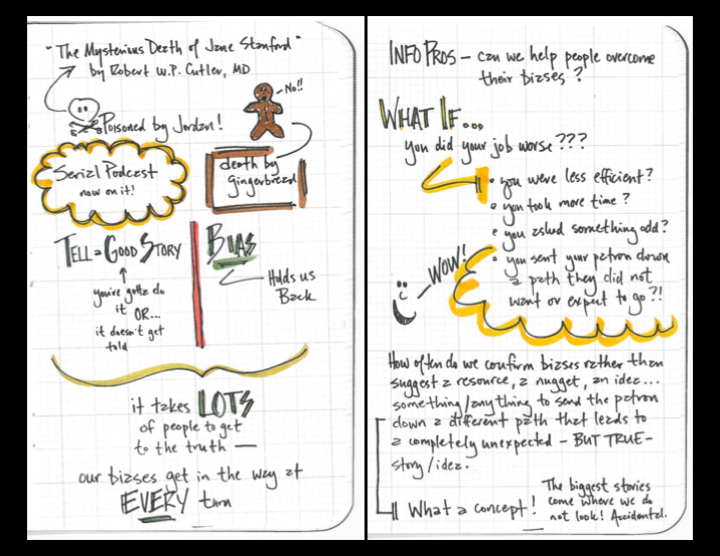
For me, the key to the talk hinged upon the question, “What if you (meaning a bunch of research librarians) did your job worse?” Put another way, in our rush to answer a patron’s request, is it possible that what we end up doing is confirm their biases? We point them to what they are looking for, not necessarily what they need to find. What would happen if we perhaps sent them down a path that they didn’t expect to go? What might they find then? What unexpected discoveries might be uncovered?

To illustrate the point of these questions, Miller told an engaging story of how just such an experience led her to some discoveries, some history, and an amazing mystery that she’d never have encountered had she not been led astray from her own biases. She talked about how many people and how many sources and how much dumb luck (the latter being a bit of me editorializing) it generally takes to get to the truth and how at every turn in the process of truth-seeking, our biases can get in the way. Our task, then, as information professionals, is to help people overcome their biases and we do so, first, by changing some of our own behaviors. (You can see her instructions in my notes below.)

“Disobey!” was her commandment to the crowd. Disobey those “tried and true” information professional rules of searching and seeking and delivering, and see what happens.  You never know where it may lead and the discoveries perhaps uncovered.

I’ve not stopped thinking about this talk since I heard it – a sure sign that it was worth hearing the first time!

Slide4

Slide5

Slide6