Regular readers of my blog know that I recently attended the Texas Library Association’s annual conference in San Antonio. I was invited to talk about both emerging roles in eScience and embedded librarianship.
Going to San Antonio also means, for me, visiting my father who moved there from Virginia about 20 years ago. Details of family drama are beyond the scope of this blog (if you’re interested in my take on that, you can read my other blog), but as I told the audience for the first talk (the one on librarians’ roles in eScience), before I prepared my talk on the subject, I had to work through the existential crisis that always arises at the thought of family visitations. In a nutshell, visiting my dad means thinking about my mom and oddly enough, from those thoughts emerged a theme for the talk. The live audience appreciated it. I hope you do, too. What follows is an abridged version:
It’s always good to start your talks on the same page, particularly when you don’t know your audience very well and the subject you’re talking about is bantered around in different ways in different circles. For clarity’s sake, I start with a definition of eScience, a guide to where I’m going and where I’ve been in terms of the roles I play in this arena, and a disclaimer. There’s always a disclaimer.
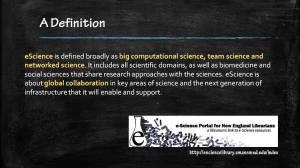
My colleague, Donna Kafel, is the project coordinator for the eScience initiatives that emerge from my library and the National Network of Libraries of Medicine, New England Region. One of her jobs is to develop and maintain the eScience Portal for New England Librarians. Don’t know much about librarians and eScience? Give it a look-see. It’s packed with great resources and information.
It’s from the Portal that I take the definition of eScience that I use. Bunch of words, but the highlights to remember are that eScience is big, computational, and done in teams that are connected via sophisticated networks. It involves collaboration across disciplines and across geographies, something that is possible today, given where we are with technology.
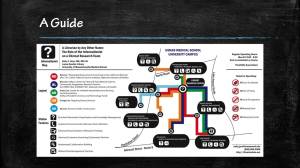
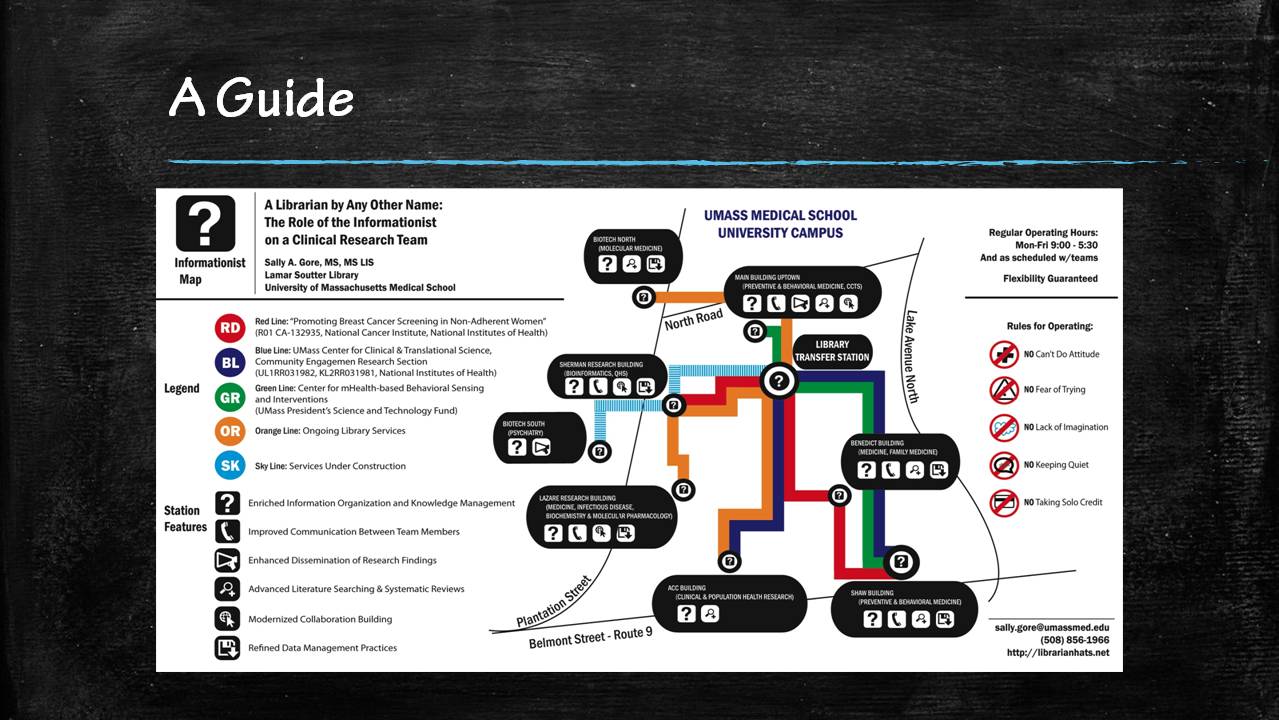
One of the reasons that I’m invited to speak on this subject is because I do it. Since we received a grant from the National Library of Medicine to embed informationist services into an existing research study/team, I’ve been charged with developing and expanding these same services across our campus. I’m happy to report that it’s been a successful couple of years, as you can see from my campus map that shows all of the projects, connections, routes, and services that have come to be. I’m also happy to report that the “under construction” line is now complete. We received word recently that our latest proposal for grant funding to bring informationist services to a large neuroimaging project on campus has come through. I’ll be starting work on that very soon.
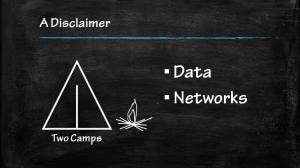 And a disclaimer; when it comes to eScience and libraries (or eScience in general), two fairly distinct camps arise. For many, the focus is on the data. It’s all about the data – creating it, managing it, saving it, making it accessible, sharing it, etc. There is MUCH talk of the role of librarians here. It’s important work and an extension of many of the services we’ve always provided (think cataloging, archiving, and digital repository work). eScience institutes tend to give a lot of attention to our emerging roles with data management. These are good roles, but my disclaimer is this… it’s not my personal favorite part about eScience. I’m also sometimes concerned that we pass on the second camp, i.e. we don’t think enough about what our roles can be when it comes to developing and supporting the network aspect of eScience. I believe that there’s much that we can do here and this is pretty much what I focus on in this talk; what’s our role in the network? Where do we fit with the people and what skills do we have or can we work on to make us effective?
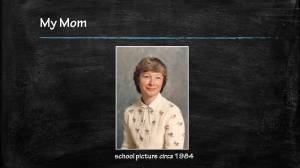
It’s here that my mom, not a librarian but a teacher, can maybe teach us something. She taught me, that’s for sure.

Lesson #1 – “Make your bed.” When you get up in the morning and you put your feet on the floor, the first thing to do is turn around and make up your bed. In doing so, you’ve started off your day by cleaning up one clutter. When it comes to working with researchers and research teams involved in eScience, keeping things in order and cleaning up the clutter is a key role that librarians can take on. Juggling multiple tasks, projects, times, and people isn’t easy – not for anyone involved in this work. Keeping things neat and organized from the get-go (e.g. make those data dictionaries before you start collecting data) will help everyone find success.
Next, do your own laundry. And do your own laundry as soon as you’re able. When my brother and I were growing up, the rule was that as soon as you could reach the controls on the washing machine, doing your own laundry was your own job. My mom worked full time and had a number of things that she enjoyed doing outside of our home and family. She felt it was only fair (and a good lesson in responsibility) if we took care of our own clothes. One of the really exciting things about working as an embedded librarian and/or informationist in research is that I get to take some control over my job. In fact, it’s my responsibility to take that control. Being fully embedded into a team means that you have certain responsibilities, certain tasks and roles that you and you alone have to do or they don’t get done. It’s the difference between supporting work and partnering on projects. Take control and do what you’re able to do – as soon as you’re able. That’s the lesson.

Along the same lines, my mom often told us (and showed us) to do those things that you’re good at doing. KNOW the things that you do well and become really good at articulating them. Interestingly, when we recently interviewed a number of people on our campus regarding how they work with their data and what they see as the role of the library in that work, more than a few admitted that they’d never thought of any role the library can play here. They never connected data with the library. That’s a challenge, but it’s also an opportunity. However, it only becomes an opportunity when you know what you’re capable of doing and you know how to express it clearly. One of the best ways to convince people that we’re up for the task of providing new services in eScience is to “start with why.” Per Simon Sinek, we often tell people what we do and how we do it, but it’s the why we do it that gains their trust. Check out his TED Talk on “The Golden Circle,” if you’re interested in his theory.
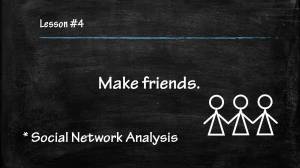 My mom was an elementary school teacher. She started out as a kindergarten music teacher. Of course she taught us to make friends. She taught us songs about it. One of the really cool skills that I’ve been working on acquiring during the past year is social network analysis. In a world where demonstrating the success of networks and the spread of your science is essential for both the evaluation of funding and securing the same for future projects, social network analysis is a powerful tool. I’ve also noticed that it’s not a skill that too many people around my university have. This makes it pretty valuable. Being able to do something that’s both needed and wanted puts you in a winning position.

My mom was the president of her garden club, the vice president of her needlework guild, a mentor to younger teachers, a leader in our church, and a coordinator of outings or parties for friends. She taught me the importance of service and the importance of leadership. She taught me that you have an obligation to lead people in those things that you know, you do well, and you enjoy. For librarians seeking to work in team science, the desire to lead is an imperative. We might not be the principal investigators on these studies (the leaders on paper), but we have to take the lead when it comes to managing and organizing the information flow that makes teams effective and efficient. That’s our job. Take the lead in doing it.

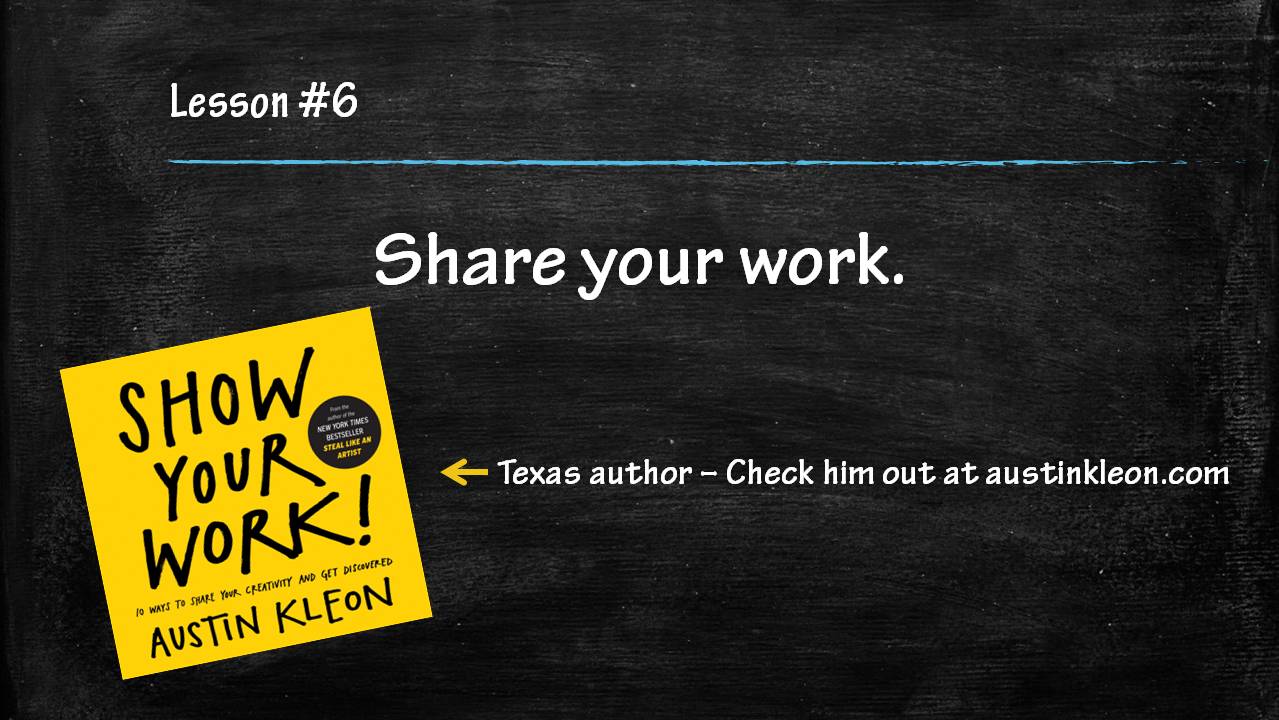
“Show your work! No one else is going to.” This is but one of the great lessons you can find in Austin Kleon’s latest book. He’s writing to artists, but it’s really a good lesson for librarians, too. Show and share what you know, what you do, and what you’ve done. We can no longer rely upon people simply finding all of the resources that the library has to offer. Our electronic resources are vast and often buried. Our professional services are stereotyped. It’s nobody else’s responsibility to get the message that we want people to know out. It’s our responsibility. Tell people what you have to offer, what the library has to offer. My mom entered her original pieces of needlework in competitions. She shared her skills with others by teaching and mentoring. Years before I came across this nice little book, I learned the same lesson from my mother’s example.
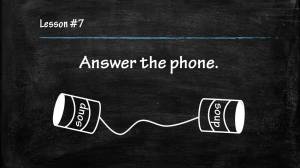 When I was off at college and called home (we’re talking once a week, maybe – such a different world than today), I’d talk to my dad about the latest sports scores or about camping trips he was taking with the Boy Scout troop. Fun stuff. Then I’d always say, “Can you put Mom on the phone? I have something important to say.” If I needed a check for tuition or if I needed to say that I was coming home next weekend, I had to tell these things to my mom. I could tell my dad the same, but if I want it remembered or needed some action taken, I told Mom. She got it done. The lesson? Be the person that people know to seek out when they need something done!
Just as my dad was the one to talk fun stuff with, he was also often the one to do fun stuff with. One of these things was backpacking. Alternating between my brother and me, he’d take us on week-long backpacking trips along the Appalachian Trail throughout Virginia. I was probably around 12 years old when he took me for the first time. I remember my mom drove us up to the trail head, several hours from home, and as she was about to leave I asked her, “Are you going to be okay without us? Are you going to miss us?” She smiled, gave me a hug, and said, “Oh, I’ll miss you, but I’ll be just fine,” code for “I can’t wait for a week by myself!” It was a great life lesson, not just an eScience lesson. To be good at what we do, we need time to ourselves. We need the time to figure things out, gain new skills, and keep up-to-date on current trends. We also need the time for things we enjoy, things outside of work, and things that keep us happy and healthy. We’re better at pretty much everything when we have that. Do yourself a favor. Leave the email alone until tomorrow morning; until Monday. Really. It will be just fine.

Over dinner during my first night in San Antonio, I was asked where my creativity comes from. I answer with no hesitation, “My mother.” Art, sewing, music, cooking, gardening, and flower arranging were all things that my mother loved to do and she did them all very well. And like any good, creative person, she never stopped trying new things and learning new things. There is so much in both scientific and popular work today regarding creativity and how important it is to success in almost any vocation. Creativity as an informationist is seen when we come up with new ideas, new solutions; when we see new connections and patterns that make the science happen. That’s a role we play in the network, i.e. the role of seeing the possibilities of where and how connections can be made. That’s creativity. I got many a thing from my mother, but this is likely the thing that I’m most grateful for.

The last lesson that my mom taught me was one that she didn’t plan on teaching, at least not the way that she taught it. My mom’s life ended suddenly on a snowy day in January of 1985 when the car she was driving was hit by another whose driver lost control of it on an icy road. Life – including everything of life that’s related to work – needs to be kept in perspective. A bit of stress over meeting deadlines, meeting budgets, dealing with people, dealing with changing times and the uncertainty of the future… these are all to be expected in our work lives, but the bigger picture is always bigger. Helping people is our job. We help who we can, when we can, and how we can. The “data deluge” and the “information explosion” and the “crisis of librarianship” are each due their share of our attention and concern, but the lesson that I learned from my mom is that things can change in an instant. Life can change in an instant. It’s in the showing up and building relationships and doing what we’re both good at and what we enjoy that we find real success – the kind that lasts through every economic cycle, every new technology developed, every new service rolled out. eScience with its big data, networks, and embedded services are one playground for today. Who knows where we’ll be next, but it’ll surely be somewhere else. Keep perspective that today is today. And do your best now. I can hear my mom saying it.
Tags: Austin Kleon, creativity, embedded librarianship, escience, lessons, mothers, new roles, perspective, Texas Library Association











 A Librarian by Any Other Name