Archive | Skills RSS feed for this section

Don’t Fence Me In

11 Sep

I just returned from the bookstore where I bought myself a few Tootsie Rolls (yes, my tooth is much better, thanks), my reward for sitting through a 90-minute webinar. This isn’t to say that the webinar wasn’t interesting, but more that I believe in positive reinforcement and extrinsic motivators. Walking to the store, I was thinking about the question that comes up so much in classes, presentations, talks, and webinars on the topic of emerging roles for librarians today, i.e. “How to talk to researchers about ___.” You fill in the blank. Most of the time lately, it’s “How do we talk to researchers about their data?” All three presenters during the webinar that I listened to today mentioned it and/or gave advice on the subject, and so I was thinking about it as I was on the hunt for my well-deserved, afternoon treat.

Our bookstore always has a cart or two outside of it with books that are marked way down. Passing it, the title, The Art of Conversation: A Guided Tour of a Neglected Pleasure, by Catherine Blyth, caught my eye. “Funny,” I thought to myself, considering what I’d just been thinking about.

In Chapter 2, “Small Talk, Big Deal,” Blyth gives us these five principles to follow when engaging in small talk:

  • Put others at ease
  • Put yourself at ease
  • Weave in all parties
  • Establish shared interests
  • Actively pursue your own

She then offers several rules as a strategy to follow. One is to “approach small talk like a treasure hunt.” “The most productive spirit is pioneering: sincere, curious, light, humorous,” she writes. The other rule is, “Start in neutral.” By this, she means that one of the best ways to be prepared to talk to people is to have a mind filled with a whole host of interesting thoughts and ideas; news items, books you’ve read, music you enjoy, fashion tid bits, and cultural affairs. In other words, be well-versed in a whole host of relatively safe, non-controversial topics. “Keep it light: an observation, question, a thread to weave to something new.”

Now, you might think that these rules are all fine and good for the next cocktail party, but I advocate that they are also EXCELLENT tenets to apply when asking the question, “How do I talk to researchers (clinicians, docs, students, etc.) about data?” About anything. Here’s why… despite the fact that we all live in a harried, time-sensitive, pressure cooker of a working world, most everyone still enjoys an expression of kindness and friendliness. Such expressions accomplish the first two principles – they put both you and the person that you’re talking to at ease. With that in place, everything else that follows becomes a whole lot easier.

BAD_Mar2

Complementary Colors

Similarly, small talk allows you to be inclusive of everyone. It lets you discover those things, sometimes completely unrelated to work (but sometimes not) that allow you to build a conversation that, ultimately, puts you in the best place to achieve your goal(s).

Which brings me to the bigger point – the one that I was thinking about before I picked up this book. When we go into a meeting or a conversation with an agenda, i.e. “I’d like to talk with you about your data management needs,” we’ve already eliminated about 7/8 of the services that we might be able to offer this patron. I agree that it’s good to have a few things in mind when you approach the person that you wish to pitch your services to, but go in with too tight of an agenda and you’ll likely miss a bunch of opportunities to do things and to meet needs that are being unmet. You want to provide data services, but maybe the researcher really needs help with disseminating his/her research findings in more creative ways. When you engage in some small talk, when you “start in neutral,” you’re much less likely to get hung up when the person says, “that’s interesting, but…”

Ladies and gentlemen once kept commonplace books, magpie hoards containing scraps of literature, historical facts, bon mots – any bauble that snagged the owner’s fancy – that were consulted and memorized before engagements, lest opportunity arose to flourish them and impress the company. (The Art of Conversation, Catherine Blyth, p. 51)

Consider your work, your toolbox of skills and knowledge, to be your “magpie hoards.” (I’d never heard this expression before, but I love it.) Review those things that you do and that you know, often. Take stock of yourself. Then, when someone is telling you about his/her research project, your much more likely to be prepared to know just when, where, and how you can insert yourself and your skills into the process. If it’s what you may have initially intended, great. If it’s something else, that’s great, too. Bottom line, you found the way to integrate yourself into the work of the person you wish to help. You’ve experienced success.

You might recall that a few posts back I mentioned that I have a new boss. After answering questions about this project and that project and the many iterations of “What do you do?” that a new supervisor needs to ask her team members, I finally sat down last Friday afternoon and wrote out a list of all of the projects I’m currently working on, along with any relevant documentation that explains my role(s) on each, and emailed it to her. I also wrote down the teams that I serve on in the Library and the Med School at large, professional organizations I serve, places that I’ve been invited to speak, classes that I’ve been invited to teach. It was a good list and when I finished I couldn’t help but notice the extent of it. I don’t say this as a way of saying, “Look at all of that stuff I have to do!” but more, “Look at all of the things that I do!” It was a really varied and interesting list and for me, that’s pretty important. I like to do a lot of different things. I like to be involved in a lot of different projects. It makes my job a lot more enjoyable.

And I think that this is key when it comes to finding success in the role of an informationist or embedded librarian (likely in a whole bunch of professions). The art of conversation involves being interesting and interested – the more, the better. So go ahead and have your goals and agenda, but keep them on the back burner the next time you’re tasked with talking to a potential patron. Instead, engage them in conversation – even a little small talk – about something(s) you like or know or think they could relate to. Ask them questions about themselves and their work. Ask them if they play a musical instrument or what they think about the scraggly beards that the Red Sox players are partial to this year or if they saw that article in Science News about caffeine and its effect on brain growth in mice (this would be a good one while waiting in line for coffee). You absolutely have no idea where these topics can lead you or the value that they can bring to what you’re trying to accomplish. My bet is that you’ll have better results and if not, you’ll have had the chance to enjoy the “neglected pleasure” of chatting with another interesting person who shares your world.
Whad’ya Know? (Not Much)

26 Jul

mind the gapYou may or may not be a fan of Michael Feldman’s radio show, “Whad’ya Know?” Me, I make more time for “Wait, Wait… Don’t Tell Me!” and “A Prairie Home Companion,” but despite the fact that I rarely listen to “Whad’ya Know?,” I can still hear the audience’s retort when the show begins with the announcer asking the eponymous question… NOT MUCH!

I thought of this line as I read a couple of pieces on data management this week, both written by colleagues; Dorothea Salo’s Library Journal article, Data Curation’s Dirty Little Secret, and Jen Ferguson’s response to it, Dirty Little Secrets, that was posted on the e-Science Community Blog. Salo’s original piece argues that the need for discipline knowledge is secondary, if anything, when it comes to the practice of managing research data. Ferguson, a molecular biologist turned librarian, agrees. I believe both authors make some excellent and valid points and don’t want to spend my post arguing against them. I think that their pieces are worth reading, considering, and adding to the arsenal of experience and opinion that continues to grow in regards to the discussion.

I do, however, want to have a think on the emphasis placed on both data management skills and subject knowledge that informationists need to have; at least so far as “informationist” is defined by the National Library of Medicine’s Administrative Supplement Grants for these services and/or this role. (As an aside, I was in a meeting at my church last night with a wonderful British woman who kept saying, “Let’s have a think on this.” I’ve decided that it’s my new favorite phrase.) In the latest announcement for the informationist grants, the funding purpose is again defined as:

These administrative supplements provide funds to supported research and center grants in order to enhance the storage, organization, management and use of electronic research data through the involvement of informationists, also known as in-context information specialists.

The purposes of this administrative supplement program are (1) to enhance collaborative, multi-disciplinary basic and clinical research by integrating an information specialist into the research team in order to improve the capture, storage, organization, management, integration, presentation and dissemination of biomedical research data; and (2) to assess and document the value and impact of the informationist’s participation.

It seems fairly clear to me that this role of managing data is what some feel is the most important new role for librarians to undertake. If librarians were the audience for “Whad’ya Know?”, I can hear our cry to the announcer being, “DATA!” Personally, I’m not exactly sure how true this rings, but it’s for sure the shout that we want to be making. The informationist grants aren’t aimed to support other, more traditional, librarian services, but instead, data services.

And interestingly, the National Library of Medicine does believe that disciplinary knowledge is a characteristic of an informationist (see background information here).

Here’s my take on all of this…

Does my background in exercise physiology help me in my work as an embedded librarian? You betcha! Why? Because most of the studies and teams that I’m supporting involve research around the areas of prevention, intervention, and changing health behaviors. It’s not my discipline background that necessarily helps me undertake the data management aspects of this role (that’s library and information science expertise), but it is extremely valuable in my being able to become fully integrated into the research team. Maybe this is due to nothing much more than what Jen describes in her post as “a little instant ‘cred'” upon entering the team. Credibility gets you a seat at the table and I also think that it gives you confidence that you belong there. It helps to see yourself less as supporting cast and more as a member of an ensemble.

I’m not arguing against what Dorothea and Jen state, for I don’t necessarily disagree. I do believe that you can provide a level of data management and support without needing to know much of anything related to the data itself. But still I’m left wondering, based upon the accepted definition of an informationist (by NLM and the literature), why the call for the discipline knowledge for this role OR why the emphasis upon data services above everything else we can provide? Why do we believe that data management is the most valuable thing that we can bring to a research team? Why do we see it as the role that we can fill above other roles? Is this really the way we’ll find success?

The jury is still out, of course. Part of my time as an informationist this go ’round involves evaluating the value of the role. Maybe in time we’ll have a better grasp on the skills that are most valuable to a team. I have a feeling that there will never be a truly clear answer, though. I think so much of the success of our individual roles, as well as the overall team, is dependent upon a lot of factors and skills that are not necessarily learned in school – at least not now. Fortunately, a movement is afoot to shed light on the importance of these soft skills, people skills, personal dynamics, and the like that are increasingly valued in a cross-disciplinary research world.

Time and experience will tell where we best fit and, hopefully, what we do best once we get there.

Summer Picks

18 Jul

I’ve but a short post to share this week. Honestly, it’s just too hot to even think clearly enough to write, BUT not to read. With this in mind, I thought I’d share a few of the informationist-related books that I’m working through this summer. If you have others to contribute or thoughts to share about any of these, I hope you’ll do so in the comments section.

Beginning Database Design, Clare Churcher

Beginning Database Design, Clare Churcher

It’s true that most librarians learn about database design in grad school and it’s surely a skill that we should have expertise in throughout our careers, but a good refresher text is never anything to snuff at. I picked up this one at the MIT bookstore when I was taking the Software Carpentry Bootcamp several weeks back. It’s a keeper for the bookshelf on my desk.

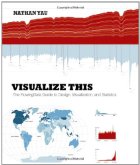
Visualize This, Nathan Yau

Visualize This, Nathan Yau

Data Points: Visualization that Matters, Nathan Yau

Data Points: Visualization that Matters, Nathan Yau

These two books by Nathan Yau, together, are providing me with both a skill set to retrieve data from the Web and a really good understanding of how to present data and/or information so that it makes the most sense to an audience. Yau writes clearly and with a tone that keeps you interested in a topic that, lets face it, could easily slip into the dry and “put you to sleep” mode. As one with an appreciation for design, I also think that the books are treasures to look at. They’re a great starter set for what is my summer reading’s real focus, data visualization.

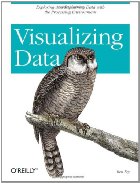
Visualizing Data: Exploring and Explaining Data with the Processing Environment, Ben Fry

Visualizing Data: Exploring and Explaining Data with the Processing Environment, Ben Fry

More technical and dense than Yau’s books, I had a half-price coupon for an O’Reilly Media ebook and so I picked this one. It’s definitely good for reference and troubleshooting, though I know it’s not one that I’ll read cover-to-cover.

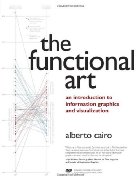
The Functional Art: An introduction to information graphics and visualization (Voices That Matter), Alberto Cairo

The Functional Art: An Introduction to Information Graphics and Visualization, Alberto Cairo

Cairo’s is another really beautiful book to both look at and read. Design is first and foremost. I’m finding Yau’s books more practical for my learning, but I love picking this one up and flipping through its pages every now and then, just because it’s so nice to peruse. But not to sell it short, it’s filled with a lot of good advice for communicating information in a clear and interesting manner. It fits well with the others on my shelf.

Beautiful Visualization: Looking at Data through the Eyes of Experts (Theory in Practice), edited by Julie Steele and Noah Iliinsky

Beautiful Visualization: Looking at Data through the Eyes of Experts (Theory in Practice), edited by Julie Steele and Noah Iliinsky

As the title suggests, this is a phenomenal collection of works by many of the leading practitioners of data visualization working today. This is the perfect working informationist beach book, offering a bunch of short, quick reads, separate to themselves, that together give you a really high bar to shoot for if you want to go into this field.

A Simple Introduction to Data Science,  Lars Nielsen & Noreen Burlingame

A Simple Introduction to Data Science, Lars Nielsen & Noreen Burlingame

Short and sweet (just 75 pages long), this is a staple on my Kindle. It explains data science in lay terms, yet from the scientist’s (not the librarian’s) point of view. It’s a nice reference to keep handy.

Pretty Good for a Girl

Pretty Good for a Girl: Women in Bluegrass (Music in American Life), Murphy Hicks Henry

And finally, lest you think I’ve completely rearranged all of my life’s priorities, I’m really, (really), enjoying this compilation of women (most forgotten and/or overlooked) from the 1920s to present who have held their own in the male-dominated world of bluegrass music. It’s stellar!

That’s a full beach bag of books for me (and you, if you want to seek some or all of them out) and summer is really only so long. In fact, how many days do I have ’til vacation?!?!

Happy reading and stay cool!