Archive | Day-to-Day RSS feed for this section

Full Speed Ahead

16 Apr

“Make your mistakes, take your chances, look silly, but keep on going. Don’t freeze up.” ~ Thomas Wolfe, You Can’t Go Home Again

I came out of an 8 o’clock meeting on Monday morning with the thought, “Well, at least I still have the whole week ahead for things to improve.” They didn’t. Not really. Not until today. It’s been a difficult week.

One of the steepest learning curves of a new job is less often the tasks at hand, but more learning the people. People make life really great, really difficult, and everything in between. That’s pretty much how it goes, unless we live alone on an island. And no one lives alone on an island. Except Tom Hanks in that movie a few years back. Even then, he had Wilson. My work during the earlier part of the week was not critiqued by inanimate objects and/or sporting equipment. It was reviewed and editorialized and shredded to bits before being put back together into something that only marginally resembled what I started off with by people. I admit it … it hurt. And yes, it also made me a little angry.

I had to do a lot of self-talk to keep going. I said to myself, “If someone you know came to you and expressed to you what you’re feeling right now, you would tell them without hesitation that it takes a lot of courage to take chances, to try new things, to stretch yourself beyond your comfort zone.” But if you’re like me, you probably find it much easier to encourage others than to do the same for yourself.

There was, of course, nothing personal in the assessment of the work that I’d done. I had to speak before the Committee on Scientific Research Affairs to explain the findings of a user survey that I carried out for a core service recently. I was representing my department in what I was saying and those who are responsible for it just wanted to make sure that I said the right things, in the right way, to highlight the right points. Still, while it may not have been intentional, I couldn’t shake the feeling that I was being spoken to like I was a complete newcomer to this business, as if I had never presented anything to any audience ever before.

I walked into my house on Monday night and shouted to my animals, “DON’T THEY KNOW WHO I AM?!?!?!” (It’s good to have animals during moments like this. They never judge you for any angst-ridden, bruised-ego-induced outbursts.)

As I talked about it more with my spouse later that evening and then I paid attention to it more during meetings on Tuesday and Wednesday, I realized a couple of things. First, the folks that I work for and with now DON’T know who I am. I get invited to speak at conferences, be on task forces, elected to offices in the world of libraries because my peers in these organizations do know me. They know what I do well. They know how I say things, how I do things, how I believe certain things and express them. And yes, it is a nice ego boost when people like you and respect you for those very things; when they like you and respect you for yourself. But it takes awhile for people to get to know you. It takes work and efforts and showing up and volunteering and writing a blog post week after week.

I have none of this going for myself right now and let me tell you, it’s hard. It’s harder than I thought it would be.

But I also noticed a second thing about my new environs this week and that’s that there is a tendency for people to work collaboratively in a way that is more critical than perhaps I’m used to. On Tuesday morning, I worked for two and a half hours with a couple of docs (an MD and a PhD) on the same presentation. We talked through everything. Every piece – not just what I’d put together, but what they’d put together, too – was up for critique. Everything got moved around and rearranged. Parts got lopped off. I was struggling again to hear people telling me that I needed to say something this way, not that way.

Again, I wanted to shout, “I know how to talk to people, for <expletive> sake!!” But along the way somewhere, I was able to step back from my frustrations and hurt feelings a moment to realize we were all in this together. The process that I was a part of was simply the process that’s the norm for these people. The people who I don’t know and who don’t know me, but yet we work together now.

Yes, I do think that the steepest learning curve involves learning the new people. Coming out of yesterday morning’s presentation, one of my new co-workers said to me, “You’re pretty good at that.” I replied, “Yes, I know. And thanks for saying so.”

We’re getting to know each other. Full speed ahead!

Damn the torpedoes!

Damn the torpedoes!

Do you REALLY want it all?

10 Apr
Feeling the Big Squeeze? Remember that even a squeeze box can make a pretty song.

Feeling the Big Squeeze? Remember that even a squeeze box can make a pretty song.

There’s a billboard across the street from my office building, promoting the hospital that’s affiliated with the medical school where I work. It features a friendly looking young woman with the words above her head, “I want it all.” The implication, of course, is that the medical center can meet all of the health needs of this person, indeed of anyone who uses the hospital and its network of health care providers.

This isn’t a criticism of their advertising campaign, but more just a few thoughts that come to my mind every time that I drive past that sign. Wanting it all is pretty much the American dream, is it not? Maybe it’s the dream of all people, everywhere. We all want whatever it is that we want, whether we necessarily need it or not. You may not subscribe to this belief personally, but you have to admit that it’s an awfully loud societal message.

From the perspective of a provider, be one a provider of health care services or a provider of information services, we want it all, too. We want to say that we can provide anything and everything to anyone and everyone who comes through our doors. Libraries, especially, have this idea deeply ingrained in their DNA. They exist for everyone.

But as we have become such a specialized world, I think we’d do well to face the facts that our ability to meet that mission anymore is dwindling, if not altogether extinct. I’ve been working on an evaluation of one of the research cores for the CCTS and in talking to those involved with it, I can’t help but notice they speak many of the same concerns that I long heard in my former home in the library; a handful of people simply cannot meet the needs and demands of everyone.

This imbalance causes us to rethink much of what we do, how we measure our success, and how we plan for the future. The reality of health care is that you really cannot have it all. A few weeks back, I was feeling really miserable and went to the walk-in clinic of the hospital next door only to learn that it’s really not a walk-in clinic, but rather a place for patients who see a certain group of doctors there. These patients can walk in for a last-minute appointment. If one is available. My doctor is a doctor within the same system, but while he has an office a few floors above the very clinic where I was seeking treatment, his clinical office is in another location, thus I wasn’t able to use the services provided there. Again, not a criticism of the provider network (though I am a big critic of the messed-up system that dictates these type decisions), but I share the story as an example of how claiming all can be provided to everyone ought to be a statement with an asterisk after it. Some restrictions DO apply.

One of the reasons that I chose to leave the library and work for the CCTS is that I felt the expectations in this new role were somewhat more realistic. Here was a defined group of programs and research cores for me to evaluate. It’s a lot, but still seems a manageable number. It allows me the ability to focus more, to feel less scattered, to feel less pulled, to feel less like I’m always falling short of meeting my goals, not because I’m not trying hard or working hard, but because I am only one person and trying to give time to everyone feels like a losing proposition. To me.

Sustainability is a key issue as we continue to work in institutions and businesses and governments that are constantly under the pressures of too little resources to meet all of the required needs. We are limited in people, certainly. Positions are cut or people leave posts and are never replaced. Everyone feels overworked as we try to fill holes and do more.

But we’re also limited by our current service models. Yesterday, I was able to attend the annual eScience Symposium hosted by the NN/LM NER. The afternoon session featured two speakers from different universities who described their particular programs for data services. Regarding their data repositories, one school allows self-deposit while the other offers a mediated service, i.e. researchers send their data to the library and then staff their deposit on their behalf, adding all of the proper metadata, annotation, etc. necessary in order for people to search and find the data sets in the said repository. During the Q&A, I asked the speakers about the differences between their models. I asked them some of the same questions that are asked in the process of evaluating research cores and programs:

How did you decide which path to follow? How did you decide which aspect of your repository to sacrifice; the quality of the content (enhanced by the mediation) or the ability to be a bigger service (because you’re not limited by the time/efforts of staff in the library)?

As one speaker said, “It’s a balancing act.” Indeed. And it’s also a clear example of how believing we can be all for all is misguided. It’s just not possible. We have to set priorities and make choices.

For good and bad, though, these are the realities of academic institutions, health care providers, research centers, and libraries. The one thing that we all really do have is the challenge to face these limitations, all the while trying to come up with the solutions for providing the best of whatever we can offer to as many as possible. Whether it’s what we really want or not, THAT is the “all” that we have.

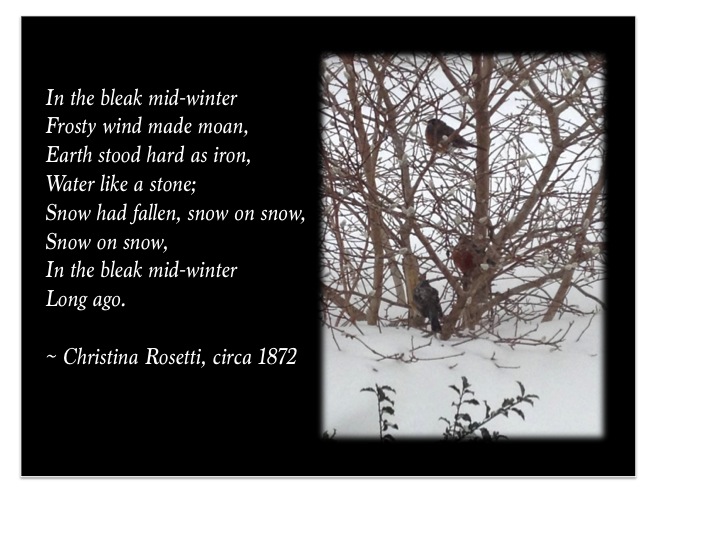
In the Bleak Midwinter

12 Feb

As I write this, it’s snowing here in Worcester, Massachusetts. If you’re not up-to-speed on the “Golden Snow Globe National Snow Contest Snowiest U.S. Cities” rankings, you’ve missed out on the story about my snowy city’s great claim to fame this season… We’re Number 1! 92+ inches and counting. Many folks are tired of it, but not me. I love the snow. I love winter. And I’m loving being in first place! Midwinter

Perhaps the thing that I love best about a snowy winter is that it forces upon us the time to sit still. Stay home. Be quiet. When I’m stuck at home during a blizzard, once I get past the elation that the Medical School is closed for the day and I don’t have to go to work, I hunker in on the couch with a blanket, my dog, something to drink, and either a good movie or a good book, and I revel in the fact that I have nothing to do but enjoy myself. I get this strange feeling that in another life, I must have been some woodland animal; not the kind that hibernates, but the kind that just knows how to hunker in for a day or two. I can do it, no problem at all. 

 For the record, in my 10+ years working at UMass Medical School, this is the first and only time that the school has closed. Twice now. I’m telling you, we’ve had some snow!

I remember reading Helen and Scott Nearing’s memoir, The Good Life, years ago and being struck by their choice of living. In spring, they planted. In summer, they tended to all of the many chores around the homestead. In fall, they harvested and prepared for the winter. And in the winter, they rested. They read and they wrote and they studied. It was the quiet time of year to do those very things.

Funny thing, though, is that while I love hunkering in at home on a snow day, I struggle with it at work on a work day. 

One thing about a new job is the requirement that it can put upon you to be quiet, to pay attention, and to read to learn a lot of new stuff. You know the joke about how librarians do nothing but read all day? Well, I’ve read more in my new role as an evaluator in two months than I likely read as a librarian in the past two years! And the strangest thing about that is how I’ve noticed I have to fight the urge to think that I’m not doing anything. Not being busy attending meetings and troubleshooting problems and answering questions and teaching classes and bouncing from thing to thing to thing … well, sometimes I feel downright guilty just sitting here in my office reading! Reading and planning – two things that I never had enough time to do in my previous job. Never. And now that I have the luxury to do so, I feel a little off my game.

But maybe that’s it. Maybe the fact that it’s ingrained into our workaday mindset and values that busy-ness means a jam-packed schedule is why I feel off. We measure productivity more by a full calendar than anything else. We measure our value in accomplishing stuff. Replying, “I’m free all day on Thursday and Friday,” meaning I don’t have any meetings on Thursday and Friday, makes me feel weird. Lazy. Guilty! I’ve realized that it really is a luxury, in this day and age, to sit and think and read and plan. On work time. 

Now that I’ve begun to plan out some projects, to schedule some meetings, to get out and DO something, I’m feeling better. More balanced.

And the fact that I’ve been doing just what I needed to do until now … that’s buried in the snow.