Archive | Day-to-Day RSS feed for this section

Sins of Omission

8 Jan

I want to thank everyone who took the time to comment, via the comment section or email, on my last post. I’ve been writing this blog for awhile now and written a number of posts (84, counting this one), and my post from last week may have received the most “this is my favorite” comments from readers. Evidently, I struck a chord and of course, I immediately began to wonder why.

It’s not a big stretch, given my picture on this blog and my social media name, mandosally, that I play the mandolin. What you might not know, however, is that I also play the drums. In fact, I’ve been a drummer many more years than I’ve been a mandolinist. It started when I walked into a drum shop in Portland, Maine, and said to the fellow working there, “Is it weird for a 30-something year old woman to want to play the drums?” Chris, the fellow running the shop, gave me an enthusiastic, “Are you kidding? Heck no!” response and I signed up for lessons on the spot. I was in my early 30s then. I’m in my early 50s now. You can do the math to figure out how long I’ve been percussing (not to be confused with cussing). You might not also know that the mandolin is the traditional percussion instrument of bluegrass and/or old-time music. I didn’t know this when I started playing the mandolin about 8 years ago, but it makes a lot of sense to me today.

By Hyacinth (Own work) [CC-BY-SA-3.0 (http://creativecommons.org/licenses/by-sa/3.0) or GFDL (http://www.gnu.org/copyleft/fdl.html)], via Wikimedia Commons

By Hyacinth (Own work) [CC-BY-SA-3.0 (http://creativecommons.org/licenses/by-sa/3.0) or GFDL (http://www.gnu.org/copyleft/fdl.html)%5D, via Wikimedia Commons

What does any of this have to do with why I think people resonated with my “getting cut from the team” post? Well, in percussion (music in general), there are notes called “ghost notes.” They’re also called “dead notes” or “false notes” and basically are notes that you either play very quietly or not at all. They accentuate the moment by being silent, or at least very quiet. It’s different than a rest, though for the purposes of my point here, you can think of both as what’s left out. 

In the literature, what’s often left out are research studies that didn’t prove anything, case studies that found nothing, and brief communications and/or “in action” articles that report what didn’t work or what not to do. This is a shame, isn’t it? We learn an awful lot when we experience something that doesn’t work; when we set out to do something and fail at it. But rarely does anyone want to write up a failure and even more rarely does a publisher want to publish it. What we don’t write, report, share… these things are like the ghost notes of our work. And unfortunately, the result of this “musical pattern” is too often that we repeat failures that we could have easily avoided, if only our peers and colleagues had shared them. In other words, what we don’t write has as much, sometimes more, of an impact than what we write.

The gist of most of the comments that I heard from people after last week’s post was, “Thank you for sharing what didn’t work.” I believe that the reason people appreciated it is because we don’t share these experiences nearly enough. The other really gratifying sentiment said to me was, “Thank you for showing how a negative (aka “a failure”) isn’t a bad thing. Thank you for being positive.” Truthfully, there wasn’t a darned thing personal about the decision (it was all about grant funding and a PI’s decision to go with another person already a part of the funded work) and that makes it pretty easy to stay positive. We are a grant fund-driven institution. That’s the reality. If librarians (and libraries) want to get into this arena, we have to accept that reality. We will come and go on teams and projects, we will juggle multiple tasks, and we will never have enough time to do everything that we wish we could do. It’s everyone’s reality. If you approach it that way and reflectively look at experiences, noting what you can learn from them, you’ll remain a lot more positive. You’ll also become better at what you do. That’s my belief, anyway.

During the mammography study team’s weekly meeting yesterday, I was asked about what I think has worked and not worked during my time as an informationist on the study. My formal, funded time working with them is up at the end of this month, though I’ll continue to work with them to wrap up some projects. As I’ve said all along, the team has been a terrific one for me to work with/on because they’ve been as interested in the value of this role as we in libraries are. I shared with them what I think has worked well and what I think hasn’t work so well. They offered feedback and their individual perspectives, too. The discussion wasn’t planned, but the fact that it happened was great. 

One thing that I heard myself saying during the discussion (what I’ve heard myself saying for months now) is that there are very few rights and wrongs, pros and cons, and clear answers to what makes – or will make – an informationist a viable, sustainable, alternative or complementary model for librarians and the library. There are so many variables that it’s hard to pin down. Similarly, there are still a lot of unknowns about what the library and librarian of the future, meaning next week, will look like.  We work in a rapidly evolving field, something pretty ironic for such an old, old profession, and the clash of these two characteristics is clearly evident in most of our professional issues and discussions today.

Moving forward, I hope we will all be encouraged and inspired to share our experiences – good and bad – in open venues so that we can all learn from one another. In a time when we’re often feeling our way through the unknown, sharing is good for any number of reasons.
 

Getting Cut from the Team

3 Jan
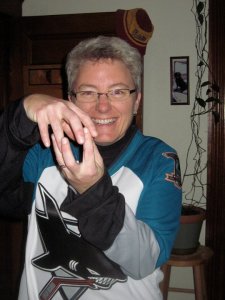
Doing the "Shark Attack" cheer.

Doing the “Shark Attack” cheer.

I love ice hockey. Ever since I was a kid and used to tag along with my season ticket-holder dad to the Richmond (VA) Robins games, I’ve loved it. I wish I could have played it. I wish I could put on all of those pads and fly around the ice, smashing into other people and the boards. I love the rough and tumble, blue collar nature of the sport. I love its northern roots. I love the cold, winter, snow, ice, and ice hockey. I live in the right place.

I grew up to be a season ticket holder myself; a fan of my hometown team, the Worcester Sharks, the AHL affiliate of the San Jose Sharks (baseball fans, think Triple-A; football fans think University of Miami). Early in December, I went on the season ticket holder bus trip to Manchester, NH, to cheer for the Sharks as they took on the Manchester Monarchs. On the ride up, we watched the movie, “Miracle.” Arguably the greatest American sports story, the movie tells of the 1980 U.S. Olympic men’s hockey team – at that time, a group of amateur and college players – who, against great odds, defeated one of the best hockey teams in history, the Soviet Union national team. It’s a movie and a story that makes me cry every time I see it. It’s a story that’s symbolic of so much that is the best in us in sports and in life. 

In the movie, there’s a particularly emotional scene where Coach Herb Brooks has to cut one last player in order to get the final roster to 20. He carried 21 players as long as he could, but when it came time for the Olympics to begin, he could only carry 20 guys on the team. The last player cut from the squad was Ralph Cox. Brooks himself had once been the last player cut from an Olympic squad (1960), so he knew a particular truth about the decision; (1) it was terribly difficult to make and (2) it wasn’t to be the crushing end of Cox’s hockey career. Both men went on to play hockey after this shared life event and both had success. But in 1960 and in 1980, neither would make their respective teams. They were each the last ones cut.

I got word last week that I’ve been cut from one of the research teams/projects that I’ve been working on for awhile. After a year of feeling like I was rolling right along in my new(ish) role as an embedded librarian and informationist, snaring opportunities and having  lot of success, I got cut. And I admit, it was a little bit of a blow. There’s not enough money on the grant to keep me, I haven’t been able to carve out the time necessary to do my best work, and there’s someone else who can do what I was doing for the team. I’ve been cut. 

By far, the hardest part of doing this embedded role is the feeling of being pulled in multiple directions, or perhaps better stated, having your foot in multiple doors. It’s hard to balance it all. I’ve tried to learn a lot about project management, prioritizing, organizing time and tasks, and the like, but at the end of the day, I still have a long way to go to be better at doing this. I don’t think I’m alone in my struggle, either. I think that we all have a bit of a hard time juggling multiple roles and projects, particularly as we continue to do more with less. Lots of people work in such an environment. And as it doesn’t appear that there’s any relief and/or change in this situation in the future, I need to do my best to get better at doing my best in this setting. It’s a goal for the new year.

So while the sting of being cut is still there, I’m also reminding myself that Herb Brooks and Ralph Cox went on to do good, even great, things in their lives. Getting cut from the team isn’t the end of the world. It’s not even the end of the season.

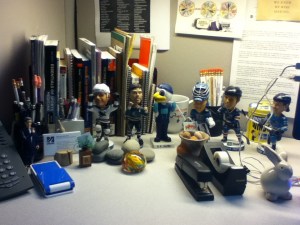
A clean desk for 2014. A clean "ice rink" for my Sharks bobbleheads!

A clean desk for 2014. A clean “ice rink” for my Sharks bobbleheads!

Change is Inevitable, but is Transformation?

12 Dec

Maria Sibylla Merian [Public domain], via Wikimedia Commons

My colleague, Mary Piorun, is defending her doctoral dissertation this afternoon. (Woohoo!! Go, Mary! Go!) To help her get ready, a bunch of us listened to her give her presentation earlier this week. Her topic is on transformational change in organizations, in particular, this type of change in academic libraries today. I found it to be pretty interesting stuff, not just as it relates to our work in eScience and data management (the focus of Mary’s research question), but the bigger topic of how organizations change, in general. Transformation suggests significant shifts in one’s thinking, behavior, environment, etc. How do such changes happen? What are the components of the change and how do leaders usher their organization through them? Don’t ask me, ask Mary. She’s the one who’s spent the last several years reading and thinking and writing about it. You can reach her at… 

But seriously, as a librarian in today’s changing environment, as an exercise physiologist who encourages behavior changes around exercise and diet, and as a member of a committee at my church called the “Transition Team,” I can’t help but be curious about how and why we change. And how and why we don’t. 

We often hear that change is inevitable and I won’t argue that, but there are lots of different levels of change. Compared to changing an institutional mindset, choosing a salad for lunch is pretty easy. Relatively speaking. Libraries – at least my library – are undergoing some significant, likely even defined as transformational changes. We have reorganized a few times since I came on board 9 years ago. We have made some big shifts in the services we provide and how we provide them. However, the latest changes require a different level of shifting and adjustment. We are, in many ways, redefining what it means to be a librarian on this campus. This is certainly the case for my role as a librarian here. I do very different things today than I did a couple of years ago. I think of myself and my role in very different ways than I did then. I operate with a different mindset – some days clearer than others – than I did before. As Mary outlined the process of this kind of change during her talk, I could see how it has played out in my own career the past years.

I remain curious, though, of how many times and how many levels of an organization have to go through this process before the whole of the institution experiences transformational change. I asked Mary this question and she said that it’s an area that certainly needs research. As a result of leadership taking us through transformation, I may experience a real shift in my understanding of who I am as a librarian. Similarly, our library, as a whole, over time, will hopefully achieve the same. But what’s next? Who is next? Because we are an organization within a larger institution, it seems to me that our work isn’t finished here until we can change the whole of the institution in how it perceives the library and librarians. It’s a big job ahead, no doubt.

Maybe we’ll get Mary to take it on as soon as she finishes up that defense!