Every now and then, Dan Shaughnessy of the Boston Globe titles his column “Picked Up Pieces.” I used to find this kind of lame, a column of random thoughts and pieces, things that he could easily elaborate on if he took the time. However, now that I’ve adopted this weekly writing regimen and have people actually following what I write (kind of like Dan, on the mini-Dan scale), I clearly see the advantage. Sometimes, lots of things happen in a short time frame and in order not to miss capturing them, we collect the bits and pieces and put them in a column – or in my case, a post. So here goes:
The Missing Link
Last week, I wrote about the need for documentation, for writing code and logic and field descriptions based upon guidelines, and how often we skip this crucial step. Pressures of time and staff shortages, coupled with the ease by which we can make changes in practices and procedures, lead us to take shortcuts that may well prove beneficial in the moment, but later end up costing much more. After another exasperating hour that found the research team going round-and-round questions that they simply couldn’t answer, we decided to go to the source this week, and called for a meeting with the IT guru for the study. At this meeting, Scott graciously drew pictures, showed us code, and clearly laid out the details we were lacking. I left the meeting not with the problem solved, but with a MUCH clearer understanding of it. I also had the beginnings of the tools needed to begin putting together the documents that we need that will, in time, give us the solution we need.
Could the research team have done this at the outset? Sure. But it’s hardly a fault that they didn’t. They did what most studies do, working within the constraints that we all find ourselves in today. What sets the PIs and this team apart is that they realized how this pattern was detrimental to their outcomes and the insertion of an informationist can help prevent the same in the future. To date, it’s the clearest indication of my value to the team. Now to get to work with the tools I’ve been given.
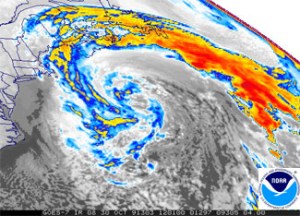
INFRARED SATELLITE IMAGE – OCTOBER 30, 1991 (NOAA Archives)
What Did You Say?
Communication shortcomings continue to baffle me. As I posted earlier, this isn’t a bafflement confined to the study. I am universally baffled. “Baffusally” – (see my name in that word? makes sense.) I feel like I keep repeating myself over and over and over again. And unlike Einstein’s famous quote about insanity, I’m not repeating the SAME thing over and over. I feel like I practice saying something this way and that, different ways to try and get my point across. But still… my efforts seem to be falling short. Am I alone in this? Do others feel like they give clear instructions, offer clear descriptions, state clear facts, yet people keep coming back asking for more and more explanation? I wonder if it’s overload – the information overload, stimulation overload, an epidemic of an inability to pay attention. Maybe it’s just more of what I stated in the previous paragraphs; continuous high pressure of time shortage meets the wall of information flow meets too few people to do all that needs to be done… it’s the perfect storm.
What I take away from this is that I need to continue to work on being clear, being concise, stating things in multiple (even if frustratingly obvious) ways. We’re all in this rocking boat together. (Bet you thought I was going to type “sinking ship” didn’t you?)
All Beagles are Dogs, But Not All Dogs are Beagles
I was really lucky to be invited to speak on a panel at last Friday’s “Emerging Roles Symposium” sponsored by the Pacific Northwest Chapter of the Medical Library Association. It was a wonderful day of learning, meeting new friends and colleagues, and soaking in so much positive energy. (As an aside, if everyone and everything related to Portland, OR is like I found it/them, I’m moving there tomorrow! What a wonderful place.) One thing that I appreciated most from the event was how many different emerging roles were covered. Steven Bell, current President of ACRL, got us started by sharing a plethora of examples and ideas we need to embrace in the age of the “Alt-Librarian.” I talked about eScience, data and scholarly communications, embedded librarianship, and being an informationist. Mary Anne Hansen from Montana State University talked about teaching library skills via online/distance courses. Amy Harper from Harborview Medical Center in Seattle shared how clinical librarians at her hospital are really engaged in providing the tools and resources to give clinicians the information that they need in the most seamless manner.
That was just the morning!
In the afternoon, Erica Lake from the Eccles Health Library at the University of Utah told us about all that she’s doing to successfully integrate herself and her skills into the world of the EMR. Stephanie Wright showed off a fantastic tool she’s built to help researchers at the University of Washington manage their data. And finally, Jerry Perry, Director of the Health Sciences Library at the University of Colorado and immediate past president of MLA (and all-around good guy – we love Jerry!) presented role after role, activity after activity, opportunity after opportunity, that he sees librarians at his library, as well as around the country, becoming engaged in. It was a terrific recap AND for me, a much-needed reminder that there is no one direction that we need to be looking and/or heading as health sciences librarians. We can, we do, and we are evolving and emerging in so many ways we likely never imagined before. It’s hardly a time to fret, friends. We may look different, but we’re still here.
The Tail Wagging the Cat (for Tater, my cat, because I titled the previous segment about dogs)
My latest philosophical pondering goes something like this… When did we stop creating new environments for the sake of adopting ones? In other words, when did we give up teaching behaviors and instead, simply build environments to suit the behaviors we’ve adopted. I’m sure that I’ve posted on this before, but it’s still there, the big question that I come back to again and again in my mind. We talk so much of control, yet have given so much of it away. It’s kind of what I teach people who are struggling with weight issues (this would be when I’m wearing my exercise physiologist hat) – you need to create your own environment, a healthy environment. It takes work. Restaurants serve the foods people will eat, not the healthy foods we are better off eating. Ball parks and airlines and movie theaters install larger seats, because that’s what we need. We sit a lot traveling, watching movies, watching others play instead of playing ourselves. The ballplayers like the big salaries we give them by filling the seats. They’ll build bigger seats in bigger stadiums to meet our behavior. (If you find this of interest or need help and support in becoming more healthy, follow my favorite researcher/doc in this area – @drsherrypagoto on Twitter and at FUDiet.)
What does this have to do with being an informationist? Oh, pretty much everything. The one common thread that is emerging in our profession is our need to take chances, take risks, and be more creative. I was asked last week how one goes about getting over his/her fears or resistance to step out and do this risk-taking that we keep talking about. My response, “Film yourself playing your mandolin and singing a song and then post it to YouTube.” More seriously (sort of), I added, “I don’t know if it’s building self-confidence or just lowering your fear.” Control your own environment, as much as you can, and you’ll have a lot more confidence and a lot more success. I feel pretty certain about that. So does Tater.
Happy Friday, everyone! Enjoy a little weekend ahead. And if you live in or around Worcester, come out and see my band, RedRock, tomorrow night. 🙂

 A Librarian by Any Other Name