Archive | Bits and Pieces RSS feed for this section

The Privilege to be a Crusader

15 Jan

I went to bed last in a fitful state, my mind racing with thoughts of several online discussions I’d taken part in during the day. I also thought that if there was ever a time for me to heed Clay Johnson’s words from The Information Diet, it was then. I felt sick, as if I’d eaten one too many pieces of chocolate cake. Aaron Swartz, Lance Armstrong, and the flu shot were the sources of my calories.

The death of Aaron Swartz is a tragedy, there is no dispute. As Kevin Poulson of Wired Magazine said to Margaret Warner during an interview on PBS NewsHour, “If he had done nothing but co-invent RSS when he was a teenager, that alone would be an achievement to assure some sort of place in Internet history. But then he went on to do one thing after another.” It was, sadly, one of those other things that led to repercussions that many now claim caused him to take his own life. As most know by now, Swartz was pursued vehemently (many will conclude, unfairly) and ultimately charged with breaking a number of federal laws for hacking into MIT’s network and downloading thousands of full-text articles provided to MIT via their paid subscription to JSTOR.

There is a lot to this story, more than I am qualified or prepared to go into on this post. However, the one point I do want to make relates to the notion expressed by numerous sources as they praise Swartz for his activism:

  • “You know, it’s not accurate to say that he hacked into it. This was a database that was available on MIT’s campus for free to any students there, because MIT paid the subscription cost. So what he did is he went onto the campus and he used their network there, their public network initially, to automatically access the database, the same way you could do manually legally, and download one article right after another in rapid succession.” – Kevin Poulson
  • Comparing Swartz’s actions to those of HSBC, and most importantly the Governments actions towards both as they addressed the crimes, James Allworth writes, “Lay those two cases down beside that of a 26-year old kid who did the online equivalent of checking out too many books out of the library. “
  • “MIT deliberately operates an ‘extraordinarily open network’ with few controls to prevent abuse. Any visitor can register, and it’s easy to bypass the controls that do exist by assigning yourself an IP address. There are no terms of use or definition of abusive practices. And when Swartz downloaded the JSTOR articles, ‘the JSTOR website allowed an unlimited number of downloads by anybody’ on MIT’s network.” – Alex Stamos, expert witness for Swartz, in recent blog post

The issue I take with each of these statements is the notion behind them that the end justifies the means. He didn’t really “hack” into the network because (a) his methods weren’t all that complicated and (b) because the network was public. MIT promotes an open atmosphere of sharing. And downloading a bunch of articles is just like borrowing too many books and not returning them on time. In other words, none of it was a big deal.

Swartz didn’t believe that information should be trapped behind walls. He lobbied for a free and open Internet. He was an extremely important person in this movement. He brought to the public a wealth of information, particularly information that was in the public domain and should have been easily accessible, through his work in several ventures. It was good work and it will be missed by us all, whether we realize it or not.

However, the glossing over of a few aspects of the allegations (and they remain allegations) troubles me. Swartz was not a student at MIT. Universities, and more importantly libraries, pay substantial subscription prices to make the full content of scholarly journals available to their students, faculty, staff, researchers, etc. One can argue that anyone who believes scholarly articles are worth much monetarily are nuts (as Larry Lessig does well here), but just because Swartz could have never made any money off of the articles he downloaded, something the prosecution errantly believed, this doesn’t mean that they weren’t worth anything. They were, in fact, worth a great deal. The MIT library paid no small price for that subscription. It is a line item in their budget. It costs them money that, if they really didn’t have to pay for JSTOR or any other database or online journal, could be used for something else like, say, research support or instruction. Materials that are made available to patrons of a library are not free.

Was the punishment that the prosecutors wanted disproportional to the crime? Absolutely. Without a doubt. But if the charges against Swartz could have been proven in court, if he really did set up his laptop in that network closet and download thousands of articles, then he did break the law and he deserved some sort of punishment. He did not deserve to be bullied, singled-out, or made to be an example to others who might seek to do similar acts. I agree with Lessig, who states in the above-referenced post,

“I am a big supporter of changing the law. As my repeated injunctions against illegal file sharing attest, however, I am not a believer in breaking bad laws. I am not even convinced that laws that protect entities like JSTOR are bad. And even if sometimes civil disobedience is appropriate, even then the disobedient disobeys the law and accepts the punishment.”

Which brings me to the second helping of chocolate cake that kept me tossing and turning, Lance Armstrong. One might wonder (as I do) why the federal government dropped its case against Armstrong last year. “The government always has a tremendous amount of prosecutorial discretion regarding whether or not to bring an indictment. In this case it appears that they have acted judiciously and likely considered all of the good works of Lance Armstrong and his foundation” (Mathew Rosengart, a former federal prosecutor). Yes, Armstrong has now had his time on Oprah’s couch and supposedly confessed to the years of doping that he engaged in while riding professionally. I don’t care. I am an avid cycling fan. I absolutely LOVE the Tour de France. I am in awe of the feats that cyclists can accomplish, blood doped or not. I couldn’t even walk up Alpe d’Huez, let alone ride a bicycle to the top of it. As I listened to Tyler Hamilton and Daniel Coyle’s book, “The Secret Race“, over the weekend, I felt sorry for everyone involved. For the most part, Armstrong EXcluded, the individuals in the story seemed like nice guys who got caught up in something bigger than themselves. They wanted to win and the only way to do that was to cheat.

But there you have it. Another means to an end. Justification, perhaps, but not an excuse. There were rules in place and the cyclists chose to break them. Some got caught and others didn’t. That’s not fair. None of it is fair. Exorbitant journal prices are not fair. Allowing some people an advantage, whether it be through wealthy schools that can afford large subscription fees or wealthy cyclists who can afford to stay one step ahead of the testers, is unfair. Armstrong claims, via Hamilton (and perhaps even admits it to Oprah), that he didn’t cheat because everyone was cheating. If everyone is breaking the rules, then the rules no longer apply. That’s the logic. Personally, I think it’s anarchy.

What bothers me most about both Armstrong and Swartz, is that neither of them ever appeared to accept the consequences of their actions. Armstrong lied ad nauseum over the years and it is only now, when he is retired, when his charity is facing huge losses, when his image is tarnished, when his millions in sponsorships are drying up, when he can no longer win over (or bully) his former teammates into saying what he wants them to say… only then does he go to the Queen of Confessions herself to share his sad story and ask our forgiveness. Maybe. But when one is forced into the place of admission and apology, what’s the point? Can it even possibly be sincere?

Aaron Swartz hung himself. This is sad beyond sad. Anyone who has lived with depression or knows someone suffering from it, you know that the depths of despair that must come at the moment of suicide are unbearable. It is the unbearableness that leads to the choice of ending one’s life. It is a horrible, horrible thought – a horrible thing. The federal government, MIT, and others involved in the case, bear some responsibility for Swartz’s death, but so does he.

The ends justify the means only when one takes responsibility for those means in the first place. Rules and laws can need changing, but we need to be accountable for the means by which we bring about the change. The fact that no one in either of these cases (I am referencing all sides) seems to want to take any responsibility for his or her or their actions – that’s what bothers me the most.

And finally, the flu shot. I did not get one. I talked with my doctor about whether or not I needed a shot during my last check-up, in November. I am healthy and I don’t live or work with a vulnerable population. My chances of getting the flu may be higher this year, if there really is an epidemic happening, but if I do get it, I can sequester myself, stay in bed, ride it out, and in a couple of weeks, be fine. It isn’t that I want to get sick. Who wants to get sick? But sickness – germs and viruses and bacteria – is a part of life. I’ve had influenza twice in my lifetime. Twice in 50 years. I’ve had more cavities than that, despite fluoride in my water, regular dental visits, and pretty good oral hygiene practices.

I posed the question, “Who do you listen to more for health advice, your health insurance company or your doctor?” on my Facebook page yesterday. I posed it in the context of the flu shot – I received an email from my insurer telling me to get a shot, despite the fact that I’d had an intelligent, thoughtful discussion with my doctor and, based upon it, made a decision. In a nutshell, I was hung out to dry. Horror stories of individuals’ experiences with the flu were shared, layers of guilt over how I was going to make others sick were applied, pleas were made for me to use my good sense. So I shared an abstract  from the Cochrane Systematic Review on the effectiveness of flu shots for preventing the flu in healthy adults (modest), thinking that by at least providing some evidence for my beliefs and actions, my many colleagues who teach (and preach) the importance of evidence-based decision-making would pause. Nope. Didn’t matter. The episode marked the trifecta of things not making any sense to me for the day. I called it quits and turned out the lights.

What do any of these stories have to do with my role as an informationist? Specifically, nothing, but generally, I think each one is a clear indication of the ways in which the distribution and management of information effect us all. We try to control it, manipulate it, commodify it, and use it to prove or disprove our beliefs. We can twist it or ignore it or accept only the parts of it that we agree with. It is, in many ways, a free-for-all.

The discussion at the end of this morning’s team meeting centered around the question(s) of what kind, if any, conclusions the research to date might be giving. It is a multi-year study and the final results won’t be available for several years, but is there anything there now that’s of value to a larger audience? Is there anything new? Depending upon how the question is framed and the data presented, there may be. It’s something to look into (and off I went with a couple more lit searches to do). But the point is that with so much information available to us, integrity becomes so much more important. Taking responsibility for the actions that we take, the questions that we ask, and the conclusions that we draw around information may be more important now than they have ever been. Those of us working in the field not excepted.

Follow Along

7 Jan

blog bubbleI’m a HUGE fan of Twitter. I know that many of my colleagues, associates, and people in general still don’t get it. They don’t understand how a continuing stream of bits of information could be relevant to anyone. Mostly, I find that those who either don’t get or don’t like the social media tool always sum up their feelings by stating, “I don’t care if you brushed your teeth today.”

Concerns for halitosis and dental hygiene aside, these short-sighted and shallow accusations of Twitter are just that. But this isn’t a blog post to share the merits of Twitter. I need to write that piece for another blog (NAHSL) later this week. Instead, this is a very quick collection of BLOGS that, in many cases, Twitter led me to. In other words, the 140 characters shared by someone on Twitter ultimately took me to the following substantive resources that I check daily. The blogs themselves are not all updated on a daily basis, but I decided that this year I would put them into a folder on my bookmarks toolbar and look at them each morning. Anything new that these people write never ceases to inform, inspire, energize, and/or entertain. I share them with you here in the hopes that you will choose to either follow them as well, or perhaps create your own “Top Ten” to share with others.

  • Get Moving: Fitting Fitness into Your Day is the blog of Boston.com’s senior health and wellness producer, Elizabeth Comeau. You can follow along with Elizabeth on her own journey to live a healthy life, as well as find many links to important news stories related to health and wellness. Elizabeth gets the first listing in this list because today marks her one year “blogiversary”. Congrats, Elizabeth! You can also follow Elizabeth on Twitter at @BeWellBoston.
  • FUDiet is the blog of, admittedly, my favorite researcher at UMass Medical School. Librarians are not supposed to choose favorites (I think I’ve typed this before), but I have a bias towards Sherry Pagoto, PhD, a clinical psychologist and researcher in the areas of health, nutrition, fitness, depression and obesity. She lets me work with her, she planks in the Library, she makes me laugh. Ranking #1 for sure! Her blog and her social media movement, #PlankADay, are not to be missed. If you want to know the FACTS about health and fitness, follow an expert. Follow Sherry! @DrSherryPagoto
  • The Brilliant Blog is home of the musings of author, journalist, consultant and speaker, Annie Murphy Paul. Annie is a regular contributor to numerous news sources including Time, CNN, Forbes, MindShift, Psychology Today, and The New York Times, to name a few. She writes fascinating and thought-provoking pieces on the science behind learning and intelligence. You can also find Annie on Twitter at @anniemurphypaul
  • I started following Laura Vanderkam’s blog after reading her book, 168 Hours. I need all the help I can find, all the tips offered, to help me manage the multiple projects I have going on in my life, both at work and away from here. Laura provides these through her books, her videos, and her blog. Felling overwhelmed? Take a few minutes to read her stuff. You really DO have more time than you think. @lvanderkam
  • Librarians know Daniel Pink. Members of the Medical Library Association were lucky to have Dan speak at our annual meeting a few years back, as well as host a webcast just for us! When it comes to understanding people and how to put that understanding to practice in my people-oriented work, his books are at the top of my list. And his blog is a great way to keep those ideas going in between the publication of said books. @DanielPink is also on Twitter.
  • I would be remiss if I didn’t include my colleague, Donna Kafel’s, blog in this list. Donna oversees the e-Science Community Blog, a multi-contributor source for all information related to librarians, eScience, and data. I slip in a post there myself, from time to time. If you’re an informationist, a research librarian, any kind of librarian working with data, you can find a lot of relevant information here. The NER eScience Portal tweets, too – @NERescience.
  • Speaking of data, David McCandless and Omid Kashan’s website and blog, Information is Beautiful, is… beautiful! Leaders in data visualization, these guys regularly publish amazing pieces on all kinds of topics. It’s a fun stop in your busy day. Info=Beautiful, @infobeautiful
  • The Chronicle of Higher Education hosts a number of great blogs, but the one I choose to list here is Percolator: Research that Matters. From politics to morality to academia, Percolator is worth your attention. Grab a cup of Joe(sephine) and enjoy! You can keep up with all news from The Chronicle on Twitter at @chronicle.

And now, perhaps the two most important blogs to follow (save my own, of course!):

  • Because a life without music is no life at all, read Kim Ruehl’s blog for great writing on music and community. Kim writes regularly for No Depression, FolkAlley, NPR, and Yes! magazine. Though you can find her work at each of these places, I like to follow her own website. One-stop reading.
  • Ask Amy. Go ahead, ask her! She will answer. The Chicago Tribune’s nationally syndicated advice columnist, Amy Dickinson, is a sure thing for a 2-minute daily ponder regarding some important life lesson. Wondering what to say to your tacky neighbors (nothing, you McSnippy!), your whining children (just do the chores, you lazy kiddos!), the last guy to not return your calls after a date (seriously?! move on!)? No worries, someone has surely asked Amy and she’s provided just the right advice. If you work in a cubicled environment with other people (as opposed to being a zoo keeper), Amy can help you get through the days a little bit easier. Her memoir, The Mighty Queens of Freeville, is also worthy of a list, just not this one. Even better, buy the audio version and Amy will read it to you herself. Follow Amy on Twitter @AskingAmy and catch her from time to time as a regular panelist on NPR’s Wait Wait… Don’t Tell Me!

Yes, I can see that you’re hard-pressed to make an argument that each of these blogs is relevant to the librarian life, but this librarian’s life would be much less of what it is without them. Thanks to each of the writers for writing them!

Making a List

13 Dec

Any gift-giving occasion often prompts us to make lists. The same can be said for markers in time, particularly the end of a calendar year. As we’re almost to the mid-point of December, it’s double-duty list-making time, as many are planning what to give others for the holidays, as well as making resolutions about what they might do or change or accomplish in the New Year. I grew up celebrating Christmas and making my yearly list to Santa Claus, asking for whatever I wanted him to bring me. I asked for a bicycle one year, a pogo stick another, a Hoppity Hop a third. These are things I remember. I also remember getting some really cool gifts that I never thought to ask for. Once, my dad gave me a small, square, metal box with plastic drawers, each filled with a treasure like brand new Pink Pearl erasers, scissors, a tiny stapler, and colored pencils and crayons. I still have that box. My mom co-opted it from me years after I’d received it and used it to organize her embroidery thread. That’s it’s purpose, still today. Other surprises include a djembe from my partner a few years back and sewing lessons last year. The latter was not a surprise, per se, but I was surprised that I could actually operate a sewing machine. It’s great fun!

In Informationist-landia, I’ve been making a list of things – services, skills, areas of expertise – that I can bring to a research team. We did this exercise, somewhat quickly, as we prepared the supplemental grant application that ultimately landed me on the breast cancer intervention study, but I’ve been working on it more since then. You might recall that the whole group of funded informationists did this exercise back in early November when we gathered here in Worcester. I shared that list in an earlier post. Now however, as I’m about to embark on this work full-time, I need to really become familiar with this list. I need to practice articulating it to those on campus with whom I hope to work. I wrote to a researcher just this morning and mentioned the change in my role. I also asked her if we could grab a cup of coffee sometime so that I can share more about how this role could benefit her and others in her department.

As much as I cringe at the thought of it, this is about selling something; specifically, it’s about selling myself. I don’t much like that thought. I’m fine with self-promotion and I have no real trouble talking to people, but there’s something about the word “selling” that leaves me queasy. It’s not really fair, as I know plenty of honest, decent, nice, funny, every-other-kind-of-pleasant-attribute-you-can-name people who sell things for a living, but for whatever reason, I can’t get past the image of myself with slicked back hair and a bit of a sleazy smile, pulling the wool over a researcher’s eye as I convince him/her that I’ll deliver 180 articles per gallon of coffee and index from A-Z in 4.2 seconds. Best deal this side of Pecos, Texas, pardner.

Considering I’m short on both Brylcreem and sleaziness (thankfully), I’m willing to consider sales in a different light. Fortunately, in just about a month, one of my favorite business authors has a new book coming out that will (fingers crossed) help me do just that. In January, Dan Pink (MLA members might recall him as our keynote speaker at the annual meeting in Washington, DC a few years ago) offers us, To Sell is Human: The Surprising Truth about Moving Others. Per the website, Pink’s book can help the employee “pitching colleagues on a new idea”. That is, after all, exactly what informationists and embedded librarians are doing. We’re trying to convince our patrons, our colleagues, that library services go well beyond access to articles, database searching, and inter-library loan. One item on my list: Dan Pink’s new book!

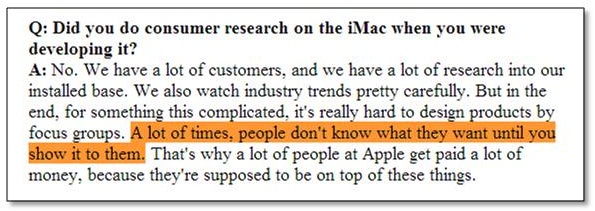
Another salesperson that comes to mind is likely one of the greatest of all times, Steve Jobs. Plenty has been written about Mr. Jobs, both during and after his lifetime, much of it detailing his brilliance at pitching new ideas, new products, entire new ways of living. He was a master. As I’ve been reading and thinking and writing about the task of convincing researchers of their need for an informationist on their teams, I’ve often thought of a particular, quite popular, quote from an interview with Jobs that appeared in a May, 1998 issue of Business Week:

Jobs Quote

It’s true, isn’t it? And it was the genius of Jobs and Apple that they consistently, over the years, give us things that we never knew we needed before we saw them, before we had them in our hands, before they became integrated into our lives. Can you remember typewriters and carbon paper? Can you remember dial-up modems? Can you remember not having a cell phone? Can you remember when music came on vinyl records? Can you remember when you had to actually buy a CD in order to hear your favorite band? Desktop computers and iPods and iPhones and email… we can’t function without them nowadays, but it really wasn’t that long ago when we didn’t have any idea that they were indispensable to our lives. But Steve Jobs and Bill Gates and other giants of Silicon Valley changed our world over the last few decades. They changed it for good, both in that it will never again be the same, and in the sense of making it better. Some things, anyway.

We may be lacking such a visionary in our profession today (or maybe not), but individually we can each work to have a vision of what researchers need in terms of information management and organization, data management,  information literacy, etc. We can formulate a vision of what we each bring to the picture and then, paint that picture for those we hope to work with. Maybe researchers just don’t know what they want from us yet. Maybe it’s our job to show it to them.

And now…

… as it is the time of giving and receiving, I wanted to share a story that is for me perhaps the very best example of receiving something that I didn’t know I needed before I got it. It’s also a story of the real meaning of this season – whether you celebrate Christmas or Hanukkah or Kwanzaa or even Festivus. Regardless, the Season is about sharing gifts with one another, be they material or otherwise. And oftentimes, the ones we least expect are the most special…

When I was in college, I worked in the dining hall. These were the days before Aramark or Sodexo or other large corporate big-box food service entities. They were the days when students still ran the dining hall; where we worked side-by-side with a handful of adults, cooking and serving and running the dish line. It was, in all seriousness, one of the most fun jobs that I have ever had in my lifetime. It was akin to belonging to a large fraternity. I did belong to a sorority in college, but D-Hall was a separate group. We had fun at work and we had fun outside of work. It was a blast.

After a year or so of working on one of the serving lines, I got promoted to the position of Cook’s Aid. The job was what it says, I was an aid to the cook’s in the kitchen. The cooks were full-time working adults. They supervised us, watched out for us, mothered us (in the case of Mary, the chief cook), and barked at us (in the case of the two guys who were retired Navy cooks). I loved working with them.

During my junior year of school, over the winter break, my mom was killed in a car accident. I went back to school a few weeks after it occurred, grateful for classes and a job that filled up time. When Christmas break was looming the following year, I was working one of my last shifts during finals when Robin, one of the cooks, found me as I was clocking out and took me to a break room where she gave me a small, fully decorated, Christmas tree. It was the kind that would fit on the top of my dresser back in the sorority house. She had tears in her eyes as she gave it to me and as she told me how worried she was that I was going to go home and find no tree. She knew how hard that Christmas was going to be. She knew that I needed a tree to get through it. I didn’t know that, but she did. And she was right.

It’s a story that really hasn’t much to do with being an informationist, unless you think about the fact that being an informationist means being a person. And sometimes people do the kinds of things that show us the very best of the human spirit. I wish everyone this spirit throughout the Season and into the New Year.

Thank you for reading my blog the past few months. I’ve received so many kind words and thoughtful responses to things I’ve posted. It’s a real gift.

~ Sally