[A colleague recently posed the question on a professional listserv as to what kind and/or which professional organization best fits an academic, health, and special library librarian – something that many health sciences librarians feel that they are, i.e. a mix of a librarian that doesn’t solely fit within the Medical Library Association (MLA), the American Library Association (ALA), or the Special Libraries Association (SLA). It’s a GREAT question and I wanted to share my reply both to the list and on my blog, as I feel the value of professional organizations, in general, is really up for grabs. I hope this will spark some discussion.]
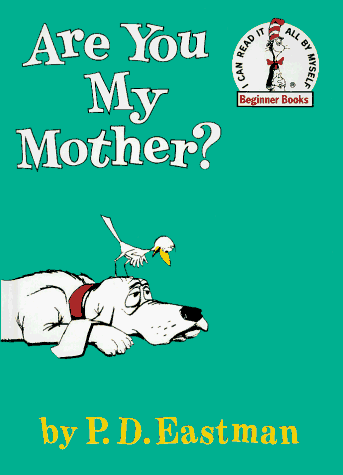
Do I belong to you?
One of the best children’s book’s ever!
Your question is a really good one AND one that I know is being asked at national, regional and state-level organizations across the board. What is the relevance of these groups. Annual memberships, meeting costs, and service time add up quickly, and in this day and age when both time and money are in short supply, the return on one’s investment really needs to be clear.
I very recently joined SLA. I made this decision for several reasons:
- My fairly new role as an informationist and embedded librarian requires many skills and covers many topics that I noticed SLA programming and resources (both regionally and nationally) support more than MLA, e.g. entrepreneurship, knowledge management, and embedded librarianship itself.
- I feel that my work is progressive in nature, meaning that I’m doing some things as a librarian that haven’t always been viewed as a librarian’s role. Quite frankly, I find MLA as a whole (please read this as a general statement and in no way a reflection upon any individual member and/or group within the organization) to be something less than progressive. We tend to put energies towards fighting a lot of battles that we have likely already lost. This is NOT to say that preserving our past and/or current roles is irrelevant, but I do feel that we often fight to keep things a certain way when we’d do better to fight for change. Again, this is simply my opinion and what played into my joining SLA.
- I appreciated the fact that membership in the national organization of SLA automatically included membership in the regional and local chapters. To me, this is a critical piece that MLA has missed for awhile. We really need strong local associations in order for the national one to mean much. To paraphrase our former Speaker of the House, “all professional development is local.” We support one another a lot easier in our states and regions than we do at the national level. I have many, many wonderful friends in MLA who I LOVE seeing each year at the annual meeting, but when it comes to the day-to-day of my job, I get the most from colleagues nearby. I have felt for a number of years now that MLA could do a much better job demonstrating that it appreciates the value of the regional chapters.
- And finally, along with the reason cited above (one cost for both regional and national membership), the fact that membership dues in SLA are based upon a sliding scale, i.e. based upon salary, is a fantastic idea. This didn’t make my membership much cheaper (maybe not cheaper than MLA at all, I can’t remember at the moment), but it demonstrated an effort and awareness on behalf of the organization that while no librarian ever makes a million bucks, there is a bit of difference across the board and those who don’t get paid much, in no way deserve to be left out of professional groups. While my institution has never paid any of my professional association dues, I know that some who experienced this benefit in the past are quickly finding it disappearing. Helping people belong is a good thing.
For now, I’ll remain a member of both MLA and SLA. I’ve not yet experienced enough of SLA to grade it long-term and I do value the relationships I’ve made in MLA, along with most of the annual meeting programming, to stay a member. Hopefully, I’ll be able to afford both for awhile, but I think that you raise a really good – and REALLY important – issue for all groups to grapple with today.
 The time away also made me miss my Librarian Hats blog. I missed time with my teams and I missed time in the library. I missed my projects and the work that I’m doing and the weekly sharing of that with all of you. It’s great to get away. Anyone who knows me knows that I’m hardly one to shy away from a break from work and I’ll never turn down a good vacation, but it’s also a really nice feeling to know that I’ve come to a place where I enjoy my work so much that I miss it when I’m away. Fortunately, I know a lot of people in this profession who feel similarly. It’s a nice bonus for being a librarian.
 A Librarian by Any Other Name