Archive | Bits and Pieces RSS feed for this section

An Illustrated Vacation

12 Aug

As noted in my previous post, I was on vacation last week. Vacation is important. Sadly, too few of us are afforded it, take it, and/or enjoy it. Many lament that taking a vacation only results in more work, either before you go away (all of the prep involved in going away) or upon your return (the pile of email and phone messages and “to do” items that await). I know very few people who actually go away for a week or two and stay away, i.e. don’t check email, answer calls, follow-up on things. Somehow, we just feel like we cannot be away. And this is a shame, because time away is really important. We need breaks from our work and the stresses of the everyday work-a-day world. We need some time to do nothing. We need a change of scenery every now and then.

Determined to follow my own convictions, I went away last week (well, for 5 days, anyway). I checked email only occasionally and I don’t believe that I actually replied to any until I returned home on Thursday. Even then, I answered only a couple of them; ones that just really needed to be answered. I tried really hard to simply enjoy being away and to engage the parts of my brain and my body (physically, because I sit way too much in my job) that don’t get the attention they deserve when I’m working.

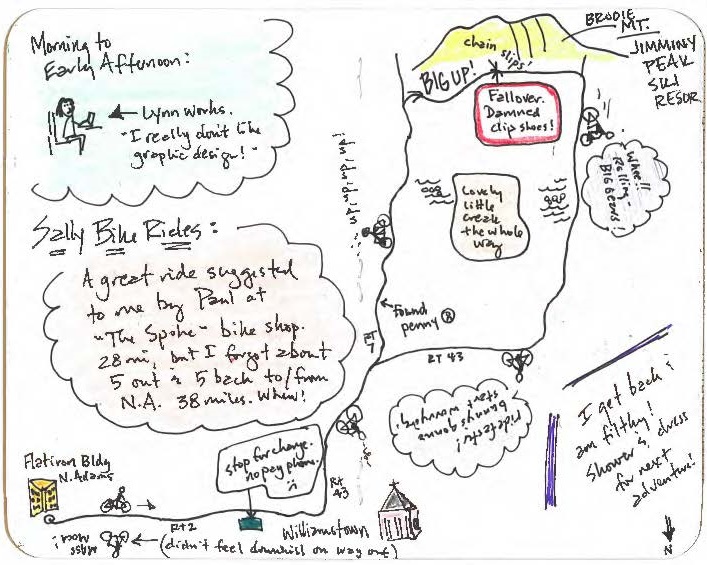
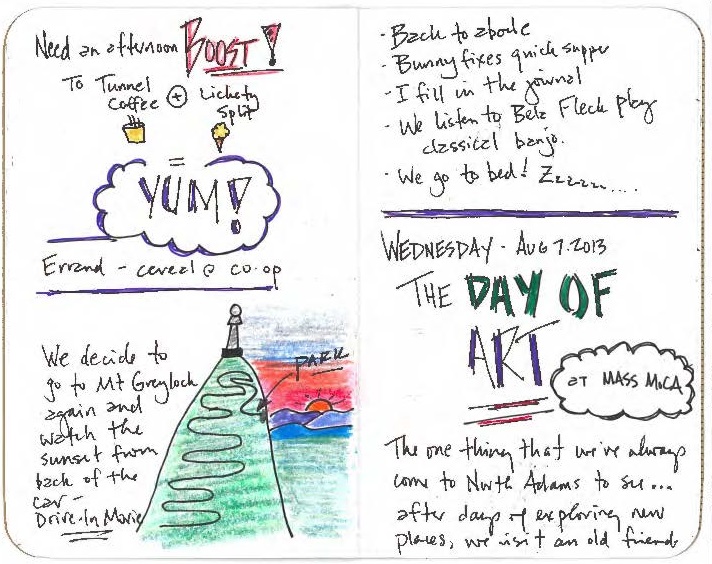
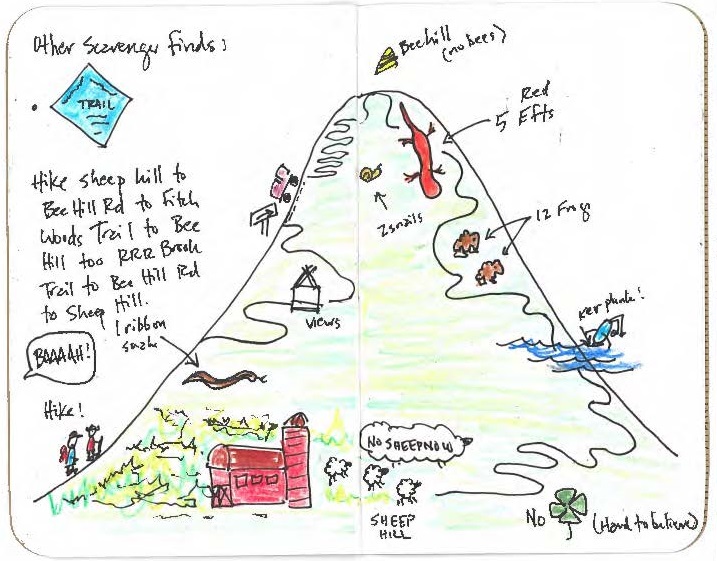
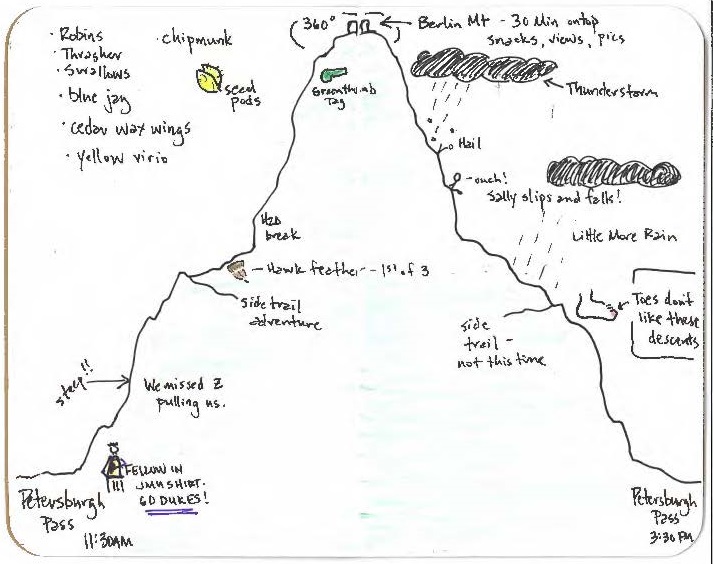
Not out of the ordinary, I took along a journal and recorded our adventures. What was different this time, though, was that I illustrated the week. I owe a great deal to Suzy Becker, Mike Rohde, Sunni Brown, the folks at AlphaChimp, and others who have inspired me over the past year+ to think with both words and pictures. If you follow my blog, you know that I’ve mentioned all of these people before. They inspire me with their illustrated memoirs, their sketchnotes, their doodles, and their scribing. I took them all with me, in a way, on my trip. Here’s a little bit of the result (a few selections from my notebook):

Vacation_Page_1 Vacation_Page_2 Vacation_Page_3 Vacation_Page_4 Vacation_Page_5 Vacation_Page_6 Vacation_Page_7

Summer Picks

18 Jul

I’ve but a short post to share this week. Honestly, it’s just too hot to even think clearly enough to write, BUT not to read. With this in mind, I thought I’d share a few of the informationist-related books that I’m working through this summer. If you have others to contribute or thoughts to share about any of these, I hope you’ll do so in the comments section.

Beginning Database Design, Clare Churcher

Beginning Database Design, Clare Churcher

It’s true that most librarians learn about database design in grad school and it’s surely a skill that we should have expertise in throughout our careers, but a good refresher text is never anything to snuff at. I picked up this one at the MIT bookstore when I was taking the Software Carpentry Bootcamp several weeks back. It’s a keeper for the bookshelf on my desk.

Visualize This, Nathan Yau

Visualize This, Nathan Yau

Data Points: Visualization that Matters, Nathan Yau

Data Points: Visualization that Matters, Nathan Yau

These two books by Nathan Yau, together, are providing me with both a skill set to retrieve data from the Web and a really good understanding of how to present data and/or information so that it makes the most sense to an audience. Yau writes clearly and with a tone that keeps you interested in a topic that, lets face it, could easily slip into the dry and “put you to sleep” mode. As one with an appreciation for design, I also think that the books are treasures to look at. They’re a great starter set for what is my summer reading’s real focus, data visualization.

Visualizing Data: Exploring and Explaining Data with the Processing Environment, Ben Fry

Visualizing Data: Exploring and Explaining Data with the Processing Environment, Ben Fry

More technical and dense than Yau’s books, I had a half-price coupon for an O’Reilly Media ebook and so I picked this one. It’s definitely good for reference and troubleshooting, though I know it’s not one that I’ll read cover-to-cover.

The Functional Art: An introduction to information graphics and visualization (Voices That Matter), Alberto Cairo

The Functional Art: An Introduction to Information Graphics and Visualization, Alberto Cairo

Cairo’s is another really beautiful book to both look at and read. Design is first and foremost. I’m finding Yau’s books more practical for my learning, but I love picking this one up and flipping through its pages every now and then, just because it’s so nice to peruse. But not to sell it short, it’s filled with a lot of good advice for communicating information in a clear and interesting manner. It fits well with the others on my shelf.

Beautiful Visualization: Looking at Data through the Eyes of Experts (Theory in Practice), edited by Julie Steele and Noah Iliinsky

Beautiful Visualization: Looking at Data through the Eyes of Experts (Theory in Practice), edited by Julie Steele and Noah Iliinsky

As the title suggests, this is a phenomenal collection of works by many of the leading practitioners of data visualization working today. This is the perfect working informationist beach book, offering a bunch of short, quick reads, separate to themselves, that together give you a really high bar to shoot for if you want to go into this field.

A Simple Introduction to Data Science,  Lars Nielsen & Noreen Burlingame

A Simple Introduction to Data Science, Lars Nielsen & Noreen Burlingame

Short and sweet (just 75 pages long), this is a staple on my Kindle. It explains data science in lay terms, yet from the scientist’s (not the librarian’s) point of view. It’s a nice reference to keep handy.

Pretty Good for a Girl

Pretty Good for a Girl: Women in Bluegrass (Music in American Life), Murphy Hicks Henry

And finally, lest you think I’ve completely rearranged all of my life’s priorities, I’m really, (really), enjoying this compilation of women (most forgotten and/or overlooked) from the 1920s to present who have held their own in the male-dominated world of bluegrass music. It’s stellar!

That’s a full beach bag of books for me (and you, if you want to seek some or all of them out) and summer is really only so long. In fact, how many days do I have ’til vacation?!?!

Happy reading and stay cool!

Larry, Darryl, and Darryl

17 Jun

[A Monday afternoon editorial.]


Sometime within the past couple of months, the National Institutes of Health decided to start enforcing the requirements of its public access mandate that went into effect in April of 2008. On the one hand, it was nice of NIH to give its funded researchers a year or two or five to come around to following the rules. Yet on the other, the recent applied pressure has sent a flurry of befuddled and irritated biomedical researchers, clinical researchers, research coordinators, administrative assistants, and any number of other folks my way, usually in a deadline-induced panic, trying to figure out what the heck they’re supposed to do to get in compliance with the law.

For awhile, I was slightly irritated myself – at the researchers, that is. When it comes to “the Mandate,” I’ve been announcing and instructing and updating and troubleshooting ad nauseum for these past years. I’ve sent out countless invitations to talk to departments, to labs, to admins, to the staff in research funding (and to their credit, many – though hardly a majority – took me up on it). I have made it my business to know every in and out and upside down aspect of this Policy since before it became law, lo those many years ago now. And so, over the past couple of months, I’ve stifled more than one, “What rock have you been living under?!” retort to more than one, “NIH has instituted another new thing!” whine landing in my email inbox or coming across my phone line.

All of this said, as I have worked to smooth and soothe and clean up messes these past weeks, I can’t help but come to the conclusion that NIH, and more, the National Library of Medicine, could have done us all a HUGE favor if they had taken just a moment to think through the naming conventions that they chose for the various resources and tools associated with this Policy. Why, for the love of Pete, did you name PubMed Central, PubMed Central? Why is there something so crucial as “My Bibliography” buried within “My NCBI”? Why are there “journal publishers that submit articles on behalf of authors,” as well as “journal publishers that submit manuscripts on behalf of authors”?

If you think that I typed the same thing twice there, read again. Closely. Which is EXACTLY what you have to say to researchers over and over and over again.

And that’s kind of my point. In one of the most basic textbooks of library science, Richard Rubin’s, Foundations of Library and Information Science, every aspiring librarian learns a handful of principles related to information management and organization. As Rubin warns, “Unless there are ways to organize it,it (information) quickly becomes chaos.” (p. 171)

Perhaps one can make a strong argument that the conundrum that is the naming conventions of NIH/NLM resources and tools isn’t really a naming convention problem at all. There certainly are distinctions between them. “My Bibliography” is not the same as “My NCBI.” PubMed is a completely different database than PubMed Central. How hard is this to grasp?!  I argue, harder than the average librarian and/or programmer and/or chief resource namer of highest level (aka CRNHL – pronounced “colonel” – on Twitter) ever realizes.

I bring this topic up on my informationist blog because I find it pretty funny (in a black humor, ironic sort of way) that one of the primary reasons I was placed on a research team was because of my expertise in information organization. Librarians are the experts in applying the standards, language, and processes that help people communicate, find, and access information more easily and efficiently. This being the case, I can’t help but wonder why we shot ourselves in the foot here, choosing labels that are so easily confused and swapped one for the other. Like homology, homography, or holograms and homograms… who can’t help but get these mixed up? And when there is a compliance officer, grant funding, and a deadline all in play, well, we in the information arena could do better to make things a little easier on everyone.