Archive | Bits and Pieces RSS feed for this section

Hello Muddah, Hello Faddah…

16 Aug

… here I am at, Camp …  well … at Townshend State Park in Townshend, Vermont. Last week’s vacation spot. It was a wonderful week of camping, hiking, reading, drawing, cooking, and more. Just what a summer vacation is supposed to be. The only downside is that it was all of one week. Too short. Ah, well…

I read three good books while camping:

The latter two are books that appeared in my Little Free Library this summer and I decided after reading them last week that I’d add a “review” feature to my library. We’ll see how – or if – it takes off.

Three work-related books that were recommended and/or loaned to me lately include:

Not quite the page-turners as my vacation books, but worthwhile reading all the same. The first two give very practical advice, examples, and exercises to help one hone his/her data science and math skills, and Few’s book is like all of his others, i.e. chocked full of information and advice for effective data visualization.

And finally, a few interesting websites to peruse and enjoy:

A Snapshot of a 21st-Century Librarian (Adrienne Green, The Atlantic) is a terrific profile piece on Theresa Quill, a research librarian at the Herman B. Wells Library at Indiana University, Bloomington. If you, like me, struggle to explain your not-so-stereotypical librarian job to friends and family, point them to this article as a good example of how we’re pushing the boundaries and redefining our role(s).

Sawbones: A Marital Tour of Misguided Medicine is a hilarious – and informative – podcast that I recently stumbled upon. Dr. Sydnee McElroy provides the medical expertise and her husband, Justin, the banter. Actually, they both banter quite a bit, making it an enjoyable program. I see that last week’s topic was cupping. If you noticed those round bruises on Michael Phelps body during the Olympics, you might want to listen to learn about how they got there (and if the science behind the practice is real).

Speaking of the Olympics, Dynamic Dialects is just a downright awesome site to explore how people around the world pronounce the same set of words. It’s great fun!

If you bookmark sites for free-to-use images, you’ll want to add the USDA’s Pomological Watercolor Collection to your list. One “Fast Fact” from the site – it contains 7, 584 watercolor paintings, lithographs, and line drawings of fruits and nuts, and almost 4,000 of those are apples. Imagine! It’s a beautiful resource.

The Open Notebook gives visitors a wealth of insight and knowledge about science writing, and also provides tools to help one become a better science writer. Interviews, Elements of the Craft, Profiles, and Science Blogging are some of its features. 

 Finally, someone once asked how I discover all of these sharable finds. Better put, I think she asked, “How do you find the time to discover them?” The answer is that I read a lot (stories from Twitter; magazines like The Atlantic, The Economist, and The New Yorker; a number of interesting blogs), I listen to the news via public radio and podcasts of interest, and I subscribe to several email newsletters including The Scout Report from Internet Scout at the University of Wisconsin-Madison, Austin Kleon’s weekly post, Banana Data News, and Wait But Why. I like that with the exception of the last one (which arrives maybe once a month), these appear in my email on Friday mornings. They’re not overwhelming in length and never cease to offer up something that I find interesting and useful – kind of like how I hope you find my blog. 

Summer Sightseeing

20 Jul

I subscribe to #dataviz guru, Stephanie Evergreen’s blog and found this morning’s post about timelines really great.  I love timelines, both aesthetically and functionally. I particularly liked Stephanie’s idea to use a visual timeline to outline a day’s agenda:

Timeline

The next time I put together a presentation and am tempted to do that requisite “Here’s What We’re Going to Cover in this Talk” slide, I’m going to use this technique rather than some boring list of bullet points. For sure.

My friend and authorstrator, Suzy Becker, shared a wonderful article with me from the latest issue of Smithsonian magazine. The Surprising History of the Infographic will be required reading for the data visualization course that I’m putting together for next spring. And as I told Suzy, I’m changing my job title to “polymath.” I love it.

If you’re interested in joining me in this new old vocation, writer Nir Eyal’s post, Three Steps to Get Up to Speed on Any Subject Quickly may be of help. “Google once, take notes, then stop Googling and start sketching” was perhaps my favorite bit of advice.

And a few other good things I’ve come across and/or have been shared with me over the last couple of weeks:

15 Data Visualization Tools to Help You Present Ideas Effectively has a few listed that I’ve yet to try. I’m always up for trying new tools.

The Analog is a brilliant site for reviews of all things analog – you know, pens, paper, pencils and such. If you’re like me and read James Ward’s, The Perfection of the Paper Clip: Curious Tales of Invention, Accidental Genius, and Stationery Obsession in one sitting, you’ll love this blog.

Design Observer is also a beautiful and enlightening blog that I came across through a tweet to its posts, 50 Books and 50 Covers. Books can be art, in more ways than one.

Finally, July is always a month of celebrations and anniversaries. This very day marks the 47th anniversary of Apollo 11’s landing on the moon (Do you remember where you were?) and July 5th was the 20th birthday of perhaps the most famous sheep since Lamb Chop, Dolly. Yes, Dolly, “the first mammal cloned from an adult cell, was born July 5, 1996.” Scientific American’s story behind the story of Dolly is a fascinating summer read. Enjoy! 

‘Til next time…Sheep

If Pat Summitt had been a Librarian

28 Jun
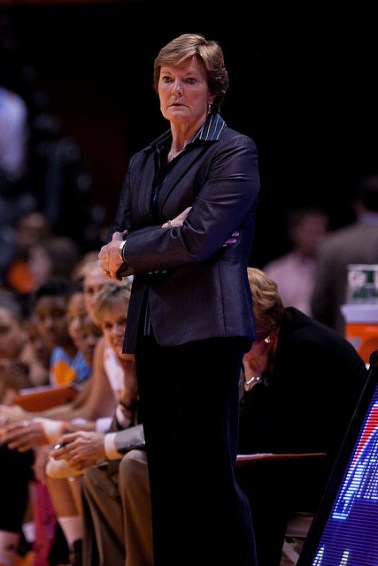
Summitt

Photo by Ben Ozburn/TNJN, Creative Commons

I wonder what kind of librarian – what kind of person – I’d be, if Pat Summitt had coached me. I wonder what kind of librarian Pat Summitt would have been. How might she have changed libraries, changed our profession, in the same way she changed women’s basketball and women’s sports forever? How would she challenge us? How would she push us? How would she make us see that we are never the best that we can be? That there’s always room to get better – to be better. To not simply settle for being pushed to the sidelines, but to stand up for the importance of our work. To constantly fight and change and fight and change, as is necessary, in order to push ahead. 

 I admit that this is a strange set of questions to be thinking about (Pat Summitt a librarian?!), but I’m a librarian and I so loved and admired Pat Summitt, and I grew up a tomboy and a gym rat and in the decades of great change in girl’s and women’s sports. And so these pieces come together for me this morning.

Pat Summitt, the legendary basketball coach of the University of Tennessee Lady Vols and honest-to-goodness trailblazer in girl’s and women’s sports, died this morning. She was 64 years old. I live in Massachusetts where women’s basketball is rightly dominated by the dominating University of Connecticut, but I grew up in Virginia and much closer to Tennessee. I played basketball in junior high and high school and I went to college when women’s basketball was just coming under the umbrella of the NCAA (it was still the AIAW during my freshman year). I am also closer in age to Pat Summitt than to the amazing players of today and so when I read the stories of her and see the video reels, I’m in tune with the trailblazer – the van driving, laundry washing, sandwich making Pat Summitt – and I note how far women’s sports have come from those days. And I’m grateful.

I had the great fortune to have a front row seat for a small part of those early days. I was a manager for the women’s team at James Madison University, coached at that time by another giant figure in the game, Betty Jaynes. JMU never played Tennessee during my years, but we did play Old Dominion and I got to see the likes of future Hall of Fame players, Nancy Lieberman and Anne Donovan, and their own great coach, Marianne Stanley. They wiped the floor with the Lady Dukes, but what an experience to be at those games.

I used to imagine playing for Pat Summitt. I was nowhere near a good enough basketball player to ever do so (I wasn’t even a starter on my high school team) and by the time I was imagining this, I was way too old for such a dream, but I imagined it all the same. I often wondered what it would be like to come under the tutelage – under the stare – of Coach Summitt. Mostly, I wanted to play for her because I am one of the most undisciplined people on the planet and I believe that if ever there was someone who could whip me into shape, it was Pat Summitt. I might be beaten down and die in the process, but still I wanted to give it a try. 

It will never happen now. I mean, it wasn’t going to ever happen before today, either, but now it really won’t ever happen. So I’ll just have to keep on imagining it.

I think of Pat Summitt, Betty Jaynes, and Kay Yow. I think of Joan Benoit Samuelson,  Roberta Gibb, and Kathrine Switzer. I think of Linda Cohn and Robin Roberts and Doris Burke. I think of Billie Jean King. Today, I think of these women who blazed trails for so many in a world still dominated by men. They have been role models to many, many young women and young men. And I’m grateful.

In a changing profession in a changing world, I’m remembering Pat Summitt and all of her fellow trailblazers today. I’m remembering that they changed the world for the better and that they can inspire me to do the same.