Archive | May, 2015

A Sheep in Sheep’s Clothing

28 May

[Alternate Title: The Sheep that Wags the Wolf’s Tail]

Photo Credit:  petsadviser.com

Photo Credit: petsadviser.com

A few years back, I made a deal with a friend to run the Chicago Marathon. I’d run several marathons previously, but none in a number of years. I was nowhere near the shape I wanted to be in when I made the deal and as both my friend and I were trying to be healthy, it was a win-win situation. At least it seemed that way. I trained in the winter, indoors on the treadmill. Once spring came, I moved outside. Week after week, I slogged through, never feeling like I was gaining any stamina, losing any weight, or getting any healthier. As summer came along and I started to stretch out my miles, I found myself getting pretty sick after running. I couldn’t eat anything without having serious digestive troubles. It got to the point that after running I’d stick with a smoothie and not much else. Even that didn’t always go well. I’d never had this experience in past training and kept chalking it up to being out of shape.

Then, one Friday evening I went for a 12 mile run – struggling through it as my gut rebelled against me. I finally finished, stopped by the 7-11 for a Gatorade, and drove home. After showering, I had a smoothie and settled in to watch the Red Sox. Next thing I knew, I was on the floor of my bathroom and next after that in an ambulance to the emergency room. I’d never been in an ambulance before – and that’s about the only positive I can think of regarding the experience.

After a night in the ER, tests that revealed nothing much, trips to my doc and a couple of specialists, the vascular surgeon told me that he suspected I had celiac artery compression syndrome (or median arcuate ligament syndrome). He also said, as I described my symptoms related to running with him, that he’d never heard of it being associated with exercise.

Being the medical librarian that I am, I set about searching PubMed (now that I knew some terms to search) to learn about what was going on inside of me. Mostly, I was looking for something that would link my training with this syndrome. Lo and behold, I found one. One. That was it. One case study about one individual – an elite runner who’d suffered something similar to what I was experiencing. Granted, I was hardly “elite” in my running, but the symptoms and situations described for this runner were just what kept happening to me.

I promptly sent a copy of the article to my surgeon and then, a couple of weeks later when I was wheeled into the operating room for an arteriogram to confirm his diagnosis, he said to everyone in the room, “If you have any questions, ask Sally. She’s read more about this than you have.” (Though fortunately not more than my surgeon!)

This is a long, round-about story to demonstrate a point – when it comes to evidence, a case study that resonates with you, the individual, is worth as much as any randomized control trial.

Evidence-based practice is THE term in medicine today. As noted by Stewart Donaldson, Christina Christie, and Melvin Mark in the introduction to their book, “What Counts as Credible Evidence in Applied Research and Evaluation Practice?” we live in an evidence-based society. Evidence-based medicine, evidence-based mental health, evidence-based management, evidence-based decision making, evidence-based education, evidence-based coaching, evidence-based policy, evidence-based sex education, evidence-based fill-in-any-blank are just some of the examples they list from a quick Google search of “evidence-based practice”. For those of us who have taught any course related to evidence-based practice, we know all about the EBM Pyramid and the hierarchy of quality when it comes to evidence. At the top of the pyramid sits the randomized control trial and systematic reviews. Further down, the anecdotal case study. In other words, something happening to one or two people – like me and that other runner – simply doesn’t qualify as enough evidence to state that there is any connection between exercise and celiac artery compression syndrome.

Except when it is enough. As it is/was for the two of us (and no doubt a few others).

I found myself thinking often of my personal case history and the evidence-based pyramid during a number of sessions that I attended during last week’s annual meeting of the Medical Library Association. Why? Well, mostly because I attended a lot of talks on the new roles that librarians and other professionals working within libraries, i.e. PhDs in bioinformatics, are assuming today. People are doing an awful lot of interesting things related to specialized services. I count myself in that lot. I may well be an evaluator now, but I personally think it’s simply an extension of the specialized work that I was doing in the library. But the thing that I kept noticing – and a point I raised in one of the sessions – was when, if ever, will we get past case studies related to these services? When, if ever, will we be able to say as a profession that the successful new roles and services that some libraries are offering today are roles and services that can be adopted broadly? When, if ever, will we have enough evidence that demonstrates the success is based more on the service and the role, and less upon the individual delivering it?

Watching Twitter throughout the meeting, I noticed one person tweet a picture of a slide from Bart Ragon’s (University of Virginia) presentation, “Where is My Data Scientist?” (Disclaimer: I was in a different session at the time, thus am taking Bart’s slide out of context.) The slide read, “Unless you are Kristi Holmes or Michele Tennant – Most librarians lack any of these skills.” For those less familiar with MLA, for many years, Kristi (formerly at Washington University, St. Louis, now the Library Director of Galter Health Science Library, Northwestern University) and Michele (University of Florida) were known as the two PhD biochemistry people in our midst. They were anomalies; scientists working in medical libraries. Today we have more – Jackie Wirz at Oregon Health Sciences University, Meng Li and Yibu Chen at the University of Southern California, and Tobin Magle at the University of Colorado Denver to name a few – but they still remain oddities.

When I asked the panel of Kristi, Tobin, Jackie, Meng, and Jerry Perry (former director of UC-Denver’s medical library, soon to be the same at the University of Arizona’s health sciences library) this question about case studies versus a broader body of evidence, Jackie admitted that sometimes she does wonder if people call on her because they think “Jackie can help” or if they think the bigger, “the library can help.” I don’t mean to suggest that the two are mutually exclusive, but how much are our trends towards specialized services redefining the health sciences/medical library profession, as a whole, and how much are they simply taking advantage of particular individuals and the strengths, expertise, etc. they bring to a particular library?

One of the bits of advice that Kristi Holmes offered during this session was, “Build the best library for your institution, thus what works here may not work there.” It’s hard to argue that this isn’t good advice, yet at the same time I can’t help but wonder about how well it sums up our future as a profession. It’s becoming more and more specialized, more and more individualized, and the parts aren’t easily interchangeable anymore. This can be either good or bad for us. Thinking to what Mae Jemison said in her McGovern Lecture (I wrote about this for the NAHSL blog and will share the link when it’s published), innovation is not inherently good or bad; progressive or regressive. It’s the choices that we make around our innovations, our new ideas, our new roles, and our new services that ultimately make the difference.

I’m a librarian with the title of “Evaluator” sitting in an office in the UMass Center for Clinical and Translational Science. Jackie Wirz is a PhD biochemist and molecular biologist with the title “Biomedical Research Specialist” and an office in the OHSU library. What do we have in common? What do we do that can be teased out, taught to others, and adopted by other libraries, centers, or institutions? To me, that’s a BIG question and something worth continuing to try and answer/address as our profession continues to redefine itself for the future (and now).
Austin Or Bust!

15 May

It’s one of my FAVORITE times of the year, the time to attend the Annual Meeting of the Medical Library Association. This year’s meeting is in Austin, Texas and its theme is “Librarians Without Limits.” I can’t wait to visit Austin and I love the theme. As a music lover, particularly Western Swing music, and a librarian who no longer works in a library or even goes by any job title close to “librarian,” the meeting seems to have been made for me! I’ve got a schedule planned out that’s filled with interesting sessions about non-traditional roles, plus a different music venue picked out for each night. Oh, it’s gonna be goooood!!

I’ll be tweeting throughout the meeting (follow along at #mlanet15 and/or @mandosally) and will also be sure to share more than a couple of thoughts and nuggets of inspiration that I experience next week. Until then …

… let’s get to Texas!!

Taking Inventory

7 May

I was invited to present a webinar to a group of military medical librarians. Originally, back in 2011 when I first got the invitation, I was going to offer up something related to eScience (based on a webinar I’d done for the NN/LM GMR around that time). A few hiccups along the way and the event got put aside for a few years. When the organizer came back to me late last year, I said that I was happy to still present, but that my job was different now. We decided upon the topic of transition in health sciences librarianship, i.e. how the profession is changing and how librarians within it can change, too. Here’s what I came up with:

USAMRIID 1

While my job title has changed many times over the past ten years, most noticeably last December when I moved from the UMMS Library to the UMass Center for Clinical and Translational Science, I still think of myself as a librarian. I’ve done many things under that umbrella – tackled all kinds of projects and honed many skills. That’s one of the best parts about being an information professional today. Information drives so much of everything. The more you can learn, adapt, refocus, redefine, etc., the better off you’ll be in terms of having a fulfilling and enjoyable career – either within the walls of a library or not.

USAMRIID 2

I heard a great presentation at MAHSLIN’s Annual Meeting last week by Jean Shipman, Director of the Spencer S. Eccles Library at the University of Utah School of Medicine (stay tuned for the sketchnotes). Besides the content – applying Lean process improvement principles to projects in her library – what I liked was how Jean structured her talk around 4 case studies. Her presentation followed another terrific one by Varang Parikh, Senior Process Improvement Specialist at UMass Memorial Healthcare. Varang covered the theory and then Jean offered some real-life examples from her library.

As I thought about how to structure my own talk, I thought about how there’s a lot of theory and a lot of talk about transitioning within the profession of librarianship. It’s helpful. What’s also helpful are some concrete examples, thus I decided to follow Jean’s lead and offer up myself as a case study for my talk.

I’ve worked for UMass Medical School for over 10 years. In that time, I can identify 5 distinct roles and/or jobs and/or titles and/or transitions within my career. I often tell people that this is the longest that I’ve ever worked at any one place, not to mention the longest that I’ve ever worked in any one profession. I think that the fact that I’ve been able to assume so many different roles is what’s made that possible. Who can get bored when you’re regularly doing something new?

So in my 10 years, I’ve been a consumer health librarian, a reference librarian, a research and scholarly communications librarian, an informationist, and now a research evaluation analyst. But remember what I said earlier, for me these are all facets of the same profession – librarianship and/or information science. They’re all about dealing with information, that’s the common denominator.

USAMRIID 3

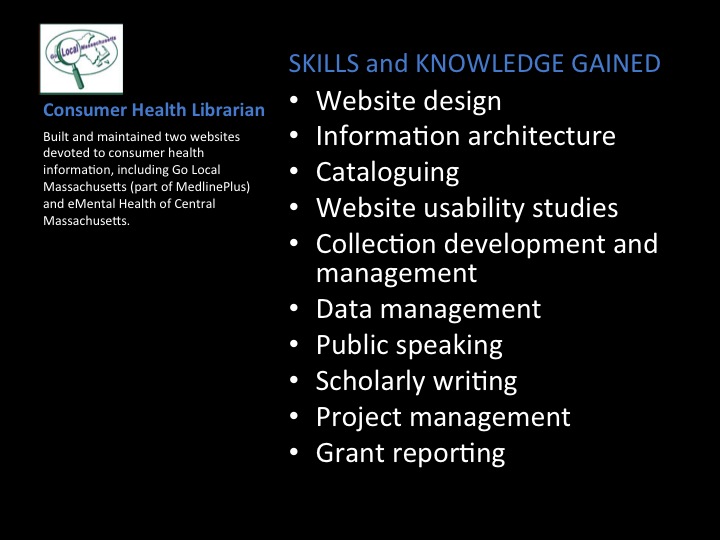
In each of these roles, I gained some knowledge and skills. I decided to take an inventory of these things, to see where they built upon one another or carried over from one role to the next. As a consumer health librarian, working on the projects, “MedlinePlus Go Local Massachusetts” and “eMental Health of Central Massachusetts,” I was able to both put to good use a  bunch of things I’d learned in library school (this was my first job after graduating), as well as add some new skills to my toolbox.

USAMRIID 4

The same thing happened, a couple of years later, when I got to move from being a grant-funded librarian to a full-time staff person. As a reference librarian (something I’d been doing all along, but now more formally), I added to my skill set, essentially adding to my value as a librarian.

USAMRIID 5

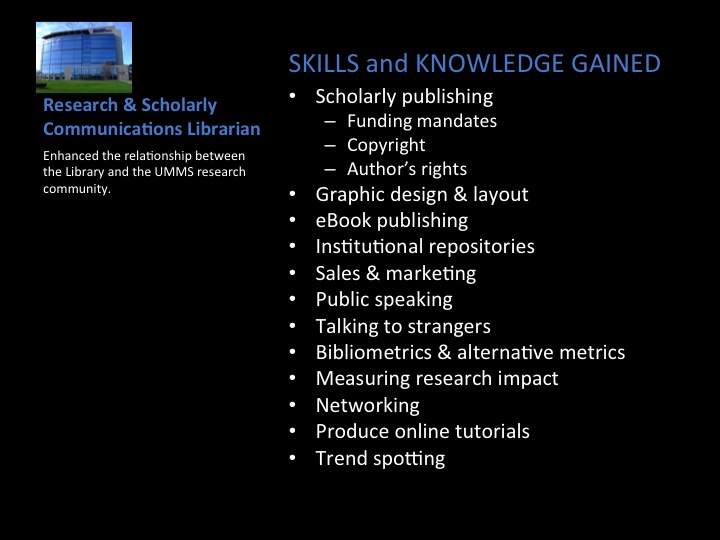
As a research and scholarly communications librarian, I had the chance to do more of the same. I also learned during this time that I didn’t like administration. I don’t do it well, at least not in the context where I was working. I recently saw a colleague who’s moved from administration to teaching and data services in her library. We talked about how it’s hard in our world to not be made to feel like you’re somehow failing and/or taking a step backwards to not be an administrator. Supervision and management, for better or worse, is seen as the one “promotion” in many a business, including higher ed. It’s too bad, since we all know that there are many, many ways to improve in your career without taking that path. But alas, it’s our world. And I share this as encouragement for anyone who’s happy and content finding their professional way along a path that doesn’t necessarily go up a corporate ladder.

USAMRIID 6

As in embedded research librarian and informationist, I gained a whole big grab bag of new skills. In many ways, it’s the transition that transitioned me most. If you read this blog with any sense of regularity, you know how all of these new skills and knowledge and projects emerged. And from them, I inventoried this nice list …

USAMRIID 7

When I added all of these lists together, when I took my inventory of all of the librarian skills I’ve gained the past years, I was amazed. Whenever I teach library school students, I encourage them to start their list now. I offer the same idea/advice to seasoned veterans. Think of all of the things you’ve done in your work and all of the resulting skills gained. Write them down. Take an inventory. You’ll be amazed, too.

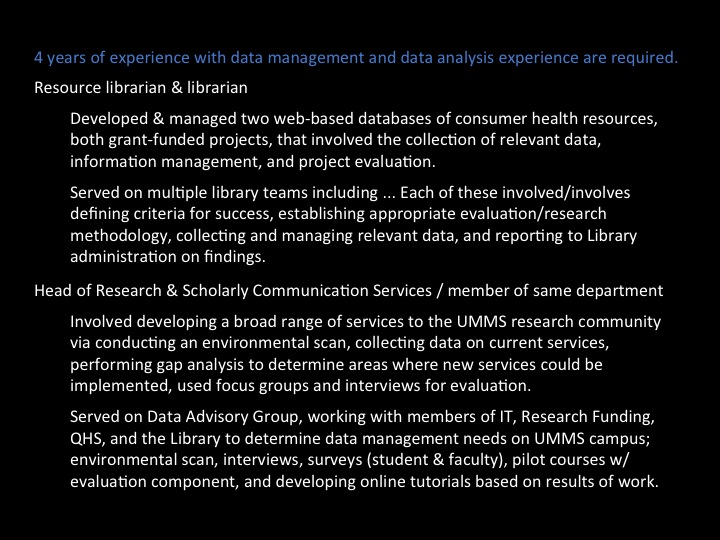
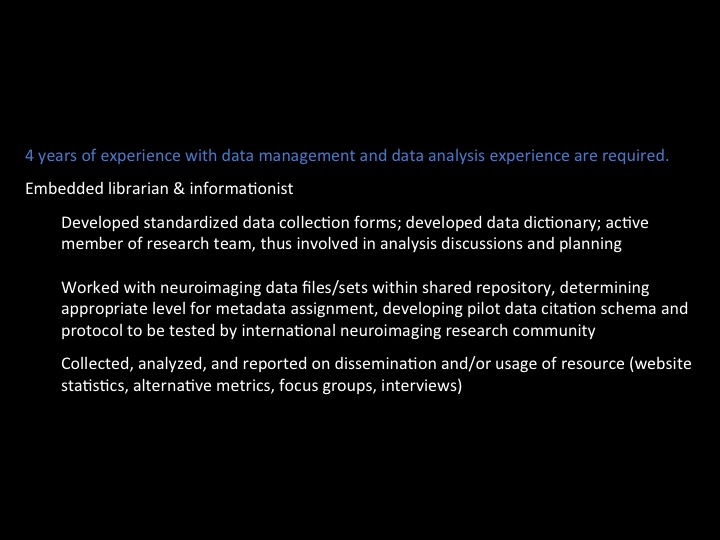
But more, my inventory was put to the test last year when I decided to take my skill set beyond the library altogether. When I applied for the position in the UMCCTS, I had to make the case that all of those library and information and data management skills made me well-prepared to take on the role of a research evaluation analyst. It wasn’t the easiest sell, either, but fortunately I’d also learned perseverance when it comes to making this argument. It’s something we’ve been doing for a long time now, as we’re continually put into the position of demonstrating our relevance and value. So, when our HR department asked me to map my very librarian-centric CV to the job requirements listed in the position announcement, I offered them this:

USAMRIID 8

This was the job listing.

And these were my “maps”:

USAMRIID 9

USAMRIID 10

USAMRIID 11

USAMRIID 12

All I did for these was pull pieces from my CV and put them with the requirements. It was a great exercise (beyond landing me the job), because it forced me to prove what I’d been saying for awhile – that the skill set of a librarian, by any name, is pretty darned valuable and can offer a person any number of opportunities.

USAMRIID 13

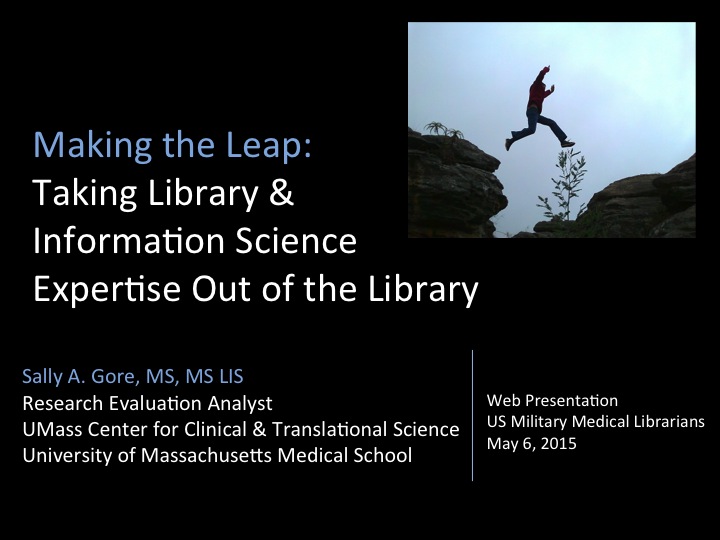
And of course, I’m still learning. My new job is filled with new challenges (opportunities for growth) that keep work interesting and fulfilling. For me, that’s the reward of taking the leap.

I left my audience yesterday with three takeaways:

USAMRIID 14

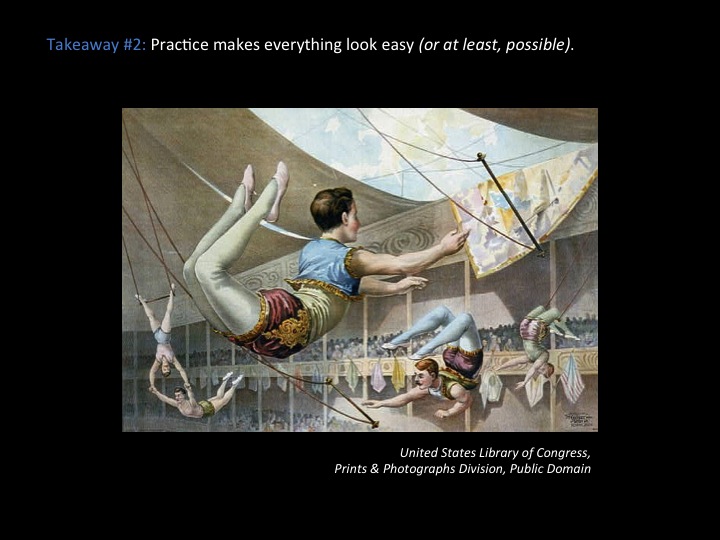
Nobody makes “The Flying Wallendas” varsity team without years and years of practice (and good genes). And the little Wallendas don’t start off by leaping off the high platform. Scaffolding, nets, safety gear … it’s all there. And it’s there for librarians, too. In fact, I think that the library profession has to be one of the most interwoven, networked, supporting professions out there. It is, after all, our nature to share and to help. And we do so for one another all of the time.

USAMRIID 15

Then eventually, you become so good at what you do that people don’t see the nets and the scaffolding. They only see you doing what you know how to do. And you know what else? It doesn’t matter what they call you, either. I feel most pleased when people simply say, “I call Sally because she can help.” It’s not “Sally the librarian” or “Sally the informationist” or “Sally the knowledge manager” or “Sally the evaluator.” Just Sally.

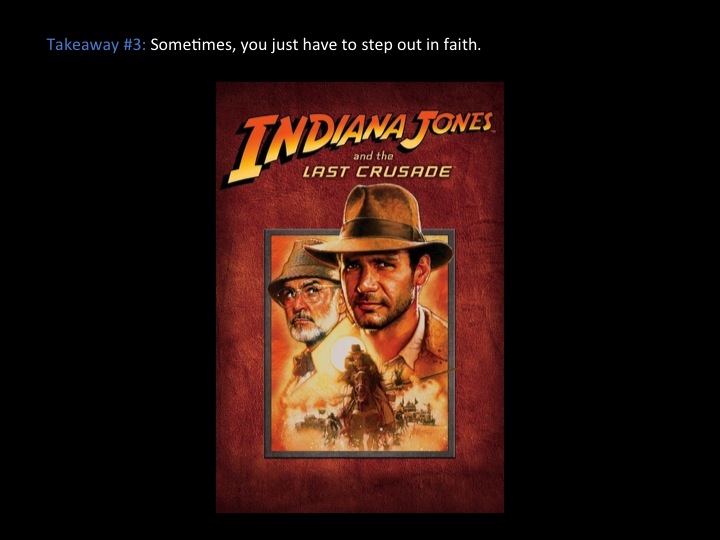
The last takeaway is “Step out in faith.” Just like Indiana Jones in “The Last Crusade.” Step out over the chasm between the library and wherever you want to take your skills and whether you see it or not, a bridge will appear under your feet to take you there safely. (If you don’t know this scene from the movie, seek it out. It’s a good one.)

So that’s what I shared with the group of librarians yesterday. I hope they enjoyed it and got something out of it. And by reading this, I hope you have, too.