A number of years ago, the librarians at Lamar Soutter Library, UMass Medical School, received the directive, “Get Out!” Our Library Director wanted us out of our cubicles and away from our desks. She wanted us to go to the people that we served. If people didn’t need to come to the Library anymore, the Library needed to go to them. And thus was born our embedded librarian program.
One of the very first lessons that I learned when I started getting out of the Library was that I needed to learn about politics. I remember going to my Library Director and asking if she could give us a lesson on the topic during one of our professional development meetings. Fortunately, she understood where I was coming from and from that point on, was open and willing to answering any questions any of us had regarding who was who and how things worked, politically, at the Medical School.
Our political system has become so broken the past few decades, it’s easy to think of politics as a dirty word. We think of corruption and conniving and backstabbing and the like. But the truth of the matter is that most, if not all, organizations and institutions exist in some sort of political atmosphere. If we’re lucky, it’s NOT a destructive framework, but it is an existing structure all the same.
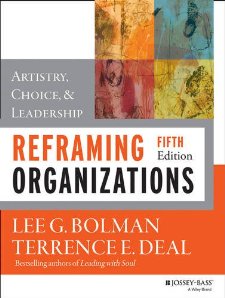 When I was earning my library science degree from Syracuse, I had to take a course on management and one of the required textbooks was Lee Bolman and Terrence Deal’s book, Reframing Organizations: Artistry, Choice, and Leadership. The “Political Frame” is one of four organizational frameworks that they present and they describe it as follows:
The political frame views organizations as alive and screaming political arenas that host a complex web of individual and group interests. Five propositions summarize the perspective:
- Organizations are coalitions of various individuals and interest groups.
- There are enduring differences among coalition members in values, beliefs, information, interests, and perceptions of reality.
- Most important decisions involve the allocation of scarce resources – who gets what.
- Scarce resources and enduring differences give conflict a central role in organizational dynamics and make power the most important resource.
- Goals and decisions emerge from bargaining, negotiation, and jockeying for position among different stakeholders.
(Bolman & Deal, Reframing Organizations, 2nd ed., p. 163)
Now that I work in a different environment than the Library, I’m learning a different political landscape. Different people, different personalities, different programs, different priorities. I’m still in the same institution, so I have a slight head start, in that I at least know the people; by name and position, if nothing else. I also know, thanks to my years in the Library, that walking into situations without respecting the politics is not only naive, but can be downright disastrous to any efforts you’re attempting. It’s a really important lesson and a skill set that’s not necessarily taught in graduate school or in continuing education classes. That’s a shame, because when we pretend that politics doesn’t matter or that it’s a dirty game that we want to avoid, we’re setting ourselves up for trouble. Politics is an eight letter word. There’s no need to not talk about it.

 A Librarian by Any Other Name