Archive | October, 2012

Dressing Up for Halloween (and work)

31 Oct

Dreams DO come true! At this past weekend’s Boston Book Festival I fulfilled my lifelong dream to dress up as a cartoon character. I don’t mean the Halloween costume kind of character, but a real character. The kind that you find at Disney World or King’s Dominion or sporting events; Mickey Mouse, Huckleberry Hound, Finz of my beloved Worcester Sharks.

It started when I received an email, the long-anticipated reply to my volunteer application:

My reaction was an email reply to Sarah at the BBF saying, “OH MY GOSH! OH MY GOSH! OH MY GOSH!! I can’t believe I got picked to be a character. It’s like a lifetime dream come true! Thank you!!” a response that neither hid nor exaggerated my excitement. Really. This was a big deal for me. Several weeks passed before I learned my assignment (Curious George). I watched YouTube videos to prepare myself – method acting, you know. I practiced George’s dance moves and tried to absorb his mischievous nature. I dodged a last-minute change in schedule that tried to thwart my big day, and come 3:45 on Saturday afternoon, I donned the sweaty padded under-suit, the furry overcoat, the bright red t-shirt with “Curious George” in yellow script across the front. I put on the big feet, the expressive hands, and, of course, the head, and I headed up from the basement level of the Boston Public Library to the awaiting throng of children and adults alike.
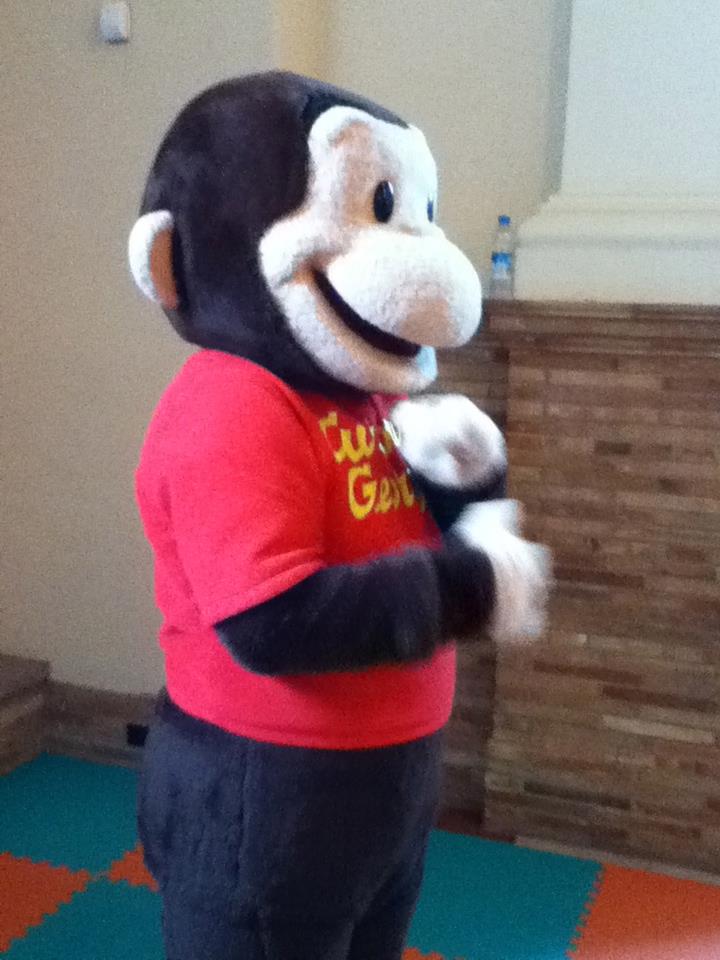
Curious George appears at the Boston Book Festival

For the next 45 minutes, I posed and waved and hugged and had my picture taken a hundred times or more. I wasn’t Sally in a Curious George suit. I WAS Curious George.

We’re hard-pressed to think of a superhero who gains superpowers without the aid of some transformation. Superman dons a cape, Batman a bat suit, the Hulk emerges from an angry Dr. Bruce Banner, and with a clink of her bullet-proof, Athenian gold wrist bracelets, Diana Prince becomes Wonder Woman. The ordinary becoming extraordinary is a common thread between most of these characters. Clark Kent needs glasses, but when he is Superman, he has X-Ray vision.

What does this have to do with being an informationist? Am I suggesting that I jump into a phone booth on my way to meetings with the research team? Hardly. When’s the last time that you saw a phone booth? No, embedded librarians have no superpowers, at least none that I’m aware of yet, and alas, we don’t get to wear any special costumes.

Still, think about it. What is it about a costume that can change a person?

What’s the importance of a medical student getting a white coat?

It changes perceptions – both those of the student, as well as any patients and/or family members s/he comes into contact with. A first-year med student, one month into his/her studies, knows no more about medicine than most of us with average intelligence and a bit of background in our own health. Yet, with that white coat on, the one with the embroidered name and the school emblem on the chest, the student is suddenly something more than a young adult lugging around a too-heavy backpack of laptop, books and notes. With that white coat on, the student is, in the eyes of the patient, someone who knows something of what’s in those books. S/he is someone to be trusted with a person’s health. It is an empowering and powerful thing, that jacket.

In a really wonderful TED Talk, neuroscientist Beau Lotto and 12-year-old student, Amy O’Toole, share the story of the Blackawton Bee Project, a research project conducted by Lotto and 25 students from the Blackawton School in Devon (UK). Their work, Blackawton Bees, was published in Biology Letters, making O’Toole and her 8-10 year old (at the time) classmates the youngest peer-reviewed, published scientists in history. When you have 15 minutes, watch this video.


The purpose of Lotto’s seeking out the primary school students and doing research with them was not, however, to set any new world record. Instead, it was to demonstrate his theory that science is for everyone and it is merely our perceptions of science (and scientists) that prevent us from being open to and accepting of this fact. As he pointedly states,

Perception underpins everything we think, we know, we believe, our hopes, our dreams, the clothes we wear, falling in love, everything begins with perception. Now if perception is grounded in our history, it means we’re only ever responding to what we’ve done before. But actually, it’s a tremendous problem, because how can we ever see differently?

Lotto goes on to talk about how hard it is to create new perceptions because doing so involves asking questions that, in turn, create uncertainty. And as much as we talk about wanting change, particularly in this election time of year, let’s face it… we do not like it. Human beings do not like change. We do not like uncertainty. Lotto argues that this is part of us, as a species. He says, “Now, uncertainty is a bad thing. It’s evolutionarily a bad thing. If you’re not sure that’s a predator, it’s too late.”

To put all of this in the context of being an informationist, if the perception of librarianship, both by librarians and our patrons, is rooted in our past experience(s), we’ve more than a bit of work to do to get others, and ourselves, to ask the questions that prompt the uncertainty that will ultimately lead to a new, more accurate perception. And to make it all the more difficult, we must do this without any superpowers and, for most of us, no costume changes.

There are many who argue that all we need to do to change the perception is call ourselves something other than librarians. As much as I respect this idea, in my opinion it falls short. I believe it holds some merit and is worthy of discussion, but think that it is only the beginning – the very beginning – of a longer, harder, more arduous process. The Blackawton Bee Project didn’t try to change what people called scientists, but rather, what people perceived scientists to be.

I propose that the next steps in librarianship’s pursuit of changing the perception people hold of it are found in the story of the Blackawton kids. By choosing children, Lotto demonstrated that their intrinsic abilities, i.e. their nature to play (as kids do), is the key to being a good scientist. Said another way, the key to being a good scientist is play, not age.

Play is “evolution’s answer to the problem of uncertainty,” says Lotto. Play involves five characteristics that correspond closely with the work of a scientist. Play:

  • celebrates uncertainty
  • is adaptable to change
  • is open to possible
  • is cooperative
  • and is intrinsically motivated

The Blackawton Bee Project was carried out to show that these five characteristics of play, things possessed by children, made them ideal scientists despite every preconceived perception held by the scientific community. Despite years of experience that said otherwise.

I’m just back from the annual meeting of the North Atlantic Health Sciences Libraries organization, the regional group of the national Medical Library Association. Being at the meeting, I missed the weekly meeting of my research team yesterday, so have some catching up to do there. But it’s these times of professional gathering, particularly among groups facing uncertainty, like medical librarians, that brings to focus more than ever our thoughts and discussions and anxiety over the uncertainty we see before us. And so I’m thinking this week about these things and about Beau and Amy and the other kids of the Blackawton Primary School, of the researchers who believed in the possibility of kids as scientists, and of Biology Letters who ultimately published their article. I’m also thinking about the teachers who didn’t think the kids could do the project, the funding bodies that wouldn’t fund the project, the open access journal that originally rejected (twice) the article that the kids wrote. And finally, I’m thinking about how to do my own scientific experiment; how to incorporate the aspects of play that describe so well both scientists and librarians like myself who are looking for the best way(s) to become embedded in their research teams.

We play to play, says Lotto. “Play is its own reward.” It seems a really fitting message for a day when adults dress up and tap into their childlike “trick or treat” selves. I’m going to start looking at my work as an informationist this way. It’s play. Enjoy it!
Do what interests you and the success (if not the money) will follow

25 Oct

I donned both my librarian and exercise physiologist hats when I stopped off at the Worcester Public Library on my way home from work last night to pick up copies of Gary Taubes ‘ books, Why We Get Fat (2011) and Good Calories, Bad Calories (2007). Taubes is one of the keynote speakers at the upcoming annual meeting of the North Atlantic Health Sciences Libraries, Inc. (NAHSL), the regional organization of the Medical Library Association that I’m a member. I admit from the outset that I am not a fan of his writing in this area. I disagree with his theory that obesity has become an epidemic in our country because we fell, as a society, for the “myth” propagated by the medical, public health, and health fitness/exercise communities; namely that a high carbohydrate, low fat diet is beneficial for our health AND promotes weight loss.

Like most others in the popular diet press, he generally proposes that a single factor is to blame for one of the most multi-factoral and complex health problems imaginable. Such writing is popular and it gains a following. It lands authors on the NY Times bestseller lists and makes “fitness gurus” quite wealthy. And despite the millions who read and follow and praise, the problem of obesity in our country (and the world) continues. Why? Because it’s based on bad science.

I will resist making this an exercise physiology post and elaborating on the bad science part, because that’s not the purpose of this blog. The purpose of this blog is to reflect upon and recount my experience and role as an informationist. From that end, my experience last night is relevant. Here’s why…

I stopped at the WPL and picked up the books, flipped through them and took notes, spent a couple of hours on PubMed searching the literature for the best evidence, organized my findings into a new folder in “My NCBI” that I named “Energy Intake & Fad(t) Diets,” and then read several articles before I went to bed AND then again first thing this morning. Stepping back and looking at this behavior, I realized something about it that may well prove as important, if not more, than the discussion of skill sets that we often focus on as we’re talking about what’s needed for an informationist to find success in his/her work. That something, I’m going to call passion.

When I was in high school, the professional women’s tennis tour had a regular stop at the University of Richmond. I saved money from my job at the local Rite Aid and during the summers between both my sophomore and junior years, bought tickets for the entire tournament, driving myself to the West End each morning and staying until the last match ended that night. To this day, Martina Navratilova and Billie Jean King and Virginia Wade and Rosie Casals and the awesome doubles-pair of Ann Smith and Kathy Jordan, stick with me as my favorites. What also happened during those weeks was that I became enamored with the idea of becoming an athletic trainer. I thought that the woman who came out and taped the ankles, brought ice packs and heat rubs, took care of these incredible athletes had the BEST JOB IN THE WORLD! I wanted to grow up to do the same.

I studied up on sports medicine programs (it was very early in the history of this profession) and identified colleges with accredited programs. I applied to the three closest and ended up at one of them. For a whole host of reasons that I’ll not go into, I switched my major several times during my years at JMU and, it goes without saying, never landed that “best job”. Funny though, after a stroll down a different career path for a decade and a half, and facing the realization that I wanted to do something else, a series of events helped me to see that the passion of that 17 year old had not ever really been extinguished. I went back to school and earned two degrees in exercise physiology – studying the very subject, though from a different perspective, that I’d come to be fascinated with some 20 years earlier.

Passion drives interest. And interest takes us a really long way in terms of helping us stick with something, dig for answers, go after the new knowledge that we need. Passion and interest bring us something in our work that nothing else can. Mary Costanza, one of the co-PIs on the study where I’m an informationist, is passionate about breast cancer prevention. PASSIONATE. Women need to take advantage of the technologies of medicine that we have; they need to get regular mammograms. Early detection saves lives. She believes this fully. You can tell when you talk to her, when you sit in meetings with her. Even though my primary care doc tells me that I don’t need regular mammograms yet, being around Mary makes me start thinking that I better go sign up today! She is not a co-PI on this study simply because it’s a good thing or a good study. She is much more invested than that. She has passion for it.

Similarly, the “obesity doc” that I mentioned in my post last week, Sherry Pagoto, is passionate about helping people adopt healthy lifestyles. PASSIONATE. She lives and breathes and tweets and blogs about it. She designs studies and secures funding to carry out research that will hopefully provide the answers we need to solve the epidemic of obesity that we face in our society. I feel really fortunate to work with her as as exercise physiologist, not just because she’s fun to work with and her passion is infectious, but because of this…

… it is my interest, too.

And that’s the thought that occurred to me last night as I found myself spending my off-hours searching PubMed. I was searching it because I was looking for something that interested me. We have debated whether or not subject-specialty is a necessity for success in this new role. Law librarians have law degrees. Music librarians have music degrees. Do biomedical librarians, in particular, informationists, need biomedical degrees to be successful in this realm? The jury is still out, but here’s the bit of evidence that I want to present to it as it deliberates – knowledge is important, but maybe what’s equally important about the subject specialty is the interest that the person perhaps has in it. (I say “perhaps” because too many people major in subjects that they could care less about. They think about hire-ability. I’ll not fault them that, but just note it here.)

As we looked for a study where an informationist from our library would fit well, I immediately looked to those in preventive medicine, epidemiology, public health, in other words, applied research. Knowing that I was likely going to be the informationist, I hoped we could find something in an area of research in which I felt somewhat comfortable. I’m not a bench top scientist. I have no experience there. I also have little interest in areas like bioinformatics and sequence-heavy data. It’s just not my thing. And I have no doubt whatsoever that a lack of interest coupled with a lack of experience would have been the perfect recipe for failure for me (and ultimately, my library and our goals here) had we gone that route.

Fortunately, we found a study that did, to a better degree, fit my research experience. It also interests me. I admit that I’ve not spent my after-hours searching for articles on mammography yet. I’m curious about different approaches to helping people adhere to screening tests. I’m enjoying learning about motivational interviewing techniques and how they might (or might not) prove effective in interventions. I’m challenged and satisfied by the work of organizing all of the information we’re creating and data we’re collecting. It’s fulfilling work. I’m not passionate about it, but I don’t need to be. I’m interested enough – and interest is more than enough to generate success.

Discovering how far we can go with interest is … pardon me for saying it … interesting. It’s not a total substitute for subject knowledge, but I do believe it is helpful to any librarian who is wondering how s/he can become more involved in the research process. Think about what interests you. Take note of it. And then start looking for people at your institutions or on your campuses who are working in that area. Match your interests with theirs. It will show when you talk to them and it will make them much more likely to welcome you into their working circle(s). I don’t yet have the evidence to prove this, but it’s a theory that I think might bare out in time.

Now for lunch and more reading about energy balance. That Gary Taubes… I’m gonna have some questions for him during the Q&A of his talk.


Thoughts and Updates (It’s Been a LONG 10 Days)

19 Oct

Every now and then, Dan Shaughnessy of the Boston Globe titles his column “Picked Up Pieces.” I used to find this kind of lame, a column of random thoughts and pieces, things that he could easily elaborate on if he took the time. However, now that I’ve adopted this weekly writing regimen and have people actually following what I write (kind of like Dan, on the mini-Dan scale), I clearly see the advantage. Sometimes, lots of things happen in a short time frame and in order not to miss capturing them, we collect the bits and pieces and put them in a column – or in my case, a post. So here goes:

The Missing Link

Last week, I wrote about the need for documentation, for writing code and logic and field descriptions based upon guidelines, and how often we skip this crucial step. Pressures of time and staff shortages, coupled with the ease by which we can make changes in practices and procedures, lead us to take shortcuts that may well prove beneficial in the moment, but later end up costing much more. After another exasperating hour that found the research team going round-and-round questions that they simply couldn’t answer, we decided to go to the source this week, and called for a meeting with the IT guru for the study. At this meeting, Scott graciously drew pictures, showed us code, and clearly laid out the details we were lacking. I left the meeting not with the problem solved, but with a MUCH clearer understanding of it. I also had the beginnings of the tools needed to begin putting together the documents that we need that will, in time, give us the solution we need.

Could the research team have done this at the outset? Sure. But it’s hardly a fault that they didn’t. They did what most studies do, working within the constraints that we all find ourselves in today. What sets the PIs and this team apart is that they realized how this pattern was detrimental to their outcomes and the insertion of an informationist can help prevent the same in the future. To date, it’s the clearest indication of my value to the team. Now to get to work with the tools I’ve been given.

INFRARED SATELLITE IMAGE – OCTOBER 30, 1991 (NOAA Archives)

What Did You Say?

Communication shortcomings continue to baffle me. As I posted earlier, this isn’t a bafflement confined to the study. I am universally baffled. “Baffusally” – (see my name in that word? makes sense.) I feel like I keep repeating myself over and over and over again. And unlike Einstein’s famous quote about insanity, I’m not repeating the SAME thing over and over. I feel like I practice saying something this way and that, different ways to try and get my point across. But still… my efforts seem to be falling short. Am I alone in this? Do others feel like they give clear instructions, offer clear descriptions, state clear facts, yet people keep coming back asking for more and more explanation? I wonder if it’s overload – the information overload, stimulation overload, an epidemic of an inability to pay attention. Maybe it’s just more of what I stated in the previous paragraphs; continuous high pressure of time shortage meets the wall of information flow meets too few people to do all that needs to be done… it’s the perfect storm.

What I take away from this is that I need to continue to work on being clear, being concise, stating things in multiple (even if frustratingly obvious) ways. We’re all in this rocking boat together. (Bet you thought I was going to type “sinking ship” didn’t you?)

All Beagles are Dogs, But Not All Dogs are Beagles

I was really lucky to be invited to speak on a panel at last Friday’s “Emerging Roles Symposium” sponsored by the Pacific Northwest Chapter of the Medical Library Association. It was a wonderful day of learning, meeting new friends and colleagues, and soaking in so much positive energy. (As an aside, if everyone and everything related to Portland, OR is like I found it/them, I’m moving there tomorrow! What a wonderful place.) One thing that I appreciated most from the event was how many different emerging roles were covered. Steven Bell, current President of ACRL, got us started by sharing a plethora of examples and ideas we need to embrace in the age of the “Alt-Librarian.” I talked about eScience, data and scholarly communications, embedded librarianship, and being an informationist. Mary Anne Hansen from Montana State University talked about teaching library skills via online/distance courses. Amy Harper from Harborview Medical Center in Seattle shared how clinical librarians at her hospital are really engaged in providing the tools and resources to give clinicians the information that they need in the most seamless manner.

That was just the morning!

In the afternoon, Erica Lake from the Eccles Health Library at the University of Utah told us about all that she’s doing to successfully integrate herself and her skills into the world of the EMR. Stephanie Wright showed off a fantastic tool she’s built to help researchers at the University of Washington manage their data. And finally, Jerry Perry, Director of the Health Sciences Library at the University of Colorado and immediate past president of MLA (and all-around good guy – we love Jerry!) presented role after role, activity after activity, opportunity after opportunity, that he sees librarians at his library, as well as around the country, becoming engaged in. It was a terrific recap AND for me, a much-needed reminder that there is no one direction that we need to be looking and/or heading as health sciences librarians. We can, we do, and we are evolving and emerging in so many ways we likely never imagined before. It’s hardly a time to fret, friends. We may look different, but we’re still here.

The Tail Wagging the Cat (for Tater, my cat, because I titled the previous segment about dogs)

My latest philosophical pondering goes something like this… When did we stop creating new environments for the sake of adopting ones? In other words, when did we give up teaching behaviors and instead, simply build environments to suit the behaviors we’ve adopted. I’m sure that I’ve posted on this before, but it’s still there, the big question that I come back to again and again in my mind. We talk so much of control, yet have given so much of it away. It’s kind of what I teach people who are struggling with weight issues (this would be when I’m wearing my exercise physiologist hat) – you need to create your own environment, a healthy environment. It takes work. Restaurants serve the foods people will eat, not the healthy foods we are better off eating. Ball parks and airlines and movie theaters install larger seats, because that’s what we need. We sit a lot traveling, watching movies, watching others play instead of playing ourselves. The ballplayers like the big salaries we give them by filling the seats. They’ll build bigger seats in bigger stadiums to meet our behavior. (If you find this of interest or need help and support in becoming more healthy, follow my favorite researcher/doc in this area – @drsherrypagoto on Twitter and at FUDiet.) 

What does this have to do with being an informationist? Oh, pretty much everything. The one common thread that is emerging in our profession is our need to take chances, take risks, and be more creative. I was asked last week how one goes about getting over his/her fears or resistance to step out and do this risk-taking that we keep talking about. My response, “Film yourself playing your mandolin and singing a song and then post it to YouTube.” More seriously (sort of), I added, “I don’t know if it’s building self-confidence or just lowering your fear.” Control your own environment, as much as you can, and you’ll have a lot more confidence and a lot more success. I feel pretty certain about that. So does Tater.

Happy Friday, everyone! Enjoy a little weekend ahead. And if you live in or around Worcester, come out and see my band, RedRock, tomorrow night. 🙂